usa
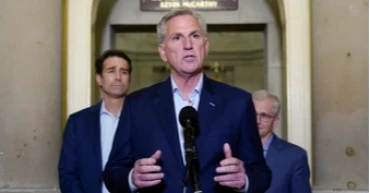
Biden, GOP reach tentative deal to raise debt ceiling, avoid calamitous US default
President Joe Biden and House Speaker Kevin McCarthy reached an “agreement in principle” to raise the nation's legal debt ceiling late Saturday as they raced to strike a deal to limit federal spending and avert a potentially disastrous U.S. default.
However, the agreement risks angering both Democratic and Republican sides with the concessions made to reach it. Negotiators agreed to some Republican demands for increased work requirements for recipients of food stamps that had sparked an uproar from House Democrats as a nonstarter.
Support from both parties will be needed to win congressional approval next week before a June 5 deadline.
The Democratic president and Republican speaker reached the agreement after the two spoke earlier Saturday evening by phone, said McCarthy. The country and the world have been watching and waiting for a resolution to a political standoff that threatened the U.S. and global economies.
“The agreement represents a compromise, which means not everyone gets what they want,” Biden said in a statement late Saturday night. “That’s the responsibility of governing,” he said.
Biden called the agreement “good news for the American people, because it prevents what could have been a catastrophic default and would have led to an economic recession, retirement accounts devastated, and millions of jobs lost.”
McCarthy in brief remarks at the Capitol, said that "we still have a lot of work to do.”
But the Republican speaker said: “I believe this is an agreement in principle that’s worthy of the American people.”
With the outlines of a deal in place, the legislative package could be drafted and shared with lawmakers in time for votes early next week in the House and later in the Senate.
Central to the package is a two-year budget deal that would hold spending flat for 2024 and impose limits for 2025 in exchange for raising the debt limit for two years, pushing the volatile political issue past the next presidential election.
The agreement would limit food stamp eligibility for able-bodied adults up to age 54, but Biden was able to secure waivers for veterans and the homeless.
The two sides had also reached for an ambitious overhaul of federal permitting to ease development of energy projects and transmission lines. Instead, the agreement puts in place changes in the the National Environmental Policy Act that will designate “a single lead agency” to develop economic reviews, in hopes of streamlining the process.
The deal came together after Treasury Secretary Janet Yellen told Congress that the United States could default on its debt obligations by June 5 — four days later than previously estimated — if lawmakers did not act in time to raise the federal debt ceiling. The extended “X-date” gave the two sides a bit of extra time as they scrambled for a deal.
Biden also spoke earlier in the day with Democratic leaders in Congress to discuss the status of the talks.
The Republican House speaker had gathered top allies behind closed doors at the Capitol as negotiators pushed for a deal that would avoid a first-ever government default while also making spending cuts that House Republicans are demanding.
But as another day dragged on with financial disaster looming closer, it had appeared some of the problems over policy issues that dogged talks all week remained unresolved.
Both sides have suggested one of the main holdups was a GOP effort to expand work requirements for recipients of food stamps and other federal aid programs, a longtime Republican goal that Democrats have strenuously opposed. The White House said the Republican proposals were “cruel and senseless.”
Biden has said the work requirements for Medicaid would be a nonstarter. He seemed potentially open to negotiating minor changes on food stamps, now known as the Supplemental Nutrition Assistance Program, or SNAP, despite objections from rank-and-file Democrats.
McCarthy, who dashed out before the lunch hour Saturday and arrived back at the Capitol with a big box of takeout, declined to elaborate on those discussions. One of his negotiators, Louisiana Rep. Garret Graves, said there was “not a chance” that Republicans might relent on the work requirements issue.
Americans and the world were uneasily watching the negotiating brinkmanship that could throw the U.S. economy into chaos and sap world confidence in the nation’s leadership.
Anxious retirees and others were already making contingency plans for missed checks, with the next Social Security payments due next week.
Yellen said failure to act by the new date would “cause severe hardship to American families, harm our global leadership position and raise questions about our ability to defend our national security interests.”
The president, spending part of the weekend at Camp David, continued to talk with his negotiating team multiple times a day, signing off on offers and counteroffers.
Any deal would need to be a political compromise in a divided Congress. Many of the hard-right Trump-aligned Republicans in Congress have long been skeptical of the Treasury’s projections, and they are pressing McCarthy to hold out.
Lawmakers are not expected to return to work from the Memorial Day weekend before Tuesday, at the earliest, and McCarthy has promised lawmakers he will abide by the rule to post any bill for 72 hours before voting.
The Democratic-held Senate has largely stayed out of the negotiations, leaving the talks to Biden and McCarthy. Senate Majority Leader Chuck Schumer of New York has pledged to move quickly to send a compromise package to Biden’s desk.
Weeks of talks have failed to produce a deal in part because the Biden administration resisted for months on negotiating with McCarthy, arguing that the country’s full faith and credit should not be used as leverage to extract other partisan priorities.
But House Republicans united behind a plan to cut spending, narrowly passing legislation in late April that would raise the debt ceiling in exchange for the spending reductions.
3 years ago

Biden releases new strategy to tackle rise in antisemitism, says 'hate will not prevail'
President Joe Biden on Thursday announced what he said is the most ambitious and comprehensive undertaking by the U.S. government to fight hate, bias and violence against Jews, outlining more than 100 steps the administration and its partners can take to combat an alarming rise in antisemitism.
Speaking during a videotaped address at the White House, Biden said the first U.S. National Strategy to Counter Antisemitism sends a "clear and forceful message" that "in America, evil will not win, hate will not prevail" and "the venom and violence of antisemitism will not be the story of our time."
Months in the making, the strategy has four basic goals: increasing awareness and understanding of antisemitism, including its threat to America, and broadening appreciation of Jewish American heritage; improving safety and security for Jewish communities; reversing the normalization of antisemitism and countering antisemitic discrimination; and building "cross-community" solidarity and collective action to counter hate.
Jewish organizations largely applauded the administration's effort.
"Jewish safety is inextricably linked to the safety of other communities and the health and vibrancy of our multiracial democracy," said Amy Spitalnick, CEO of the Jewish Council for Public Affairs. "As we see antisemitism and extremism increasingly normalized in our politics and our society, the urgency of this framework is even more clear."
The strategy also calls on Congress, state and local governments, tech companies and other private businesses, faith leaders and others to help combat bias and hate directed at Jews.
Tech companies are asked to establish "zero tolerance" policies against antisemitic content on their platforms. The U.S. Holocaust Memorial Museum has committed to launching an education research center. Professional sports leagues and clubs are asked to use their platforms and clout to raise awareness. The White House public engagement office will invite members of the public to describe how they have supported Jewish, Muslim or other communities that are different from their own.
Doug Emhoff, who is married to Vice President Kamala Harris, said at the White House that hate crimes against Jews accounted for 63%, or nearly two-thirds, of all religiously motivated hate crimes in the United States in 2022 although Jews make up just over 2% of the overall population.
"I know the fear. I know the pain. I know the anger that Jews are living with because of this epidemic of hate," said Emhoff, the first Jewish spouse of a U.S. president or vice president. He has become the administration's point-person on combating antisemitism.
Emhoff, formerly an entertainment lawyer in California, said he never envisioned that this issue would become "my cause" as second gentleman of the United States, " but now, more than ever, we must all rise to the challenge and meet this moment." He said the plan will save lives.
"We are committed to making sure that everyone can live openly, proudly and safely in their own communities," Emhoff said. "It's on all of us to put an end to the visceral hate we are seeing across our nation. We cannot normalize this."
In a sign of the administration's support for the strategy, Emhoff was flanked by White House domestic policy adviser Susan Rice; homeland security adviser Liz Sherwood-Randall; and Ambassador Deborah Lipstadt, the special envoy to monitor and combat antisemitism.
Harris slipped into the auditorium for a few minutes to watch her husband from the back of the room and flashed him a thumbs-up before departing.
A survivor of the 2018 massacre at the Tree of Life synagogue in Pittsburgh, the deadliest antisemitic attack in U.S. history, welcomed the strategy.
"I am proud that our leaders understand the urgency and importance of countering antisemitism in a comprehensive way, but grieve the levels of antisemitism in the country that required the need for a plan in the first place," said Rabbi Jeffrey Myers, who survived the attack that killed 11 worshippers.
Jury selection concluded Thursday in the trial of Robert Bowers, the man charged with those killings. Testimony is expected to begin Tuesday.
In his videotaped remarks, Biden said hate does not go away, that it only hides until given oxygen. He recalled the deadly white supremacist rally in Charlottesville, Virginia, in 2017, and noted that the antisemitic chants by participants led him to run for president in 2020.
"Silence is complicity," the president said.
Last fall, Biden hosted a White House summit against hate-fueled violence. Emhoff led a White House discussion with Jewish community leaders last December to discuss the rise in antisemitism and how to counteract it. Days later, Biden created a government working group to develop the new strategy.
Lipstadt said the strategy's release is a "historic moment in the modern fight against what's known as the world's oldest hatred."
"For the first time, the United States government is not only acknowledging that antisemitism is not only a serious problem in this country, but laying out a clear plan to counter it," she said.
3 years ago

Trump and DeSantis' rivalry intensifies as Florida governor formally enters 2024 presidential race
Ron DeSantis ' entry into the 2024 White House race against former President Donald Trump sets up a clash of the Republican Party's two leading figures as the Florida governor attempts to topple a man who has dominated the GOP for the last seven years.
Trump, who has established himself as the clear front-runner for the Republican nomination, has spent the months since he launched his own campaign working to hobble the once-ascendant DeSantis, whom he and his team have long viewed as his most serious challenger. DeSantis so far has tried to remain above the fray, ignoring Trump's escalating attacks on everything from his record to his personality.
"The campaign is about to get a lot more intense. He can't just lay low in Tallahassee signing bills," said GOP strategist Alex Conant of DeSantis' strategy. "Now he has to hit the campaign trail, take media questions and punch back at his opponents."
But DeSantis, during a series of events Wednesday night launching his campaign, took only veiled swipes at his chief rival without mentioning him by name. It is a strategy reminiscent of 2016, when Trump's army of Republican rivals failed to go after the candidate directly for fear of alienating his supporters and assumed — wrongly — that he would flame out on his own.
"There is no substitute for victory. We must end the culture of losing that has infected the Republican Party in recent years," DeSantis said on a Twitter Spaces debut that was plagued by technical difficulties. "We must look forward, not backwards," he added.
In an interview later with Fox News, he said he believed all candidates should participate in the planned GOP primary debates, which Trump has threatened to boycott. "Nobody's entitled to anything in this world," he said.
The rollout made clear that, at least for the time being, DeSantis intends to leave the dirty work of attacking Trump to his allies, who see openings that they plan to exploit, particularly on policy.
Now that he's officially in the race, DeSantis' well-funded super PAC is poised to intensify its attacks against the former president. His team plans to focus on policy differences between the two Republicans, making the case that Trump has "lurched left" on some issues — most notably, abortion.
"We're going to amplify him and his voice, and when necessary, contrast with the former president. But right now that contrast is really one is lurching left and one is fighting," said David Polyansky, senior adviser to the pro-DeSantis super PAC Never Back Down.
DeSantis' team believes Trump is particularly vulnerable with Republican primary voters on abortion. Although the former president appointed the Supreme Court justices who overturned Roe v. Wade, he has drawn the ire of anti-abortion activists by refusing to say whether he supports a federal ban on the procedure.
While Trump has openly suggested that Republican candidates' hard-line stances led to GOP losses in last fall's midterms, DeSantis has leaned in even further on the issue, signing a six-week abortion ban in Florida — before most women know they are pregnant.
DeSantis and his backers must tread carefully: In order to win the nomination, he will need to assemble a coalition that includes both Trump critics and supporters. DeSantis risks alienating a large swath of the party if he goes after Trump too forcefully.
Acknowledging the challenge, DeSantis' super PAC plans to steer clear of criticism directly related to Trump's many legal entanglements. The Florida governor himself was stung earlier in the spring when he took a swipe at Trump, instead of defending him, following his New York indictment.
Trump, meanwhile, has spent months relentlessly attacking DeSantis, nicknaming him "Ron DeSanctimonious" and subjecting him to a daily onslaught of criticism on his Truth Social app and in ads.
Trump has repeatedly called out the Florida governor's votes to cut Social Security and Medicare when he served in Congress, arguing his record will make him unelectable in a general election. He has tried to undermine DeSantis' success as governor of Florida, claiming the state was "doing GREAT long before Ron DeSanctus got there." And he has pointed to the crime rate in some of the state's large cities and criticized DeSantis' handling of the COVID-19 pandemic — the issue that made DeSantis a conservative star.
Beyond policy, Trump has attacked DeSantis' character — accusing him of being "disloyal" after Trump helped DeSantis win his 2018 gubernatorial primary — and saying he "desperately needs a personality transplant and, to the best of my knowledge, they are not medically available yet."
Trump has also veered into deeply personal attacks, suggesting that DeSantis "might face allegations from "a woman, even classmates that are 'underage' (or possibly a man!)"
Trump's allied super PAC, Make America Great Again Inc., has already spent millions on anti-DeSantis ads, and the group has no plans to change its strategy, given the fact that it has been treating DeSantis like a candidate for months already.
"Ron DeSantis' failed campaign launch is just another example that he's not ready for this critical moment," said spokesperson Alex Pfeiffer. "Voters don't yet know Ron DeSantis, but they'll find out he has a record of targeting Social Security, trying to raise taxes, and voting against border wall funding."
So far the effort appears to have paid off. Polls suggest Trump's support has only grown since earlier this year, while the appetite for DeSantis as an alternative has faded.
DeSantis' team largely dismisses Trump's early polling advantage given that the Florida governor only just became an official candidate. DeSantis said Wednesday he was prepared for the onslaught he faces.
"You can call me whatever you want. Just call me a winner," DeSantis said on Fox News. "There will be slings and arrows. I'm a big boy. I can take it."
Republican donor Dan Eberhart, who donated millions to Trump but is now supporting DeSantis, argued that Trump's continued attacks make clear the former president still sees DeSantis as a threat.
"Trump's fixation with DeSantis is proof that the Florida governor is a serious contender," he wrote in an email. "The former president spent more money attacking Gov. DeSantis before he was even a candidate than Trump did helping Republicans last cycle. Trump's biggest fear just came true."
Some voters, meanwhile, continue to have trouble reconciling the feud between two men who were once allies.
Wina Fernandez, who lives in Miami, said she'd prefer DeSantis and Trump run together on the same ticket, with DeSantis serving four years as vice president and then running for president in 2028.
"I would just love them as president and vice president. That would be an amazing thing. I would go out to the street and dance," she said.
But if she had to choose, she said, she would choose Trump.
"There's a lot of drama involving Trump. However, he started this movement. He started it all," she said. "DeSantis is young, and he still has time to work on things."
3 years ago

New York City is sinking due to its skyscrapers, study says
According to recent research, New York City is sinking under the cumulative weight of all of its buildings.
This slow process might cause problems for a metropolis whose sea level has been rising more than twice as fast as the world average — and is expected to climb by eight to 30 inches by 2050, reports CNN.
Furthermore, experts predict that the human-caused climate crisis will result in more frequent and intense rainfall events such as nor'easters and hurricanes, it said.
“We’re a ways off from the ocean simply moving in,” said lead study author Tom Parsons, a research geophysicist at the US Geological Survey. “But we’ve had a couple of major hurricane events with Sandy and Ida in New York where heavy rainfall caused inundation in the city, and some of the effects of urbanization have allowed water to come in.”
The article, published in the journal Earth's Future, intends to demonstrate how high-rise structures in coastal, riverbank, or lakefront locations may contribute to future flood risk, and that mitigation measures should be implemented to prevent the potentially dangerous effects.
Sinking city risks — and a mystery
The researchers computed the mass of the 1,084,954 structures in New York City's five boroughs at the time, estimating that they weighed nearly 1.68 trillion pounds (762 billion kilograms) – roughly 1.9 million fully loaded Boeing 747-400s, the report also said.
The research team afterwards used simulations to evaluate the impact of that weight on the ground, which they compared to satellite data revealing actual surface geology. This analysis revealed how fast the city is sinking: “The average is about 1 to 2 millimeters a year, with some areas of greater subsidence that are up to about 4½ millimeters a year,” Parsons said.
Subsidence is the technical word for the sinking or settling of the Earth's surface caused by natural or man-made factors. According to a research published in September 2022, 44 of the 48 most populous coastal towns have parts that are sinking faster than sea levels are rising. The new technique of this current study is to consider the weight of New York City's skyscrapers and how they contribute to the sinking of the area underneath them, added the report.
However, the structures are not entirely to blame for the disaster. “We could see some correspondence where there’s construction on very soft soils and artificial fill,” Parsons said. “Other places, we see subsidence that’s difficult to explain. And there’s a lot of different causes of it, such as post glacial relaxation that happened after the last ice age, or groundwater pumping.”
According to the study, several sections of lower Manhattan, Brooklyn, and Queens are sinking at a quicker than average pace.
“Some of that seems to correspond with construction projects going on,” Parsons said. “But we also see subsidence on the north end of Staten Island that I can’t figure out an explanation for, and I’ve looked into all kinds of different things — so that still remains a mystery.”
Mitigating risk around sinking cities
According to the study, subsidence can cause floods even before sea level rise, and not just in New York City. “It’s a global issue. My co authors from the University of Rhode Island looked at 99 cities around the world, not only coastal but inland as well, and the vast majority of them have subsidence issues,” Parsons said, citing Jakarta as an example which is sinking so quickly that the Indonesian government is contemplating to relocate the country's capital.
“We know that global sea levels are rising and shorelines are changing, and that it is critical to understanding the impact of human activities, such as greenhouse gas emissions, on our warming world,” said geophysicist Sophie Coulson, a postdoctoral fellow at Los Alamos National Laboratory who was not involved in the study. “This research takes a look at an important human factor that has only recently come into focus — the effect of urban building loads on coastal land subsidence.”
The scientists, she continued, employ a sophisticated combination of computer modeling, satellite observations, and GPS data to estimate the short- and long-term sinking rates of different regions of the city and pinpoint the places most at risk.
“New York City is among the most densely populated coastal areas in the world, with a large portion of its critical infrastructure constructed in low-lying coastal areas,” she said.
“Understanding how and why the landscape is changing, and identifying areas most vulnerable to flooding is essential for making the right preparations to mitigate future sea level rise.”
3 years ago

Russia fights alleged incursion from Ukraine for 2nd day, reports more drone attacks
Russian troops and security forces fought for a second day Tuesday against an alleged cross-border raid that Moscow blamed on Ukrainian military saboteurs but which Kyiv portrayed as an uprising against the Kremlin by Russian partisans.
Vyacheslav Gladkov, governor of the Belgorod region on the Ukraine border, said forces continued to sweep the rural area around the town of Graivoron, where the alleged attack on Monday took place. Ten civilians were wounded in the attack, he said, and one died during evacuation.
Gladkov urged residents of the area who evacuated on Monday to stay put and not come back to their homes just yet. "We will let you know immediately ... when it is safe," Gladkov said. "Security agencies are carrying out all the necessary actions. We're waiting for the counterterrorism operation to be over."
Also Read: Russia alleges border incursion by Ukrainian saboteurs; Kyiv claims they are disgruntled Russians
It was impossible to independently verify who was behind the attack or what its aims were, and disinformation has been one of the weapons of the almost 15-month war.
While it is not the first time Russia has alleged an incursion by Ukrainian saboteurs, it is the first time the operation to counter the raid has continued for a second day, highlighting the struggles Moscow is facing amid its bogged-down invasion of Ukraine and embarrassing the Kremlin.
The British Defense Ministry said Russian security forces "highly likely" clashed with partisans in at least three locations within Belgorod.
"Russia is facing an increasingly serious multi-domain security threat in its border regions, with losses of combat aircraft, improvised explosive device attacks on rail lines, and now direct partisan action," it said in a tweet on Tuesday.
In addition to the alleged incursion, Gladkov reported multiple drone attacks on Graivoron and other settlements of the Belgorod region on Monday night. The attacks resulted in no casualties, but damaged buildings and caused a fire. On Tuesday morning, two more drones were shot down by the region's air defense systems.
Also Read: New sanctions: How effective are they in stopping Russia's invasion of Ukraine?
According to Gladkov, an elderly woman died during evacuation, and two more people were wounded "in the settlements the enemy entered." That brought the total number of those wounded during the attack to 10.
Gladkov first reported on Monday afternoon that a Ukrainian Armed Forces saboteur group entered Graivoron, a town about 5 kilometers (3 miles) from the border with Ukraine. The town also came under Ukrainian artillery fire, he said.
He later announced a counterterrorist operation in the area, and said that authorities were imposing special controls, including personal document checks, and stopping the work of companies that use "explosives, radioactive, chemically and biologically hazardous substances."
Ukrainian officials blamed the incident on Russian guerrilla groups bent on changes at the Kremlin. Ukraine intelligence representative Andrii Cherniak said Russian citizens belonging to murky groups calling themselves the Russian Volunteer Corps and the "Freedom of Russia" Legion were behind the assault.
Also Read: ‘Exhaust them’: Why Ukraine has fought Russia for every inch of Bakhmut, despite high cost
The Russian Volunteer Corps claimed in a Telegram post it had crossed the border into Russia again, after claiming to have breached the border in early March.
The Russian Volunteer Corps describes itself as "a volunteer formation fighting on Ukraine's side." Little is known about the group, and it is not clear if it has any ties with the Ukrainian military. The same is true for the "Freedom of Russia" Legion.
The Belgorod region in southwest Russia, just like its neighboring Bryansk region and several others, has witnessed sporadic spillover from the 15-month war, with its border towns and villages regularly coming under shelling and drone attacks.
3 years ago

No debt ceiling agreement in White House meeting, though Biden and McCarthy call talks productive
President Joe Biden and House Speaker Kevin McCarthy both said they had a productive debt ceiling discussion late Monday at the White House, but there was no agreement as negotiators strained to raise the nation's borrowing limit in time to avert a potentially chaotic federal default.
It's a crucial moment for the Democratic president and the Republican speaker, just 10 days before a looming deadline to raise the debt limit.
Also read: Debt ceiling: Biden, McCarthy to meet Monday as negotiators ‘keep working’ to resolve standoff
As soon as June 1, Treasury Secretary Janel Yellen, said in a letter to Congress, “it is highly likely” the government will be unable to pay all the nation's bills. Such an unprecedented default would be financially damaging for many Americans and others around the world relying on U.S. stability, sending shockwaves through the global economy.
Each side praised the other's seriousness, but basic differences remained. They are at odds over how to trim annual budget deficits. Republicans are determined to cut spending while Biden's team offered to hold spending levels flat. Biden wants to increase some taxes on the wealthiest Americans and some big companies, but McCarthy said early on that that is out of the question.
“The time of spending, just spending more money in America and government is wrong,” McCarthy after the Oval Office meeting.
In a brief post-meeting statement, Biden called the session productive but merely added that he, McCarthy and their lead negotiators “will continue to discuss the path forward.” McCarthy said their teams would work “through the night.”
Biden said all agreed that "default is not really on the table."
Though there is no agreement on basic issues, the contours of a deal are seem within reach. Negotiations have narrowed on a 2024 budget year cap that would be key to resolving the standoff. Republicans have insisted next year’s spending cannot be more than 2023 levels, but the White House instead offered to hold spending flat at current numbers.
Also read: Debt limit standoff brings tough talk, little action as Biden, world leaders watch for progress
A budget deal would unlock a separate vote to lift the debt ceiling, now $31 trillion, to allow more borrowing.
Time is growing short. The House speaker promised lawmakers he will abide by the rule to post any bill for 72 hours before voting, making any action doubtful until the end of the week — just days before the potential deadline. The Senate would also have to pass the package before it could go to Biden's desk to be signed into law.
After a weekend of start-stop talks, both Biden and McCarthy have declared a need to close out a compromise deal. U.S. financial markets turned down last week after negotiations paused amid a jittery economy.
Biden and McCarthy spoke by phone Sunday while the president was returning home on Air Force One after the Group of Seven summit in Japan.
Biden used his concluding news conference in Hiroshima, Japan, to say he had done his part by agreeing to spending cuts and to warn, “It’s time for Republicans to accept that there is no deal to be made solely, solely, on their partisan terms.”
“Now it’s time for the other side to move from their extreme position,” he said.
The call between the two revived talks, and negotiators met for 2 1/2 hours at the Capitol late Sunday evening, saying little as they left.
“We’ll keep working,” said Steve Ricchetti, counselor to the president, as the White House team exited talks late Sunday.
Negotiators for the White House were back at it again for nearly three hours Monday morning with McCarthy’s team at the Capitol ahead of the session at the White House.
But McCarthy continued to blame Biden for having refused to engage earlier on annual federal spending, a separate issue but linked to the nation’s debt.
GOP lawmakers have been holding tight to demands for sharper spending cuts with caps on future spending, rejecting the alternatives proposed by the White House that call for reducing deficits in part with new revenue from taxes.
McCarthy has insisted personally in his conversations with Biden that tax hikes are off the table
Republicans want to roll back next year's spending to 2022 levels, but the White House has proposed keeping 2024 the same as it is now, in the 2023 budget year. Republicans initially sought to impose spending caps for 10 years, though the latest proposal narrowed that to about six. The White House wants a two-year budget deal.
A compromise on those topline spending levels would enable McCarthy to deliver for conservatives, while not being so severe that it would chase off the Democratic votes that would be needed in the divided Congress to pass any bill.
Republicans also want work requirements on the Medicaid health care program, though the Biden administration has countered that millions of people could lose coverage. The GOP additionally introduced new cuts to food aid by restricting states’ ability to waive work requirements in places with high joblessness. But Democrats have said any changes to work requirements for government aid recipients are nonstarters.
GOP lawmakers are also seeking cuts in IRS money and, by sparing Defense and Veterans accounts from reductions, would shift the bulk of spending reductions to other federal programs.
The White House has countered by keeping defense and nondefense spending flat next year, which would save $90 billion in the 2024 budget year and $1 trillion over 10 years.
All sides have been eyeing the potential for the package to include a framework to ease federal regulations and speed energy project developments. They are all but certain to claw back some $30 billion in unspent COVID-19 funds now that the pandemic emergency has officially lifted.
For months, Biden had refused to engage in talks over the debt limit, contending that Republicans in Congress were trying to use the borrowing limit vote as leverage to extract administration concessions on other policy priorities.
But with June nearing and Republicans putting their own spending legislation on the table, the White House launched talks on a budget deal that could accompany an increase in the debt limit.
McCarthy faces a hard-right flank that is likely to reject any deal, which has led some Democrats encouraging Biden to resist any compromise with the Republicans and simply raise the debt ceiling on his own to avoid default.
The president, though, said he was ruling out the possibility, for now, of invoking the 14th Amendment as a solution, saying it's an “unresolved” legal question that would become tied up in the courts.
3 years ago

Guam braces for hit from Typhoon Mawar as storm heads toward Pacific US territory
Guam's governor urged residents to stay home and warned the island could take a direct hit from Typhoon Mawar as the storm strengthened on a path toward the U.S. territory in the Pacific.
Gov. Lou Leon Guerrero urged residents in a YouTube message to remain calm and prepare for Mawar, which the weather service said could hit the southern part of Guam around midday local time on Wednesday.
“We may take a direct hit," Patrick Doll, lead meteorologist for the National Weather Service in Tiyan, Guam, told The Associated Press. "If we don’t take a direct hit, it’s going to be very close.”
The center of the Category 3 storm was about 195 miles (313.8 kilometers) southeast of Guam Tuesday, and moving northwest at 9 to 10 mph (14.4 to 16 kph) toward Guam, according to the weather service.
It was expected to arrive as a 140 mph (225 kph) Category 4 typhoon, weather officials said, possibly delivering the biggest hit in two decades.
The typhoon could cause “extensive damage,” Doll said.
The governor said she would place Guam essentially in a lockdown effective 1 p.m. Tuesday.
“Unless you’re a first responder, you do not leave your house," Doll said.
Rain from the storm's outer bands was starting to fall Tuesday morning, he said.
A storm surge of 6 to 10 feet ( 1.82 to 3 meters) above the normal high tide was expected and could reach up to 15 feet (4.6 meters). Surf was expected to build sharply in the next day or two along south- and east-facing reefs, with dangerous surf of 20 to 25 feet (6 to 7.6 meters) Tuesday afternoon into Wednesday, the weather service said.
At the island’s grocery and hardware stores Monday, people were leaving with shopping carts full of canned goods, cases of water and generators, the Pacific Daily News reported.
The Guam Department of Education was preparing to open emergency shelters Tuesday, KUAM reported.
The Rev. Francis X. Hezel, a Jesuit priest and assistant pastor at Santa Barbara Church in Dededo, was trying to visit people at the hospital before it closed to visitors Tuesday.
Before hitting the road, he had trouble finding someone to help him put air in his tires because everyone was busy readying their homes to withstand the storm, he said.
“I live in a rectory,” he said. “I'm just closing the windows hoping that the gusts don't bash them in. Praying for the best, I guess.”
Officials warned residents who aren’t in fully concrete structures to consider moving for safety. Many homes are made of wood and tin.
“The triple threat of cat 4 typhoon force winds, torrential rains and life-threatening storm surge are all expected for Guam and Rota,” the weather service said in a Tuesday morning update.
Rota, an island in the U.S. Commonwealth of the Northern Mariana Islands, was also under a typhoon warning, Doll said. Tinian and Saipan, in the northern Marianas, were under tropical storm warnings.
Some people in those areas are still in temporary shelters or tents after Category 5 Super Typhoon Yutu in 2018, Doll noted.
“Guam takes a Category 4 or 5 hit every five to seven years. Mother Nature has spared us as of late,” Doll said, adding that the last direct hit was in 2002. “So we are way overdue.”
3 years ago

Debt ceiling: Biden, McCarthy to meet Monday as negotiators ‘keep working’ to resolve standoff
The White House and House Republicans wrapped up another round of debt ceiling talks Sunday as Washington races to strike a budget compromise along with a deal to raise the nation's borrowing limit and avert an economy-wrecking federal default.
President Joe Biden and House Speaker Kevin McCarthy spoke by phone Sunday while the president was returning home on Air Force One after the Group of Seven summit in Japan. Upbeat, McCarthy, R-Calif., told reporters at the Capitol that the call was "productive" and that the on-again, off-again negotiations between his staff and White House representatives are focused on spending cuts.
Biden and McCarthy are set to meet for a pivotal meeting Monday at the White House.
Also Read: Debt limit standoff brings tough talk, little action as Biden, world leaders watch for progress
Negotiators for the Democratic president and Republican speaker met for 2 1/2 hours at the Capitol as talks appear to be narrowing on a 2024 budget year cap that would be key to resolving the standoff. "We'll keep working," said Steve Ricchetti, counselor to the president, as the White House team exited. The Republicans were not seen leaving the speaker's office and offered no immediate comment after the talks.
They all face a deadline, as soon as June 1, when the government could run out of cash to pay its bills. Treasury Secretary Janet Yellen said Sunday that June 1 is a "hard deadline."
McCarthy said after his call with Biden that "I think we can solve some of these problems if he understands what we're looking at." The speaker added, "But I've been very clear to him from the very beginning. We have to spend less money than we spent last year."
Also Read: Biden aims to reassure world on US debt standoff as he consults with Indo-Pacific leaders
McCarthy emerged from that conversation sounding optimistic and was careful not to criticize Biden's trip, as he had before. He did caution, "There's no agreement on anything."
"We're looking at, how do we have a victory for this country?" McCarthy said. He said he did not think the final legislation would remake the federal budget and the country's debt, but at least "put us on a path to change the behavior of this runaway spending."
The White House confirmed the Monday meeting and late Sunday talks but did not elaborate on the leaders' call.
Earlier, Biden used his concluding news conference in Hiroshima, Japan, to warn House Republicans that they must move off their "extreme positions" over raising the debt limit and that there would be no agreement to avoid a catastrophic default only on their terms.
Biden said "it's time for Republicans to accept that there is no deal to be made solely, solely, on their partisan terms." He said he had done his part in attempting to raise the borrowing limit so the government can keep paying its bills, by agreeing to significant cuts in spending. "Now it's time for the other side to move from their extreme position."
Also Read: Biden scraps planned visit to Australia, Papua New Guinea to focus on debt limit talks
Biden had been scheduled to travel from Hiroshima to Papua New Guinea and Australia, but cut short his trip in light of the strained negotiations with Capitol Hill.
Even with a new wave of tax revenue expected soon, perhaps giving both sides more time to negotiate, Yellen said on NBC's "Meet the Press" that "the odds of reaching June 15, while being able to pay all of our bills, is quite low."
GOP lawmakers are holding tight to demands for sharp spending cuts with caps on future spending, rejecting the alternatives proposed by the White House for reducing deficits in part with revenue from taxes.
Republicans want to roll back next year's spending to 2022 levels, but the White House has proposed keeping 2024 the same as it is now, in the 2023 budget year. Republicans initially sought to impose spending caps for 10 years, though the latest proposal narrowed that to about six. The White House wants a two-year budget deal.
A compromise on those topline spending levels would enable McCarthy to deliver for conservatives, while not being so severe that it would chase off the Democratic votes that would be needed in the divided Congress to pass any bill.
Top Republican negotiator Rep. Garret Graves of Louisiana, speaking alongside McCarthy at the Capitol, said the numbers "are the foundation" of any agreement.
Republicans also want work requirements on the Medicaid health care program, though the Biden administration has countered that millions of people could lose coverage. The GOP additionally introduced new cuts to food aid by restricting states' ability to waive work requirements in places with high joblessness. That idea, when floated under President Donald Trump, was estimated to cause 700,000 people to lose their food benefits.
GOP lawmakers are also seeking cuts in IRS money and, by sparing Defense and Veterans accounts from reductions, would shift the bulk of spending reductions to other federal programs.
The White House has countered by keeping defense and nondefense spending flat next year, which would save $90 billion in the 2024 budget year and $1 trillion over 10 years.
All sides have been eyeing the potential for the package to include a framework that would speed energy project developments.
And despite a push by Republicans for the White House to accept parts of their proposed immigration overhaul, McCarthy indicated the focus was on the House's previously approved debt and budget package.
"I think that we can reach an agreement," Biden said, though he added this about Republicans: "I can't guarantee that they wouldn't force a default by doing something outrageous."
Republicans had also rejected various White House revenue proposals. Among the proposals the GOP objects to are policies that would enable Medicare to pay less for prescription drugs. Republicans also have refused to roll back Trump-era tax breaks on corporations and wealthy households as Biden's own budget has proposed.
For months, Biden had refused to engage in talks over the debt limit, contending that Republicans in Congress were trying to use the borrowing limit vote as leverage to extract administration concessions on other policy priorities.
But with the June 1 potential deadline looming and Republicans putting their own legislation on the table, the White House launched talks on a budget deal that could accompany an increase in the debt limit.
Biden's decision to set up a call with McCarthy came after another start-stop day with no outward signs of progress.
The president tried to assure leaders attending the meeting of the world's most powerful democracies that the United States would not default. U.S. officials said leaders were concerned, but largely confident that Biden and American lawmakers would resolve the crisis.
The president, though, said he was ruling out the possibility of taking action on his own to avoid a default. Any such steps, including suggestions to invoke the 14th Amendment as a solution, would become tied up in the courts.
"That's a question that I think is unresolved," Biden said, adding he hopes to try to get the judiciary to weigh in on the notion for the future.
3 years ago

Debt limit standoff brings tough talk, little action as Biden, world leaders watch for progress
Debt limit negotiations between the White House and House Republicans hung over the weekend with tough talk but little action, as President Joe Biden and world leaders kept watch from afar hoping high-stakes discussions would make progress on avoiding a potentially catastrophic federal default.
The Biden administration and House Speaker Kevin McCarthy, R-Calif., are racing for a budget deal that would pave the way to increase the nation's debt limit. Republicans are demanding steep spending cuts that Democrats oppose as too severe. The two sides are up against a deadline as soon as June 1 to raise its borrowing limit, now at $31 trillion, so the government can keep paying the nation’s bills.
With talks frozen on Saturday as each side accused the other of being unreasonable, Biden was frequently briefed on the status of negotiations and directed his team to set up a call with McCarthy on Sunday morning, after he concludes meetings at the Group of Seven summit in Hiroshima, Japan.
The decision to set up a call came after another start-stop day with no outward signs of progress. Food was brought to the negotiating room at the Capitol on Saturday morning, only to be carted away hours later, and no meeting was expected. Talks, though, could resume on Sunday after the two leaders' conversation.
“The Speaker’s team put on the table an offer that was a big step back and contained a set of extreme partisan demands that could never pass both Houses of Congress,” press secretary Karine Jean-Pierre said in a statement late Saturday.
“Let’s be clear: The President’s team is ready to meet any time,” said Jean-Pierre, adding that Republican leadership is beholden to its extreme wing in threatening default.
McCarthy tweeted that it was the White House that was “moving backward in negotiations.”
He said “the socialist wing” of the Democratic party appears to be in control, “especially with President Biden out of the country.”
Biden, attending the meeting of the world's most powerful democracies, tried to reassure them on Saturday that the United States would not default, a scenario that would rattle the world economy. He said he felt there was headway in the talks.
“The first meetings weren’t all that progressive, the second ones were, the third one was,” he said. The president added that he believes “we’ll be able to avoid a default, and we’ll get something decent done.”
For months, Biden had refused to engage in talks over the debt limit, insisting that Congress must not play political games by trying to use the borrowing limit vote as leverage to extract other policy priorities.
But as the deadline approaches as soon as June 1 when Treasury says it could run out of cash, and Republicans put their own legislation on the table, the White House launched on a budget deal that would unlock voting on the debt limit.
The latest proposal from the White House would keep discretionary spending flat from the current 2023 levels into fiscal 2024, according to a person familiar with the talks and granted anonymity to discuss them.
That would essentially cut spending in real terms, when adjusted for inflation, the person said. The spending changes offered by the White House would produce roughly $1 trillion in deficit savings. Biden’s team has pushed for policies to raise revenues in order to further increase deficit savings, but McCarthy’s representatives are refusing to consider them.
The proposal likely falls short of what McCarthy wants for a deal as he faces a restive hard-right flank demanding budget cuts. House Republicans passed their own bill that would roll back spending to fiscal 2022 levels and impose a 1% cap on spending going forward for a decade.
In negotiations, House Republicans have called for defense spending to increase for the coming 2024 fiscal year, even as they want overall spending to decrease, the person said. The person said education, health care, Meals on Wheels and other programs would then “bear the entire burden of harsh cuts.”
Republicans have refused to roll back the Trump-era tax breaks on corporations and wealthy households as Biden's own budget has proposed.
Negotiations heading into the weekend had been dizzying. McCarthy said Friday it was time to “pause” talks but then the two sides convened again in the evening, only to quickly call it quits for the night.
“We reengaged, had a very, very candid discussion," Rep. Garret Graves, R-La., a negotiator on McCarthy’s side, said Friday evening.
As the White House team left the nighttime session, Biden counselor Steve Ricchetti, who is leading talks for the Democrats, said he was hopeful. “We’re going to keep working,” he said.
McCarthy had said resolution to the standoff is “easy,” if only Biden's team would agree to some spending cuts Republicans are demanding. The biggest impasse was over the fiscal 2024 top-line budget amount, according to a person briefed on the talks and granted anonymity to discuss them. Democrats contend the steep reductions Republicans have put on the table would be potentially harmful to Americans, and they are insisting that Republicans agree to tax increases on the wealthy, in addition to spending cuts, to close the deficit.
Wall Street turned lower Friday as negotiations came to a sudden halt. Experts have warned that even the threat of a debt default would could spark a recession.
Republicans argue the nation's deficit spending needs to get under control, aiming to roll back spending to fiscal 2022 levels and restrict future growth. But Biden's team is countering that the caps Republicans proposed in their House-passed bill would amount to 30% reductions in some programs if Defense and veterans are spared, according to a memo from the Office of Management and Budget.
Any deal would need the support of both Republicans and Democrats to find approval in a divided Congress and be passed into law. Negotiators are eyeing a more narrow budget cap deal of a few years, rather than the decade-long caps Republicans initially wanted, and clawing back some $30 billion of unspent COVID-19 funds.
Still up for debate are policy changes, including a framework for permitting reforms to speed the development of energy projects, as well as the Republican push to impose work requirements on government aid recipients that Biden has been open to but the House Democratic leader Hakeem Jeffries of New York has said was a "nonstarter."
McCarthy faces pressures from his hard-right flank to cut the strongest deal possible for Republicans, and he risks a threat to his leadership as speaker if he fails to deliver. Many House Republicans are unlikely to accept any deal with the White House.
Biden is facing increased pushback from Democrats, particularly progressives, who argue the reductions will fall too heavily on domestic programs that Americans rely on.
3 years ago

Walmart boosts outlook after a strong first quarter and rising online sales
Walmart reported a strong first quarter and boosted its outlook for the year as the nation's largest retailer continues to draw budget conscious consumers in a challenging economic environment.
Shares rose 1.5% in premarket trading Thursday.
Walmart's financial performance hints at a U.S. consumer that has remained resilient in the face of stubbornly high inflation and tightening credit, though evidence of a pullback in spending has begun to emerge for a number of retailers, particularly for non-essential goods.
Home Depot, the nation’s largest home improvement retailer, said Tuesday that sales for the first quarter fell 4.2%, and it expects its first annual revenue decline since 2009.
On Wednesday, Target reported another quarterly profit decline and issued a cautious sales and profit outlook. The Minneapolis company is dealing with rising costs, which includes rising theft as a big factor.
And despite modesty stronger spending last month, recent government data revealed how Americans are barely keeping up with inflation.
Many Americans are trading down to private label brands, those produced by retailers like Walmart, to save money. That shift, which began in March 2022, accelerated more during the fourth quarter, Walmart executives said in February. Walmart emphasized on Thursday that shoppers remain cautious about spending.
Walmart reported net income of $1.67 billion, or 62 cents per share for the three month period ended April 30. Earnings, adjusted for non-recurring costs, came to $1.47 per share, far exceeding the per-share earnings of $1.32 that Wall Street was looking for, according to a survey by FactSet.
That compares with $2.05 billion, or 74 cents per share, in the year ago period.
Sales rose 7.6% to $152.3 billion, also topping estimates.
Comparable store sales — those from established stores and online operating over the past 12 months -- at Walmart's namesake division rose 7.4%, a bit slower than the 8.3% during the fourth quarter but still solid. It posted an 8.2% gain in the fiscal third quarter.
Online global sales rose 26% in the first quarter, an acceleration from the 17% in the previous quarter.
The company said that it expects that consolidated net sales will be up 3.5%, higher than the previous guidance of 2.5% to 3%. The retailer also projects that per share results for the year will be $6.10 to $6.20, up from the previous range of $5.90 to $6.05.
3 years ago