usa

One of Silicon Valley's top banks fails; assets are seized
Regulators rushed Friday to seize the assets of one of Silicon Valley's top banks, marking the largest failure of a U.S. financial institution since the height of the financial crisis almost 15 years ago.
Silicon Valley Bank, the nation’s 16th-largest bank, failed after depositors hurried to withdraw money this week amid anxiety over the bank’s health. It was the second biggest bank failure in U.S. history after the collapse of Washington Mutual in 2008.
The bank served mostly technology workers and venture capital-backed companies, including some of the industry's best-known brands.
“This is an extinction-level event for startups,” said Garry Tan, CEO of Y Combinator, a startup incubator that launched Airbnb, DoorDash and Dropbox and has referred hundreds of entrepreneurs to the bank.
“I literally have been hearing from hundreds of our founders asking for help on how they can get through this. They are asking, ‘Do I have to furlough my workers?’”
There appeared to be little chance of the chaos spreading in the broader banking sector, as it did in the months leading up to the Great Recession. The biggest banks — those most likely to cause an economic meltdown — have healthy balance sheets and plenty of capital.
Nearly half of the U.S. technology and health care companies that went public last year after getting early funding from venture capital firms were Silicon Valley Bank customers, according to the bank’s website.
The bank also boasted of its connections to leading tech companies such as Shopify, ZipRecruiter and one of the top venture capital firms, Andreesson Horowitz.
Tan estimated that nearly one-third of Y Combinator’s startups will not be able to make payroll at some point in the next month if they cannot access their money.
Internet TV provider Roku was among casualties of the bank collapse. It said in a regulatory filing Friday that about 26% of its cash — $487 million — was deposited at Silicon Valley Bank.
Roku said its deposits with SVB were largely uninsured and it didn’t know “to what extent” it would be able to recover them.
As part of the seizure, California bank regulators and the FDIC transferred the bank's assets to a newly created institution — the Deposit Insurance Bank of Santa Clara. The new bank will start paying out insured deposits on Monday. Then the FDIC and California regulators plan to sell off the rest of the assets to make other depositors whole.
Read more: Startup-focused Silicon Valley Bank becomes largest bank to fail since 2008 financial crisis
There was unease in the banking sector all week, with shares tumbling by double digits. Then news of Silicon Valley Bank's distress pushed shares of almost all financial institutions even lower Friday.
The failure arrived with incredible speed. Some industry analysts suggested Friday that the bank was still a good company and a wise investment. Meanwhile, Silicon Valley Bank executives were trying to raise capital and find additional investors. However, trading in the bank’s shares was halted before stock market's opening bell due to extreme volatility.
Shortly before noon, the FDIC moved to shutter the bank. Notably, the agency did not wait until the close of business, which is the typical approach. The FDIC could not immediately find a buyer for the bank's assets, signaling how fast depositors cashed out.
The White House said Treasury Secretary Janet Yellen was “watching closely.” The administration sought to reassure the public that the banking system is much healthier than during the Great Recession.
“Our banking system is in a fundamentally different place than it was, you know, a decade ago,” said Cecilia Rouse, chair of the White House Council of Economic Advisers. “The reforms that were put in place back then really provide the kind of resilience that we’d like to see.”
In 2007, the biggest financial crisis since the Great Depression rippled across the globe after mortgage-backed securities tied to ill-advised housing loans collapsed in value. The panic on Wall Street led to the demise of Lehman Brothers, a firm founded in 1847. Because major banks had extensive exposure to one another, the crisis led to a cascading breakdown in the global financial system, putting millions out of work.
At the time of its failure, Silicon Valley Bank, which is based in Santa Clara, California, had $209 billion in total assets, the FDIC said. It was unclear how many of its deposits were above the $250,000 insurance limit, but previous regulatory reports showed that lots of accounts exceeded that amount.
The bank announced plans Thursday to raise up to $1.75 billion in order to strengthen its capital position. That sent investors scurrying and shares plunged 60%. They tumbled lower still Friday before the opening of the Nasdaq, where the bank's shares were traded.
As its name implied, Silicon Valley Bank was a major financial conduit between the technology sector, startups and tech workers. It was seen as good business sense to develop a relationship with the bank if a startup founder wanted to find new investors or go public.
Conceived in 1983 by co-founders Bill Biggerstaff and Robert Medearis during a poker game, the bank leveraged its Silicon Valley roots to become a financial cornerstone in the tech industry.
Bill Tyler, director of operations for TWG Supply in Grapevine, Texas, said he first realized something was wrong when his employees texted him at 6:30 a.m. Friday to complain that they did not receive their paychecks.
TWG, which has just 18 employees, had already sent the money for the checks to a payroll services provider that used Silicon Valley Bank. Tyler was scrambling to figure out how to pay his workers.
"We’re waiting on roughly $27,000," he said. "It’s already not a timely payment. It’s already an uncomfortable position. I don’t want to ask any employees, to say, ‘Hey, can you wait until mid-next week to get paid?’”
Silicon Valley Bank's ties to the tech sector added to its troubles. Technology stocks have been hit hard in the past 18 months after a growth surge during the pandemic, and layoffs have spread throughout the industry. Venture capital funding has also been declining.
At the same time, the bank was hit hard by the Federal Reserve's fight against inflation and an aggressive series of interest rate hikes to cool the economy.
As the Fed raises its benchmark interest rate, the value of generally stable bonds starts to fall. That is not typically a problem, but when depositors grow anxious and begin withdrawing their money, banks sometimes have to sell those bonds before they mature to cover the exodus.
That is exactly what happened to Silicon Valley Bank, which had to sell $21 billion in highly liquid assets to cover the sudden withdrawals. It took a $1.8 billion loss on that sale.
Ashley Tyrner, CEO of FarmboxRx, said she had spoken to several friends whose businesses are backed by venture capital. She described them as being “beside themselves” over the bank's failure. Tyrner's chief operating officer tried to withdraw her company's funds on Thursday but failed to do so in time.
“One friend said they couldn't make payroll today and cried when they had to inform 200 employees because of this issue,” Tyrner said.
3 years ago

Jaded with education, more Americans are skipping college
When he looked to the future, Grayson Hart always saw a college degree. He was a good student at a good high school. He wanted to be an actor, or maybe a teacher. Growing up, he believed college was the only route to a good job, stability and a happy life.
The pandemic changed his mind.
A year after high school, Hart is directing a youth theater program in Jackson, Tennessee. He got into every college he applied to but turned them all down. Cost was a big factor, but a year of remote learning also gave him the time and confidence to forge his own path.
“There were a lot of us with the pandemic, we kind of had a do-it-yourself kind of attitude of like, ‘Oh — I can figure this out,’” he said. “Why do I want to put in all the money to get a piece of paper that really isn’t going to help with what I’m doing right now?”
Hart is among hundreds of thousands of young people who came of age during the pandemic but didn’t go to college. Many have turned to hourly jobs or careers that don’t require a degree, while others have been deterred by high tuition and the prospect of student debt.
What first looked like a pandemic blip has turned into a crisis. Nationwide, undergraduate college enrollment dropped 8% from 2019 to 2022, with declines even after returning to in-person classes, according to data from the National Student Clearinghouse. The slide in the college-going rate since 2018 is the steepest on record, according to the U.S. Bureau of Labor Statistics.
Economists say the impact could be dire.
At worst, it could signal a new generation with little faith in the value of a college degree. At minimum, it appears those who passed on college during the pandemic are opting out for good. Predictions that they would enroll after a year or two haven’t borne out.
Fewer college graduates could worsen labor shortages in fields from health care to information technology. For those who forgo college, it usually means lower lifetime earnings — 75% less compared with those who get bachelor’s degrees, according to Georgetown University’s Center on Education and the Workforce. And when the economy sours, those without degrees are more likely to lose jobs.
“It’s quite a dangerous proposition for the strength of our national economy,” said Zack Mabel, a Georgetown researcher.
In dozens of interviews with The Associated Press, educators, researchers and students described a generation jaded by education institutions. Largely left on their own amid remote learning, many took part-time jobs. Some felt they weren’t learning anything, and the idea of four more years of school, or even two, held little appeal.
At the same time, the nation's student debt has soared. The issue has loomed large in the minds of young Americans as President Joe Biden pushes to cancel huge swaths of debt, an effort the Supreme Court appears poised to block.
As a kid, Hart dreamed of going to Penn State to study musical theater. His family encouraged college, and he went to a private Christian high school where it’s an expectation.
But when classes went online, he spent more time pursuing creative outlets. He felt a new sense of independence, and the stress of school faded.
“I was like, ‘OK, what’s this thing that’s not on my back constantly?’” Hart said. “I can do things that I can enjoy. I can also do things that are important to me. And I kind of relaxed more in life and enjoyed life.”
He started working at a smoothie shop and realized he could earn a steady paycheck without a degree. By the time he graduated, he had left college plans behind.
It happened at public as well as private schools. Some counselors and principals were shocked to see graduates flocking to jobs at Amazon warehouses or scratching together income in the gig economy.
The shift has been stark in Jackson, where just four in 10 of the county's public high school graduates immediately went to college in 2021, down from six in 10 in 2019. That drop is far steeper than the nation overall, which declined from 66% to 62%, according to the Bureau of Labor Statistics.
Jackson's leaders say young people are taking restaurant and retail jobs that pay more than ever. Some are being recruited by manufacturing companies that have aggressively raised wages to fill shortages.
“Students can’t seem to resist sign-on bonuses and wages that far exceed any that they’ve seen before,” said Vicki Bunch, the head of workforce development for the area’s chamber of commerce.
Across Tennessee, there’s growing concern the slide will only accelerate with the opening of several new manufacturing plants. The biggest is a $5.6 billion Ford plant near Jackson that will produce electric trucks and batteries. It promises to create 5,000 jobs, and its construction is already drawing young workers.
Daniel Moody, 19, was recruited to run plumbing for the plant after graduating from a Memphis high school in 2021. Now earning $24 an hour, he’s glad he passed on college.
“If I would have gone to college after school, I would be dead broke,” he said. “The type of money we’re making out here, you’re not going to be making that while you’re trying to go to college.”
America’s college-going rate was generally on the upswing until the pandemic reversed decades of progress. Rates fell even as the nation's population of high school graduates grew, and despite economic upheaval, which typically drives more people into higher education.
In Tennessee, education officials issued a “call to action” after finding just 53% of public high school graduates were enrolling in college in 2021, far below the national average. It was a shock for a state that in 2014 made community college free, leading to a surge in the college-going rate. Now it's at its lowest point since at least 2009.
Searching for answers, education officials crossed the state last year and heard that easy access to jobs, coupled with student debt worries, made college less attractive.
“This generation is different,” said Jamia Stokes, a senior director at SCORE, an education nonprofit. “They’re more pragmatic about the way they work, about the way they spend their time and their money.”
Most states are still collecting data on recent college rates, but early figures are troubling.
In Arkansas, the number of new high school graduates going to college fell from 49% to 42% during the pandemic. Kentucky slid by a similar amount, to 54%. The latest data in Indiana showed a 12-point drop from 2015 to 2020, leading the higher education chief to warn the “future of our state is at risk.”
Even more alarming are the figures for Black, Hispanic and low-income students, who saw the largest slides in many states. In Tennessee's class of 2021, just 35% of Hispanic graduates and 44% of Black graduates enrolled in college, compared with 58% of their white peers.
There's some hope the worst has passed. The number of freshmen enrolling at U.S. colleges increased slightly from 2021 to 2022. But that figure, along with total college enrollment, remains far below pre-pandemic levels.
Amid the chaos of the pandemic, many students fell through the cracks, said Scott Campbell, executive director of Persist Nashville, a nonprofit that offers college coaching.
Some students fell behind academically and didn't feel prepared for college. Others lost access to counselors and teachers who help navigate college applications and the complicated process of applying for federal student aid.
“Students feel like schools have let them down,” Campbell said.
In Jackson, Mia Woodard recalls sitting in her bedroom and trying to fill out a few online college applications. No one from her school had talked to her about the process, she said. As she scrolled through the forms, she was sure of her Social Security number and little else.
“None of them even mentioned anything college-wise to me,” said Woodard, who is biracial and transferred high schools to escape racist bullying. “It might be because they didn’t believe in me.”
She says she never heard back from the colleges. She wonders whether to blame her shaky Wi-Fi, or if she simply failed to provide the right information.
A spokesperson for the Jackson school system, Greg Hammond, said it provides several opportunities for students to gain exposure to higher education, including an annual college fair for seniors.
“Mia was an at-risk student,” Hammond said. “Our school counselors provide additional supports for high school students in this category. It is, however, difficult to provide post-secondary planning and assistance to students who don’t participate in these services.”
Woodard, who had hoped to be the first in her family to get a college degree, now works at a restaurant and lives with her dad. She’s looking for a second job so she can afford to live on her own. Then maybe she'll pursue her dream of getting a culinary arts degree.
“It’s still kind of 50-50,” she said of her chances.
If there’s a bright spot, experts say, it’s that more young people are pursuing education programs other than a four-year degree. Some states are seeing growing demand for apprenticeships in the trades, which usually provide certificates and other credentials.
After a dip in 2020, the number of new apprentices in the U.S. has rebounded to near pre-pandemic levels, according to the Department of Labor.
Before the pandemic, Boone Williams was the type of student colleges compete for. He took advanced classes and got A's. He grew up around agriculture and thought about going to college for animal science.
But when his school outside Nashville sent students home his junior year, he tuned out. Instead of logging on for virtual classes, he worked at local farms, breaking horses or helping with cattle.
“I stopped applying myself once COVID came around,” the 20-year-old said. “I was focusing on making money rather than going to school.”
When a family friend told him about union apprenticeships, he jumped at the chance to get paid for hands-on work while mastering a craft.
Today he works for a plumbing company and takes night classes at a Nashville union.
The pay is modest, Williams said, but eventually he expects to earn far more than friends who took quick jobs after high school. He even thinks he’s better off than some who went to college — he knows too many who dropped out or took on debt for degrees they never used.
“In the long run, I’m going to be way more set than any of them,” he said.
Back in Jackson, Hart says he's doing what he loves and contributing to the city's growing arts community. Still, he wonders what's next. His job pays enough for stability but not a whole lot more. He sometimes finds himself thinking about Broadway, but he doesn't have a clear plan for the next 10 years.
“I do worry about the future and what that may look like for me," he said. "But right now I’m trying to remind myself that I am good where I’m at, and we’ll take it one step at a time.”
___
This story was produced with support from the Education Writers Association Reporting Fellowship program.
The Associated Press education team receives support from the Carnegie Corporation of New York.
3 years ago

Here’s how the 4 Americans abducted in Mexico were found
The anonymous tip that led Mexican authorities to a remote shack where four abducted Americans were held described armed men, people wearing blindfolds and plenty of activity around a ranch.
Authorities headed for the rural area east of Matamoros on Tuesday morning, leaving the highway and driving remote dirt roads looking for the described location, according to Mexican investigative documents viewed Friday by The Associated Press.
Finally, they saw the wooden shack far from any homes or businesses, surrounded by brush, and a white pickup parked outside that matched the one the Americans had been loaded into last Friday. Then they began to hear someone shouting, “Help!”
Inside the shack, the documents said, Latavia “Tay” McGee and Eric Williams were blindfolded. Beside them were the bodies of Shaeed Woodard and Zindell Brown, wrapped in blankets and plastic bags. When authorities arrived, McGee and Williams shouted desperately to them in English.
A guard who tried to escape out a back door was quickly apprehended, the documents said. He was wearing a tactical vest, but there is no mention of him being armed.
Also Read: Two kidnapped Americans found dead in Mexico, 2 others alive
The four Americans had crossed into Matamoros from Texas so that McGee could have cosmetic surgery. About midday, they were fired on in downtown Matamoros and then loaded into the pickup truck. Another friend, who remained in Brownsville, called police after being unable to reach the group that crossed the border. A Mexican woman, Areli Pablo Servando, 33, was also killed, apparently by a stray bullet.
In the letter obtained by The Associated Press through a Tamaulipas state law enforcement official Thursday, the Scorpions faction of the Gulf cartel apologized to the residents of Matamoros where the Americans were kidnapped, Servando, and the four Americans and their families.
But relatives of the abducted Americans said that the purported apology has done little to dull the pain of their loved ones being killed or wounded.
Woodard’s father said he was speechless upon hearing that the cartel had apologized for the violent abduction captured in video that spread quickly online.
“I’ve just been trying to make sense out of it for a whole week. Just restless, couldn’t sleep, couldn’t eat. It’s just crazy to see your own child taken from you in such a way, in a violent way like that. He didn’t deserve it,” James Woodard told reporters Thursday, referring to his son’s death.
The cousin of Williams, who was shot in the left leg during the kidnapping, said his family feels “great” knowing he’s alive but does not accept any apologies from the cartel.
“It ain’t gonna change nothing about the suffering that we went through,” Jerry Wallace told the AP on Thursday. Wallace, 62, called for the American and Mexican governments to better address cartel violence.
U.S. Ambassador Ken Salazar told reporters Friday that U.S. officials had contacted President Andrés Manuel López Obrador directly over the weekend to ask for help in locating the missing Americans in Matamoros. He said the cartel there “must be dismantled.”
The letter attributed to the cartel condemned last week’s violence and said the gang turned over to authorities its own members who were responsible.
“We have decided to turn over those who were directly involved and responsible in the events, who at all times acted under their own decision-making and lack of discipline,” the letter reads, adding that those individuals had gone against the cartel’s rules, which include “respecting the life and well-being of the innocent.”
A photograph of five bound men face-down on the pavement accompanied the letter, which was shared with The Associated Press by the official on condition that they remain anonymous because they were not authorized to share the document.
A separate state security official said that five men had been found tied up inside one of the vehicles that authorities had been searching for, along with the letter. That official also spoke on condition of anonymity because they were not authorized to speak about the case.
On Friday, Tamaulipas state prosecutor Irving Barrios said via Twitter that five people related to the violence had been arrested on charges of aggravated kidnapping and homicide. He said only one other person had been arrested in recent days.
3 years ago
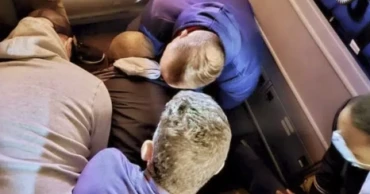
How passengers teamed up to restrain man on chaotic flight
A passenger who helped restrain a threatening man on a weekend flight from Los Angeles to Boston said Tuesday that the entire chaotic episode was over within seconds thanks to teamwork.
Simik Ghookasian said in a telephone interview that he was seated several rows behind the man, who had quietly tried to open an airliner’s emergency door before trying to stab a flight attendant with a broken metal spoon, according to prosecutors.
“I heard the guy getting louder and louder and I thought it was just an argument, but he started yelling and screaming and threatening people, threatening to kill them,” said Ghookasian, a Los Angeles government contractor flying to Boston on United Flight 2609 on Sunday for work.
Until the yelling, he hadn’t noticed anything unusual about the man, who federal authorities have identified as Francisco Severo Torres.
Ghookasian said he saw the spoon and he was among five or six passengers who piled onto Torres and removed it from his grasp. It turned out to be the handle of a metal spoon, from which the bowl portion had been broken off, authorities said.
“That guy was really strong and was really resisting,” Ghookasian said. “We had a hard time holding him down. It was total teamwork.”
Ghookasian asked a flight attendant for some zip ties or duct tape, and the flight attendant produced some zip ties.
Ghookasian, who said he has first aid and counter-terrorism training, said he didn’t have time to be scared, he just reacted and used his instincts.“Everything just exploded in a few seconds,” he said.
Torres, 33, of Leominster, Massachusetts, was arrested when the plane arrived in Boston and charged with interference and attempted interference with flight crew members and attendants using a dangerous weapon, federal prosecutors said. He was detained pending a hearing scheduled for Thursday.
The plane was about 45 minutes from Boston when the crew received an alarm that a side door on the aircraft was disarmed, according to court documents. One flight attendant noticed the door’s locking handle had been moved. Another flight attendant had noticed that Torres was seen near the door and believed he had moved the handle.
Airplane doors cannot be opened once in flight due to cabin pressure.
The crew told the captain that he was a threat and the plane should be landed as soon as possible, authorities said.
Then Torres approached two flight attendants, according to the court documents. One of the flight attendants felt the metal object in Torres’ hand hit him on his shirt collar and tie three times.
Torres told investigators that he went into the airplane’s bathroom and broke a spoon in half to make a weapon, prosecutors said in the documents. They say he told authorities he wanted to open the door so that he could jump out of the plane.
Investigators said Torres admitted knowing that if he opened the door many people would die.
Torres said the flight attendants confronted him and he stabbed one of them in an attempt to defend himself, according to investigators. They said he believed the flight attendant was trying to kill him.
Authorities did not say where Torres got the spoon, but TSA rules allow airline passengers to bring metal utensils except knives onto planes.
United Airlines said no one was injured.
“Thanks to the quick action of our crew and customers, one customer was restrained after becoming a security concern on United flight 2609 from Los Angeles to Boston,” the company statement said. “The flight landed safely and was met by law enforcement.”
If convicted of the charges against him, Torres could face life in prison.
An email seeking comment from him was sent to his federal public defender, and a voicemail was left.
Torres has previously sued two mental health facilities where he was patient, according to federal court records. He sued the state-run Worcester Recovery Center and Hospital in March 2021, alleging medical malpractice for misdiagnosis. That suit was dismissed several months later.
He also sued Fuller Hospital in Attleboro, Massachusetts last May, alleging his constitutional rights were violated because he was a vegan and was denied almond milk. The suit was dismissed in June.
In both cases he acted as his own attorney.
3 years ago

Child marriage ban bill resurrected in West Virginia Senate
A bill to prohibit minors from getting married in West Virginia was resurrected in the state Senate on Thursday, a day after its defeat in a committee.
The about-face didn't necessarily give the bill a clear path to passage. Several senators gave impassioned speeches after the bill was brought back, some of whom defended the right of teenagers in love to marry.
The House of Delegates passed the bill last week. The Senate Judiciary Committee narrowly rejected it Wednesday night without debate. Republican Sen. Charles Trump of Morgan County, a committee member, made a motion that was adopted by the full Senate Thursday to withdraw the bill from the committee and give it a second reading. It will be up for a final reading Friday, and the Senate will have the right to amend the bill.
Currently, children can marry as young as 16 in West Virginia with parental consent. Anyone younger than that also must get a judge’s waiver.
The bill's main sponsor, Democratic Del. Kayla Young of Kanawha County, has said that since 2000 there have been more than 3,600 marriages in the state involving one or more children.
Cabell County Democratic Sen. Mike Woelfel, an attorney, said he represented a girl who got both married and divorced when she was in the eighth grade. Woelfel said he was concerned about older men who court young girls “and the next thing you know, some young girl has convinced her parents to let her get married.”
“What we have here is a good bill, because it does recognize that we aren’t in the 1950s or ’60s,” Woelfel said. “I think we’re moving into the modern era with this."
Both Kanawha County Republican Sen. Mike Stuart, a former federal prosecutor, said he supports the age of 16 to marry. Stuart said his parents 50 years later “are still giddy teenagers” who were married at age 16.
Putnam County Republican Sen. Eric Tarr said he got married in high school but understands problems need to be addressed in the bill.
"Knowing what it means to be two mature high school students in love and getting married and creating a life together, that's a family born and a family that stays together," Tarr said. “I think every one of us in this chamber values that and understands that.”
The bill would establish that 18 is the age of consent and remove the ability of a minor to obtain consent through their parents, legal guardians, or by court petition. Existing legal marriages, including those done in other states, would be unaffected.
According to the nonprofit group Unchained At Last, which seeks to end forced and child marriage, seven states have set the minimum age for marriage at 18, all since 2018. Supporters of such legislation say it reduces domestic violence, unwanted pregnancies and improves the lives of teens.
Although recent figures are unavailable, according to the Pew Research Center, West Virginia had the highest rate of child marriages among the states in 2014, when the state's five-year average was 7.1 marriages for every 1,000 children ages 15 to 17.
3 years ago

US sanctions against individuals abroad violate due process rights: UN expert
The US has for years been imposing sanctions on individuals and entities without national criminal jurisdiction and in the absence of universal jurisdiction, a UN independent human rights expert said Thursday.
This is a clear violation of due process rights, including the presumption of innocence and fair trial, she added.
These rights are guaranteed under the International Convention on Civil and Political Rights which the US ratified and must fully implement, UN Special Rapporteur Alena Douhan said.
The convention is a core international human rights treaty that was adopted by the UN General Assembly in 1966 and entered into force a decade later.
Douhan was appointed by the UN Human Rights Council to monitor the negative impact of unilateral coercive measures on the enjoyment of human rights.
She said the unilateral sanctions target individuals abroad for alleged activities outside the US, including activities that are legal where they occur.
Secondary sanctions target foreign individuals and companies for alleged interaction with sanctioned parties or for evading sanction regimes.
As the sanctions typically prohibit entry into the US and freeze assets with any connection to the country, they violate the right to freedom of movement, and the right to not be arbitrarily deprived of property.
"Fear of US sanctions has led many foreign companies and financial institutions to over-comply to reduce their risks. This only exacerbates the impact of sanctions on human rights," Douhan said.
Also, human rights are infringed when US trade bans against certain countries penalise foreign companies for conducting business there.
"These policies affect labour rights, freedom of movement, and the rights of foreign individuals who may be associated with these companies," she said, pointing to the harm caused to the human rights of ordinary citizens who rely on the goods or services these companies provide, such as medicines and medical equipment.
In questioning the compatibility of this type of imposition of extraterritorial jurisdiction with international human rights standards, she called for reflecting on how it impacts the international principle of non-interference in domestic affairs.
3 years ago

Joe Biden plans new taxes on the rich to help save Medicare
President Joe Biden on Tuesday proposed new taxes on the rich to help fund Medicare, saying the plan would help to extend the insurance program's solvency by 25 years and provide a degree of middle-class stability to millions of older adults.
In his plan, Biden is overtly declaring that the wealthy ought to shoulder a heavier tax burden. His budget would draw a direct line between those new taxes and the popular health insurance program for people older than 65, essentially asking those who've fared best in the economy to subsidize the rest of the population.
Biden wants to increase the Medicare tax rate from 3.8% to 5% on income exceeding $400,000 per year, including salaries and capital gains. The White House did not provide specific cost-saving estimates with the proposal, but the move would likely increase tax revenues by more than $117 billion over 10 years, according to prior estimates in February by the Tax Policy Center.
Also Read: Biden, Scholz to huddle on Ukraine war at White House
“This modest increase in Medicare contributions from those with the highest incomes will help keep the Medicare program strong for decades to come,” Biden wrote in a Tuesday essay in The New York Times. He called Medicare a "rock-solid guarantee that Americans have counted on to be there for them when they retire.”
Senate Minority Leader Mitch McConnell, R-Ky., was quick to dismiss the plan, telling reporters on Tuesday that Biden’s budget agenda “will not see the light of day.”
More than 65 million people rely on Medicare at a cost to taxpayers of roughly $900 billion every year. The number of Medicare enrollees is expected to continue growing as the U.S. population ages. But funding for the program is a problem with federal officials warning that, without cuts or tax increases, the Medicare fund might only be able to pay for 90% of benefits by 2028.
Biden's suggested Medicare changes are part of a fuller budget proposal that he plans to release on Thursday in Philadelphia. Pushing the proposal through Congress will likely be difficult, with Republicans in control of the House and Democrats holding only a slim majority in the Senate.
The proposal is a direct challenge to GOP lawmakers, who argue that economic growth comes from tax cuts like those pushed through by former President Donald Trump in 2017. Those cuts disproportionately favored wealthier households and companies. They contributed to higher budget deficits, when growth failed to boom as Trump had promised and the economy was then derailed in 2020 by the coronavirus pandemic.
The conflicting worldviews on how taxes would impact the economy is part of a broader showdown. Biden and Congress need to reach a deal to raise the government's borrowing authority at some point this summer, or else the government could default and plunge the U.S. into a debilitating recession.
Grover Norquist, president of Americans for Tax Reform and an advocate for the kinds of tax cuts generally favored by Republicans, said that the U.S. economy would suffer because of the president's plan.
"The Biden tax hikes will raise the cost of goods and services for everyone, and make American workers and businesses less competitive internationally and vs. China,” Norquist said.
But Maya MacGuineas, president of the Committee for a Responsible Federal Budget, applauded the plan despite having some reservations about it.
“The president’s plan would generate hundreds of billions of dollars – perhaps even approaching a trillion dollars – to strengthen Medicare,” said MacGuineas, a fiscal watchdog focused on deficit reduction.
White House press secretary Karine Jean-Pierre declined to discuss the numbers behind the budget plan. She told reporters at Tuesday's briefing that she would not “dive into the math,” but that Biden's proposal on Thursday “will be very detailed and transparent.”
The independent, nonpartisan Congressional Budget Office will analyze the proposal later this year.
William Arnone, chief executive of the National Academy of Social Insurance, says there's some risk in taxing wealthier Americans more for the program, given that they already pay more in premiums for Medicare coverage as well.
“At some point higher-income Medicare enrollees may say: ‘This isn’t a good deal for me anymore,'” Arnone said. “The genius of social insurance is that we all pay in, and we all get something out in return. If higher income people start to question the equity – that could lead to a loss confidence in the program.” His group is an advocacy organization for Medicare and other entitlement programs.
Ahead of an expected budget feud and the 2024 campaign season, Democrats have ramped up talk around Medicare, vowing to fend off any Republican attempts to cut the program, although so far the GOP has vowed to avoid any cuts. Still, Republican lawmakers have reached little consensus on how to fulfill their promise to put the government on a path toward balancing the federal budget in the next 10 years.
Last year, members of the House Republican Study Committee proposed raising the eligibility age for Medicare to 67, which would match Social Security. But that idea hasn’t moved forward in a split Congress.
Republicans have denied that they plan to cut the program. A proposal from Sen. Rick Scott, R-Fla., that would require Congress to reconsider all federal laws every five years, including Medicare, has gotten little traction.
Raising taxes on Americans who make more than $250,000 to pay for Medicare has broad support among older Americans, but raising the eligibility age for Medicare, is widely unpopular, said Mary Johnson, a policy analyst for the nonpartisan Senior Citizens League who has researched the issue.
Politicians who try that route might “lose supporters and it can backfire. You can wind up losing your office, too," she said. "A very high percentage of seniors are voting in elections.”
Biden's plan is also intended to close what the White House describes as loopholes that allow people to avoid Medicare taxes on some income. Besides the taxes, Biden wants to expand Medicare's ability to negotiate drug costs, which began with the Inflation Reduction Act. He signed the sweeping legislation last year.
The White House said its budget plan would expand the pharmaceutical drug provisions of the Inflation Reduction Act. More drugs would be subject to price negotiations, other drugs would be brought into the negotiation process sooner and the scope of rebates would be expanded.
Taken together, Biden's new proposals would help shore up a key trust fund that pays for Medicare, which provides health care for older adults. According to the White House, the changes would keep the fund solvent until the 2050s, about 25 years longer than currently expected.
Changes would also be made to Medicare benefits. Biden wants to limit cost sharing for some generic drugs to only $2. The idea would lower out-of-pocket costs for treating hypertension, high cholesterol and other ailments.
3 years ago

Two kidnapped Americans found dead in Mexico, 2 others alive
Two Americans whose abduction in Mexico was captured in a video that showed them caught in a cartel shootout have been found dead, officials said Tuesday. Two others who were kidnapped with them were found alive, with one wounded.
Tamaulipas Gov. Américo Villarreal did not provide details on the extent of the wounded person’s injuries.
The surviving Americans were taken to the border near Brownsville, Texas, in a convoy of Mexican ambulances and SUVs, as seen by an Associated Press journalist Tuesday morning. It was not immediately clear if the bodies of the deceased were also being returned to the U.S.
The vehicles sped down a long dirt road escorted by Mexican military Humvees, armored vehicles, state police and National Guard in trucks with mounted .50-caliber machine guns.
The FBI had said Sunday it was searching with Mexican authorities for the missing U.S. citizens. A relative of one of them said Monday that the group had traveled together from South Carolina so one of them could get a tummy tuck from a doctor in the border city of Matamoros, where Friday’s kidnapping took place.
Shortly after entering Mexico they were caught amid fighting between rival cartel groups in the city. A video showed them being loaded into the back of a pickup truck by gunmen.
Officials said a Mexican woman also died in Friday’s crossfire.
The U.S. citizens were found in a rural area east of Matamoros called Ejido Longoreño on the way to an area on the Gulf coast known as “Bagdad Beach,” according to a state authority who requested anonymity because he was not authorized to speak about the case. Word of their location came to authorities before dawn Tuesday.
Villarreal confirmed the deaths by phone during a morning news conference by Mexican President Andrés Manuel López Obrador, saying details about the four abducted Americans had been confirmed by prosecutors.
López Obrador said one suspect was in custody.
“Those responsible will be found and they are going to be punished,” he said, referencing arrests made in the 2019 killings of nine U.S.-Mexican dual citizens in Sonora near the U.S. border.
Mexico’s president complained about the U.S. media’s coverage of the missing Americans, accusing them of sensationalism. “It’s not like that when they kill Mexicans in the United States, they go quiet like mummies.”
“It’s very unfortunate, they (the U.S. government) has the right to protest like they have,” he said. “We really regret that this happens in our country.”
The abduction illustrates the terror that has prevailed for years in Matamoros, a city dominated by factions of the powerful Gulf drug cartel who often fight among themselves. Amid the violence, thousands of Mexicans have disappeared in Tamaulipas state alone.
Video and photographs taken during and immediately after the abduction Friday show the Americans’ white minivan sitting beside another vehicle that a witness said had collided with it. Almost immediately several gunmen in tactical vests and toting assault rifles arrived in another vehicle to surround the scene.
They walked one of the Americans to a white pickup and dragged and loaded the three others while terrified drivers sat silently in their cars hoping not to draw their attention. Two of the victims appeared to be motionless.
The FBI had offered a $50,000 reward for the victims’ return and the arrest of the kidnappers.
3 years ago
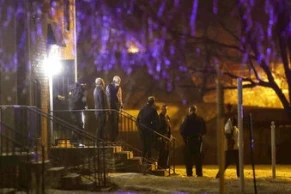
3 Indiana men guilty in fatal shooting of 3 men, 1 woman
Three Indianapolis men have been convicted of murder and other charges in the fatal shooting of three young men and a young woman found slain in a ransacked Indianapolis apartment, a prosecutor said Friday.
Cameron Banks, Desmond Banks, and Lasean Watkins were convicted of four counts each of murder, felony murder and robbery resulting in serious bodily injury following a five-day trial, Marion County Prosecutor Ryan Mears said.
The charges stemmed from the February 2020 shooting deaths of Braxton Ford, Kimari Hunt, Jalen Roberts and Marcel Wills.
A fourth suspect, Rodrience Anderson, pleaded guilty last October to four counts of robbery resulting in serious bodily injury and, under a plea agreement, agreed to cooperate with the prosecution.
Mayor Joe Hogsett announced the arrests of the four at a news conference where he praised the Indianapolis Metropolitan Police Department and “the cooperation and collaboration of community members" for their efforts leading to the arrests.
"While nothing can bring back the four young people whose lives were cut much too short by senseless violence, these charges serve as a meaningful step toward delivering justice to the impacted families," Hogsett said.
A witness who noticed that an apartment’s patio door had been shattered and possibly shot out called the police late on Feb. 5. The caller said “subjects” were seen fleeing the scene.
Inside, officers found the four victims and the apartment ransacked, with drawers pulled from dressers and an empty safe with a key still inside it in a closet, according to the affidavit. Two guns were also missing, it states.
A witness told detectives that he had been at the apartment the night of the killings and had seen three people show up there in hoodies, according to the affidavit. That person told detectives that “everyone at the apartment was shooting dice and one of the males kept coming and going from the residence while another of the males kept coming and going to the restroom as if he was trying to look around the house,” the affidavit states.
The witness provided a vehicle description and investigators identified the vehicle on surveillance video, the affidavit says.
3 years ago

Storms roll eastward after slamming South; 8 deaths reported
A large storm system took aim at the Northeast on Friday, threatening heavy snow and coastal flooding after heavy winds and possible tornadoes damaged homes and buildings, left thousands without power and caused eight deaths in a wide swath of the South and Midwest.
Three people were killed by falling trees in Alabama as severe weather swept through the state. In Mississippi, a woman died inside her SUV after a rotted tree branch struck her vehicle, and in Arkansas a man drowned after he drove into high floodwaters.
Three weather-related deaths were reported in Kentucky on Friday. The deaths happened in three different counties as storms with straight-line winds moved through the state. More than 350,000 customers were without power as of Friday evening.
The storm also barreled Friday afternoon into the Detroit area, quickly covering streets and roads beneath a layer of snow. The weather service said some areas could see blizzard conditions with snowfall approaching 3 inches (8 centimeters) per hour.
Detroit-based DTE Energy reported more than 130,000 customers lost power Friday evening. It was the latest slap after ice storms last week left more than 600,000 homes and businesses without power.
Hail and strong winds were reported in Oklahoma.
The storm system was heading toward New England, where a mix of snow, sleet and rain was expected across the region starting Friday night and lasting into Saturday, prompting the National Weather Service to issue a winter storm warning.
There’s a chance of coastal flooding in Massachusetts and Rhode Island and the storm could bring as much as 18 inches (45 centimeters) of snow to parts of New Hampshire and Maine. The storm will also bring strong winds with gusts of 40 to 50 mph (80 kph), which could cause power outages.
Read more: Heavy snow in Japan leaves 17 dead, dozens injured
Airport officials in Portland, Maine, canceled several flights for Saturday ahead of the weather and some libraries and businesses in the region announced weekend closures. Still, with warmer weather expected to return by the end of the weekend, most New Englanders were taking the storm in stride.
It wasn't the same story in California, where the weather system slammed the state earlier in the week with as much as 10 feet (3 meters) of snow. Some residents in mountains east of Los Angeles will likely remain stranded in their homes for at least another week after the snowfall proved too much to handle for most plows.
Many residents of Alabama, Louisiana, Kentucky, Arkansas and Texas emerged Friday to find their homes and businesses damaged and trees toppled by the reported tornadoes. Tens of thousands were without power and some were also without water.
In Alabama, a 70-year-old man sitting in his truck in Talledega County was killed when a tree fell onto his vehicle. A 43-year-old man in Lauderdale County and a man in Huntsville also were killed by falling trees Friday, local authorities said.
In Texas, winds brought down trees, ripped the roof off a grocery store in Little Elm, north of Dallas, and overturned four 18-wheelers along U.S. Highway 75. Minor injuries were reported, police said.
Winds of nearly 80 mph (130 kph) were recorded near the Fort Worth suburb of Blue Mound. The roof of an apartment building in the suburb of Hurst was blown away, resident Michael Roberts told KDFW-TV.
“The whole building started shaking. ... The whole ceiling is gone,” Roberts said. “It got really crazy.”
Read more: Heavy snowfall kills 3 people in Himalayan Kashmir
Heavy rain was also reported in southern Missouri and northern Arkansas, causing flooding in both states.
In southwest Arkansas, Betty Andrews told KSLA-TV that she and her husband took shelter in the bathroom of their mobile home while a tornado moved through.
“It was very scary. I opened the front door to look out and saw it coming. I grabbed Kevin and went and got into the bathtub,” Andrews said. “We hunkered down, and I said some prayers until it passed.”
They were OK but the home sustained major damage and the couple was temporarily trapped in the bathroom until a neighbor cleared debris from outside the door.
Elsewhere in the Midwest, Minnesota and Wisconsin expected areas of freezing fog with less than a quarter mile of visibility into the weekend, the weather service said. In North Dakota, South Dakota and Minnesota, highways could get up to 10 inches (25 centimeters) of snow and 45 mph (72 kph) wind gusts on Sunday and Monday.
3 years ago