Others

UN goal of achieving gender equality by 2030 is impossible because of biases against women, UN says
The U.N. goal of achieving gender equality by 2030 is impossible to attain because of deeply rooted biases against women around the world in heath, education, employment and the halls of power, the United Nations said in a report Thursday.
"The world is failing women and girls," UN Women, the agency promoting gender equality, and the U.N. Department of Economic and Social Affairs said in "The Gender Snapshot 2023" report.
According to the U.N.'s findings, " active resistance to gender equality and chronic under-investment are key factors in slow progress and, in some cases, reversals of gains already made." It said "unequal access to sexual and reproductive health, unequal political representation, economic disparities and a lack of legal protection, among other issues, prevent tangible progress."
Also read: 90% of adolescent girls, young women don’t use internet in low-income countries: UNICEF
Assistant Secretary-General Maria-Francesca Spatolisano told a news conference launching the report that gender equality is becoming "an ever increasingly distant goal." She pointed to recent setbacks for women and girls living in fragile and conflict-affected countries, the impact of climate change, and "active resistance to gender equality and chronic underinvestment" that are slowing and in some cases reversing progress.
The report assessing the progress for women in achieving the 17 U,N. goals for 2030 on issues ranging from poverty and education to climate change and human rights paints a grim picture of the gender gap, and the "lackluster commitment" globally to equality for women.
On a key goal of eradicating extreme poverty, the report said, one in every 10 women today, or 10.3%, lives on less than $2.15 a day – the extreme poverty level. If current trends continue, it said, 8% of the world's female population, 342.4 women and girls, will still be living in extreme poverty in 2030, most in Sub-Saharan Africa.
Also read: Ensuring young women's equal access to education central to gender equality: US
While overall access to education is rising for girls and boys, the U.N. report said millions of girls never enter a classroom or complete their education, especially in conflict areas. The goal calls for every child to receive quality secondary school education, yet in Afghanistan, it said, the Taliban rulers have banned education for girls beyond elementary school.
"In 2023, up to 129 million girls and young women may be out of school globally," the report said. "At current rates of progress, an estimated 110 million will remain out of school in 2030."
As for the goal of decent work, the report said less than two-thirds of women aged 25 to 54 – 61.4% -- were in the labor force in 2022 compared to 90.6% of men, and the women were paid far less.
"In 2019, for each dollar men earned in labor income, women earned only 51 cents," it said.
Also read: Innovation, collaboration, financial support from private sector essential to support government in achieving SDGs: UN
In jobs critical to the future in science, technology and innovation, the report said, "ongoing gender barriers limit women's roles," which is evident as the field of artificial intelligence takes off.
"In 2022, inventors listed on international patent applications were five times less likely to be female than male," it said. "In 2020, women held only one in three research positions worldwide and only one in five science, technology, engineering and math (STEM) jobs."
And in getting seats at decision-making tables, the report said, globally women hold only 26.7% of parliamentary seats, 35.5% of local government seats, and only 28.2% of management positions at work.
As for the goal promoting peace, the report said, conflicts are escalating around the world and "a shocking 614 million women and girls lived in conflict-affected contexts in 2022, 50% higher than in 2017."
The report by UN Women and ECOSOC warned that the continuing failure to make the achievement of gender equality a priority will put the achievement of all 17 goals "in peril."
It called funding for programs promoting gender equality and the empowerment of women "inadequate, unpredictable and inconsistently distributed among countries," saying between 2020-2021 this government aid amounted to "a mere 4% of total bilateral aid, a notable decrease from 5% in previous years."
The report said an estimated $6.4 trillion per year is needed across 48 developing countries – covering nearly 70% of the population in developing countries -- to achieve gender equality in key areas including ending poverty and hunger and supporting more equal participation of women in society by 2030.
The report said an estimated $6.4 trillion per year is needed across 48 developing countries – covering nearly 70% of the population in developing countries -- to achieve gender equality in key areas including ending poverty and hunger and supporting more equal participation of women in society by 2030.
If government expenditures stay on their current trajectory, it said, there will be an annual shortfall of $360 billion – which the U.N. is appealing for.
2 years ago

New report confirms record-high greenhouse gases, global sea level, ocean heat in 2022
Greenhouse gas concentrations, global sea level and ocean heat content reached record highs in 2022, according to an annual review of the global climate published online on Wednesday.
The State of the Climate report, the 33rd annual assessment compiled by the National Centers for Environmental Information at the U.S. National Oceanic and Atmospheric Administration, is based on contributions from more than 570 scientists in over 60 countries.
Read: Zombie ice from Greenland will raise sea level 10 inches
It provides the most comprehensive update on Earth's climate indicators, notable weather events and other data collected by environmental monitoring stations and instruments located on land, water, ice and in space.
According to the report, Earth's greenhouse gas concentrations were the highest on record in 2022. Warming trends continued across the globe.
A range of scientific analysis indicate that the annual global surface temperature was 0.25 to 0.30 degree Celsius above the 1991-2020 average.
Read: Global sea level to rise by over 10cm in 80 years: study
La Niña conditions in the equatorial Pacific Ocean that began in mid-2020, with a short break in 2021, continued through all of 2022, according to the report.
Heatwaves shattered temperature records across the planet, according to the report. In July, a 14-day heatwave swept through western Europe.
Read: New model developed on Antarctica's effect on sea level rise in coming centuries
Record-breaking summer heat in central and eastern Asia, particularly in the Yangtze River basin, led to a devastating drought that affected more than 38 million people and caused a direct economic loss of 4.75 billion U.S. dollars, according to the report.
2 years ago
Flooding in southern Brazil leaves at least 31 dead and 2,300 homeless
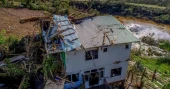
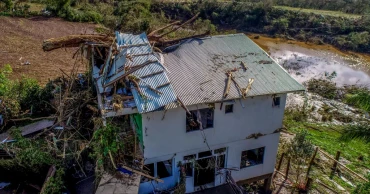
Flooding from a cyclone in southern Brazil washed away houses, trapped motorists in vehicles and swamped streets in several cities, killing at least 31 people and leaving 2,300 homeless, authorities said Wednesday.
More than 60 cities have been battered since Monday night by the storm, which has been Rio Grande do Sul state's deadliest, Gov. Eduardo Leite said.
“The fly-over we just did, shows the dimension of an absolutely out of the ordinary event,” Leite said in a video posted on the state's social media accounts. “It wasn’t just riverside communities that were hit, but entire cities that were completely compromised.”
Flooding in Sylhet, Chattogram shows Bangladesh’s vulnerabilities to impacts of climate change: UK
Videos shot by rescue teams Tuesday and published by the online news site G1 had shown some families on the top of their houses pleading for help as rivers overflowed their banks. Some areas were entirely cut off after wide avenues turned into fast-moving rivers.
Leite said Wednesday that the death toll had reached 31, and state emergency authorities said at least 2,300 people were made homeless. Another 3,000 had to temporarily evacuate their houses.
Flood in Kurigram: 7000 families still stranded
In Mucum, a city of about 50,000 residents, rescuers found 15 bodies in a single house. Once the storm had passed, residents discovered a trail of destruction along the river with most buildings swept away down to the ground level. Images showed a sheep hanging from an electrical line — an indication of how high the water had risen.
“The water arrived very fast, it was rising two meters (6½ feet) an hour,” Mucum resident Marcos Antonio Gomes said, standing on top of a pile of debris. “We have nothing left. Not even clothes.”
In an indication of how long people might be stranded, the Mucum city hall advised residents Tuesday to seek out supplies to meet their needs for the next 72 hours. Other towns called on their citizens with boats to help with rescue efforts.
Gomes, a 55-year-old businessman, said it was the fourth time in 15 years that his house was damaged by floods. He said this one was the worst so far, and he expects more flooding in the future.
“There's no way we can live here. This will come back. We have to abandon (this place)," Gomes said.
11 dead, resources worth over Tk 400cr damaged in Bandarban floods: DC
Many of the victims died from electrical shock, or were trapped in vehicles, online news site G1 reported. One woman died as she was swept away during a rescue attempt.
Search and rescue teams have focused on the Taquari Valley, about 150 kilometers (30 miles) northwest of the state capital, Porto Alegre, where most of the victims and damage were recorded. But those efforts expanded farther west on Wednesday morning, with helicopters sent to the Rio Pardo Valley.
More heavy rains were expected to hit the state’s center-south region, while possibly sparing worst-hit areas. Authorities maintained three flooding alerts on Wednesday — for the Jacui, Cai and Taquari rivers.
Rio Grande do Sul was hit by another cyclone in June, which killed 16 people and caused destruction in 40 cities, many of those around Porto Alegre.
2 years ago

Russian missile strike on Ukrainian market kills 17 as Blinken announces new $1B aid package
A Russian missile tore through an outdoor market in eastern Ukraine on Wednesday, killing 17 people and wounding dozens, as U.S. Secretary of State Antony Blinken returned to the country with more than $1 billion in new American funding for Ukraine, including military and humanitarian aid.
Blinken’s fourth visit to the country was overshadowed by the strike in the city of Kostiantynivka, near the front line in the Donetsk region, that turned the marketplace into an inferno. It was one of the deadliest bombardments of civilians in the 18-month-old war. In addition to the dead, at least 32 people were wounded.
“Those who know this place are well aware that it is a civilian area,” President Volodymyr Zelenskyy said at a news conference with the Danish prime minister in Kyiv. “There aren’t any military units nearby. The strike was deliberate.”
White House press secretary Karine Jean-Pierre said such brutal Russian attacks underscore "the importance of continuing to support the people of Ukraine.”
Blinken’s visit was aimed at assessing Ukraine’s 3-month-old counteroffensive and signaling continued U.S. support as some Western allies express worries about Kyiv’s slow progress against invading Russian forces.
Russia expected to increase grain supplies to foreign market by 4.5pc
“We want to make sure that Ukraine has what it needs, not only to succeed in the counteroffensive but has what it needs for the long-term, to make sure that it has a strong deterrent,” Blinken said. “We’re also determined to continue to work with our partners as they build and rebuild a strong economy, strong democracy.”
About $175 million of the total is in the form of weaponry to be provided from Pentagon stockpiles and another $100 million is in the form of grants to allow the Ukrainians to purchase additional arms and equipment, according to the State Department.
Noting progress in the counteroffensive, Blinken said the new aid "will help sustain it and build further momentum.” He said the new military assistance would be bolstered by the arrival of U.S. Abrams tanks in the fall and the training of Ukrainian pilots on F-16 fighter jets to complement training in Europe.
Russia attacks a Ukrainian port before key grain deal talks between Putin and Turkey's president
In addition to the military assistance, Blinken announced nearly $805 million in non-arms-related aid for Ukraine, including $300 million for law enforcement, $206 million in humanitarian aid, $203 million to combat corruption and $90.5 million for removing mines, the State Department said.
The package also includes a previously announced $5.4 million transfer to Ukraine of frozen Russian oligarch assets.
The aid announced by Blinken comes from money previously approved by Congress. President Joe Biden has requested another $21 billion in military and humanitarian aid for Ukraine for the final months of 2023, but it’s not clear how much — if any — will be approved.
Many Republican lawmakers are wary of providing more aid, and the party’s presidential front-runner, former President Donald Trump, has criticized U.S. financial support. Opinion polls also have shown a decline in support for the war by the American public.
Momen to hold talks with Russian FM Lavrov September 7
Biden and the Pentagon have said repeatedly they will support Ukraine for as long as it takes. As of Aug. 29, there was approximately $5.75 billion left in the already approved funding for weapons and equipment taken from existing Pentagon stocks.
Blinken was to discuss other issues, including support for Ukraine’s economy, building on his June announcement of $1.3 billion to help Kyiv rebuild, with a focus on modernizing its energy network, which was bombarded by Russia last winter.
Kremlin spokesman Dmitry Peskov said U.S. assistance to Ukraine “can’t influence the course of the special military operation” — Moscow’s euphemism for the war.
Blinken arrived in Kyiv for an overnight visit hours after Russia launched a missile attack on the city.
On the train to Kyiv, Blinken met with the Danish prime minister, Mette Frederiksen, who was also on an official visit, and thanked her for Denmark’s leadership in training Ukrainian pilots on F-16s and for promising to donate the fighter jets to Ukraine, according to State Department spokesperson Matthew Miller.
Washington officials said there will be discussions of alternative export routes for Ukrainian grain following Russia’s exit from the Black Sea Grain Initiative and its frequent attacks on port facilities in the Odesa region.
Those alternatives may include new overland routes or ships hugging coastlines to keep out of international waters where they could be targeted by Russia’s navy. Ukrainian Foreign Minister Dmytro Kuleba also mentioned the potential to develop the Danube River corridor for grain exports.
After arriving in Kyiv, Blinken laid a wreath at the city’s Berkovetske cemetery to commemorate Ukrainian troops killed defending the country.
In a meeting, Ukrainian Prime Minister Denys Shmyhal said Ukraine is grateful the U.S. money is coming in the form of grants, not loans that would drive it into debt.
In other developments, Russia fired cruise missiles overnight at Kyiv in its first aerial attack on the capital since Aug. 30, according to Serhii Popko, the head of Kyiv’s regional military administration. Debris from a downed missile caused a fire and damage but no casualties.
One person was killed in the Odesa region in a Russian missile and drone attack on the port of Izmail that damaged grain elevators, administrative buildings and agricultural enterprises, authorities said.
The trip was Blinken’s fourth to Ukraine since the war began, including one brief excursion over the Polish-Ukrainian border in March 2022, just a month after the Russian invasion. But it will be the first time America’s top diplomat spends the night in Kyiv since January 2022, before the invasion, in what U.S. officials called another sign of American support.
Blinken’s visit comes after some of Ukraine’s allies have privately expressed concern that Ukrainian troops may fail to reach their objectives.
While the U.S. has been concerned by some day-to-day battlefield setbacks, American officials said, they are still generally encouraged by Ukraine’s handling of the military situation, particularly its air defense capabilities in knocking down Russian drones aimed at Kyiv.
Western analysts and military officials caution that the counteroffensive’s success is far from certain and that it could take years to rid Ukraine of entrenched, powerfully armed and skilled Russian troops.
Both sides will have to assess their supply shortages, with more battles of attrition likely over the winter. A long war could stretch deep into next year and beyond, according to experts.
2 years ago

This summer was a global record breaker for the highest heat ever measured, meteorologists say
Earth has sweltered through its hottest Northern Hemisphere summer ever measured, with a record warm August capping a season of brutal and deadly temperatures, according to the World Meteorological Organization.
Last month was not only the hottest August scientists ever recorded by far with modern equipment, it was also the second hottest month measured, behind only July 2023, WMO and the European climate service Copernicus announced Wednesday.
August was about 1.5 degrees Celsius (2.7 degrees Fahrenheit) warmer than pre-industrial averages. That is the threshold that the world is trying not to pass, though scientists are more concerned about rises in temperatures over decades, not merely a blip over a month's time.
The world's oceans — more than 70% of the Earth's surface — were the hottest ever recorded, nearly 21 degrees Celsius (69.8 degrees Fahrenheit), and have set high temperature marks for three consecutive months, the WMO and Copernicus said.
"The dog days of summer are not just barking, they are biting," United Nations Secretary-General Antonio Guterres said in a statement. "Climate breakdown has begun."
So far, 2023 is the second hottest year on record, behind 2016, according to Copernicus.
Scientists blame ever warming human-caused climate change from the burning of coal, oil and natural gas with an extra push from a natural El Nino, which is a temporary warming of parts of the Pacific Ocean that changes weather worldwide. Usually an El Nino, which started earlier this year, adds extra heat to global temperatures but more so in its second year.
Climatologist Andrew Weaver said the numbers announced by WMO and Copernicus come as no surprise, bemoaning how governments have not appeared to take the issue of global warming seriously enough. He expressed concern that the public will just forget the issue when temperatures fall again.
"It's time for global leaders to start telling the truth," said Weaver, a professor at the School of Earth and Ocean Sciences at the University of Victoria in Canada. "We will not limit warming to 1.5 C; we will not limit warming to 2.0 C. It's all hands on deck now to prevent 3.0 C global warming — a level of warming that will wreak havoc worldwide."
Copernicus, a division of the European Union's space program, has records going back to 1940, but in the United Kingdom and the United States, global records go back to the mid 1800s and those weather and science agencies are expected to soon report that the summer was a record-breaker.
"What we are observing, not only new extremes but the persistence of these record-breaking conditions, and the impacts these have on both people and planet, are a clear consequence of the warming of the climate system," Copernicus Climate Change Service Director Carlo Buontempo said.
Scientists have used tree rings, ice cores and other proxies to estimate that temperatures are now warmer than they have been in about 120,000 years. The world has been warmer before, but that was prior to human civilization, seas were much higher and the poles were not icy.
So far, daily September temperatures are higher than what has been recorded before for this time of year, according to the University of Maine's Climate Reanalyzer.
While the world's air and oceans were setting records for heat, Antarctica continued to set records for low amounts of sea ice, the WMO said.
"Antarctic sea ice extent was literally off the charts, and the global sea surface temperature was once again at a new record," WMO's secretary-general, Petteri Taalas, said in a statement released to the media. "It is worth noting that this is happening BEFORE we see the full warming impact of the El Nino event, which typically plays out in the second year after it develops."
2 years ago
Fierce storm in southern Brazil kills at least 21 people and displaces more than 1,600
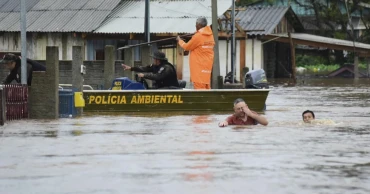
At least 21 people died in southern Brazil due to a fierce storm that caused floods in several cities, authorities said Tuesday.
Rio Grande do Sul Gov. Eduardo Leite said the death toll is the state’s highest due to a climate event. He said about 60 cities had been battered by the storm, which was classified as an extratropical cyclone.
Leite said 15 of the deaths occurred in one house in Mucum, a city of about 50,000 residents.
The Rio Grande do Sul state government said it had recorded 1,650 people made homeless since Monday night.
Rain from Tropical Storm Hilary lashes California and Mexico, swamping roads and trapping cars
TV footage showed familes on the top of their houses pleading for help as rivers overflowed their banks.
The city hall at Mucum recommended that residents seek out supplies to meet their needs for the next 72 hours.
The governor said one of the dead was a woman who was swept away during a rescue attempt.
“I regret the death of a woman in a rescue attempt over the Taquari river,” Leite said in his social media channels. “The wire broke, she and a rescuer fell. Unfortunately the woman did not survive and the rescuer is seriously injured.”
Powerful Hurricane Hilary heads for Mexico's Baja. Rare tropical storm watch issued for California
Rio Grande do Sul was hit by another extratropical cyclone in June, which killed 16 people and caused destruction in 40 cities, many of those around state capital of Porto Alegre.
Tropical Storm Mawar brings heavy rains, landslide risk to Japan's southern islands
2 years ago

Israeli military raid in the occupied West Bank kills a Palestinian man
Israeli troops killed a Palestinian man during an army raid in the occupied West Bank on Tuesday, Palestinian health officials said, the latest incident in a yearlong wave of violence that has surged to levels unseen in the territory in some two decades.
Israel has pressed on with near-nightly raids in the West Bank and amid a spike in attacks by Palestinians against Israelis in recent weeks, including a car-ramming at a major West Bank checkpoint and a shooting at a car wash.
Read: Rival Eritrean groups clash in Israel, leaving dozens hurt in worst confrontation in recent memory
The military said troops destroyed an explosives stockpile in the Nour Shams refugee camp in the northern West Bank on Tuesday. During the operation, soldiers came under attack from armed gunmen and returned fire, the army said.
The Palestinian health ministry said that a 21-year-old man died from a bullet wound to the head. No Palestinian militant groups immediately claimed him as a member.
A video of the incident released by the military appeared to show a massive fireball erupting from a building. Another unconfirmed amateur video appeared to show an explosion beneath an Israeli military bulldozer.
Palestinian assaults against Israelis have spiked in parallel to Israel’s intensification of arrest raids in the West Bank. More than 30 people have been killed in Palestinian attacks against Israelis since the start of 2023.
Read: 17-year-old Palestinian killed during Israeli military raid in northern West Bank
The raids, which were stepped up early last year, have fueled tensions in the region and have ushered in some of the worst fighting between Israel and the Palestinians in the West Bank since the last Palestinian uprising in the early 2000s.
More than 180 Palestinians have been killed in the violence, with nearly half of them affiliated with militant groups, according to a tally by The Associated Press. Israel says most of those killed were militants, but stone-throwing youths protesting the incursions as well as people not involved in the confrontations have also died.
Read: Israeli military fire killed Palestinian teen in occupied West Bank, Palestinian health officials say
Israel says the raids are meant to dismantle militant networks and thwart future attacks. Palestinians say the raids undermine their security forces, inspire more militancy and entrench Israeli control over lands they seek for a hoped-for future state.
Israel captured the West Bank in the 1967 Mideast war, along with east Jerusalem and the Gaza Strip.
2 years ago

Putin says he won't renew the grain deal until the West meets his demands. The West says it has
Russian President Vladimir Putin said Monday that a landmark deal allowing Ukraine to export grain safely through the Black Sea amid the war won’t be restored until the West meets Moscow's demands on its own agricultural exports.
Ukraine and its Western allies have dismissed the Kremlin’s demands as a ploy to advance its own interests.
Still, Putin's remarks dashed hopes that his talks with Turkish President Recep Tayyip Erdogan could revive an agreement seen as vital for global food supplies, especially in Africa, the Middle East and Asia.
Russia refused to extend the deal in July, complaining that a parallel agreement promising to remove obstacles to Russian exports of food and fertilizer hadn’t been honored. It said restrictions on shipping and insurance hampered its agricultural trade, though it has shipped record amounts of wheat since last year.
Putin reiterated those complaints Monday, while also telling reporters that if those commitments were honored, Russia could return to the deal “within days.”
Erdogan also expressed hope that a breakthrough could come soon. He said Turkey and the U.N. — which both brokered the original deal — have put together a new package of proposals to unblock the issue.
Read: Israel's PM pitches fiber optic cable idea to link Asia and the Middle East to Europe
“We believe that we will reach a solution that will meet the expectations in a short time,” Erdogan said at the news conference held with Putin in the Russian resort of Sochi.
Earlier, German Foreign Minister Annalena Baerbock lashed out, saying Putin's “game with the grain agreement is cynical.”
“It’s only because of Putin that the freighters don’t have free passage again,” she told reporters in Berlin.
A lot is riding on the negotiation. Ukraine and Russia are major suppliers of wheat, barley, sunflower oil and other goods that developing nations rely on.
Data from the Joint Coordination Center in Istanbul, which organized shipments under the deal, show that 57% of the grain from Ukraine went to developing nations, with the top destination being China.
Grain prices shot up after Russia pulled out of the deal but have since fallen back, indicating that there isn't a big crunch in the market for the moment.
Read: Russia attacks a Ukrainian port before key grain deal talks between Putin and Turkey's president
But failure to revive the agreement will have “drastic impacts” in countries such as Somalia and Egypt that rely heavily on Black Sea grain, according to Galip Dalay, an associate fellow at the Chatham House think tank in London.
Putin is looking for some relief from sanctions and at the same time is engaged in a “war of narratives,” Dalay said, because the Russian leader “doesn’t want to come across as the bad guy in the eyes of the global south as a result of this food insecurity.”
Ukraine and its allies have often noted that Russia's move left many developing nations in the lurch, since so many were recipients of the grain.
Perhaps in an effort to address that accusation, Putin said Monday that Russia was close to finalizing an agreement to provide free grain to six African countries. Last month, he promised shipments to Burkina Faso, Zimbabwe, Mali, Somalia, Eritrea and Central African Republic.
The Russian leader added that the country will ship 1 million metric tons (1.1 million tons) of cheap grain to Turkey for processing and delivery to poor countries.
In addition to pulling out of the grain deal, Russia has repeatedly attacked the Odesa region, where Ukraine’s main Black Sea port is. Hours before the Sochi meeting, the Kremlin’s forces launched a second barrage in two days on the area. The Ukrainian air force said it intercepted 23 of 32 drones that targeted the Odesa and Dnipropetrovsk regions. It did not specify damage caused by those that got through.
Russia may be hoping it can use its power over Ukraine’s Black Sea exports as a bargaining chip to reduce Western economic sanctions.
Some companies have been wary of doing business with Russia because of those sanctions, even though Western allies have made assurances that food and fertilizer are exempt. Still, Moscow remains unsatisfied.
Ukraine’s Foreign Minister Dmytro Kuleba on Monday urged Moscow to return to the deal, insisting “there were no legal and political grounds for Russia to withdraw from the agreement.”
Monday's talks took place against a backdrop of Ukraine's recent counteroffensive against the Kremlin's invasion forces.
Read: Putin, Erdogan set to meet amid efforts to repair Ukraine grain deal
In the latest development, Ukrainian President Volodymyr Zelenskyy said Sunday that Defense Minister Oleksii Reznikov would be replaced this week. The job requires “new approaches,” Zelenskyy said, without elaborating. Reznikov on Monday published a photo of his resignation letter.
Putin and Erdogan — authoritarian leaders who have both been in power for more than two decades — are said to have a close rapport, fostered in the wake of a failed coup against Erdogan in 2016 when Putin was the first major leader to offer his support.
The Turkish president has maintained those during the 18-month war in Ukraine. Turkey hasn’t joined Western sanctions against Russia following its invasion, emerging as a main trading partner and logistical hub for Russia’s overseas trade.
At the same time, Turkey, a member of NATO, has also supported Ukraine, sending arms, meeting Zelenskyy and backing Kyiv’s bid to join the Western alliance.
Russia, meanwhile, has taken steps to strengthen its military ties with North Korea. Russian Defense Minister Sergei Shoigu, who traveled to Pyongyang in July, said Monday that the two countries may hold joint war games.
U.S. National Security Council spokeswoman Adrienne Watson noted that Shoigu sought to persuade North Korea during his trip to sell artillery ammunition to Russia.
The U.S. has reason to think North Korean leader Kim Jong-Un “expects these discussions to continue” and “to include leader-level diplomatic engagement in Russia,” Watson said Monday.
Another U.S. official, who was not authorized to address the matter publicly and spoke on condition of anonymity, said the U.S. expects Kim will travel to Russia within the month. The official said the U.S. isn’t sure exactly where or when the meeting would take place, but the Pacific port city of Vladivostok would be a likely possibility given its relative proximity to North Korea.
The White House reported last week that it had intelligence indicating that Putin and Kim swapped letters following Shoigu's visit. National Security Council spokesman John Kirby said the letters were “more at the surface level” but that Russian and North Korean talks on a weapons sale were advancing.
2 years ago

Putin, Erdogan set to meet amid efforts to repair Ukraine grain deal
Russian President Vladimir Putin will host Turkish leader Recep Tayyip Erdogan for talks next week, the Kremlin announced Friday, just over six weeks after Moscow broke off a deal brokered by Ankara and the U.N. that allowed Ukrainian grain to reach world markets safely despite the 18-month war.
Kremlin spokesman Dmitry Peskov said Putin and Erdogan would meet Monday in Russia’s Black Sea resort of Sochi.
The announcement ended weeks of speculation about when and where the two leaders might meet next, while international efforts continue to try to patch up the Black Sea Grain Initiative, which sent grain to parts of Africa, the Middle East and Asia where hunger is a growing threat.
Read: Russia's Putin attends BRICS summit in South Africa remotely while facing war crimes warrant
Ukraine and Russia are both major global suppliers of wheat, barley, sunflower oil and other commodities that developing nations rely on.
Turkey, together with the United Nations, brokered the deal in July 2022 that allowed Ukraine to resume shipping foodstuffs from three Black Sea ports. Under the initiative, ship and cargo inspections were overseen from Turkey, and vessels sailed to and from Ukraine from there. Almost 33,000 tons of grain left Ukraine while the agreement was in effect.
Ankara's role was key. Turkey is one of Russia’s main trading partners and a logistical hub for Russia’s foreign trade amid Western sanctions. Erdogan calls Putin “my dear friend.”
A separate memorandum that Moscow and the U.N. agreed to at the same time as the Ukraine initiative pledged to help to overcome wartime obstacles to Russian exports of food and fertilizer. Russian officials repeatedly threatened to pull out of the deals and finally did in July, alleging its conditions hadn’t been met.
Read: Putin profits off US and European reliance on Russian nuclear fuel
Russia has complained that restrictions on shipping and insurance have hampered its agricultural exports, but it has shipped record amounts of wheat since last year.
U.N. Secretary-General Antonio Guterres sent Russia a new proposal in hopes of reviving the deal but it didn’t satisfy Moscow’s demands, Russian Foreign Minister Sergey Russian Foreign Minister Sergey Lavrov said while hosting his Turkish counterpart, Hakan Fidan, for talks in Moscow on Thursday.
Lavrov said he gave the Turkish government a list of actions that the West would have to take in order for Ukraine's Black Sea exports to resume. The scheduled talks between Putin and Erdogan could help unlock that.
The announcement of Monday's meeting coincided with the departure of two bulk cargo ships Friday from the Ukrainian port city of Yuzhne.
The Liberia-flagged Anna-Theresa and the Ocean Courtesy, traveling under a Marshall Islands flag, were carrying pig iron and iron ore concentrate, Ukrainian Minister of Infrastructure Oleksandr Kubrakov said.
It was not clear under what legal and security circumstances the ships had sailed.
Read: Russian mercenary leader Prigozhin's commanders met Putin after short-lived mutiny, pledged loyalty
The Ocean Courtesy was headed to Romania’s Black Sea port of Constanta and is estimated to arrive there Saturday afternoon, according to the global ship tracking website MarineTraffic. The website said the Anna-Theresa would reach Varna in Bulgaria the same day.
Meanwhile, Russian officials said Friday that air defenses intercepted drones heading toward three of the country’s western regions. Regional governors said defense systems stopped three drones in the Kursk, Belgorod and Moscow regions.
Moscow airports briefly halted flights but no major damage or injuries were reported, according to Russian authorities.
Drones aimed at targets inside Russia — and blamed by Moscow on Ukraine — have become almost daily occurrences as the war has entered its 19th month and Kyiv’s forces pursue a counteroffensive. Recently, the drones have reached deeper into Russia.
The apparent Ukrainian strategy is to unnerve Russia and pile pressure on Russian President Vladimir Putin, although Kyiv officials normally neither claim nor deny responsibility for attacks on Russian soil.
The Associated Press has not been able to determine whether the drones were launched from Ukraine or inside Russia.
Ukraine’s military intelligence chief, Maj. Gen. Kyrylo Budanov, said in an interview with online outlet The War Zone that “we work from the territory of Russia.” He did not elaborate.
Read: Putin says Russia is 'united as never before' during Shanghai Cooperation Organization meeting
Meanwhile, satellite images analyzed by the AP show that suspected Ukrainian drone attacks late Tuesday destroyed at least two Ilyushin Il-76 military transport planes at a Russian air base.
The transport planes were deliberately targeted, according to Budanov.
The images taken Thursday show Princess Olga Pskov International Airport, which is a dual military-civilian airport about 700 kilometers (400 miles) north of the Ukrainian border and near Estonia and Latvia.
The four-engine Il-76 is the workhorse of the Russian military’s airlift capacity and is able to land and take off in rugged conditions. The Russian military is believed to have over 100 of them in its fleet.
The AP analysis, conducted Friday, showed what appeared to be the blackened hulks of two Il-76s on separate parking pads on the air base’s apron. One included the plane’s tail, the other appeared to show pieces of another aircraft. Fire damage could be seen around the pad.
Eleven other Il-76s were moved off their parking pads into different positions on the airport’s taxiways, possibly in an attempt to make it more difficult for them to be struck again. One was on the runway itself. Another Il-76 remained on the pad, though it wasn’t clear why.
The satellite image was taken at 1:03 p.m. GMT Thursday. Videos on social media Thursday night showed anti-aircraft fire going off around the air base again, though it remained unclear whether it was another attack.
Ukrainian President Volodymyr Zelenskyy said Thursday that his country had developed a weapon that hit a target 700 kilometers (400 miles) away, apparently referencing the air base attack. He described the weapon as being produced by Ukraine’s Ministry of Strategic Industries but gave no other details.
Oleksiy Danilov, secretary of the National Security and Defense Counci of Ukraine, suggested on television Friday that the weapon can fly even further than the distance Zelenskyy mentioned.
2 years ago

Typhoon Saola makes landfall in southern China after nearly 900,000 people moved to safety
Typhoon Saola made landfall in southern China before dawn Saturday after nearly 900,000 people were moved to safety and most of Hong Kong and other parts of coastal southern China suspended business, transport and classes.
Guangdong province's meteorological bureau said the powerful storm churned into an outlying district of the city of Zhuhai, just south of Hong Kong at 3:30 a.m. It was forecast to move in a southwesterly direction along the Guangdong coast at a speed of around 17 kph (10 mph), gradually weakening before heading out to sea.
Philippines warns of possible flooding, landslides as Typhoon Mawar slowly passes to north
On Friday, 780,000 people in Guangdong were moved away from areas at risk as did 100,000 others in neighboring Fujian province. More than 80,000 fishing vessels returned to port.
Workers stayed at home and students in various cities saw the start of their school year postponed to next week. Trading on Hong Kong’s stock market was suspended Friday and hundreds of people were stranded at the airport after about 460 flights were canceled in the key regional business and travel hub.
Rail authorities in mainland China halted all trains entering or leaving Guangdong province from Friday night to Saturday evening, state television CCTV reported.
Typhoon Mawar closes in on Guam as residents shelter, military sends away ships
The Hong Kong Observatory had issued a No. 10 hurricane alert, the highest warning under the city’s weather system. It was the first No. 10 warning since Super Typhoon Mangkhut hit Hong Kong in 2018.
The observatory said Saola — with maximum sustained winds of 195 kilometers (121 miles) per hour — came its closest to the financial hub at around 11 p.m. Friday, skirting about 30 kilometers (19 miles) south of the city’s Tsim Sha Tsui shopping district. The storm’s eyewall, which surrounds its eye, was moving across the city overnight, “posing a high threat” to the territory, the agency said. By Saturday, morning, it said, maximum sustained wind speeds had fallen to 145 kilometers (90 miles) per hour.
The observatory warned of serious flooding in coastal areas and said the maximum water level might be similar to when Mangkhut felled trees and tore scaffolding off buildings in the city.
In recent months, China has experienced some of its heaviest rains and deadliest flooding in years in various regions, with dozens killed, including in outlying mountainous parts of the capital, Beijing.
Guam braces for hit from Typhoon Mawar as storm heads toward Pacific US territory
As the storm's heavy rains and strong winds closed in on Hong Kong, about 400 people sought refuge at temporary shelters and ferry and bus services halted. Residents of low-lying areas placed sandbags at their doors hoping to prevent their homes from being flooded.
Dozens of trees were knocked down, and seven people were injured and sought treatment at public hospitals. Classes at all schools were to remain suspended Saturday.
Some residents, including security guard Shirley Ng, still had to go to work Friday. Ng said people were stocking up on food to prepare for the storm.
“I just hope that the typhoon won’t cause causalities,” she said.
Weather authorities in the nearby gambling hub of Macao also warned of flooding, forecasting that water levels might reach 1.5 meters (5 feet) in low-lying areas Saturday morning. The cross-border bridge connecting Hong Kong, Macao and Zhuhai city was closed at midafternoon. Macao leader Ho Iat Seng ordered a halt to casino operations.
Another storm, Haikui, was gradually moving toward eastern China. Coupled with the influence of Saola, parts of Guangdong, Fujian and Zhejiang provinces would experience strong winds and heavy rains, the meteorological administration said. It predicted Haikui would hit Taiwan’s east coast Sunday.
Dozens of domestic flights were canceled along with air services to Hong Kong and Macao.
Despite the twin storms, China's military conducted more operations Friday night and early Saturday meant to intimidate Taiwan, a self-ruled island democracy that Beijing seeks to bring under Chinese sovereignty by force if necessary. Taiwan's Defense Ministry said it had detected six Chinese military aircraft and three naval vessels around Taiwan during the 24 hours leading up to 6 a.m. Saturday.
It said the island's armed forces were monitoring the situation and put aircraft, navy vessels and land-based missile systems on alert. However, it said there were no indications that the Chinese ships or aircraft had crossed the median line in the Taiwan Strait or entered Taiwan's air defense identification zone as they often do.
Saola passed just south of Taiwan on Wednesday before turning toward mainland China, with its outer bands hitting the island’s southern cities with torrential rain. The typhoon also lashed the Philippines earlier this week, displacing tens of thousands of people in the northern part of the islands because of flooding.
2 years ago