Others
G-7 envoys urge tough stance on Chinese, N Korean aggression
Top diplomats from the Group of Seven wealthy democracies are tackling two major worries in Northeast Asia, vowing a tough stance on China’s increasing threats to Taiwan and North Korea's unchecked tests of long-range missiles.
Another major crisis, Russia’s war in Ukraine, will also consume the agenda Monday as the diplomats gather in this Japanese hot spring resort town for Day Two of talks meant to pave the way for action by G-7 leaders when they meet next month in Hiroshima.
For the American delegation, the meeting comes at a crucial moment in the world’s response to Russia’s invasion of Ukraine and efforts to deal with China, two issues that G-7 ministers from Japan, the United States, the United Kingdom, France, Germany, Canada, Italy and the European Union regard as potent challenges to the post-World War II rules-based international order.
Also Read: G7 vows to step up moves to renewable energy, zero carbon
A senior U.S. official traveling with U.S. Secretary of State Antony Blinken told reporters that the Biden administration’s goal for the talks is to shore up support for Ukraine, including a major initiative on Ukraine’s energy infrastructure launched at last year’s G-7 gatherings in Germany, as well as to ensure the continued provision of military assistance to Kyiv. Ramping up punishment against Russia for the conflict, particularly through economic and financial sanctions that were first threatened by the G-7 in December 2021, before the invasion, will also be a priority, the official said.
Ukraine faces an important moment in coming weeks with Russia’s current offensive largely stalled and Ukraine preparing a counter-offensive. The U.S. official, who spoke on condition of anonymity to discuss Blinken’s priorities at the closed-door meetings, said there would be discussion about ways to deepen support for Ukraine’s long-term defense and deterrence capabilities. That might also improve Kyiv’s position for potential negotiations that could end the conflict on its terms.
The role of Japan — the only Asian member of the G-7 — as chairman of this year's talks provides an opportunity to discuss coordinated action on China. Leaders and foreign ministers of G-7 countries, most recently France and Germany, have recently concluded visits to China, and the diplomats in Karuizawa are expected to discuss their impressions of where the Chinese stand on numerous issues, including the war in Ukraine, North Korea, and Taiwan, which is a particular sore point in U.S.-Chinese relations.
At a private working dinner on Sunday night that marked the diplomats’ first formal meeting, Japanese Foreign Minister Yoshimasa Hayashi urged continued dialogue with China on the many global challenges where participation from Beijing is seen as crucial. Among the Chinese interests that are intertwined with those of wealthy democracies are global trade, finance and climate efforts.
But the diplomats are also looking to address China’s more aggressive recent stance in Northeast Asia, where it has threatened Taiwan, the self-governing democracy that Beijing claims as its own.
Hayashi told ministers that outside nations must continue “building a constructive and stable relationship, while also directly expressing our concerns and calling for China to act as a responsible member of the international community,” according to a summary of the closed-door dinner.
China recently sent planes and ships to simulate an encirclement of Taiwan. Beijing has also been rapidly adding nuclear warheads, taking a tougher line on its claim to the South China Sea and painting a scenario of impending confrontation.
The worry in Japan can be seen it its efforts in recent years to make a major break from its self-defense-only post-WWII principles, working to acquire preemptive strike capabilities and cruise missiles to counter growing threats.
Blinken, the top U.S. diplomat, had been due to visit Beijing in February, but the trip was postponed because of a Chinese spy balloon incident over U.S. airspace and has yet to be rescheduled.
Blinken met briefly with China’s top diplomat, Wang Yi, on the sidelines of the Munich Security Forum, but high-level contacts between Washington and Beijing have become rare. Thus, Blinken will be seeking insight from his French and German counterparts on their interactions with the Chinese, the senior U.S. official said.
Despite indications, notably comments from French President Emmanuel Macron, that the G-7 is split over China, the official said there is shared worry among G-7 nations over China’s actions. The official added that the foreign ministers would be discussing how to continue a coordinated approach to China.
North Korea is also a key area of worry for Japan and other neighbors in the region.
Since last year, Pyongyang has test-fired around 100 missiles, including intercontinental ballistic missiles that showed the potential of reaching the U.S. mainland and a variety of other shorter-range weapons that threaten South Korea and Japan.
Hayashi “expressed grave concern over North Korea’s launch of ballistic missiles with an unprecedented frequency and in unprecedented manners, including the launch in the previous week, and the G-7 Foreign Ministers strongly condemned North Korea’s repeated launches of ballistic missiles,” according to the summary.
3 years ago
China protests US sanctioning of firms dealing with Russia
Beijing on Saturday protested U.S. sanctions against additional Chinese companies over their alleged attempts to evade U.S. export controls on Russia, calling it an illegal move that endangers global supply chains.
The U.S. Commerce Department on Wednesday put five firms based in mainland China and Hong Kong on its “entity list,” barring them from trading with any U.S. firms without gaining a nearly unobtainable special license.
Washington has been tightening up enforcement of sanctions against foreign firms it sees as providing assistance to Russia in its war against Ukraine, forcing them to choose between trading with Moscow or with the U.S. A total of 28 entities from countries ranging from Malta to Turkey to Singapore were added to the list.
A statement from China's Commerce Ministry said the U.S. action “has no basis in international law and is not authorized by the United Nations Security Council.”
“It is a typical unilateral sanction and a form of ‘long-arm jurisdiction’ which seriously damages the legitimate rights and interests of enterprises and affects the security and stability of the global supply chain. China firmly opposes this,” the statement said.
“The U.S. should immediately correct its wrongdoing and stop its unreasonable suppression of Chinese companies. China will resolutely safeguard the legitimate rights and interests of Chinese companies,” it added.
The latest sanctions were leveled against Allparts Trading Co., Ltd.; Avtex Semiconductor Limited; ETC Electronics Ltd.; Maxtronic International Co., Ltd.; and STK Electronics Co., Ltd., registered in Hong Kong.
The list identifies entities — essentially businesses — that the U.S. suspects “have been involved, are involved, or pose a significant risk of being or becoming involved in activities contrary to the national security or foreign policy interests of the United States,” the department said.
Entities named were designated as "military end users" for “attempting to evade export controls and acquiring or attempting to acquire U.S.-origin items in support of Russia’s military and/or defense industrial base,” it said.
The Chinese protest was similar to one issued in February after the U.S. announced sanctions against the Chinese company Changsha Tianyi Space Science and Technology Research Institute Co. Ltd., also known as Spacety China.
The department said the company supplied Russia's Wagner Group private army affiliates with satellite imagery of Ukraine that support Wagner’s military operations there. A Luxembourg-based subsidiary of Spacety China was also targeted.
At that time, China's Foreign Ministry accused the U.S. of “outright bullying and double standards” for sanctioning its companies while intensifying efforts to provide Ukraine with defensive weapons.
China has maintained that it is neutral in the conflict, while backing Russia politically, rhetorically and economically at a time when Western nations have imposed punishing sanctions and sought to isolate Moscow for the invasion of its neighbor.
China has refused to criticize Russia's actions, blasted Western economic sanctions on Moscow, maintained trade ties and affirmed a “no limits” relationship between the countries just weeks before last year's invasion.
Chinese President Xi Jinping visited Moscow last month and China announced Friday that Defense Minister Gen. Li Shangfu would visit Russia this coming week for meetings with counterpart Sergei Shoigu and other military officials.
However, Foreign Minister Qin Gang on Friday said China won’t sell weapons to either side in the war, responding to Western concerns that Beijing could provide outright military assistance to Russia.
“Regarding the export of military items, China adopts a prudent and responsible attitude,” Qin said at a news conference alongside visiting German counterpart Annalena Baerbock. “China will not provide weapons to relevant parties of the conflict, and manage and control the exports of dual-use items in accordance with laws and regulations.”
3 years ago
Myanmar Junta urged to end attacks on civilians, comply with world court rulings
The Myanmar military junta should end the ongoing Rohingya genocide and atrocities against other civilians and fulfill legally binding provisional measures issued in 2020 by the International Court of Justice (ICJ) in The Hague, said Fortify Rights.
The ICJ, also known as the World Court, published a ruling rejecting the military junta’s request for an extension in a historic genocide trial initiated against Myanmar in 2019.
“Today’s ruling is another in a series of defeats for the Myanmar junta at The Hague,” said Matthew Smith, Chief Executive Officer at Fortify Rights on Friday.
“The same generals responsible for the Rohingya genocide wanted to significantly delay the genocide trial, and the court was right to reject their request.”
On October 23, 2020, The Gambia filed a 500+-page Memorial at the ICJ in a lawsuit against Myanmar for genocide against the Rohingya.
The court set April 24, 2023, as the deadline for the junta to file a “Counter-Memorial”—an official response to The Gambia’s evidence of genocide against the Rohingya people.
In a letter to the court dated March 14, 2023, the Myanmar junta requested that the ICJ grant a ten-month extension, until February 2024, for filing its Counter-Memorial.
On April 6, 2023, the ICJ issued an order, published today, rejecting the junta’s request.
In its request to the court, the junta cited numerous reasons for demanding more time to file its response to the evidence of genocide presented to the court by The Gambia, including a “change in Government in February 2021,” which is a euphemism for the Myanmar military’s deadly coup d’état on February 1, 2021.
The court announced today that The Gambia contended that the Myanmar junta “should not be allowed to further delay the proceedings because of its own military coup.”
According to the court, the Myanmar junta also claimed it needed more time due to the “voluminous nature” of The Gambia’s Memorial; the time needed for the translation of documents in Burmese and English; limited resources “to conduct the case;” and due to the requirement that the junta report to the court every six months on its implementation of provisional measures ordered by the court in January 2020.
The junta also cited reasons related to COVID-19 “restrictions” and, lastly, so that it could “take statements from witnesses who were presently living in camps in Bangladesh or would soon be repatriated to Myanmar.”
In recent weeks, Myanmar junta officials visited Bangladesh Rohingya refugee camps as part of a “pilot repatriation” effort to return refugees, despite the fact that the junta continues to commit human rights violations that amount to genocide against Rohingya in Myanmar.
In response to the junta’s requests for an extension, in a letter dated March 21, 2023,
The Gambia argued that it produced its Memorial to the court in nine months and that Myanmar already had a total of 29 months to produce its Counter-Memorial.
In January 2023, Fortify Rights and 16 individuals from Myanmar filed a criminal complaint with the Federal Public Prosecutor General of Germany under the principle of universal jurisdiction against senior Myanmar military generals and others for genocide, war crimes, and crimes against humanity.
3 years ago
China vows not to sell arms to any party in Ukraine war
China won’t sell weapons to either side in the war in Ukraine, the country’s foreign minister said Friday, responding to Western concerns that Beijing could provide military assistance to Russia.
China has maintained that it is neutral in the conflict, while backing Russia politically, rhetorically and economically at a time when Western nations have imposed punishing sanctions and sought to isolate Moscow for its invasion of its neighbor.
Qin Gang is the highest-level Chinese official to make such an explicit statement about arms sales to Russia. He added that China would also regulate the export of items with dual civilian and military use.
“Regarding the export of military items, China adopts a prudent and responsible attitude,” Qin said at a news conference alongside visiting German counterpart Annalena Baerbock. “China will not provide weapons to relevant parties of the conflict, and manage and control the exports of dual-use items in accordance with laws and regulations.”
The minister also reiterated China’s willingness to help find a peaceful resolution to the conflict.
At the same news conference, Qin also blamed Taiwan’s government for heightened regional tensions after Beijing held large-scale military drills in an attempt to intimidate the island it claims as its own territory.
In February, Secretary of State Antony Blinken said the U.S. had intelligence suggesting China was considering providing arms and ammunition to Russia — and warned that such involvement in the Kremlin’s war effort would be a “serious problem.”
In recent days, European leaders have issued similar warnings, even as they visited China, and the European Union’s foreign policy chief lashed out at Beijing, saying its support of Russia during the invasion was “a blatant violation” of its United Nations commitments.
In her remarks, Baerbock also referred to China’s role as a permanent member of the U.N. Security Council, saying it bore a special responsibility for helping end the conflict.
“But I have to wonder why the Chinese positioning so far does not include a call for the aggressor, Russia, to stop the war,” she said. “We all know that President (Vladimir) Putin would have the opportunity to do so at any time, and the people in Ukraine would like nothing more than to finally be able to live in peace again.”
A visit to Moscow last month by Chinese leader Xi Jinping underscored how Beijing is increasingly becoming the senior partner in the relationship as it provides Russia with an economic lifeline and political cover. China announced Friday that Defense Minister Gen. Li Shangfu would visit Russia next week for meetings with counterpart Sergei Shoigu and other military officials.
On both Ukraine and Taiwan, Qin articulated well-worn defenses of Chinese policies that underscore Beijing’s rejection of criticisms from the West, particularly the U.S. Under the ardently nationalist Xi, China has sharpened its rhetoric, particularly on the issue of Taiwan, which split from mainland China amid civil war in 1949.
Tensions around the island rose significantly after China deployed warships and fighter planes near Taiwan last weekend in retaliation for a meeting between U.S. House Speaker Kevin McCarthy and the island’s president, Tsai Ing-wen.
China insists that self-governing Taiwan submit to its rule, either peacefully or by force, and Qin said the pursuit of independence by Taiwan’s government and its foreign supporters — a veiled reference to chief ally the United States — were the reason for the tensions.
Baerbock warned that a conflict in the Taiwan Strait, through which much of the world’s international trade passes, would bring global disaster.
“We therefore view the increasing tensions in the Taiwan Strait with great concern,” she said. “Conflicts must be resolved peacefully. A unilateral change of the status quo would not be acceptable to us as Europeans.”
Apparently rejecting Baerbock’s concerns, Qin said Taiwan was “China’s internal affair.”
“Taiwan independence and peace cannot co-exist,” he said.
3 years ago
China says no weapons exports to parties in Ukraine conflict
China's foreign minister on Friday said the country would not sell weapons to parties involved in the conflict in Ukraine and would regulate the export of items with dual civilian and military use.
Qin Gang was responding to concerns from the U.S. and others that China was considering providing military assistance to Russia, which Beijing has backed politically and rhetorically in the conflict while formally saying it remains neutral.
Qin reiterated China’s willingness to help facilitate negotiations to find a peaceful resolution to the conflict and said all parties should remain “objective and calm.”
Speaking at a news conference with his visiting German counterpart Annalena Baerbock, Qin also blamed Taiwan’s government for heightened regional tensions after Beijing held large-scale military drills in an attempt to intimidate the island it claims as its own territory.
On both Ukraine and Taiwan, Qin articulated well-worn defenses of Chinese policies that underscore Beijing's rejection of criticisms from the West, particularly the U.S. Under ardently nationalist leader Xi Jinping, China has been sharpening its rhetoric, particularly on the issue of Taiwan, which split from mainland China amid civil war in 1949.
“Regarding the export of military items, China adopts a prudent and responsible attitude," Qin said.
"China will not provide weapons to relevant parties of the conflict, and manage and control the exports of dual-use items in accordance with laws and regulations,” he added.
In her remarks, Baerbock said that as a permanent member of the United Nations Security Council, China bore a special responsibility for helping end the conflict.
She also referred to tensions in the Taiwan Strait, through which much of the world's international trade passes, and said a conflict in the area would be a global disaster.
China’s ruling Communist Party sent warships and fighter planes near Taiwan last weekend in retaliation for a meeting between U.S. House Speaker Kevin McCarthy and the island’s president, Tsai Ing-wen.
China insists that self-governing Taiwan submit to its rule, either peacefully or by force, and Qin said the pursuit of independence by Taiwan's government and its foreign supporters — a veiled reference to chief ally the United States — were the reason for the tensions.
Apparently rejecting Baerbock's concerns, Qin said Taiwan was “China's internal affair and bore no outside interference."
“Taiwan independence and peace can not co-exist,” he said.
While Germany has strongly backed Ukraine’s resistance to Russia’s invasion, Beijing has blamed the U.S. and NATO for provoking the conflict, refused to criticize Moscow's actions and criticized economic sanctions against President Vladimir Putin's regime.
“Territory is indivisible, and security is equally indivisible," Qin said. “Without recognition of the security interests of a particular party, crises and conflicts are inevitable.”
"China is willing to continue to work for peace, and hopes that all parties involved in the crisis will remain objective and calm, and make constructive efforts to resolve the crisis through negotiations,” he added.
3 years ago
Safe drinking water: Bangladesh 5th in South Asia, 128th in the world
In Bangladesh, we may expect that whatever comes out of the tap will be drinkable. The data, however, suggests a very grim reality.
Bangladesh scored 26.90 out of 100 in the 2022 Environmental Performance Index (EPI), meaning the local tap water is one of the most dangerous in the world.
Bangladesh ranked fifth in terms of access to safe drinking water in South Asia and 128th overall.
In South Asia, Bangladesh is only ahead of Nepal (25.90), India (18.30), and Pakistan (15.30).
Read More: On India’s shore, rising salinity means daily water struggle
Meanwhile, Sri Lanka ranked first in the region with a score of 46.70, followed by the Maldives (41.2), Bhutan (31.5), and Afghanistan (27.80).
The Yale University’s EPI index looks at the quality of drinking water in 180 countries around the world based on the number of age-standardized disability-adjusted life-years lost per 100,000 persons (DALY rate) due to exposure to unsafe drinking water. All of the countries on the list are ranked by a score from 0 to 100, with a score of 100 indicating very safe drinking water and a score of 0 indicating the most unsafe.
QS Supplies, one of the UK's largest independent bathroom wholesalers and retailers, has used EPI and CDC data to create a new set of data visualizations to illustrate the severity of the situation and to flag the countries where it is and is not safe to consume the tap water.
Read More: Dhaka for enhanced international cooperation for advancing Water Action Agenda
The data from the CDC suggests that the water coming out of the tap in Bangladesh is “not safe to drink.”
According to the World Health Organization (WHO), more than a quarter of the world's population lives in water-stressed countries, and a similar number uses a drinking water source contaminated with feces.
These conditions cause diarrheal diseases including cholera, dysentery, typhoid, and polio to spread through drinking water each year. Common chemical contaminants include lead, mercury, pesticides, pharmaceuticals, and microplastics.
Read More: Momen for sustainable water management for promoting global peace, stability
While the large cluster of 100-rated nations in the centre of the data visualization consists entirely of European nations, the 24 countries with the lowest rating are all in Africa.
Among the 180 countries, there are only 50 that the CDC lists as having drinkable tap water. The US disease control agency discourages drinking tap water in much of Asia and Latin America and in every country in Africa.
According to the CDC's safety advisory on tap water, no country in South Asia has access to drinkable tap water.
Read more: How to Build Dhaka as a Water Wise City
3 years ago
Being a US ally doesn’t mean being a ‘vassal’: Macron on Taiwan issue
French President Emmanuel Macron has defended his recent remarks regarding Taiwan, in which he stated that France should not become involved in an escalation between the United States and China.
He made the remarks during a weekend interview following his three-day state visit to China, reports BBC.
Being a US ally did not mean being a “vassal”, he also said.
Politicians and other public figures on both sides of the Atlantic have criticized his statements.However, on a visit to the Netherlands on Wednesday, he stated that he stood by his views, said the report.
Read More: China military displays force toward Taiwan after Tsai trip
“Being an ally does not mean being a vassal... doesn’t mean that we don’t have the right to think for ourselves,” Macron told a press conference in the Netherlands.
Macron also stated that France’s support for the “status quo” in Taiwan had not altered and that Paris “supports the One China policy and the search for a peaceful resolution to the situation.”
Meanwhile, the White House has downplayed the statements, saying the Biden administration is “comfortable and confident in the terrific bilateral relationship we have with France.”
Taiwan’s foreign ministry took a similar approach but stated that it “noted” Macron’s remarks.A top Taiwanese official, on the other hand, was “puzzled” by the comments.
Read More: China's military announces 'combat readiness patrols' around Taiwan
“Are ‘liberté, égalité, fraternité’ out of fashion?” – wrote Taiwan’s parliament speaker You Si-kun on social media, referring to France’s motto.
According to some analysts, Macron’s remarks signal that the US is equally to blame for the escalating tensions over Taiwan, making it more difficult for the EU to take a tougher stance with Beijing.
Meanwhile, China has appreciated Macron’s statements and stated that it is not surprised by the criticism, added the report.
“Some countries do not want to see other nations become independent and self-reliant, and instead always want to coerce other countries into obeying their will,” China’s foreign ministry spokesperson Wang Wenbin said.
Read More: Australia won’t promise to side with US in Taiwan conflict
Taiwan, with its own constitution and democratically chosen leaders, sees itself as different from the Chinese mainland.
However, Beijing regards Taiwan as a breakaway province that will inevitably fall under Chinese rule and has never renounced the use of force to achieve this.
While the United States diplomatically recognizes China’s view that there is only one Chinese government, President Joe Biden has pledged to engage militarily to support Taiwan if it is attacked, the report said.
Beijing began practising the encirclement of Taiwan earlier this week during days of military manoeuvres regarded as retaliation to the recent meeting between Taiwan’s President Tsai Ing-wen and US House Speaker Kevin McCarthy.
Read More: Anger spreads in France over Macron's retirement bill push
President Tsai said on Saturday that her administration will continue to collaborate with the US and other democracies while the island faces “continued authoritarian expansionism” from China.
3 years ago
China says Taiwan encirclement drills a ‘serious warning’
Recent Chinese air and sea drills simulating an encirclement of Taiwan were intended as a “serious warning” to pro-independence politicians on the self-governing island and their foreign supporters, a Chinese spokesperson said Wednesday.
The three days of large-scale air and sea exercises named Joint Sword that ended Monday were a response to Taiwanese President Tsai Ing-wen’s meeting with U.S. House Speaker Kevin McCarthy in California last week during a transit visit to the U.S. China had warned of serious consequences if that meeting went ahead.
“The People’s Liberation Army recently organized and conducted a series of countermeasures in the Taiwan Strait and surrounding waters, which is a serious warning against the collusion and provocation of Taiwan independence separatist forces and external forces," Zhu Fenglian, a spokesperson for the Cabinet’s Taiwan Affairs Office, said at a biweekly news conference.
“It is a necessary action to defend national sovereignty and territorial integrity,” she said.
Also Read: China military displays force toward Taiwan after Tsai trip
China claims Taiwan as its own territory to be brought under its control by force if necessary and regularly sends ships and warplanes into airspace and waters near the island.
Such missions have grown more frequent in recent years, accompanied by increasingly bellicose language from the administration of Communist Party leader Xi Jinping. Any conflict between the sides could draw in the U.S., Taiwan's closest ally, which is required by law to consider all threats to the island as matters of “grave concern.”
ALso Read: Taiwan threat from China serious, House GOP chairman says
China has kept up military pressure against Taiwan despite the formal conclusion of the drills. On Wednesday, Taiwan's Ministry of National Defense said it tracked 35 flights by People's Liberation Army warplanes within the last 24 hours, and eight navy vessels in the waters surrounding the island.
The vast majority of Taiwanese favor maintaining their current de-facto independent status, while Tsai has said there is no need for a formal declaration since the island democracy is already an independent nation.
Also Read: China's military announces 'combat readiness patrols' around Taiwan
Despite that, China, which does not recognize Taiwan's government institutions and has cut off contact with Tsai's administration, routinely accuses her of plotting formal independence with outside backing — generally seen as referring to the U.S.
“External forces are intensifying their endeavor of containing China with Taiwan as a tool,” Zhu said.
Zhu also repeated China's assertion that its military threats are “targeted at Taiwan’s independence separatist activities and interference from external forces, and by no means at our compatriots in Taiwan.”
What that means in practical terms isn't clear, although Beijing has long exploited political divisions within Taiwanese society, which boasts a robust democracy and strong civil liberties.
“Taiwanese compatriots should clearly recognize the serious harm that the provocation of Taiwan independence forces poses to cross-strait relations and peace and stability in the Taiwan Strait, recognize the interests, distinguish right from wrong, and stand on the correct side of history,” Zhu said.
The Chinese military issued a threat as it concluded the exercises, saying its troops “can fight at any time to resolutely smash any form of ‘Taiwan independence’ and foreign interference attempts.”
In August, after then-Speaker Nancy Pelosi visited Taiwan, China conducted missile strikes on targets in the seas around Taiwan and sent warships and warplanes over the median line of the Taiwan Strait. It also fired missiles over the island that landed in Japan’s exclusive economic zone in a significant escalation.
The most recent exercises focused more on air strength, with Taiwan reporting more than 200 flights by Chinese warplanes. On Monday alone, Taiwan’s Defense Ministry tracked 91 flights by Chinese warplanes.
They also featured the use of China's first indigenously built aircraft carrier, Shandong, which launched dozens of J-15 Flying Shark fighter missions during the exercises, according to Japanese officials.
That came as the USS Nimitz Carrier group is operating in the South China Sea south of Taiwan and as American and Filipino forces hold their largest combat exercises in decades in Philippine waters across the disputed South China Sea and the Taiwan Strait.
3 years ago
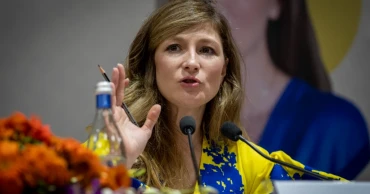
Ukraine wants India to play bigger role in ending war
Ukraine wants India to play a bigger role in helping end Russia’s war, its deputy foreign minister said Tuesday during the first visit by a senior Ukrainian official to India since the war began last year.
India “can play a bigger and greater role" and Ukraine would "welcome any effort that is directed at resolving the war,” Emine Dzhaparova said.
She made the comments in a speech at the Indian Council of World Affairs, a think tank in New Delhi, after meeting with her Indian counterpart, Sanjay Verma, and other officials.
Dzhaparova has sought to use her visit to deepen ties with India, which has refrained from condemning Russia's role in the war and has abstained several times from voting on U.N. resolutions against Moscow. Instead, New Delhi has stressed the need for diplomacy and dialogue on ending the war and has expressed its willingness to contribute to peace efforts.
Dzhaparova said she hopes Indian officials including National Security Adviser Ajit Doval, who visited Moscow in February and held talks with President Vladimir Putin, will also visit Kyiv.
"We would be happy to welcome Indian officials to Kyiv,” she said.
Russian officials are expected to visit India in coming weeks for meetings of the Shanghai Cooperation Organization, which the country is chairing this year.
India depends on Russia for nearly 60% of its defense equipment and has ramped up its purchases of low-priced Russian oil since the war in Ukraine began.
On Monday, Dzhaparova warned India against an over reliance on Russia.
“India should be pragmatic in diversifying its energy resources, military contracts and political interactions. Because what we see in my country when you are dependent on Russia, they will always use this blackmail instrument,” she told reporters.
India also holds the rotating presidency of the Group of 20 leading rich and developing nations this year. As host, India has cast itself as a rising superpower while leveraging its position on the global stage to bridge the gap between the West and Russia.
Dzhaparova urged India to use its presidency to spotlight the crisis in Ukraine by inviting Ukrainian officials to the G-20 events and summit, which will be held in September.
Also Read: India can be a mediator in resolving the Ukraine war: Momen tells Indian media
She said her visit was “a mark of friendship” and hoped it would kickstart Ukraine's dialogue with India. “Let us make Ukraine more visible in India, let us help Ukraine to tell its own story, let us also bring India closer" to Ukraine, Dzhaparova said.
3 years ago
Brazil’s Lula visits China, seeking ties and Ukraine support
Brazilian President Luiz Inácio Lula da Silva flew off to China on Tuesday to strengthen ties with his nation's biggest trade partner and win support for his long shot push for peace in Ukraine.
Lula wants Brazil, China and other nations to help mediate the war as part of his nation's return to the world stage, but his proposals to end the conflict have irked Ukraine and some in the West. Less controversial is the Brazilian and Chinese mutual interest in trade after a rocky period under Lula's predecessor.
China and Brazil are expected to sign at least 20 bilateral agreements during Lula’s two-day stay, according to the Brazilian government. Lula plans to visit Shanghai and Beijing, and meet with his counterpart, Xi Jinping, on Friday.
The two leaders are expected to discuss trade, investment, reindustrialization, energy transition, climate change and peace agreements, the Brazilian government said.
China is Brazil’s biggest export market, each year buying tens of billions of dollars worth of soybeans, beef, iron ore, poultry, pulp, sugar cane, cotton and crude oil. Brazil is the biggest recipient of Chinese investment in Latin America, according to Chinese state media.
Former Brazilian President Jair Bolsonaro and members of his family at times caused friction with Chinese authorities during his 2019-2022 term.
In 2020, when Bolsonaro’s lawmaker son Eduardo blamed the COVID-19 pandemic on the Chinese Communist Party, the Chinese ambassador to Brazil called his words “an evil insult against China and the Chinese people.” Later that year, Eduardo referred to the giant Chinese technology company Huawei as “Chinese espionage,” prompting a sharp rebuke from China’s embassy. Last year, China did not have an ambassador in Brasilia for eight months.
The rift stoked criticism in Brazil, even among sectors that supported Bolsonaro, like agribusiness.
“I want the Chinese to understand that their investment here will be wonderfully welcome, but not to buy our companies. To build new things, which we need,” Lula told journalists in Brasilia on April 6.
Chinese companies are involved in public works projects in Brazil, including a metro line in Sao Paulo, the country’s business capital. One of the agreements Lula will sign in China will be for construction of the sixth satellite built under a binational program, a satellite that would monitor biomes such as the Amazon rainforest.
“Brazil can’t afford to turn its back on the benefits China brings. The U.S. doesn’t have the capacity to absorb Brazil’s exports as China does, nor occupy the same space in investment and infrastructure,” said Pedro Brites, an expert on China at the Getulio Vargas Foundation, a university and think tank in Sao Paulo.
And China is encouraging its companies to find new markets and foreign partners to reduce reliance on the U.S.
"Lula knows you have to treat your clients well. Even more so when it is your best client,” said Charles Tang, who chairs the Brazil-China Chamber of Commerce.
In what Tang suggested was the result of a renewed partnership, China ended restrictions on Brazilian beef just before Lula was initially scheduled to make his trip. Sales of Brazilian beef to China were banned in February following the discovery of an atypical case of mad cow disease.
Lula’s visit to China, initially scheduled for March but canceled after he fell sick, is also an attempt by the leftist leader to reaffirm Brazil’s role on the global stage following Bolsonaro’s term, who admired right-wing nationalists and showed little interest in international affairs or travel abroad.
Lula visited Argentina and Uruguay in January and the U.S. in February, signaling the importance he gives to international affairs, experts said. He toured the world during his first presidency, particularly in his second term, when he visited dozens of countries, and has visited China twice before.
“Lula is implementing the promise he made that Brazil is back,” said Oliver Stuenkel, a political scientist at the Getulio Vargas Foundation.
China and Brazil are members of the BRICS group of developing countries and have pushed for changes in what they say is a U.S.-dominated system of managing global political affairs.
Russia is also a BRICS member, and a key piece of Lula’s outreach abroad is his proposal that Brazil and other developing countries, including China, mediate peace.
Lula has irritated Ukraine and some in the West with his position on the war, most recently by suggesting during a meeting with journalists in Brasilia last week that Ukraine cede Crimea as a means to forge peace. Xi met with Putin last month, sending a message to U.S. and European leaders that their condemnation of Russia’s invasion is not unanimous.
Earlier this month, a Lula adviser, former foreign affairs minister Celso Amorim, took a discreet trip to Moscow, where he met with President Vladimir Putin.
Amorim "went to listen and to say the time has come to talk,” Brazilian Foreign Minister Mauro Vieira told reporters in the capital, Brasilia, on April 5.
There is at least some common ground. Vieira noted that the Chinese peace proposal presented in February contains aspects in common with Lula’s, such as ceasing hostilities and starting negotiations.
“These are completely plausible and may be stimulus for talks,” he said.
3 years ago