others

UN agencies' Regional Directors call for immediate action to halt attacks on Gaza hospitals
The regional directors of UNFPA, UNICEF and WHO call for urgent international action to end the ongoing attacks on hospitals in Gaza.
We are horrified at the latest reports of attacks on and in the vicinity of Al-Shifa Hospital, Al-Rantissi Naser Paediatric Hospital, Al-Quds Hospital, and others in Gaza city and northern Gaza, killing many, including children, said a press release.
Millions of Indians set a new world record celebrating Diwali as worries about air pollution rise
Intense hostilities surrounding several hospitals in northern Gaza are preventing safe access for health staff, the injured, and other patients.
Premature and new-born babies on life support are reportedly dying due to power, oxygen, and water cuts at Al-Shifa Hospital, while others are at risk. The Staff across a number of hospitals are reporting lack of fuel, water and basic medical supplies, putting the lives of all patients at immediate risk.
Over the past 36 days, WHO has recorded at least 137 attacks on health care in Gaza, resulting in 521 deaths and 686 injuries, including 16 deaths and 38 injuries of health workers on duty.
A fragile global economy is at stake as US and China seek to cool tensions at APEC summit
Attacks on medical facilities and civilians are unacceptable and are a violation of International Humanitarian and Human Rights Law and Conventions. They cannot be condoned. The right to seek medical assistance, especially in times of crisis, should never be denied.
More than half of the hospitals in the Gaza Strip are closed. Those still functioning are under massive strain and can only provide very limited emergency services, lifesaving surgery and intensive care services. Shortages of water, food, and fuel are also threatening the wellbeing of thousands of displaced people, including women and children, who are sheltering in hospitals and their surroundings.
Netanyahu rejects growing international calls for a cease-fire in Gaza
The world cannot stand silent while hospitals, which should be safe havens, are transformed into scenes of death, devastation, and despair. Decisive international action is needed now to secure an immediate humanitarian ceasefire and prevent further loss of life, and preserve what’s left of the health care system in Gaza.
Unimpeded, safe and sustained access is needed now to provide fuel, medical supplies and water for these lifesaving services. The violence must end now.
2 years ago

A fragile global economy is at stake as US and China seek to cool tensions at APEC summit
The United States and China are the two global economic heavyweights. Combined, they produce more than 40% of the world's goods and services.
So when Washington and Beijing do economic battle, as they have for five years running, the rest of the world suffers, too. And when they hold a rare high-level summit, as Presidents Joe Biden and Xi Jinping will this week, it can have global consequences.
The world's economy could surely benefit from a U.S.-China détente. Since 2020, it has suffered one crisis after another — the COVID-19 pandemic, soaring inflation, surging interest rates, violent conflicts in Ukraine and now Gaza. The global economy is expected to grow a lackluster 3% this year and 2.9% in 2024, according to the International Monetary Fund.
“Having the world’s two largest economies at loggerheads at such a fraught moment," said Eswar Prasad, senior professor of trade policy at Cornell University, “exacerbates the negative impact of various geopolitical shocks that have hit the world economy.”
Hopes have risen that Washington and Beijing can at least cool some of their economic tensions at the Asia-Pacific Economic Cooperation summit, which starts Sunday in San Francisco. The meeting will bring together 21 Pacific Rim countries, which collectively represent 40% of the world’s people and nearly half of global trade.
Read: UK police step up efforts to ensure a massive pro-Palestinian march in London remains peaceful
The marquee event will be the Biden-Xi meeting Wednesday on the sidelines of the summit, the first time the two leaders will have spoken in a year, during which time frictions between the two nations have worsened. The White House has sought to tamp down expectations, saying to expect no breakthroughs.
At the same time, Prasad suggested that the threshold for declaring a successful outcome is relatively low. “Preventing any further deterioration in the bilateral economic relationship," he said, "would already be a victory for both sides.’’
The U.S.-China economic relationship had been deteriorating for years before it erupted in 2018, at the instigation of President Donald Trump, into an all-out trade war. The Trump administration charged that China had violated the commitments it made, in joining the World Trade Organization in 2001, to open its vast market to U.S. and other foreign companies that wanted to sell their goods and services there.
In 2018, the Trump administration began imposing tariffs on Chinese imports to punish Beijing for its actions in trying to supplant U.S. technological supremacy. Many experts agreed with the administration that Beijing had engaged in cyberespionage and had improperly demanded that foreign companies turn over trade secrets as the price of gaining access to the Chinese market. Beijing punched back against Trump's sanctions with its own retaliatory tariffs, making U.S. goods more expensive for Chinese buyers.
When Biden took office in 2021, he kept much of Trump’s confrontational trade policy, including the China tariffs. The U.S. tax rate on Chinese imports now exceeds 19%, versus 3% at the start of 2018, before Trump imposed his tariffs. Likewise, Chinese import taxes on U.S. goods are up to 21%, from 8% before the trade war began, according to calculations by Chad Bown of the Peterson Institute for International Economics.
One of the tenets of Biden's economic policy has been to reduce America’s economic reliance on Chinese factories, which came under strain when COVID-19 disrupted global supply chains, and to solidify partnerships with other Asian nations. As part of that policy, the Biden administration last year forged the Indo-Pacific Economic Framework for Prosperity with 14 countries.
In some ways, U.S.-China trade tensions are even higher under Biden than they were under Trump. Beijing is seething over the Biden administration’s decision to impose — and then broaden — export controls that are designed to prevent China from acquiring advanced computer chips and the equipment to produce them. In August, Beijing countered with its own trade curbs: It began requiring that Chinese exporters of gallium and germanium, metals used in computer chips and solar cells, obtain government licenses to send those metals overseas.
Beijing has also taken aggressive actions against foreign companies in China. Orchestrating what appears to be a counterespionage campaign, its authorities this year raided the Chinese offices of the U.S. consulting firms Capvision and the Mintz Group, questioned Shanghai employees of the Bain & Co. consultancy and announced a security review of the chipmaker Micron.
Read: US and India reaffirm security ties as their top diplomats and defense officials hold talks
Some analysts speak of a “decoupling’’ of the world’s two biggest economies after decades in which they relied deeply on each other for trade. Indeed, imports of Chinese goods to the United States were down 24% through September compared with the same period of 2022.
The rift between Beijing and Washington has forced many other countries into a delicate predicament: Deciding which side they're on when they actually want to do business with both countries.
The IMF says such economic “fragmentation’’ is damaging to the world. The 190-country lending agency estimates that higher trade barriers will subtract $7.4 trillion from global economic output after the world has adjusted to the higher trade barriers.
And those barriers are rising: Last year, the IMF said, countries imposed nearly 3,000 new restrictions on trade, up from fewer than 1,000 in 2019. The agency foresees international trade growing just 0.9% this year and 3.5% in 2024 — down sharply from the 2000-2019 annual average of 4.9%.
The Biden administration insists it isn’t trying to undermine China's economy. On Friday, Treasury Secretary Janet Yellen met with her Chinese counterpart, Vice Premier He Lifeng, in San Francisco and sought to set the stage for Biden-Xi summit.
“Our mutual desire — both China and the United States — is to create a level playing field and ongoing, meaningful and mutually beneficial economic relations,” Yellen said.
Xi, too, has reason to try to restore economic cooperation with the United States. The Chinese economy is under heavy strain. Its real estate market has collapsed, youth unemployment is rampant and consumer spirits are low. The raids on foreign businesses have spooked international companies and investors.
“With serious headwinds facing the Chinese economy and many U.S. firms packing up their bags and leaving China, Xi needs to convince investors that China is still a profitable place to conduct business,’’ said Wendy Cutler, vice president of the Asia Society Institute and a former U.S. trade negotiator. “This will not be an easy sell.’’
Complicating matters is that the tensions between Washington and Beijing go well beyond economics. Under Xi, the Chinese Communist Party has punished dissent in Hong Kong and the autonomous Muslim region of Xinjiang. His government made aggressive territorial demands in Asia, engaging in deadly border clashes with India and bullying the Philippines and other neighbors in parts of the South China Sea it claims as its own. It has increasingly threatened Taiwan, which it considers a renegade Chinese province.
U.S.-China tensions could intensify next year with presidential elections in Taiwan and the United States, where criticism of Beijing is among the few areas that unite Democrats and Republicans.
Read: India bars protests that support Palestinians
Xi’s policies appear to be costing China in the battle for world opinion. In a recent survey of people in 24 countries, the Pew Research Center reported that the United States was viewed more favorably than China in all but two (Kenya and Nigeria) nations.
Could China change course?
Speaking at the Center for Strategic and International Studies think tank in Washington, Rep. Raja Krishnamoorthi, an Illinois Democrat who serves on a House committee that monitors China, noted optimistically that Xi has reversed himself before — notably in declaring a sudden end to the draconian zero-COVID policies that crippled China's economy last year.
“We have to give that possibility a chance, even at the same time that we hedge and protect our interests,’’ Krishnamoorthi said. “That’s what I’m hoping we also see come out of this meeting.’’
2 years ago

UK police step up efforts to ensure a massive pro-Palestinian march in London remains peaceful
London police have stepped up efforts to ensure a pro-Palestinian march on Saturday remains peaceful following a week of political sparring over whether the demonstration should go ahead on the weekend Britain honors its war dead.
More than 2,000 officers, some called in from surrounding forces, will be on the streets of the capital this weekend to make to ensure marchers obey the law and to prevent potential confrontations with counter protesters, the Metropolitan Police Service said.
Police are also taking steps to reassure the Jewish community, which has been targeted by a surge in antisemitic incidents since Hamas militants attacked Israel on Oct. 7 and Israeli forces responded with strikes and sending troops into the Gaza Strip.
“We know the cumulative impact continued protest, increasing tensions, and rising hate crimes are having across London and the fear and anxiety our Jewish communities in particular are feeling,” the police said in a statement. “They have a right to feel safe in their city, knowing they can travel across London without feeling afraid of intimidation or harassment.”
Read: Thousands who were sheltering at Gaza City’s hospitals flee as Israel-Hamas war closes in
The law enforcement operation comes after Metropolitan Police Commissioner Mark Rowley resisted pressure from political leaders to ban the march over fears that it would interfere with Saturday’s Armistice Day events commemorating the end of World War I.
Prime Minister Rishi Sunak and Home Secretary Suella Braverman have also expressed concern that the protests could spill over into Sunday, when King Charles III and the prime ministers of Commonwealth nations will lay wreaths at the national war memorial, known as the Cenotaph.
The commemoration events are “sacred” to Britain and should be a time for unity and “solemn reflection,” Sunak said in a statement.
“It is because of those who fought for this country and for the freedom we cherish that those who wish to protest can do so, but they must do so respectfully and peacefully,” Sunak said.
Organizers of Saturday’s march say they have taken steps to ensure it doesn’t conflict with Armistice Day events. The march is scheduled to begin at 12:30 p.m., more than an hour after the nation observes a two-minute silence, and it will follow a route from Hyde Park to the U.S. Embassy that doesn’t go near the Cenotaph.
Read: ‘From the river to the sea': Why these 6 words spark fury and passion over the Israel-Hamas war
Ben Jamal, director of the Palestine Solidarity Campaign, said the marchers are calling end to the bombing of Gaza, and he criticized Braverman for characterizing the protesters as extremists who were going to desecrate the Cenotaph. The group has sponsored marches every Saturday in London since the war began.
“We said to the police we did not want to be anywhere near Whitehall on November the 11th; we did not want to disrupt preparations for the commemoration of remembrance on the Sunday,” Jamal told the BBC. “It is inconceivable, unless she doesn’t speak to the police, that the home secretary did not know that when she made her remarks.”
But police have gone further, declaring an exclusion zone around the Cenotaph and stationing a 24-hour guard around the memorial, amid concerns that some protesters may seek to deface it. Protesters have also been barred from the streets around the Israeli Embassy, near the start of the march, and some areas next to the U.S. Embassy.
Police also said they would take steps to prevent convoys of vehicles traveling to the march from driving through Jewish communities. In past years, convoys carrying people who waved flags and shouted antisemitic abuse caused “significant concern, fear and upset,” the force said.
Read: Fights in bread lines, despair in shelters: War threatens to unravel Gaza's close-knit society
Laurence Taylor, the Met’s deputy assistant commissioner, said police would likely have to use force to manage some of the confrontations that occur over the weekend.
“We are aware there will be counter-protests, as well as a lot of people who would ordinarily come to London to mark their respect on Armistice Day, on Remembrance Sunday,'' he said. "That means we need a large and robust policing plan in place.”
2 years ago

5.0-magnitude quake hits Ethiopia
An earthquake with a magnitude of 5.0 jolted Ethiopia at 0626 GMT on Saturday, the GFZ German Research Centre for Geosciences said.
Read: 3 earthquakes jolt district close to Nepal capital
The epicenter, with a depth of 10.0 km, was initially determined to be at 5.31 degrees north latitude and 36.75 degrees east longitude.
Read: Two earthquakes strike Nepal, sending tremors through the region
2 years ago
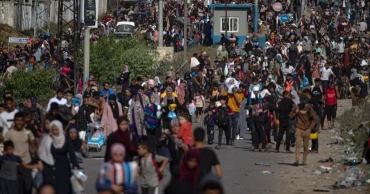
Thousands who were sheltering at Gaza City’s hospitals flee as Israel-Hamas war closes in
Thousands of Palestinians sheltering from the Israel-Hamas war at Gaza City’s main hospital fled south Friday after several reported strikes in and around the compound overnight. They joined a growing exodus of people escaping intense urban fighting in the north — including near other hospitals — as Gaza officials said the territory’s death toll surpassed 11,000.
The search for safety across the besieged Gaza Strip has grown desperate as Israel intensified its assault on the territory’s largest city.
The Israeli army says Hamas’ military infrastructure is based amid Gaza City’s hospitals and neighborhoods, and that it has set up its main command center in and under the largest hospital, Shifa — claims the militant group and Shifa staff deny.
Civilians flee north Gaza or shelter at a hospital as Israel and Hamas battle in the city
Israel has vowed to destroy Hamas after its deadly Oct. 7 surprise incursion, which killed at least 1,200.
More than 100,000 Palestinians have fled south over the past two days, according to Israel, but they still face bombardment and dire conditions. Reported strikes on or near at least four hospitals in northern Gaza overnight underscored the danger for tens of thousands more who had crowded into the facilities, believing they would be safe.
BATTLES AROUND HOSPITALSEarly Friday, at least three strikes over several hours hit the courtyard and the obstetrics department of Shifa Hospital, according to Ashraf al-Qidra, spokesperson at the Health Ministry in Hamas-run Gaza.
A video of the courtyard recorded the sound of incoming fire waking people in makeshift shelters, followed by shouts for an ambulance. In the blood-spattered courtyard, one man writhed, screaming on the ground, his leg apparently severed.
Israel fights Hamas deep in Gaza City and foresees control of enclave’s security after war
Al-Qidra blamed the attack on Israel, a claim that could not be independently verified. The Israeli army said one strike at Shifa was the result of a misfire by militants targeting its troops nearby.
For weeks, tens of thousands of displaced Palestinians — reaching as many 60,000 this week, according to the Health Ministry — have been sheltering in the Shifa complex.
The overnight strikes triggered a mass exodus of the displaced. About 10 a.m., large numbers packed up their belongings and began walking toward the south, five people who were among those who left told The Associated Press.
Al-Qidra told the Qatar-based satellite news network Al-Jazeera that more than 30,000 displaced people, medical workers and patients remain in the hospital.
Israel-Hamas war crowds crisis-heavy global agenda as Blinken, G7 foreign ministers meet in Japan
Mainly those who could not walk or did not know where to go remained, said Wafaa abu Hajajj, a journalist who arrived in the south after leaving the hospital Friday.
“The strikes were hoping to scare people and it worked. … It became too much,” said 32-year-old Haneen Abu Awda, who had been at Shifa being treated for wounds from an earlier strike on his house.
At the same time, Shifa has been overwhelmed by thousands of wounded, even as it operates with minimal power and medical supplies.
In video released Friday by the Gaza Health Ministry, bodies of limp children are seen on stretchers across blood-stained floors in the hospital, some dead, some barely breathing. Other patients were strewn around the floor, unable to be treated for lack of supplies. One man is seen gasping for air.
The director of Shifa, Mohammed Abu Selmia, said Israel demanded the facility be evacuated, but he said there was nowhere for such a large number of patients to go.
“Where are we going to evacuate them?” he said, speaking to Al Jazeera television.
The Health Ministry said one person had been killed at Shifa and several were wounded. Another strike near the Nasr Medical Center killed two people, according to the ministry. Abu Selmia said at least 25 people were killed when a strike hit a Gaza City school where people were sheltered inside.
The strike on Nasr forced the shutdown of its children’s hospital, the only remaining specialized pediatric care in north Gaza, said World Health Organization spokesperson Margaret Harris. She said it was not known what happened to patients there, including children receiving dialysis and on life support — “things that you cannot possibly evacuate them safely with.”
Military spokesman Lt. Col. Richard Hecht said Israel is “aware of the sensitivity” of hospitals and that forces were closing in on them slowly. Israel “does not fire on hospitals,” he said, but if militants are seen firing from them “we will do what we need to do” and kill them.
Israel has produced video that it says is evidence that Hamas uses not only hospitals, but schools and mosques as well, as cover for military activities.
U.N. Secretary-General Antonio Guterres has said on multiple occasions that Hamas uses civilians as "human shields,’’ while stressing that this does not give Israel free rein to target buildings where militants are hiding among civilians. He has pointed to international humanitarian law, which states that protection of civilians and hospitals, schools, and homes is paramount.
CIVILIANS FLEE SOUTHTens of thousands of new evacuees from the north, some from Shifa, flowed down Salah al-Din road — the central spine running the length of the Gaza Strip — and reached the central city of Deir al-Balah on Friday. With no fuel for vehicles, the crowds walked for hours as explosions echoed a short distance away. Among them were wounded and older people.
They arrived hungry, exhausted and with a stew of emotions: relief, rage, and despair.
Reem Asant, 50, described seeing bodies on the streets as he and others made their way out of Gaza City, trying to avoid shelling.
“We’re talking about children killed in a hospital,” shouted one man, Abu Yousef. “Hundreds of women killed every day. Houses collapsing on the heads of civilians. … Where are human rights? Where is the United Nations? Where is the United States? Where is the International Criminal Court? Where is the entire world?”
The Israeli military announced an expanded six-hour window Friday for civilians to escape northern Gaza along Salah al-Din, the route used since last weekend. It also announced the opening of a second route, along the coastal road, after an agreement announced by the White House a day earlier.
More than two-thirds of Gaza’s population of 2.3 million have fled their homes since the war began. Israel estimates that more than 850,000 of the 1.1 million people in northern Gaza have left, according to military spokesman Jonathan Conricus.
RISING DEATH TOLLSMore than 11,070 Palestinians, two-thirds of them women and minors, have been killed since the war began, according to the Gaza Health Ministry, which does not differentiate between civilian and militant deaths. Another 2,650 people have been reported missing.
U.S. Secretary of State Antony Blinken said Friday that “far too many” Palestinians have died and suffered. While recent Israeli steps to try to minimize civilian harm are positive, he said, they are not enough.
Assistant Secretary of State Barbara Leaf told U.S. lawmakers this week that it was “very possible” the death toll was even higher than the Gaza Health Ministry's tally.
At least 1,200 people have been killed in Israel, mainly in the initial Hamas attack, and 41 Israeli soldiers have been killed in Gaza since the ground offensive began, Israeli officials say. The Foreign Ministry had previously estimated the civilian death toll at 1,400, and gave no reason Friday for the revision.
An Israeli official told The Associated Press that the number had been changed after a painstaking weekslong process to identify bodies, many of which were mutilated or burned in the Hamas rampage. The final death toll could still change, according to the official, who spoke on condition of anonymity pending a formal announcement.
Nearly 240 people abducted by Hamas from Israel remain captive.
Palestinian militants have continued to fire rockets into Israel, and an attack on Tel Aviv wounded at least two people Friday, said Yossi Elkabetz, a paramedic with Israel’s rescue services. Hamas claimed credit.
About 250,000 Israelis have been forced to evacuate from communities near Gaza and along the northern border with Lebanon, where Israeli forces and Hezbollah militants have traded fire repeatedly.
2 years ago
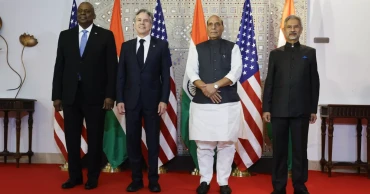
US and India reaffirm security ties as their top diplomats and defense officials hold talks
India and the U.S. underlined their commitment to boosting security ties Friday as their top diplomats and defense chiefs met to discuss regional security, China and the wars in Ukraine and Gaza.
U.S. Secretary of State Antony Blinken and U.S. Secretary of Defense Lloyd Austin met with their Indian counterparts in New Delhi as part of an Asian trip aimed at showing unity over Russia’s war in Ukraine and preventing differences on the Israel-Hamas war from deepening.
Blinken said the U.S. and India were continuing to “deepen our collaboration on everything from emerging technologies to defense to people-to-people ties" and align diplomacy for "an Indo-Pacific region that’s free, that’s open, that’s prosperous, that’s resilient.”
He said the two sides discussed the crisis in the Middle East and "we appreciate the fact that from day one India has strongly condemned the attacks of Oct. 7. And as our joint statement makes clear, India and the United States stand with Israel against terrorists.”
Read: Civilians flee north Gaza or shelter at a hospital as Israel and Hamas battle in the city
Indian External Affairs Minister Subrahmanyam Jaishankar said the situation in the Middle East was a big concern. While India has condemned the Hamas attack on Israel, it balances its position by calling for talks on "a sovereign, independent and viable state of Palestine living within secure and recognized borders, side-by-side at peace with Israel.”
Blinken met with India's Prime Minister Narendra Modi and "reaffirmed their shared vision for close partnership in the Indo-Pacific," said U.S. State Department spokesperson Matthew Miller.
"They emphasized working together to address ongoing crises such as Russia’s war against Ukraine and the conflict in the Middle East," Miller said.
Vinay Mohan Kwatra, India's top bureaucrat in the foreign ministry, said India's tense ties with China also were discussed at the official-level talks, but declined to give details.
India’s relationship with China has deteriorated since 2020, when Indian and Chinese troops clashed along their disputed border in the Himalayan Ladakh region, leaving 20 Indian and four Chinese soldiers dead. A standoff involving thousands of soldiers in the eastern Ladakh region continues, despite several rounds of military and diplomatic talks.
Read: India, Pakistan border guards trade fire along their frontier in Kashmir; one Indian soldier killed
Blinken said he also discussed with the Indian side a diplomatic dispute that erupted when Canada alleged that India was involved in the assassination of a Sikh separatist in Canada.
Blinken said that the U.S. wants the two sides to resolve their differences in a cooperative way and urged India to “work with Canada on its investigation.”
The dispute started when Canadian Prime Minister Justin Trudeau said there were “credible allegations” of Indian involvement in the killing of Canadian citizen Hardeep Singh Nijjar in suburban Vancouver in western Canada. India rejected the accusation.
India and the U.S. have held so-called two-plus-two talks between India’s external affairs and defense ministers and the U.S. secretaries of state and defense since 2018 to discuss issues of concern and strengthen bilateral ties.
Read: India bars protests that support Palestinians
Austin and his Indian counterpart, Rajnath Singh, discussed a roadmap for defense industrial cooperation that will fast-track technology cooperation and co-production of defense systems, India's defense ministry said.
“We’re integrating our industrial bases, strengthening our inter-operability, and sharing cutting-edge technology,” Austin said in his opening remarks.
Washington expects India to be a leading security provider in the Indo-Pacific region.
During Indian Prime Minister Narendra Modi’s visit to the United States in June, the two sides adopted a policy guide for defense industries to enable them to produce advanced defense systems together and collaborate on research and testing of prototypes.
The two sides reached an agreement that will allow U.S.-based General Electric to partner with India-based Hindustan Aeronautics to produce jet engines for Indian aircraft in India and the sale of U.S.-made armed MQ-9B SeaGuardian drones.
A joint statement at the conclusion of Blinken and Austin's visit to New Delhi on Friday said the two sides reaffirmed their roadmap for defense industrial cooperation to strengthen India’s capabilities, enhance its defense production, facilitate technology-sharing, and promote supply chain resilience.
2 years ago

Last 12 months on Earth were the hottest ever recorded, analysis finds
The last 12 months were the hottest Earth has ever recorded, according to a new report by Climate Central, a nonprofit science research group.
The peer-reviewed report says burning gasoline, coal, natural gas and other fossil fuels that release planet-warming gases like carbon dioxide, and other human activities, caused the unnatural warming from November 2022 to October 2023.
Over the course of the year, 7.3 billion people, or 90% of humanity, endured at least 10 days of high temperatures that were made at least three times more likely because of climate change.
Western and Arab officials are gathering in Paris to find ways to provide aid to civilians in Gaza
"People know that things are weird, but they don't they don't necessarily know why it's weird. They don't connect back to the fact that we're still burning coal, oil and natural gas," said Andrew Pershing, a climate scientist at Climate Central.
"I think the thing that really came screaming out of the data this year was nobody is safe. Everybody was experiencing unusual climate-driven heat at some point during the year," said Pershing.
The average global temperature was 1.3 degrees Celsius (2.3 degrees Fahrenheit) higher than the pre-industrial climate, which scientists say is close to the limit countries agreed not to go over in the Paris Agreement — a 1.5 C (2.7 F) rise. The impacts were apparent as one in four humans, or 1.9 billion people, suffered from dangerous heat waves.
At this point, said Jason Smerdon, a climate scientist at Columbia University, no one should be caught off guard. "It's like being on an escalator and being surprised that you're going up," he said. "We know that things are getting warmer, this has been predicted for decades."
Israeli military tour of northern Gaza reveals ravaged buildings, toppled trees, former weapons lab
Here's how a few regions were affected by the extreme heat:
1. Extreme heat fueled destructive rainfall because a warmer atmosphere holds more water vapor, which lets storms release more precipitation. Storm Daniel became Africa's deadliest storm with an estimated death toll that ranges between 4,000 and 11,000, according to officials and aid agencies. Greece, Bulgaria, and Turkey also saw damages and fatalities from Storm Daniel.
2. In India, 1.2 billion people, or 86% of the population, experienced at least 30 days of elevated temperatures, made at least three times more likely by climate change.
3. Drought in Brazil's Amazon region caused rivers to dry to historic lows, cutting people off from food and fresh water.
4. At least 383 people died in U.S. extreme weather events, with 93 deaths related to the Maui wildfire event, the deadliest U.S. fire of the century.
5. One of every 200 people in Canada evacuated their home due to wildfires, which burn longer and more intensely after long periods of heat dry out the land. Canadian fires sent smoke billowing across much of North America.
6. On average, Jamaica experienced high temperatures made four times more likely by climate change during the last 12 months, making it the country where climate change was most powerfully at work.
India bars protests that support Palestinians
"We need to adapt, mitigate and be better prepared for the residual damages because impacts are highly uneven from place to place," said Kristie Ebi, a professor at the Center for Health and the Global Environment at the University of Washington, citing changes in precipitation, sea level rise, droughts, and wildfires.
The heat of the last year, intense as it was, is tempered because the oceans have been absorbing the majority of the excess heat related to climate change, but they are reaching their limit, said Kim Cobb, a climate scientist at Brown University. "Oceans are really the thermostat of our planet ... they are tied to our economy, food sources, and coastal infrastructure."
2 years ago

Western and Arab officials are gathering in Paris to find ways to provide aid to civilians in Gaza
Officials from Western and Arab nations, the United Nations and nongovernmental organizations are gathering Thursday in Paris for a conference on how to provide aid to civilians in the Gaza Strip during Israel's war with Hamas, including proposals for a humanitarian maritime corridor and floating field hospitals.
French President Emmanuel Macron, who has called for a “humanitarian pause” in the war, wants the conference to address the besieged Palestinian enclave's growing needs including food, water, health supplies, electricity and fuel.
Read: Israeli military tour of northern Gaza reveals ravaged buildings, toppled trees, former weapons lab
Over 50 nations are expected to attend including several European countries, the United States and regional powers like Jordan, Egypt and the Gulf countries, the French presidency said. Also attending is Palestinian Prime Minister Mohammad Shtayyeh.
Israeli authorities won't participate in Thursday’s conference, the Elysee said.
The head of the U.N. agency for Palestinian refugees, the U.N.'s top aid official and the president of the International Committee of the Red Cross are expected to provide details about urgent needs in the Gaza Strip.
More than 1.5 million people — or about 70% of Gaza's population — have fled their homes, and an estimated $1.2 billion is needed to respond to the crisis in Palestinian areas.
Cyprus President Nikos Christodoulides will present his plan for a humanitarian sea corridor to Gaza which he has said aims for a “sustained, secure high-volume flow of humanitarian assistance to Gaza in the immediate, medium and long term.” Ships would deliver the aid from Cyprus’ main port of Limassol, some 255 miles away (410 kilometers.)
Read: Israel fights Hamas deep in Gaza City and foresees control of enclave’s security after war
French officials said they are also considering evacuating injured people onto hospital ships in the Mediterranean off the Gaza coast. Paris sent a helicopter carrier off the Cyprus coast and is preparing another with medical capacities on board for that purpose.
Thursday's discussions will also include financial support and other ways to help Gaza's civilians.
France is expected to announce some additional funding. Since the Hamas attack on Oct. 7, Paris has provided an additional 20 million euros ($21.4 million) in humanitarian aid for Gaza, through the U.N. and other partners and sent 54 tons of aid via three flights to Egypt.
On Tuesday, the German government said it will provide 20 million euros in new funding, in addition to releasing 71 million euros already earmarked for the U.N. agency for Palestinian refugees following a review it launched after the Hamas attack.
Read: Israel-Hamas war crowds crisis-heavy global agenda as Blinken, G7 foreign ministers meet in Japan
European Council President Charles Michel and European Commission President Ursula von der Leyen are also attending the conference. The 27-nation bloc is the world’s top aid supplier to the Palestinians. It has sent almost 78 million euros this year.
2 years ago

Israeli military tour of northern Gaza reveals ravaged buildings, toppled trees, former weapons lab
An Israeli tank rolls across a sandy moonscape, surrounded by rubble. Damaged buildings are visible in every direction. Toppled trees lie along the Mediterranean shoreline.
The Israeli military escorted international journalists into the northern Gaza Strip on Wednesday, giving them a glimpse of the aftermath of 12 days of heavy fighting in the area.
Israel has been at war against Gaza’s Hamas rulers since the Islamic militant group carried out a bloody cross-border attack on Oct. 7, killing over 1,400 people, mostly civilians, and kidnapping more than 240 others. Israel responded with weeks of intense airstrikes before launching a ground operation on Oct. 27.
Growing numbers of Palestinians flee on foot as Israel says its troops are battling inside Gaza City
“It’s been a long two weeks of fighting,” said Lt. Col. Ido, whose last name was withheld under military guidelines. “We've lost some soldiers.”
The initial focus of the operation was northern Gaza, near the Israeli border, before troops moved in on Gaza City, which Israel says is the center of Hamas’ military operations.
The Palestinian Health Ministry says 10,500 people have been killed in the Hamas-run territory. Israel says several thousand Hamas militants are among the dead. It also says Hamas uses civilians in residential areas as human shields, and so is responsible for the high death toll. Hamas has denied this.
The drive into Gaza on Wednesday was in a windowless armored vehicle. A screen inside showed images of the shoreline, damaged buildings and downed trees. Israeli tanks and armored vehicles sat motionless as soldiers patrolled the area.
Israel fights Hamas deep in Gaza City and foresees control of enclave’s security after war
During the tour, the army said it had found ammunition and a weapons-making facility inside one building. Much of the lab had been removed, but the remnants of rockets, thousands of which have been launched at Israel during the fighting, could be seen.
One floor above the lab was what appeared to be a children’s bedroom. The bright pink room had multiple beds, a doll and a Palestinian flag.
A month into war, Netanyahu says Israel will have an 'overall security' role in Gaza indefinitely
During the less than two hours they spent inside Gaza on Wednesday, journalists could hear gunfire but did not witness any live fire. Israeli troops instructed the journalists not to move around too much.
The army ordered civilians to evacuate to the southern Gaza Strip ahead of the ground offensive. While about 70% of Gaza's population is believed to have fled their homes, U.N. officials estimate that roughly 300,000 people have remained behind.
But in this corner of northern Gaza, Ido said the order appears to have worked.
“We have not seen any civilians here – only Hamas,” he said, adding that militants had been spotted operating aboveground and emerging from their underground tunnel system.
“We gave all the people that live here a good heads-up that we’re coming,” he added.
2 years ago

India bars protests that support Palestinians
From Western capitals to Muslim states, protest rallies over the Israel-Hamas war have made headlines. But one place known for its vocal pro-Palestinian stance has been conspicuously quiet: Indian-controlled Kashmir.
Indian authorities have barred any solidarity protest in Muslim-majority Kashmir and asked Muslim preachers not to mention the conflict in their sermons, residents and religious leaders told The Associated Press.
The restrictions are part of India's efforts to curb any form of protest that could turn into demands for ending New Delhi's rule in the disputed region. They also reflect a shift in India's foreign policy under populist Prime Minister Narendra Modi away from its long-held support for the Palestinians, analysts say.
India has long walked a tightrope between the warring sides, with historically close ties to both. While India strongly condemned the Oct. 7 attack by the militant group Hamas and expressed solidarity with Israel, it urged that international humanitarian law be upheld in Gaza amid rising civilian deaths.
But in Kashmir, being quiet is painful for many.
“From the Muslim perspective, Palestine is very dear to us, and we essentially have to raise our voice against the oppression there. But we are forced to be silent,” said Mirwaiz Umar Farooq, a key resistance leader and a Muslim cleric. He said he has been put under house arrest each Friday since the start of the war and that Friday prayers have been disallowed at the region’s biggest mosque in Srinagar, the main city in Kashmir.
Read: Israel-Hamas war crowds crisis-heavy global agenda as Blinken, G7 foreign ministers meet in Japan
Anti-India sentiment runs deep in the Himalayan region which is divided between India and Pakistan and claimed by both in its entirety. In 2019, New Delhi removed the region’s semiautonomy, drastically curbing any form of dissent, civil liberties and media freedoms.
Kashmiris have long shown strong solidarity with the Palestinians and often staged large anti-Israel protests during previous fighting in Gaza. Those protests often turned into street clashes, with demands for an end of India’s rule and dozens of casualties.
Modi, a staunch Hindu nationalist, was one of the first global leaders to swiftly express solidarity with Israel and call the Hamas attack “terrorism.” However, on Oct. 12, India’s foreign ministry issued a statement reiterating New Delhi’s position in support of establishing a “sovereign, independent and viable state of Palestine, living within secure and recognized borders, side by side at peace with Israel.”
Two weeks later, India abstained during the United Nations General Assembly vote that called for a humanitarian cease-fire in Gaza, a departure from its usual voting record. New Delhi said the vote did not condemn the Oct. 7 assault by Hamas.
“This is unusual,” said Michael Kugelman, director of the Wilson Center’s South Asia Institute.
India “views Israel’s assault on Gaza as a counterterrorism operation meant to eliminate Hamas and not directly target Palestinian civilians, exactly the way Israel views the conflict,” Kugelman said. He added that from New Delhi's perspective, “such operations don’t pause for humanitarian truces.”
India’s foreign minister, Subrahmanyam Jaishankar, sought to justify India’s abstention.
“It is not just a government view. If you ask any average Indian, terrorism is an issue which is very close to people’s heart, because very few countries and societies have suffered terrorism as much as we have,” he told a media event in New Delhi on Saturday.
Even though Modi’s government has sent humanitarian assistance for Gaza's besieged residents, many observers viewed its ideological alignment with Israel as potentially rewarding at a time when the ruling party in New Delhi is preparing for multiple state elections this month and crucial national polls next year.
Read: UN Security Council fails to agree on Israel-Hamas war as Gaza death toll passes 10,000
The government's shift aligns with widespread support for Israel among India’s Hindu nationalists who form a core vote bank for Modi and his Bharatiya Janata Party. It also resonates with the coverage by Indian TV channels of the war from Israel. The reportage has been seen as largely in line with commentary used by Hindu nationalists on social media to stoke anti-Muslim sentiment that in the past helped the ascendance of Modi's party.
Praveen Donthi, senior analyst with the International Crisis Group, said the war could have a domestic impact in India, unlike other global conflicts, due to its large Muslim population. India is home to some 200 million Muslims who make up the predominantly Hindu country’s largest minority group.
“India's foreign policy and domestic politics come together in this issue," Donthi said. “New Delhi's pro-Israel shift gives a new reason to the country’s right-wing ecosystem that routinely targets Muslims.”
India’s foreign policy has historically supported the Palestinian cause.
In 1947, India voted against the United Nations resolution to create the state of Israel. It was the first non-Arab country to recognize the Palestinian Liberation Organization as the representative of the Palestinians in the 1970s, and it gave the group full diplomatic status in the 1980s.
After the PLO began a dialogue with Israel, India finally established full diplomatic ties with Israel in 1992.
Those ties widened into a security relationship after 1999, when India fought a limited war with Pakistan over Kashmir and Israel helped New Delhi with arms and ammunition. The relationship has grown steadily over the years, with Israel becoming India’s second largest arms supplier after Russia.
After Modi won his first term in 2014, he became the first Indian prime minister to visit Israel in 2017. Israel’s prime minister, Benjamin Netanyahu, travelled to New Delhi the following year and called the relationship between New Delhi and Tel Aviv a “marriage made in heaven.”
Weeks after Netanyahu’s visit, Modi visited the occupied West Bank city of Ramallah, a first by an Indian prime minister, and held talks with Palestinian President Mahmoud Abbas. “India hopes that Palestine soon becomes a sovereign and independent country in a peaceful atmosphere,” Modi said.
Modi’s critics, however, now draw comparisons between his government and Israel’s, saying it has adopted certain measures, like demolishing homes and properties, as a form of “collective punishment” against minority Muslims.
Even beyond Kashmir, Indian authorities have largely stopped protests expressing solidarity with Palestinians since the war began, claiming the need to maintain communal harmony and law and order.
Read: Blinken tries to cajole wary Arabs on support for post-conflict Gaza as Israel's war intensifies
Some people have been briefly detained by police for taking part in pro-Palestinian protests even in states ruled by opposition parties. The only state where massive pro-Palestinian protests have taken place is southern Kerala, which is ruled by a leftist government.
But in Kashmir, enforced silence is seen not only as violating freedom of expression but also as impinging on religious duty.
Aga Syed Mohammad Hadi, a Kashmiri religious leader, was not able to lead the past three Friday prayers because he was under house arrest on those days. He said he had wanted to stage a protest rally against “the naked aggression of Israel." Authorities did not comment on such house arrests.
“Police initially allowed us to condemn Israel’s atrocities inside the mosques. But last Friday they said even speaking (about Palestinians) inside the mosques is not allowed,” Hadi said. “They said we can only pray for Palestine — that too in Arabic, not in local Kashmiri language.”
2 years ago