others

Israel fights Hamas deep in Gaza City and foresees control of enclave’s security after war
Israel said Tuesday that its ground forces were battling Hamas fighters deep inside Gaza’s largest city, signaling a major new stage in the month-old conflict, and its leaders foresee controlling the enclave's security after the war.
The push into Gaza City guarantees that the already staggering death toll will rise further, while comments from Prime Minister Benjamin Netanyahu about controlling Gaza’s security for “an indefinite period” pointed to the uncertain endgame of a war that Israel says will be long and difficult.
Israeli ground troops have battled Palestinian militants inside Gaza for over a week, cutting the territory in half and encircling Gaza City. The army's chief spokesman, Rear Adm. Daniel Hagari, said that Israeli ground forces “are located right now in a ground operation in the depths of Gaza City and putting great pressure on Hamas.”
Hamas spokesman Ghazi Hamad, speaking on Tuesday from Beirut, denied that Israeli forces were making any significant military gains or that they had advanced deep into Gaza City.
“They never give the people the truth,” Hamad said. He added that numerous Israeli soldiers were killed on Monday and “many tanks were destroyed.”
“The Palestinians fight and fight and fight against Israel, until we end the occupation,” said Hamad, who left Gaza days before Hamas' Oct. 7 rampage in southern Israel, which sparked the war.
A month into war, Netanyahu says Israel will have an 'overall security' role in Gaza indefinitely
The Associated Press could not independently verify the claims of either side.
Israelis commemorated the 30th day — a milestone in Jewish mourning — since the Hamas incursion, which killed 1,400 people. About 240 people Hamas abducted during the attack remain in Gaza, and more than 250,000 Israelis have evacuated homes near the borders of Gaza and Lebanon amid continuous rockets fired into Israel.
A month of relentless bombardment in Gaza has killed more than 10,300 Palestinians, two-thirds of them women and minors, according to the Health Ministry of the Hamas-run territory. More than 2,300 are believed buried from strikes that reduced entire city blocks to rubble.
Around 70% of Gaza’s 2.3 million people have fled their homes, and many of them are crowded into U.N. schools-turned-shelters. Civilians in Gaza are relying on a trickle of aid and their own daily foraging for food and water from supplies that have dwindled after weeks of siege.
Israel-Hamas war crowds crisis-heavy global agenda as Blinken, G7 foreign ministers meet in Japan
FLEEING SOUTHIsrael unleashed another wave of strikes across the Gaza Strip on Tuesday as hundreds more Palestinians fled Gaza City to the south.
Some arrived on donkey carts, most on foot, some pushing elderly relatives in wheelchairs, all visibly exhausted. Many had nothing but the clothes on their backs. “There is no food or drink, people are fighting in the bakeries,” said one man who didn’t want to give his name.
Hundreds of thousands have heeded Israeli orders to head to the southern part of Gaza, out of the ground assault’s path. Others are afraid to do so since Israeli troops control part of the north-south route. Bombardment of the south has also continued.
An Israeli airstrike destroyed several homes early Tuesday in Khan Younis. An Associated Press journalist at the scene saw first responders pulling five bodies — including three dead children — from the rubble. One man wept as he carried a bloodied young girl, until a rescue worker pried her from his arms, saying, “Let her go, let her go,” to rush her to an ambulance.
AP video at a nearby hospital showed a woman desperately searching for her son, then crying and kissing him when she found him, half-naked and bloodied, but apparently without serious injuries. A girl sobbed next to a baby on a stretcher, apparently dead.
“We were sleeping, babies, children, elderly,” said one survivor, Ahmad al-Najjar, who is the general director at the Education Ministry in Gaza.
In the town of Deir al-Balah, rescue workers brought out at least four dead and a number of wounded children from the wreckage of a flattened building, witnesses said. “My daughter,” screamed a woman as she ran behind them.
Israel says it targets Hamas fighters and infrastructure and accuses the group of endangering civilians by operating among them.
At a school in Khan Younis, thousands of displaced were living in classrooms and the playground. One of them, Suhaila al-Najjar, said the last month had been filled with sleepless nights.
“What’s to come? How will we live? Bakeries have closed, there’s no gas. What will we eat?” she said.
ISRAEL TO MAINTAIN CONTROLIsrael has vowed to remove Hamas from power and crush its military capabilities — but neither Israel nor its main ally, the United States, has said what would come next.
Netanyahu told ABC News that Gaza should be governed by “those who don’t want to continue the way of Hamas,” without elaborating.
“I think Israel will, for an indefinite period, will have the overall security responsibility because we’ve seen what happens when we don’t have it. When we don’t have that security responsibility, what we have is the eruption of Hamas terror on a scale that we couldn’t imagine,” he said.
Civilians fleeing northern Gaza's combat zone report a terrifying journey on foot past Israeli tanks
Netanyahu did not make clear what shape that security control would take. The White House on Tuesday reiterated that President Joe Biden does not support an Israeli reoccupation of the Gaza Strip after the war.
“We do think that there needs to be a healthy set of conversations about what post-conflict Gaza looks like and what governance looks like,” said White House National Security Council spokesman John Kirby, adding that he would leave it to Netanyahu to clarify what he means by “indefinite.”
Israeli officials say the offensive against Hamas will last for some time and acknowledge that they have not yet formulated a concrete plan for what comes after the war. The defense minister has said Israel does not seek a long-term reoccupation of Gaza but predicted a lengthy phase of low-intensity fighting against “pockets of resistance.” Other officials have spoken about establishing a buffer zone that would keep Palestinians away from the Israeli border.
“There are a number of options being discussed for The Day After Hamas,” said Ophir Falk, a senior adviser to Netanyahu. “The common denominator of all the plans is that 1) there is no Hamas 2) that Gaza is demilitarized 3) Gaza is deradicalized.”
Israel withdrew troops and settlers in 2005 but kept control over Gaza’s airspace, coastline, population registry and border crossings, excepting one into Egypt. Hamas seized power from forces loyal to President Mahmoud Abbas in 2007, confining his Palestinian Authority to parts of the occupied West Bank. Since then, Israel and Egypt have imposed a blockade on Gaza to varying degrees.
In his ABC interview, Netanyahu also expressed openness for the first time to “little pauses” in the fighting to facilitate delivery of aid to Gaza or the release of hostages. But he ruled out any general cease-fire without the release of all the hostages.
HEAVY FIGHTING IN THE NORTHFor now, Israel’s troops are focused on northern Gaza, including Gaza City, which before the war was home to about 650,000 people. Israel says Hamas has extensive militant infrastructure within residential areas, including a vast tunnel network.
The military says it has killed thousands of Hamas fighters. The Gaza Health Ministry’s death toll does not distinguish between civilians and combatants — and slain fighters not brought to hospitals would not be in its count. Israel also says 30 of its soldiers have been killed in Gaza since the ground offensive began.
Several hundred thousand people are believed to remain in the north in the assault’s path.
Residents in northern Gaza reported heavy battles overnight into Tuesday morning on the outskirts of Gaza City. The Shati refugee camp — a built-up district housing refugees from the 1948 war surrounding Israel’s creation and their descendants — has been heavily bombarded over the past two days, residents said.
The war has also stoked wider tensions, with Israel and Lebanon’s Hezbollah militant group trading fire along the border. More than 160 Palestinians have been killed in the West Bank since the war began, mainly during violent protests and gunbattles with Israeli forces during arrest raids.
Hundreds of trucks carrying aid have been allowed to enter Gaza from Egypt since Oct. 21. But humanitarian workers say the aid is far short of mounting needs. Egypt’s Rafah Crossing has also opened to allow hundreds of foreign passport holders and medical patients to leave Gaza.
2 years ago

WHO: Tuberculosis response recovering from pandemic; accelerated efforts needed to meet new targets
The World Health Organization (WHO) 2023 Global tuberculosis (TB) report underscores a significant worldwide recovery in the scale-up of TB diagnosis and treatment services in 2022.
It shows an encouraging trend starting to reverse the detrimental effects of COVID- 19 disruptions on TB services.
Featuring data from 192 countries and areas, the report shows that 7.5 million people were diagnosed with TB in 2022, making it the highest figure recorded since WHO began global TB monitoring in 1995.
The increase is attributed to good recovery in access to and provision of health services in many countries. India, Indonesia and the Philippines, which together accounted for over 60% of the global reductions in the number of people newly diagnosed with TB in 2020 and 2021, all recovered to beyond 2019 levels in 2022.
“For millennia, our ancestors suffered and died with tuberculosis, without knowing what it was, what caused it, or how to stop it,” said Dr Tedros Adhanom Ghebreyesus, WHO Director-General.
“Today, we have knowledge and tools they could only have dreamed of. We have political commitment, and we have an opportunity that no generation in the history of humanity has had: the opportunity to write the final chapter in the story of TB.”
Globally, an estimated 10.6 million people fell ill with TB in 2022, up from 10.3 million in 2021. Geographically, in 2022, most people who developed TB were in the WHO Regions of South-East Asia (46%), Africa (23%) and the Western Pacific (18%), with smaller proportions in the Eastern Mediterranean (8.1%), the Americas (3.1%) and Europe (2.2%).
The total number of TB-related deaths (including those among people with HIV) was 1.3 million in 2022, down from 1.4 million in 2021.
However, during the 2020-2022 period, COVID-19 disruptions resulted in nearly half a million more deaths from TB. TB continues to be the leading killer among people with HIV.
Multidrug-resistant TB (MDR-TB) remains a public health crisis. While an estimated 410 000 people developed multidrug-resistant or rifampicin-resistant TB (MDR/RR-TB) in 2022, only about two in five people accessed treatment.
There is some progress in the development of new TB diagnostics, drugs and vaccines. However, this is constrained by the overall level of investment in these areas.
Accelerating action and investment to reach new targets
WHO reports that global efforts to combat TB have saved over 75 million lives since the year 2000. However, even more efforts are needed as TB remained the world’s second leading infectious killer in 2022.
Despite significant recovery in 2022, progress was insufficient to meet global TB targets set in 2018 with disruptions caused by the pandemic and ongoing conflicts being major contributing factors:
· the net decrease in TB-related deaths from 2015 to 2022 was 19%, falling far short of the WHO End TB Strategy milestone of a 75% reduction by 2025;
· the cumulative reduction in the TB incidence rate from 2015 to 2022 was 8.7%, far from the WHO End TB Strategy milestone of a 50% reduction by 2025;
· about 50% of TB patients and their households face total costs that are catastrophic (direct medical expenditures, non-medical expenditures and indirect costs such as income losses that amount to more than 20% of total household income), far from the WHO End TB Strategy target of zero;
· the targets set for 2018-2022 in the political declaration of the first UN High-Level Meeting on TB were not met, with only 84% of the 40 million people targeted for TB treatment reached; and only 52% of the 30 million people targeted for TB preventive treatment accessing it; and
· less than half of the funding targeted for TB service delivery and research was mobilized.
The 2023 UN General Assembly High-Level Meeting on TB reinforced the 2018 commitments and targets, setting out new targets for the period of 2023-2027.
The new targets include reaching 90% of people in need with TB prevention and care services; using a WHO-recommended rapid test as the first method of diagnosing TB; providing a health and social benefit package to all people with TB; ensuring the availability of at least one new TB vaccine that is safe and effective; and closing funding gaps for TB implementation and research by 2027.
“We have strong commitments with concrete targets made by world leaders in the political declaration of the second UN High-Level Meeting on TB, that provides a strong impetus to accelerate the TB response,” said Dr Tereza Kasaeva, Director of WHO’s Global TB Programme.
“This report provides key data and evidence on the status of the TB epidemic and a review of progress, that serves to inform the translation of these targets and commitments into action in countries. We need all hands on deck to make the vision of ending TB a reality.”
The report additionally stresses the importance of concerted action across the health and other sectors to address the social, environmental and economic determinants of TB and consequences of inaction.
WHO continues to support the engagement of other sectors in the TB response, through its Multisectoral Accountability Framework.
In 2022, outside of the health sector, education was the most engaged sector in TB advocacy and information-sharing, followed by the defence sector and justice sector, for TB prevention and care services, and the social development sector for patient support, including provision of economic, social and nutritional benefits.
The report emphasizes that ending the global TB epidemic requires translating the commitments made at the 2023 UN High-Level meeting on TB into real action, changing the lives and livelihoods in communities.
2 years ago

Israel-Hamas war crowds crisis-heavy global agenda as Blinken, G7 foreign ministers meet in Japan
Fresh from a whirlwind tour of the Middle East, U.S. Secretary of State Antony Blinken shifted his intense diplomacy on the Israel-Hamas war to Asia on Tuesday, as he and his counterparts from the Group of Seven leading industrial democracies began two days of talks in Japan.
The devastating monthlong conflict in Gaza and efforts to ease the dire humanitarian impacts of Israel's response to the deadly Oct. 7 Hamas attack were set to be a major focus of the meeting. Yet with the Russia-Ukraine war, fears North Korea may be readying a new nuclear test, and concerns about China's increasing global assertiveness, it is far from the only crisis on the agenda.
“Even as we are intensely focused on the crisis in Gaza, we’re also very much engaged and focused on the important work that we’re doing in the Indo-Pacific and in other parts of the world,” Blinken told reporters in Ankara, Turkey, before leaving the Middle East for Asia.
Read: UN Security Council fails to agree on Israel-Hamas war as Gaza death toll passes 10,000
In Tokyo, Blinken and foreign ministers from Britain, Canada, France, Germany, Japan and Italy will be looking for common ground on approaches to the Israel-Hamas war that threatens to destabilize already shaky security in the broader Middle East and seeking to maintain existing consensus positions on the other issues.
Before wrapping up the Mideast portion of his trip — a four-day whirlwind that included stops in Israel, Jordan, the West Bank, Cyprus, Iraq and Turkey — Blinken said he would brief his G7 colleagues on the status of his efforts, seeking their advice and pressing ahead.
“I’ll have an opportunity to debrief my colleagues on what we’ve learned and what we’ve done during this trip, and to continue that work and carry it forward,” he said.
Those efforts include significantly expanding the amount of humanitarian aid being sent to Gaza, pushing Israel to agree to “pauses” in its military operation to allow that assistance to get in and more civilians to get out, beginning planning for a post-conflict governance and security structure in the territory and preventing the war from spreading.
Read: Man accused of Antarctic assault was then sent to remote icefield with young graduate students
Blinken described all of these as “a work in progress” and acknowledged deep divisions over the pause concept. Israel remains unconvinced and Arab and Muslim nations are demanding an immediate full cease-fire, something the United States opposes. There has also been resistance to discussing Gaza's future, with the Arab states insisting that the immediate humanitarian crisis must be addressed first.
Securing agreement from G7 members, none of which border or are directly involved in the conflict, may be a slightly less daunting challenge for Blinken.
Since before Russia’s invasion of Ukraine, the G7 has held together in defense of the international order that emerged from the destruction of World War II. Despite some fraying around the edges, the group has preserved a unified front in condemning and opposing Russia’s war.
The group similarly has been of one voice in demanding that North Korea halt its nuclear weapons and ballistic missile programs, that China exercise its growing international clout responsibly, and also in calling for cooperative actions to combat pandemics, synthetic opioids, and threats from the misuse of artificial intelligence.
Read: Blinken shuttles from the West Bank to Iraq trying to contain the fallout from the Israel-Hamas war
Yet the Gaza crisis has inflamed international public opinion and democracies are not immune from intense passions that have manifested themselves in massive pro-Palestinian and anti-Israel demonstrations in G7 capitals and elsewhere.
2 years ago

UN Security Council fails to agree on Israel-Hamas war as Gaza death toll passes 10,000
The U.N. Security Council on Monday failed again to agree on a resolution on the monthlong Israel-Hamas war.
Despite more than two hours of closed-door discussions Monday, differences remained. The U.S. is calling for “humanitarian pauses” while many other council members are demanding a “humanitarian cease-fire” to deliver desperately needed aid and prevent more civilian deaths in Gaza.
READ: Jordan airdrops medical supplies to Gaza hospital
“We talked about humanitarian pauses and we’re interested in pursuing language on that score,” U.S. deputy ambassador Robert Wood told reporters after the meeting. “But there are disagreements within the council about whether that’s acceptable.”
U.N. Secretary-General Antonio Guterres earlier Monday told reporters he wanted an immediate humanitarian cease-fire in Gaza and a halt to the “spiral of escalation” already taking place from the occupied West Bank, Lebanon and Syria to Iraq and Yemen.
READ: Israeli warplanes hit refugee camps in Gaza while UN agencies call siege an 'outrage'
Guterres said international humanitarian law, which demands protection of civilians and infrastructure essential for their lives, is clearly being violated and stressed that “no party to an armed conflict is above” these laws. He called for the immediate unconditional release of the hostages Hamas took from Israel to Gaza in its Oct. 7 attack.
China, which holds the Security Council presidency this month, and the United Arab Emirates, the Arab representative on the council, called Monday’s meeting because of the “crisis of humanity” in Gaza, where more than 10,000 civilians have been killed in less than a month.
UAE Ambassador Lana Nusseibeh said all 15 council members “are fully engaged” and efforts will continue to try to narrow the gaps and reach agreement on a resolution.
2 years ago

South Korea plans to launch its 1st military spy satellite on Nov. 30
South Korea said Monday it plans to launch its first domestically built spy satellite at the end of this month to better monitor rival North Korea, as the North pushes to expand its arsenal of nuclear weapons targeting its adversaries.
The plan was unveiled days after North Korea failed to follow through on its vow to make a third attempt to launch its own reconnaissance satellite in October, likely because of technical issues.
Jeon Ha Gyu, a spokesperson for the South Korean Defense Ministry, told reporters Monday that the country’s first military spy satellite will be launched from California’s Vandenberg Air Force Base on Nov. 30.
Read: China's foreign minister says Xi-Biden meeting in San Francisco would not be 'smooth-sailing'
The satellite will be carried by SpaceX’s Falcon 9 rocket. Under a contract with SpaceX, South Korea plans to launch four more spy satellites by 2025, according to South Korea’s Defense Acquisition Program Administration.
South Korea currently has no military reconnaissance satellites of its own and relies on U.S. spy satellites to monitor moves by North Korea.
The possession of its own spy satellites would give South Korea an independent space-based surveillance system to monitor North Korea in almost near-time. When operated together with South Korea’s so-called three-axis system — preemptive strike, missile defense and retaliatory assets — the country’s overall defense against North Korea would be sharply strengthened, according to Lee Choon Geun, an honorary research fellow at South Korea’s Science and Technology Policy Institute.
Lee said that U.S. spy satellites produce much higher-resolution imagery but they are operated under U.S. strategic objectives, not South Korea’s. He said the U.S also sometimes doesn’t share satellite photos with highly sensitive information with South Korea.
Last year, South Korea used a homegrown rocket to place what it called a “performance observation satellite” in orbit, becoming the world’s 10th nation to successfully launch a satellite with its own technology.
But Lee said it’s much more economical to use a SpaceX rocket to fire a spy satellite from the Vandenberg base. Other observers say a SpaceX rocket would be more reliable to carry the South Korean spy satellite, which is heavier than the satellite launched in 2022.
North Korea is also eager to acquire its own spy satellite. But its two launch attempts earlier this year ended in failure for technical reasons. The country said it would make a third attempt sometime in October, but it did not do so and its state media has not provided a reason.
South Korea’s spy agency told lawmakers last week that North Korea is likely receiving Russian technological assistance on a spy satellite launch program. The National Intelligence Service said North Korea was in the final phase of preparations for its third launch, which the NIS said would likely be successful.
Read: US military says Chinese fighter jet came within 10 feet of B-52 bomber over South China Sea
South Korea, the U.S. and other foreign governments believe North Korea is seeking sophisticated weapons technologies from Russia to modernize its nucler and other weapons programs in return for supplying ammunition, rockets and other military equipment to support Russia’s war in Ukraine.
The possession of spy satellites is part of ambitious arms build-up plans announced by leader Kim Jong Un in 2021. Kim said North Korea also needs more mobile intercontinental ballistic missiles, nuclear-powered submarines, hypersonic weapons and multi-warhead missiles to cope with intensifying U.S. military threats.
After the North's first, failed launch in May, South Korea retrieved debris from the North's satellite and concluded it was too crude to perform military reconnaissance. Lee said the North Korean satellite would still be capable of identifying big targets like warships so it could be militarily useful for North Korea.
2 years ago

Man accused of Antarctic assault was then sent to remote icefield with young graduate students
A man accused of physically assaulting a woman at a U.S. research station in Antarctica was then sent to a remote icefield where he was tasked with protecting the safety of a professor and three young graduate students, and he remained there for a full week after a warrant for his arrest was issued, documents obtained by The Associated Press show.
Stephen Tyler Bieneman has pleaded not guilty to misdemeanor assault over the incident last November at McMurdo Station, which his lawyer said was nothing more than “horseplay.” The case is due to go to trial Monday in Honolulu.
The National Science Foundation declined to answer AP questions about why Bieneman was sent out into the field in a critical safety role while under investigation. The case raises further questions about decision-making in the U.S. Antarctic Program, which is already under scrutiny.
An AP investigation in August uncovered a pattern of women at McMurdo who said their claims of sexual harassment or assault were minimized by their employers, often leading to them or others being put in further danger.
And on Friday, the watchdog office overseeing the NSF said it was sending investigators to McMurdo this month as it expands its investigative mission to include crimes such as sexual assault and stalking.
In their indictment, prosecutors say that late on Nov. 24 or early Nov. 25 last year, a woman was sitting in a dormitory lounge waiting for her laundry when Bieneman, who had been celebrating his birthday with lots of drinks, walked in.
When he went to the bathroom, the woman took his name tag from his jacket as a prank and then refused to give it back, running around the end of a sofa, prosecutors say.
Bieneman then took her to the floor, put her on her back and put his left shin over her throat as he rummaged through her pocket looking for the tag, prosecutors say. The woman desperately tried to communicate she couldn't breathe, signaling a choking motion and tapping on his leg as a minute passed before Bieneman finally found the tag and removed his shin from her airway, according to the indictment.
Prosecutors say the woman visited a medical clinic.
“During a follow-up visit a week later, Victim A reported improvements with respect to muscle tightness, however she was suffering from lack of sleep and appetite, anxiousness, and depression as a result of the assault," prosecutors said in the indictment. ”Soon thereafter, Victim A left her employment at McMurdo Station."
Read: Bangladeshi-Italian girl may have died by suicide over arranged marriage
Bieneman's lawyer Birney Bervar said in an August email to the AP that eyewitnesses didn't back the woman's story and a doctor who examined her soon after the incident found no evidence of “an assault of the nature and degree she described.”
Marc Tunstall, the NSF station manager who is also a sworn Deputy U.S. Marshal, heard about the incident on Nov. 29 and began investigating, according to prosecutors.
On Dec. 10, two weeks after the incident, Bieneman and the scientific team flew by Twin Otter plane to set up camp at the remote Allan Hills icefield, more than 100 miles (160 kilometers) from McMurdo. The team, which studies ice cores, was there to collect radar data to help select a site for future ice-core drilling.
In his role as mountaineer, Bieneman was responsible for the safety of the group in the unforgiving environment. The man initially assigned the role had suffered from a mini-stroke two days before his deployment, according to documents obtained by the AP.
Bieneman, who goes by his middle name Tyler, initially worked well with the team setting up camp.
“However, soon after, it became clear that something was amiss with Tyler," University of Washington Professor Howard Conway wrote on behalf of the COLDEX field team in a complaint to the NSF that was obtained by the AP.
Conway and the graduate students did not respond to AP requests for comment.
In the complaint, Conway described Bieneman as initially being “domineering and critical” of the two female graduate students at the camp.
Read: China's foreign minister says Xi-Biden meeting in San Francisco would not be 'smooth-sailing'
“One evening in the kitchen tent during the first week, he told the graduate students that earlier in the season in McMurdo he had a fight with a woman, during which he wrestled with her, and she subsequently had trouble breathing, and needed medical attention," Conway wrote.
The professor said Bieneman portrayed himself as the victim in the incident for being under scrutiny. He said the graduate students, fearing possible retaliation if they disclosed the story, felt they had to tiptoe around Bieneman.
“It was uncomfortable and stressful to be around him because it was not possible to feel physically or emotionally safe," Conway wrote.
Court documents show an arrest warrant was issued for Bieneman on Dec. 12.
The professor wrote that Bieneman was finally replaced at the camp on Dec. 19. He said they were never told Bieneman was under investigation or given a reason for him being pulled from his assignment. They pieced it together later when the case became public.
“We were astounded to find (1) Tyler was assigned to our team when it was already known that he was under investigation, and (2) that he remained in the field with us for a full week after he had been charged with assault,” Conway wrote in the complaint.
The NSF said the questions about Bieneman's camp assignment were part of an active law enforcement matter and should be directed to the U.S. Attorney's Office in Hawaii. The U.S. Attorney's Office in Hawaii did not respond to a request for comment.
According to court records, when Bieneman returned to McMurdo after the camp, he was fired, given a plane ticket back to the U.S. and arrested when he landed in Hawaii. He was then released on $25,000 bail pending Monday's trial.
2 years ago
Blinken shuttles from the West Bank to Iraq trying to contain the fallout from the Israel-Hamas war
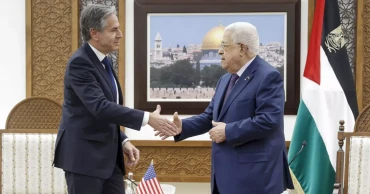
U.S. Secretary of State Antony Blinken took his diplomatic push on the Israel-Hamas war to the occupied West Bank on Sunday, trying to assure Palestinian President Mahmoud Abbas that the Biden administration was intensifying efforts to ease the plight of Gaza's civilians and insisting that Palestinians must have a main say in whatever comes next for the territory after the conflict.
Blinken later flew to Baghdad for talks with Iraqi Prime Minister Mohammed Shia al-Sudani as American forces in the region face a surge of attacks by Iranian-allied militias in Iraq and elsewhere. U.S. forces shot down another one-way attack drone Sunday that was targeting American and coalition troops near their base in neighboring Syria, a U.S. official said. From Baghdad Blinken traveled to Turkey.
President Joe Biden's top diplomat traveled through the West Bank city of Ramallah in an armored motorcade and under tight security. It was his third day of shuttle diplomacy aimed at trying to limit the destabilizing regional fallout from the war and overcome what has been Israeli Prime Minister Benjamin Netanyahu's refusal to consider a U.S. proposal for intermittent pauses in its attack on Hamas long enough to rush vital aid to Gaza's civilians.
Netanyahu had pushed back Friday against the U.S. pressure to start implementing pauses in the fighting, saying there would be no temporary cease-fire until Hamas releases some 240 foreign hostages it is holding.
“This is a process,” Blinken told reporters on the matter Sunday. “Israel has raised important questions about how humanitarian pauses would work. We’ve got to answer those questions,” including how pauses would affect Hamas hostages. "We’re working on exactly that.’’
The Biden administration, while remaining the strongest backer of Israel's military response to Hamas' attacks on Oct. 7, is increasingly seeking to use its influence with Israel to try to temper the effect of Israel's weeks of complete siege and near round-the-clock air, ground and sea assaults in Gaza, home to 2.3 million civilians.
Blinken's meeting with Abbas in the West Bank came on the same day that Israeli planes bombed two refugee camps in Gaza, killing at least 53 people, according to health officials in Gaza. An Associated Press reporter saw the dead bodies of eight children brought in to a nearby Gaza hospital after one of those strikes. Israel's military announced its forces had effectively split the Gaza Strip in two before an expected escalated assault on Hamas targets in the north.
As word spread of Blinken's arrival in Ramallah, Palestinians turned out to protest U.S. support for Israel's war. Demonstrators held signs showing dripping blood and with messages that included, “Blinken blood is on your hands."
Neither Blinken nor Abbas spoke as they greeted each other in front of cameras and their meeting ended without any public comment.
The Palestinian Authority administers semiautonomous areas of the Israeli-occupied West Bank. It has not been a factor in the Gaza Strip since 2007, when Hamas seized control after winning in elections there a year earlier. Abbas himself is unpopular among Palestinians.
Blinken said in Baghdad that the Palestinian Authority “is playing a very important role right now in the West Bank in trying to keep stability there. That’s hugely important because no one wants another front in the West Bank or anywhere else, and they’re really stepping up under very difficult conditions to do the necessary work.”
He said that “what we all agree” is that in shaping a future for Gaza, the West Bank and “ultimately” for a Palestinian state, "Palestinian voices have to be at the center of that. The Palestinian Authority is the representative of those voices so it’s important that it play a leading role.’’
Abbas, however, said the Palestinian Authority would only assume power in Gaza as part of a “comprehensive political solution” to the Israeli-Palestinian conflict, according to the Palestinians' official WAFA news agency. He also condemned Israel’s bombardment of Gaza as a “genocidal war" and urged Blinken “to immediately stop them from committing such crimes,” the news agency reported.
On his second trip to the Middle East since the war began, Blinken met with Netanyahu on Friday before holding talks in Jordan with Arab ministers Saturday. Netanyahu so far has rejected humanitarian pauses. The Arab officials pushed for an immediate cease-fire. Blinken said that would be counterproductive and could encourage more violence by Hamas.
U.S. officials believe that Netanyahu may soften his opposition to the pause idea if he can be convinced that it is in Israel’s strategic interests to ease the plight of Palestinian civilians in Gaza. The soaring death toll among Palestinians — more than 9,700, according to officials of Gaza's Hamas-run health ministry — has sparked growing international anger, with tens of thousands from Washington to Berlin taking to the streets over the weekend to demand a cease-fire now.
Arab states are resisting American suggestions that they play a larger role in resolving crisis, expressing outrage at the civilian toll of the Israeli military operations but believing Gaza to be a problem largely of Israel’s own making.
Among Arab leaders, Blinken said it is clear that “everyone would welcome the humanitarian pause.” He said it “could advance things that we’re all trying to accomplish,” including freeing hostages, bringing in aid and getting out foreign citizens. On that last point, he said: "We’ve had important progress there in recent days but also real complications that come along with it. We continue to work through them.’’
In Baghdad, the talks touched on the security of U.S. forces.
“I made very clear that the attacks, the threats coming from the militia that are aligned with Iran, are totally unacceptable and we will take every necessary step to protect" American personnel, Blinken said. He said the prime minister expressed his own determination to stop the militia strikes.
The U.S. has deep concerns that Iran and its proxies, including several militia groups in Iraq, may take advantage of the situation in Gaza to further destabilize the Middle East. Already Iranian-backed militias have intensified rocket and other attacks on U.S. military facilities in Iraq and Syria, drawing at least one retaliatory strike from American forces.
Sunday's attack by drone against a U.S. site in Syria was at least the 32nd on U.S. and coalition military facilities in Iraq and Syria since Oct. 17. To date there have been at least 17 attacks in Iraq and 15 in Syria. At least 21 service members have been injured by the attacks but all have returned to duty, the Pentagon said.
The same U.S. official who confirmed the U.S. shootdown of the drone said the drone strike was very similar to other recent attacks on U.S. personnel at bases in Iraq and Syria and is believed at this point to be linked to Iranian-backed militia. The official was not authorized to discuss the matter publicly and spoke on condition of anonymity.
2 years ago

Bangladeshi-Italian girl may have died by suicide over arranged marriage
A 15-year-old Bangladeshi-Italian girl who jumped out of her family flat's third floor window and died after three days in hospital may have done so because she feared being pushed into "an arranged marriage with an older man in Bangladesh," police said on Friday.
Read: Young couple ‘commit suicide’ in Magura: Police
Her father, who was planning to take her on holiday to his home country, has been placed under investigation for instigation to suicide in Ancona, the capital of the north-central-eastern Marche region.
Read: Suicide bomber detonates a device in front of Turkish Interior Ministry
The girl, who has not been named, died in an Ancona hospital Thursday.
2 years ago

Blinken tries to cajole wary Arabs on support for post-conflict Gaza as Israel's war intensifies
U.S. Secretary of State Antony Blinken stepped up his frantic diplomacy on Saturday, trying to build support for planning a post-conflict future for Gaza as he continued his second urgent mission to the Middle East since the Israel-Hamas conflict began.
A day after Israeli Prime Minister Benjamin Netanyahu pointedly snubbed Blinken's blunt warning that Israel risks losing any hope of an eventual peace deal with the Palestinians unless it eases the humanitarian crisis in Gaza, he met in Amman with senior Jordanian and other Arab officials, who remain angry and deeply suspicious of Israel as it intensifies its war against Hamas.
Read: Arab countries who normalized relations with Israel under growing public pressure to cut ties
Blinken met first with Lebanon’s caretaker Prime Minister Najib Mikati, whose economically and politically ravaged country is home to Hezbollah — an Iranian-backed force hostile to Israel.
The U.S. has grave concerns that Hezbollah, which has already stepped up rocket and cross-border attacks on northern Israel, will take a more active role in the conflict.
Hezbollah chief Hassan Nasrallah gave his first major speech since the Oct. 7 Hamas attacks on Israel that sparked the war, but did not forecast his group’s greater involvement despite professing it was not perturbed by U.S. attempts to deter it.
Neither Blinken nor Mikati spoke to reporters at the top of their meeting in an Amman hotel. Nor did Blinken speak publicly as he posed for pictures with Qatar’s foreign minister, whose country has emerged as the most influential interlocutor with Hamas and has been key to negotiating the limited release of hostages held by the group as well as convincing it to allow foreign citizens to leave Gaza and cross into Egypt.
Read: Biden calls for humanitarian 'pause' in Israel-Hamas war
Blinken was then to meet with the head of the United Nations agency in charge of assisting Palestinian refugees. UNRWA has said dozens of its staff have been killed in Israeli airstrikes and is running critically low on necessary supplies like food, medicine and fuel.
Later, Blinken was to hold group talks with foreign ministers of Qatar, Jordan, Egypt, Saudi Arabia and the United Arab Emirates, and the chair of the PLO executive committee. All parties have denounced Israel’s tactics against Hamas, which they say constitutes unlawful collective punishment of the Palestinian people.
Blinken will also see King Abdullah II of Jordan, whose country this week recalled its ambassador to Israel and told Israel’s envoy not to return to the country until the Gaza crisis was over.
Still, the Arab states have thus far resisted American suggestions that they play a larger role in crisis, expressing outrage at the civilian toll of the Israeli military operations but believing Gaza to be a problem largely of Israel’s own making.
The Arabs meeting with Blinken were convened by Jordanian Foreign Minister Ayman al-Safadi, who said the gathering was organized “in the context of their efforts aimed at stopping the Israeli war on Gaza and the humanitarian catastrophe it is causing,” Jordan's foreign ministry said.
Still, U.S. officials believe Arab backing — no matter how modest — will be critical to efforts to not only ease the worsening conditions in Gaza but also to lay the groundwork for what would replace Hamas as the territory’s governing authority if and when Israel succeeds in eradicating it.
Read: Israeli airstrikes crush apartments in Gaza refugee camp, as ground troops battle Hamas militants
However, ideas on Gaza’s future governance are few and far between, with Blinken and other U.S. officials offering a vague outline that it might include a combination of a revitalized Palestinian Authority — which has not been a factor in the territory since 2007 — international organizations and potentially a peacekeeping force. U.S. officials acknowledge these ideas have been met with a distinct lack of enthusiasm.
2 years ago

Arab countries who normalized relations with Israel under growing public pressure to cut ties
Arab nations that have normalized or are considering improving relations with Israel are coming under growing public pressure to cut those ties because of Israel's war with Hamas.
Tens of thousands of people have taken to the streets of Rabat and other Moroccan cities in support of the Palestinians. In Bahrain — a country that almost never allows protest — police stood by as hundreds of people marched last month, waving flags and gathering in front of the Israeli Embassy in Manama.
The demonstrations, which mirror protests across the Middle East, present an uncomfortable dilemma for governments that have enjoyed the benefits of closer military and economic ties with Israel in recent years.
In Egypt, which has had ties with Israel for decades, protesters rallied in cities and at universities, at times chanting “Death to Israel." A parliamentary committee in Tunisia last week advanced a draft law that would criminalize normalization with Israel.
In Morocco and Bahrain, the public anger has an additional dimension; activists are demanding the reversal of agreements that formalize ties with Israel, underscoring discord between the governments and public opinion.
READ: Biden calls for humanitarian 'pause' in Israel-Hamas war
The U.S.-brokered Abraham Accords, aimed at winning broader recognition of Israel in the Arab world, paved the way for trade deals and military cooperation with Bahrain, Morocco, Sudan and the United Arab Emirates starting in 2020. Their autocratic rulers — as well as American and Israeli officials — continue to frame the deals as a step toward a “ new Middle East ” in which closer ties could foster peace and prosperity.
The accords marked a major diplomatic victory for Morocco because they led the U.S. — and eventually Israel — to recognize its autonomy over the disputed Western Sahara. Morocco's Foreign Ministry did not respond to questions about the agreement or protests.
The accords also led Washington to remove Sudan from its list of state sponsors of terrorism, presenting a lifeline for the ruling military junta fighting a pro-democracy movement and spiraling inflation.
Large protests against the Israel-Hamas war have not erupted in Sudan or the United Arab Emirates.
A highly sought-after agreement between Israel and Saudi Arabia has become less likely due to the war and regionwide protests, Steven Cook, a senior fellow for Middle East and Africa Studies at the Council on Foreign Relations, told The Associated Press in October.
“I think this dynamic of normalization will likely slow down or come to a halt, at least for a period of time,” Cook said.
READ: Israeli airstrikes crush apartments in Gaza refugee camp, as ground troops battle Hamas militants
Opponents of normalization say the protests make clear the governmental wins that resulted from the accords did little to move public opinion.
“Hamas isn’t terrorists. It’s resistance to colonization. Imagine someone enters your house. How would you behave? Smile or make them leave by force?” said Abouchitae Moussaif, the national secretary of Morocco's Al Adl Wal Ihsane, a banned but tolerated Islamist association that has long supported the Palestinian cause.
The group, which rejects King Mohammed VI's dual authority as head of state and religion, organizes throughout Morocco, where undermining the monarchy is illegal.
Morocco has not always been so lenient with opponents of normalization. Before the war, authorities broke up protests and sit-ins outside Parliament and a judge in Casablanca sentenced a man to five years in prison for undermining the monarchy because he criticized normalization.
Now, law enforcement personnel mostly stand aside as the large daily protests take place.
“Normalization is a project of the state, not the people,” Moussaif said. “The protests touched on a project of the government, more specifically a project of the King.”
Zakaria Aboudahab, a professor of International Relations at Universite Mohammed V in Rabat, said the protests likely won't lead to Morocco overturning normalization but that allowing them works as a “safety valve” to temper public outrage.
READ: UN agency in Gaza says urgent cease-fire is `matter of life and death' for millions of Palestinians
“The Moroccan state knows very well that when popular anger reaches such proportions and people express injustice and so on, it has to listen to the people,” he said.
Bahrain had banned protests since the 2011 uprisings, when thousands poured into the streets emboldened by pro-democracy protests in Egypt, Syria, Tunisia and Yemen. But in recent weeks, demonstrations have been allowed again.
“Now people are taking some risks to be in the street and participate,” said Jawad Fairooz, a former leader of Bahrain’s outlawed Al Wefaq Party who lives in exile in London. “Governments want to give some relief to people’s anger by allowing them to get together.”
As the war intensified, Arab leaders moved from condemning violence and calling for peace to more pointed criticism of Israel’s attacks in Gaza.
The United Arab Emirates Foreign Ministry initially called Hamas' Oct. 7 raid in southern Israel a “serious and grave escalation," and its finance minister told reporters the country does not mix trade with politics. After Israel struck Gaza's Jabaliya refugee camp on Tuesday, the UAE warned that “indiscriminate attacks will result in irreparable ramifications in the region."
Morocco's Foreign Ministry initially said it "condemns attacks against civilians wherever they may be." But it later blamed Israel for the escalation of violence — including an explosion at a hospital in Gaza City — and highlighted its humanitarian aid efforts in Gaza.
In a statement last week, Morocco called its delivery of food, medical supplies and water part of the king's commitment to the Palestinian cause.
2 years ago