others
Biden calls for humanitarian 'pause' in Israel-Hamas war
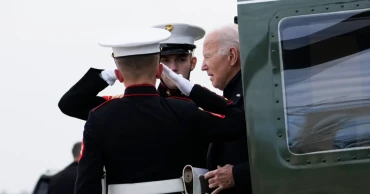
President Joe Biden said he thought there should be a humanitarian “pause” in the Israel-Hamas war, after his campaign speech Wednesday evening was interrupted by a protester calling for a cease-fire.
“I think we need a pause,” Biden said.
The call was a subtle departure for Biden and top White House aides, who throughout the Mideast crisis have been steadfast in stating they will not dictate how the Israelis carry out their military operations in response to the Oct. 7 attack by Hamas.
But the president has faced intensifying pressure from human rights groups, fellow world leaders and even liberal members of his own Democratic Party, who say that the Israeli bombardment of Gaza is collective punishment and that it is time for a cease-fire.
Israeli airstrikes crush apartments in Gaza refugee camp, as ground troops battle Hamas militants
In his comments, Biden was exerting pressure on Israeli Prime Minister Benjamin Netanyahu to give Palestinians at least a brief reprieve from the relentless military operation that’s left thousands dead and mired the 141-square-mile strip in a roiling humanitarian crisis.
The White House has refused to call for a cease-fire but has signaled that the Israelis should consider humanitarian pauses to allow civilians to receive aid and for foreign nationals trapped on the strip to leave Gaza.
Israeli ground troops have advanced near Gaza City in heavy fighting with militants, the military said on Wednesday. Meanwhile, hundreds of foreign nationals and dozens of seriously injured Palestinians were allowed to leave Gaza after more than three weeks under siege.
Death toll of Palestinians from Israeli airstrikes on Gaza approximates 5,800: Hamas-run Health Ministry
The first people to leave Gaza — other than four hostages released by Hamas and another rescued by Israeli forces — crossed into Egypt, escaping even as bombings drive hundreds of thousands from their homes, and food, water and fuel run low.
White House National Security Council spokesman John Kirby said earlier on Wednesday that Biden’s newly confirmed ambassador to Israel, Jack Lew, would soon be dispatched to the Middle East and would be tasked in part with “supporting U.S. efforts to create the conditions for a humanitarian pause to address the worsening humanitarian conditions facing Palestinian civilians.”
Israeli Ambassador to the U.S. Michael Herzog told “The Hill” on NewsNation Wednesday “we don’t need urging” in response to calls for more aid for Gaza.
“We are ramping up humanitarian supplies into Gaza in those areas which are away from Hamas in the southern part of Gaza. The number of truckloads doubles and is going to pick up more and more," he said. “We provide water. We provide other types of supplies.”
He said to NewsNation they were happy to see foreigners leave Gaza. "So we don’t need urging, urging in that sense. Our Cabinet discussed this week this issue and decided there are no limitations as long as we can make sure that Hamas does not put its hands on humanitarian supplies and uses them to feed its war machine. That will not happen. Short of that, everything is open.”
Israel vows again to destroy Hamas, rejecting calls for a cease-fire in Gaza at a major UN meeting
On Wednesday evening, Biden was speaking to a crowd of supporters in Minneapolis about his reasons for running for president in 2020 when a woman got up and yelled: “Mr. President, if you care about Jewish people, as a rabbi, I need you to call for a cease-fire."
His presence in the city drew more than 1,000 demonstrators not far from where the fundraiser was held, and they carried Palestinian flags and signs that said “Stop Bombing Children,” "Free Palestine” and “Ceasefire now."
Biden said he understood the emotions motivating the demonstrator, who was quickly shouted down by others in the room and removed. He said, when asked, that a pause "means give time to get the prisoners out.” White House officials later clarified he meant hostages and humanitarian aid.
“This is incredibly complicated for the Israelis," Biden went on. "It’s incredibly complicated for the Muslim world as well. ... I supported a two-state solution, I have from the very beginning.”
“The fact of the matter is that Hamas is a terrorist organization. A flat-out terrorist organization," he said.
But Biden noted that he's been working on humanitarian aid, saying he was the one who convinced both Netanyahu and Egyptian President Abdel Fattah el-Sissi to allow aid into Gaza.
“I'm the guy,” he said.
2 years ago
Israeli airstrikes crush apartments in Gaza refugee camp, as ground troops battle Hamas militants
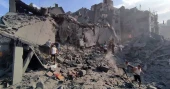
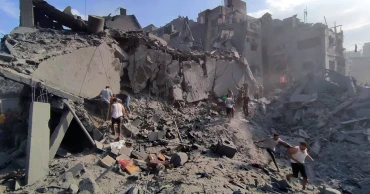
A barrage of Israeli airstrikes leveled apartment buildings in a refugee camp near Gaza City on Tuesday, with rescuers clawing through the destruction to pull men, women and children from the rubble. Israel said the strike, which targeted a senior Hamas military leader, destroyed a militant command center and an underground tunnel network.
The toll from the attack in the Jabaliya camp was not immediately known. The director of the nearby hospital where casualties were taken, Dr. Atef Al-Kahlot, said hundreds of people were wounded or killed, but he did not provide exact figures.
The Israeli military said dozens of militants were killed, including a key Hamas commander for northern Gaza.
Israel must stop killing of Palestinian women and children: PM Hasina
Israel aggressively defended the attack, with military spokesman Jonathan Conricus saying the targeted commander had also been a key planner of the bloody Oct. 7 rampage that started the war, and that the apartment buildings collapsed only because the vast underground Hamas complex had been destroyed.
Neither side’s account could be independently confirmed.
The strike underlined the anticipated surge in casualties on both sides as Israeli troops battling Hamas militants advance deeper into the northern Gaza Strip toward dense, residential neighborhoods. Israel has vowed to crush Hamas’ ability to govern Gaza or threaten Israel following the Oct. 7 assault, which ignited the war. Hamas, an Islamic militant group, openly calls for the destruction of Israel.
Israel said two of its soldiers were killed in fighting in northern Gaza, the first military deaths it reported since the ground offensive into the tiny Mediterranean territory accelerated late last week.
Several hundred thousand Palestinians remain in northern Gaza in the path of the ground assault. They have crowded into homes or are packed by the thousands into hospitals that are already overwhelmed with patients and running low on supplies.
PM Hasina denounces Israeli attacks on Palestine, calls for ending the war
In the Jabaliya refugee camp — a densely built-up area of small streets on Gaza City’s outskirts — dozens of rescuers searched for survivors amid a series of obliterated buildings and others that had partially collapsed.
Young men carried the limp forms of two children from the upper floors of the crumbling frame of one damaged apartment building, while helping down another child and woman. It was unclear whether the children were alive or dead. Gray dust, apparently left by pulverized concrete, seemed to coat nearly everything.
The Israeli military said it carried out a wide-scale strike in Jabaliya on Hamas infrastructure “that had taken over civilian buildings.”
Brig. Gen. Daniel Hagari said an underground Hamas installation beneath a targeted building collapsed, toppling other nearby buildings. Conricus later said the main strike had hit between buildings.
“We don’t intend for the ground to collapse,” he told reporters. “But the issue is that Hamas built their tunnels there and that they’re running their operations from there.”
He said the commander killed in the strike, Ibrahim Biari, played an important role in the Oct. 7 attack and had been involved in anti-Israeli attacks going back decades.
Also on Tuesday, the Israeli military said ground troops took control of a Hamas military stronghold in west Jabaliya, killing 50 militants.
Hamas spokesman Hazem Qassem denied the military’s claim, saying it was trying to justify “its heinous crime” against civilians.
Hagari repeated calls for civilians to evacuate northern Gaza to the south. The military says it targets Hamas fighters and infrastructure and that the militants endanger civilians by operating among them. The military has also repeatedly emphasized it will strike Hamas wherever it finds it.
Some 800,000 Palestinians have reportedly fled to the south, but many have not, in part because they say nowhere is safe as Israeli airstrikes in the south have continued to cause civilian deaths. The window to flee may be closing, as Israeli forces reached Gaza’s main north-south highway this week.
More than 8,500 Palestinians have been killed in the war, mostly women and minors, the Gaza Health Ministry said Tuesday, without providing a breakdown between civilians and fighters. The figure is without precedent in decades of Israeli-Palestinian violence.
Over 1,400 people have died on the Israeli side, mainly civilians killed during Hamas’ initial attack, also an unprecedented figure. Palestinian militants also abducted around 240 people during their incursion and have continued firing rockets into Israel.
A day after Israel’s first successful rescue of a Hamas captive, the spokesman of the militant group’s armed wing said they plan to release some non-Israeli hostages in coming days. Hamas has previously released four hostages, and has said it would let the others go in return for thousands of Palestinian prisoners held by Israel, which has dismissed the offer.
More than half of Gaza’s 2.3 million Palestinians have fled their homes, with hundreds of thousands sheltering in packed U.N.-run schools-turned-shelters or at hospitals.
The war has also threatened to ignite fighting on other fronts. Israel and Lebanon’s Hezbollah militant group have traded fire daily along the border, and Israel and the U.S. have struck targets in Syria linked to Iran, which supports Hamas, Hezbollah and other armed groups in the region.
Some 200,000 people have been evacuated from Israeli towns near Gaza and the northern border with Lebanon.
The military said it shot down what appeared to be a drone near the southernmost city of Eilat and intercepted a missile over the Red Sea on Tuesday, neither of which entered Israeli airspace.
Iranian-backed Houthi rebels in Yemen later claimed they fired ballistic missiles and drones at Israel, saying it was their third such operation and threatening more. Earlier this month, a U.S. Navy destroyer in the Red Sea intercepted missiles and drones launched toward Israel by the Houthis, who control much of northern Yemen.
In the occupied West Bank, where Israeli-Palestinian violence has also surged, the army demolished the family home of Saleh al-Arouri, a senior Hamas official exiled over a decade ago. An official in the village of Aroura said the home had been vacant for 15 years.
Israeli forces reportedly have advanced north and east of Gaza City. South of the city, Israeli troops were also trying to cut off the territory’s main highway and the parallel road along the Mediterranean coast, according to Dawood Shehab, a spokesperson for Islamic Jihad, a smaller militant group allied with Hamas.
Zaki Abdel-Hay, a Palestinian living a few minutes’ walk from the road south of Gaza City, said people are afraid to use it. “People are very scared. The Israeli tanks are still close,” he said over the phone, adding that “constant artillery fire” could be heard near the road.
The Israeli military said it struck some 300 militant targets over the past day, including compounds inside tunnels, and that troops had engaged in several battles with militants armed with antitank missiles and machine guns.
Gaza’s humanitarian crisis continued to worsen.
The World Health Organization said two hospitals were damaged and an ambulance destroyed in Gaza over the last two days. It said all 13 hospitals operating in the north have received Israeli evacuation orders in recent days. Medics have refused such orders, saying it would be a death sentence for patients on life support.
Gaza City’s Shifa Hospital, the largest in the territory, is on the verge of running out of fuel, the Health Ministry said.
There has been no central electricity in Gaza for weeks, and Israel has barred the entry of fuel needed to power generators for hospitals and homes, saying it wants to prevent it from falling into Hamas’ hands.
It has allowed a limited amount of food, water, medicine and other supplies to enter from Egypt, though far less than what is needed, relief groups say. A convoy of 59 aid trucks entered through the Rafah Crossing with Egypt on Tuesday — the largest yet — bringing the total that have entered since Oct. 22 to 216, according to Wael Abu Omar, Hamas’ spokesperson for the crossing.
The U.N. agency for Palestinian refugees, known as UNRWA, says 64 of its staff have been killed since the start of the war.
2 years ago
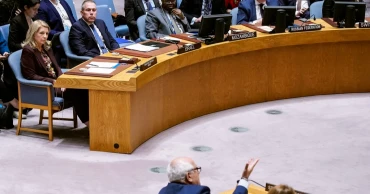
UN agency in Gaza says urgent cease-fire is `matter of life and death' for millions of Palestinians
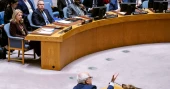
The head of the U.N. agency for Palestinian refugees told a U.N. emergency meeting Monday “an immediate humanitarian cease-fire has become a matter of life and death for millions,” accusing Israel of “collective punishment” of Palestinians and the forced displacement of civilians.
Philippe Lazzarini warned that a further breakdown of civil order following the looting of the agency’s warehouses by Palestinians searching for food and other aid “will make it extremely difficult, if not impossible, for the largest U.N. agency in Gaza to continue operating.”
Briefings to the Security Council by Lazzarini, the head of the U.N. children’s agency UNICEF and a senior U.N. humanitarian official painted a dire picture of the catastrophic humanitarian situation in Gaza 23 days after Hamas’ surprise Oct. 7 attacks in Israel, and its ongoing retaliatory military action aimed at “obliterating” the militant group, which controls Gaza.
According to the latest figures from Gaza’s Ministry of Health, more than 8,300 people have been killed – 66% of them women and children – and tens of thousands injured, the U.N. humanitarian office said.
UNICEF Executive Director Catherine Russell that toll includes over 3,400 children killed and more than 6,300 injured. “This means that more than 420 children are being killed or injured in Gaza each day – a number which should shake each of us to our core,” she said.
Lazzarini said:. “This surpasses the number of children killed annually across the world’s conflict zones since 2019.” And he stressed: “This cannot be `collateral damage.’”
Many speakers at the council meeting denounced Hamas’ Oct. 7 surprise attacks on Israel that killed over 1,400 people, and urged the release of some 230 hostages taken to Gaza by the militants. But virtually every speaker also stressed that Israel is obligated under international humanitarian law to protect civilians and their essentials for life including hospitals, schools and other infrastructure – and Israel was criticized for cutting off food, water, fuel and medicine to Gaza and cutting communications for several days.
Lazzarini said “the handful of convoys” allowed into Gaza through the Rafah crossing from Egypt in recent days “is nothing compared to the needs of over 2 million people trapped in Gaza.”
“The system in place to allow aid into Gaza is geared to fail," he said, "unless there is political will to make the flow of supplies meaningful, matching the unprecedented humanitarian needs.”
The commissioner-general of the U.N. agency known as UNRWA said there is no safe place anywhere in Gaza, warning that basic services are crumbling, medicine, food, water and fuel are running out, and the streets “have started overflowing with sewage, which will cause a massive health hazard very soon.”
UNICEF oversees water and sanitation issues for the U.N., and Russell warned that “the lack of clean water and safe sanitation is on the verge of becoming a catastrophe.”
U.S. Ambassador Linda Thomas-Greenfield urged the divided Security Council – which has rejected four resolutions that would have responded to the Oct. 7 Hamas attacks and the ongoing war – to come together, saying “the humanitarian crisis in Gaza is growing more dire by the day.”
Stressing that all innocent civilians must be protected, she said the council must call “for the immediate and unconditional release of all hostages, address the immense humanitarian needs of Palestinian civilians in Gaza, affirm Israel’s right to defend itself from terrorism, and remind all actors that international humanitarian law must be respected.” She reiterated President Joe Biden's call for humanitarian pauses to get hostages out, allow aid in, and safe passage for civilians.
“That means Hamas must not use Palestinians as human shields – an act of unthinkable cruelty and a violation of the law of war,” the U.S. ambassador said, “and that means Israel must take all possible precautions to avoid harm to civilians.”
In a sign of increasing U.S. concern at the escalating Palestinian death toll, Thomas-Greenfield told the council Biden reiterated to Israeli Prime Minister Benjamin Netanyahu on Sunday “that while Israel has the right and responsibility to defend its citizens from terrorism, it must do so in a manner consistent with international humanitarian law.”
“The fact that Hamas operates within and under the cover of civilians areas creates an added burden for Israel, but it does not lessen its responsibility to distinguish between terrorists and innocent civilians,” she stressed.
Following the rejection of the four resolutions in the 15-member Security Council – one vetoed by the U.S., one vetoed by Russia and China, and two for failing to get the minimum nine “yes” votes – Arab nations went to the U.N. General Assembly last Friday where there are no vetoes.
The 193-member world body adopted a resolution calling for humanitarian truces leading to a cessation of hostilities by a vote of 120-14 with 45 abstentions. Now, the 10 elected members in the 15-member Security Council are trying again to negotiate a resolution that won’t be rejected. While council resolutions are legally binding, assembly resolutions are not though they are an important barometer of world opinion.
Israel’s U.N. Ambassador Gilad Erdan was sharply critical of the council’s failure to condemn Hamas’ attacks and asked members: “Why are the humanitarian needs of Gazans, the sole issue, the sole issue you are focused on?”
Recalling his grandfather who survived Nazi death camps but whose his wife and seven children perished in the Auschwitz gas chamber, Erdan told the council he will wear a yellow star – just as Hitler made his grandfather and all Jews wear during World War II – “until you condemn the atrocities of Hamas and demand the immediate release of our hostages.”
The ambassador then put a large six-pointed yellow star of David saying “Never Again” on his suit jacket, as did other Israeli diplomats sitting behind him, and said: “We walk with the yellow star as a symbol of pride, a reminder that we swore to fight back to defend ourselves. Never again is now.”
Riyad Mansour, the Palestinian U.N. ambassador, also urged the Security Council to follow the General Assembly, end its paralysis, and demand “an end to this bloodshed, which constitutes an affront to humanity, war crimes, and crimes against humanity, and a clear and imminent danger for regional and international peace and security.”
“Save those who still can be saved and bury in a dignified manner those who have perished,” Mansour said. “Allow members of the same families who have survived to embrace each other and to mourn their loved ones who did not. Allow us to pay the tribute owed to the families wiped off the face of this earth. … Treat us as human beings with the respect we deserve.”
2 years ago

China's foreign minister says Xi-Biden meeting in San Francisco would not be 'smooth-sailing'
China’s foreign minister considers that the road to an expected meeting between President Xi Jinping and U.S. President Joe Biden would not be "smooth-sailing” and that both sides must work together to achieve results, the foreign ministry said on Sunday.
Wang Yi met with Biden, as well as secretary of state Anthony Blinken and national security advisor Jake Sullivan, during a three-day visit to Washington. Both sides agreed to work toward a bilateral meeting at the upcoming Asia-Pacific Economic Cooperation forum summit in San Francisco in November.
Read: G-7 nations back strong supply chains for energy and food despite global tensions
In an statement released by China’s foreign ministry summarizing the discussions with members of the “U.S. strategic community,” Wang said that the road to the bilateral meeting would not be “smooth sailing” and that they could not rely on “autopilot” to make it happen.
Wang's three-day visit to Washington came at a time when tensions between the two countries remain high, including over U.S. export controls on advanced technology and China’s more assertive actions in the East and South China seas.
The statement said that although there are still many issues to be resolved, both sides believe that it is both beneficial and necessary for the U.S. and China to maintain dialogue.
The meeting is the latest in a series of high-level contacts between the two countries as they explore the possibility of stabilizing an increasingly tense relationship at a time of conflict in Ukraine and Israel.
According to the foreign ministry statement, Wang also said that China and the U.S. needed a “return to Bali,” in a reference to Xi and Biden’s previous meeting at a G20 summit last year, where both officials discussed issues relating to Taiwan, U.S.-China trade tensions as well as cooperation to address issues like climate change, health and food security.
Read: US military says Chinese fighter jet came within 10 feet of B-52 bomber over South China Sea
Wang said that the two countries must “eliminate interference, overcome obstacles, enhance consensus and accumulate results.”
Other issues discussed between Wang and Biden included military exchanges between the U.S. and China, as well as financial, technological and cultural exchanges and cooperation, as well as the crises in the Middle East and Ukraine.
2 years ago

Israel steps up air and ground attacks in Gaza and cuts off the territory's communications
Israel knocked out internet and communications in the Gaza Strip in stepped-up bombardment Friday night, largely cutting off its 2.3 million people from contact with each other and the outside world and creating a near-blackout of information, as the military said it was “expanding” ground operations in the territory.
The military’s announcement signaled it was moving closer to an all-out invasion of Gaza, where it has vowed to crush the ruling Hamas militant group after its bloody incursion in southern Israel three weeks ago.
Explosions from continuous airstrikes lit up the sky over Gaza City for hours after nightfall. The Palestinian telecom provider, Paltel, said the bombardment caused “complete disruption” of internet, cellular and landline services. The cutoff meant that casualties from strikes and details of ground incursions could not immediately be known. Some satellite phones continued to function.
Already plunged into darkness after most electricity was cut off weeks ago, Palestinians were thrown into isolation, huddling in homes and shelters with food and water supplies running out.
Bangladesh stands united for Palestine in conflict with Israel: Humayun Kabir
Relatives outside Gaza panicked after their messaging chats with families inside suddenly went dead and calls stopped going through.
“I was so scared this was going to happen,” said Wafaa Abdul Rahman, director of a feminist organization based in the West Bank city of Ramallah. She said she hadn't heard for hours from family in central Gaza.
“We’ve been seeing these horrible things and massacres when it’s live on TV, so now what will happen when there’s a total blackout?” she said, referring to scenes of families that have been crushed in homes by airstrikes over the past weeks.
Israeli military spokesman Rear Adm. Daniel Hagari said ground forces were “expanding their activity” Friday evening in Gaza and “acting with great force ... to achieve the objectives of the war.” Israel says its strikes target Hamas fighters and infrastructure and that the militants operate from among civilians, putting them in danger.
Parts of Gaza look like a wasteland from space following relentless Israeli bombing raids
The Hamas media center reported heavy nighttime clashes with Israeli forces at several places, including what it said was an Israeli incursion east of Bureij. Asked about the report, the Israeli military reiterated early Saturday that it had been carrying out targeted raids and expanding strikes with the aim of “preparing the ground for future stages of the operation.”
Israel has amassed hundreds of thousands of troops along the border ahead of an expected ground offensive. Earlier Friday the military said ground forces conducted their second hourslong incursion inside Gaza in as many days, striking dozens of militant targets over the past 24 hours.
The Palestinian death toll in Gaza has soared past 7,300, more than 60% of them minors and women, according to the territory’s Health Ministry. A blockade on Gaza has meant dwindling supplies, and the U.N. warned that its aid operation helping hundreds of thousands of people was “crumbling” amid near-depleted fuel.
More than 1,400 people were slain in Israel during Hamas’ Oct. 7 attack, according to the Israeli government, and at least 229 hostages were taken into Gaza. Palestinian militants have fired thousands of rockets into Israel, including one that hit a residential building in Tel Aviv on Friday, wounding four people.
Israeli troops launch brief ground raid into Gaza ahead of expected wider incursion
The overall number of deaths far exceeds the combined toll of all four previous Israel-Hamas wars, estimated at around 4,000.
Defense Minister Yoav Gallant said Israel expects a long and difficult ground offensive into Gaza soon. It “will take a long time” to dismantle Hamas' vast network of tunnels, he said, adding that he expects a lengthy phase of lower-intensity fighting as Israel destroys “pockets of resistance.”
His comments pointed to a potentially grueling and open-ended new phase of the war after three weeks of relentless bombardment. Israel has said it aims to crush Hamas’ rule in Gaza and its ability to threaten Israel. But how Hamas’ defeat will be measured and an invasion’s endgame remain unclear. Israel says it does not intend to rule the tiny territory but not who it expects to govern — even as Gallant suggested a long-term insurgency could ensue.
In Washington, the Pentagon said U.S. Defense Secretary Lloyd Austin spoke with Gallant on Friday and “underscored the importance of protecting civilians during the Israel Defense Forces’ operations and focusing on the urgency of humanitarian aid delivery for civilians in Gaza.” The readout from Pentagon press secretary Brig. Gen. Pat Ryder said Austin also brought up “the need for Hamas to release all of the hostages.”
The conflict has threatened to ignite a wider war across the region. Arab nations — including U.S. allies and ones that have reached peace deals or normalized ties with Israel — have raised increasing alarm over a potential ground invasion, likely to bring even higher casualties amid urban fighting.
Jordanian Foreign Minister Ayman Safadi warned on X that the “outcome will be a humanitarian catastrophe of epic proportions for years to come.”
With no electricity, no communications and no water, many of those trapped in Gaza had little choice but to wait in their homes or seek the relative safety of schools and hospitals as Israel expanded its bombing early Saturday.
Throughout the night, orange fireballs exploded on the horizon above the apartment buildings and refugee camps of Gaza City, briefly illuminating clouds of white smoke hanging in the air from previous strikes. Some of the bombs hit in tight groups, apparently slamming into the same location, as flames shot into the air followed seconds later by a burst of loud bangs.
Lynn Hastings, U.N. humanitarian coordinator for the occupied territories, posted on X, formerly known as Twitter, that without phone lines and internet, hospitals and aid operations would be unable to operate. The Red Crescent said it could not contact medical teams and residents could no longer call ambulances, meaning rescuers would have to chase the sound of explosions to find the wounded. International aid groups said they were only able to reach a few staffers using satellite phones.
The Committee to Protect Journalists expressed alarm, saying the world “is losing a window into the reality” of the conflict. It warned that the information vacuum “can be filled with deadly propaganda, dis- and misinformation.”
The loss of internet and phones deals a further blow to a medical and aid system that relief workers say was already on the verge of collapse, overwhelmed by wounded and running out of supplies under Israel's weeks-long seal. More than 1.4 million people have fled their homes, nearly half crowding into U.N. schools and shelters. Aid workers say a trickle of aid Israel has allowed to enter from Egypt the past week is a tiny fraction of what is needed.
Gaza hospitals have been scrounging for fuel to run emergency generators that power incubators and other life-saving equipment.
Gallant said Israel believes that Hamas would confiscate any fuel that enters. He said Hamas uses generators to pump air into its hundreds of kilometers (miles) of tunnels, which originate in civilian areas. He showed reporters aerial footage of what he said was a tunnel shaft built right next to a hospital.
“For air, they need oil. For oil, they need us,” he said.
Late Friday the army released photos showing what it said were Hamas installations in and around Gaza City's Shifa Hospital, Gaza’s largest. Israel has made such claims before, but declined to say how they obtained the photos.
Little is known about Hamas’ tunnels and other infrastructure. Claims by the military and Gallant couldn’t be verified.
Speaking at Shifa Hospital, Hamas media chief Salama Maroof called Israel's claims “lies” and said they were “a precursor for striking this facility.”
“I ring the alarm bell. There is imminent danger hovering above the medical facility" and those in it, Maroof said. The hospital has been overwhelmed by thousands of patients and wounded people, and around 40,000 displaced residents have crowded in and around its grounds for shelter, the U.N. says.
Asked if Israel plans to target Shifa, Hagari said, “We will not be able to allow terror activity against Israel from hospitals, and we will have to, together with the rest of the world, confront this red flag.”
Hundreds of thousands remain in northern Gaza, unable or unwilling to evacuate to the south as Israel has ordered. Israeli leaflets dropped in Gaza have said those who remain might be considered “accomplices” of Hamas.
2 years ago

Russia takes aim at urban areas; Biden vows Putin will ‘pay’
Russian forces escalated their attacks on crowded urban areas Tuesday in what Ukraine’s leader called a blatant campaign of terror, while U.S. President Joe Biden vowed to make his Russian counterpart “pay a price” for the invasion.
“Nobody will forgive. Nobody will forget,” Ukraine’s President Volodymyr Zelenskyy vowed after the bloodshed on the central square in Kharkiv, the country’s second-largest city, and the deadly bombing of a TV tower in the capital.
Biden used his first State of the Union address to highlight the resolve of a reinvigorated Western alliance that has worked to rearm the Ukrainian military and adopt tough sanctions, which he said have left Russian President Vladimir Putin ”isolated in the world more than he has ever been.”
“Throughout our history we’ve learned this lesson — when dictators do not pay a price for their aggression, they cause more chaos,” Biden said. “They keep moving. And the costs and threats to America and the world keep rising.”
Biden devoted the first 12 minutes of his Tuesday evening address to Ukraine, with lawmakers of both parties repeatedly rising to their feet and applauding as he praised the bravery of Ukraine’s people and condemned Putin’s assault.
As Biden spoke, a 40-mile (64-kilometer) convoy of hundreds of Russian tanks and other vehicles advanced slowly on Kyiv, the capital city of nearly 3 million people, in what the West feared was a bid by Putin to topple the government and install a Kremlin-friendly regime.
The invading forces also pressed their assault on other towns and cities, including the strategic ports of Odesa and Mariupol in the south.
Day 6 of the biggest ground war in Europe since World War II found Russia increasingly isolated, beset by the sanctions that have thrown its economy into turmoil and left the country practically friendless, apart from a few nations like China, Belarus and North Korea.
As the fighting in Ukraine raged, the death toll remained unclear. One senior Western intelligence official estimated that more than 5,000 Russian soldiers had been captured or killed. Ukraine gave no overall estimate of troop losses.
The U.N. human rights office said it has recorded 136 civilian deaths. The real toll is believed to be far higher.
Russian Centre for Open Education begins journey at Dhaka University
Britain’s Defense Ministry said it had seen an increase in Russian air and artillery strikes on populated urban areas over the past two days. It also said three cities — Kharkiv, Kherson and Mariupol — were encircled by Russian forces.
Many military experts worry that Russia may be shifting tactics. Moscow’s strategy in Chechnya and Syria was to use artillery and air bombardments to pulverize cities and crush fighters’ resolve.
Ukrainian authorities said five people were killed in the attack on the TV tower, which is near central Kyiv and a short walk from numerous apartment buildings. A TV control room and power substation were hit, and at least some Ukrainian channels briefly stopped broadcasting, officials said.
The bombing came after Russia announced it would target transmission facilities used by Ukraine’s intelligence agency. It urged people living near such places to leave their homes.
Zelenskyy’s office also reported a missile attack on the site of the Babi Yar Holocaust memorial, near the tower. A spokesman for the memorial said a Jewish cemetery at the site, where Nazi occupiers killed more than 33,000 Jews over two days in 1941, was damaged, but the extent would not be clear until daylight.
In Kharkiv, with a population of about 1.5 million, at least six people were killed when the region’s Soviet-era administrative building on Freedom Square was hit with what was believed to be a missile.
The Slovenian Foreign Ministry said its consulate in Kharkiv, located in another large building on the square, was destroyed in the attack.
The attack on Freedom Square — Ukraine’s largest plaza, and the nucleus of public life in the city — was seen by many Ukrainians as brazen evidence that the Russian invasion wasn’t just about hitting military targets but also about breaking their spirit.
The bombardment blew out windows and walls of buildings that ring the massive square, which was piled high with debris and dust. Inside one building, chunks of plaster were scattered, and doors, ripped from their hinges, lay across hallways.
“People are under the ruins. We have pulled out bodies,” said Yevhen Vasylenko, an emergency official.
Zelenskyy pronounced the attack on the square “frank, undisguised terror” and a war crime. “This is state terrorism of the Russian Federation,” he said.
In an emotional appeal to the European Parliament later, Zelenskyy said: “We are fighting also to be equal members of Europe. I believe that today we are showing everybody that is what we are.”
Another Russian airstrike hit a residential area in the city of Zhytomyr, the town’s mayor said. Ukraine’s emergency services said Tuesday’s strike killed at least two people, set three homes on fire and broke the windows in a nearby hospital. About 85 miles (140 kilometers) west of Kyiv, Zhytomyr is the home of the elite 95th Air Assault Brigade, which may have been the intended target.
Russia rehearsed 'massive' nuclear strike: Kremlin
Zelenskyy said 16 children had been killed around Ukraine on Monday, and he mocked Russia’s claim that it is going after only military targets.
“Where are the children? What kind of military factories do they work at? What tanks are they going at?” Zelenskyy said.
Human Rights Watch said it documented a cluster bomb attack outside a hospital in Ukraine’s east in recent days. Residents also reported the use of such weapons in Kharkiv and Kiyanka village. The Kremlin denied using cluster bombs.
Cluster bombs shoot smaller “bomblets” over a large area, many of which fail to explode until long after they’ve been dropped. If their use is confirmed, that would represent a new level of brutality in the war and could lead to further isolation of Russia.
The first talks between Russia and Ukraine since the invasion were held Monday, but ended with only an agreement to talk again. On Tuesday, Zelenskyy said Russia should stop bombing first.
“As for dialogue, I think yes, but stop bombarding people first and start negotiating afterwards,“ he told CNN.
In his speech, Biden announced that the U.S. was joining several other countries in closing its airspace to Russian planes. He also warned the country’s oligarchs that the Department of Justice was assembling a task force to investigate any crimes they committed.
“We are joining with our European allies to find and seize your yachts, your luxury apartments, your private jets,” he said. “We are coming for your ill-begotten gains.”
Biden trumpeted the toll global measures had taken on the Russian economy already, including a stock market plunge and currency devaluation.
Moscow made new threats of escalation, days after raising the specter of nuclear war. A top Kremlin official warned that the West’s “economic war” against Russia could turn into a “real one.”
Inside Russia, a top radio station critical of the Kremlin was taken off the air after authorities threatened to shut it down over its coverage of the invasion. Among other things, the Kremlin is not allowing the fighting to be referred to as an “invasion” or “war.”
Roughly 660,000 people have fled Ukraine, and countless others have taken shelter underground. Bomb damage has left hundreds of thousands of families without drinking water, U.N. humanitarian coordinator Martin Griffiths said.
“It is a nightmare, and it seizes you from the inside very strongly. This cannot be explained with words,” said Kharkiv resident Ekaterina Babenko, taking shelter in a basement with neighbors for a fifth straight day. “We have small children, elderly people, and frankly speaking it is very frightening.”
A Ukrainian military official said Belarusian troops joined the war Tuesday in the Chernihiv region in the north, without providing details. But just before that, Belarusian President Alexander Lukashenko said his country had no plans to join the fight.
A senior U.S. defense official said that Russia’s military progress — including by the massive convoy — has slowed, plagued by logistical and supply problems. Some Russian military columns have run out of gas and food, the official said, and morale has suffered as a result.
Overall, the Russian military has been stalled by fierce resistance on the ground and a surprising inability to completely dominate Ukraine’s airspace.
The immense convoy, with vehicles packed together along narrow roads, would seemingly be “a big fat target” for Ukrainian forces, the senior Western intelligence official said on condition of anonymity.
Ukrainians prepare firewood and candles to brace for a winter of Russian strikes on the energy grid
“But it also shows you that the Russians feel pretty comfortable being out in the open in these concentrations because they feel that they’re not going to come under air attack or rocket or missile attack,” the official said.
2 years ago

Humanitarian crisis in Gaza at unprecedented level: UN
The UN Office for the Coordination of Humanitarian Affairs (OCHA) said Wednesday that the humanitarian crisis in Gaza has reached an unprecedented point.
The UN Agency for Palestine Refugees, or UNRWA, which is by far the largest humanitarian provider in Gaza, warned that the agency will be forced to halt all operations by Wednesday night unless fuel is allowed into Gaza immediately.
Hospitals are shutting down as they lack fuel, water, medical supplies and personnel. Fuel is being severely rationed for a select number of critical facilities. The backup generators are not designed for continuous operation and could break, said OCHA.
Read: Israel vows again to destroy Hamas, rejecting calls for a cease-fire in Gaza at a major UN meeting
UN personnel visited hospitals on Tuesday. In one hospital, they noted hundreds of wounded men, women and children. Many of them were unconscious, with open wounds - lying on beds, stretchers and on the floor - with limited medical attendance. In the yard, there was a tent with tens of dead bodies, including children. Many of the dead are kept there because the morgues are full, it said.
Food stocks are running out. The World Food Programme estimates that current supplies of essential food in Gaza are sufficient for about 12 days. However, at shops, the available stock is expected to last for only five days, said OCHA.
People are resorting to drinking well water, which is extremely high in salt and poses immediate health risks. Health partners have also detected cases of chickenpox, scabies and diarrhea due to poor sanitation conditions and consumption of water from unsafe sources, it said.
Read: 40 years after bombing that killed Americans in Beirut, US troops again deploy east of Mediterranean
The number of internally displaced people is now estimated at more than 1.4 million, including nearly 590,000 people sheltering in UNRWA-designated shelters. More than 15 percent of the displaced are estimated to have disabilities, yet most shelters are not adequately equipped for their needs, it said.
Local authorities report that more than 40 percent of all housing units in the Gaza Strip have been destroyed or damaged, said OCHA.
2 years ago

At least 16 dead in Maine shooting and dozens injured: Law enforcement officials
A man opened fire at a bowling alley and a bar in Lewiston, Maine, on Wednesday night, killing at least 16 people and engulfing the state's second-largest city in chaos. The suspect remained at large as authorities ordered residents and business owners to stay inside and off the streets.
Two law enforcement officials told The Associated Press dozens of people also had been wounded. The officials were not authorized to publicly discuss details of the ongoing investigation and spoke to AP on condition of anonymity.
Bangkok mall shooting: Gunman's motives remain unclear
Lewiston Police said in an earlier Facebook post that they were dealing with an active shooter incident at Schemengees Bar and Grille and Sparetime Recreation, a bowling alley about 4 miles (6,4 kilometers) away. The Androscoggin County Sheriff’s Office released two photos of the suspect on its Facebook page that showed a gunman walking into an establishment with a weapon raised to his shoulder.
“Please stay off the roads to allow emergency responders access to the hospitals,” police said.
On its website, Central Maine Medical Center said staff were “reacting to a mass casualty, mass shooter event” and were coordinating with area hospitals to take in patients. A woman who answered the phone in the emergency department said no further information could be released and that the hospital itself was on lockdown.
Two dead in shooting at Bangkok’s Siam Paragon mall
Melinda Small, the owner of Legends Sports Bar and Grill, said her staff immediately locked their doors and moved all 25 customers and employees away from the doors after a customer reported hearing about the shooting at the bowling alley less than a quarter-mile away around 7 p.m. Soon, the police flooded the roadway and a police officer eventually escorted everyone out of the building four at a time. Everyone in the bar is safe.
“I am honestly in a state of shock. I am blessed that my team responded quickly and everyone is safe,” Small told The Associated Press. “But the same time, my heart is broken for this area and for what everyone is dealing with. I just feel numb.”
The alert for Lewiston was made shortly after 8 p.m. as the sheriff's office reported that law enforcement agencies were investigating “two active shooter events.” Officials issued an update around 10 p.m. for what they described as a manhunt.
Gunman kills 3 people in twin Rotterdam shootings
"Avoid the area until authorities give the all-clear,” the statement said. “Seek alternative routes to circumvent the area and any disruptions. If already operating in the affected region, adhere to all instructions issued by local officials, including the shelter-in-place order.”
“We are encouraging all businesses to lock down and or close while we investigate,” the sheriff's office reported.
A spokesperson for Maine Department of Public Safety urged residents to stay in their homes with their doors locked.
“Law enforcement is currently investigating at two locations right now," Shannon Moss said. "Again please stay off the streets and allow law enforcement to diffuse the situation.”
Gov. Janet Mills released a statement echoing those instructions. She said she has been briefed on the situation and will remain in close contact with public safety officials. The White House said President Joe Biden also had been briefed.
Lewiston, about 35 miles (56 kilometers) north of Portland, emerged as a major center for African immigration into Maine. The Somali population, which numbers in the thousands, has changed the demographics of the once overwhelmingly white mill city into one of the most diverse in northern New England.
Ange Amores, a spokesperson for the city of Lewiston, said city officials are not commenting on the shooting. Amores said Maine State Police were planning to hold a news conference, likely at city hall, to update the public on Wednesday night.
Maine Sen. Angus King, an independent, said he was “deeply sad for the city of Lewiston and all those worried about their family, friends and neighbors” and was monitoring the situation. King’s office said the senator would be headed directly home to Maine once the Senate’s final vote is held Thursday afternoon.
2 years ago

Israel vows again to destroy Hamas, rejecting calls for a cease-fire in Gaza at a major UN meeting
Israel vowed again to destroy Hamas, rejecting calls for a cease-fire from the U.N. chief, the Palestinians and many countries at a high-level U.N. meeting on Tuesday and declaring that the war in Gaza is not only its war but “the war of the free world.”
Israel’s Foreign Minister Eli Cohen also dismissed calls for “proportionality” in the country’s response to Hamas’ surprise attacks on Israel on Oct. 7 that killed 1,400 people and has since led to more than 5,700 Palestinian deaths in Gaza according to its Health Ministry.
“Tell me, what is a proportionate response for killing of babies, for rape (of) women and burn them, for beheading a child?” Cohen asked. “How can you agree to a cease-fire with someone who swore to kill and destroy your own existence?”
Read: Israeli airstrikes surge in Gaza, killing dozens at a time in destroyed homes, witnesses say
He told the U.N. Security Council that the proportionate response to the Oct. 7 massacre is “a total destruction to the last one of the Hamas,” calling the extremist group “the new Nazis.” He stressed: “It is not only Israel’s right to destroy Hamas. It’s our duty.”
Cohen called the Oct. 7 attacks “a wake-up call for the entire free world” against extremism, and he urged “the civilized world to stand united behind Israel to defeat Hamas.”
And he warned that today it is Israel, and tomorrow Hamas and the attackers “will be at everyone’s doorstep,” starting with the West.
Cohen also accused Qatar of financing Hamas and said the fate of the more than 200 hostages taken from Israel, some of whose families came to the U.N. meeting, was in the hands of its emir.
Palestinian Foreign Minister Riyad al-Maliki demanded an end to the Israeli attacks.
Read: 40 years after bombing that killed Americans in Beirut, US troops again deploy east of Mediterranean
“We are here today to stop the killing, to stop … the ongoing massacres being deliberately and systematically and savagely perpetrated by Israel, the occupying power, against the Palestinian civilian population," he said. “Over 2 million Palestinians are on a survival mission every day, every night.”
Under international law, he said “it is our collective human duty to stop them.”
Al-Maliki warned that more attacks and killings and weapons and alliances won’t make Israel safer: “Only peace will.”
“For those actively engaged to avoid an even greater humanitarian catastrophe and regional spillover, it must be clear that this can only be achieved by putting an immediate end to the Israeli war launched against the Palestinian people in the Gaza Strip,” he said. “Stop the bloodshed.”
U.N. Secretary-General Antonio Guterres opened the monthly meeting on the decades-old Israeli-Palestinian conflict — which has turned into a major event with ministers from the war’s key parties and a dozen other countries flying to New York — warning that “the situation in the Middle East is growing more dire by the hour.”
As the council met, a barrage of Israeli airstrikes across the Gaza Strip crushed multiple residential buildings and buried families under rubble. Nearly 90 countries were on the speakers list including about 30 foreign ministers and deputy ministers, many echoing calls for a cease-fire and halt to attacks on Palestinian civilians.
The U.N. chief said the risk of the Gaza war spreading through the region is increasing as societies splinter and tensions threaten to boil over. He called for an immediate humanitarian cease-fire to deliver desperately needed food, water, medicine and fuel. He also appealed “to all to pull back from the brink before the violence claims even more lives and spreads even farther.”
Guterres stressed that the rules of war must be obeyed.
He said the grievances of the Palestinian people cannot justify “the horrifying and unprecedented Oct. 7 acts of terror” by Hamas in Israel and demanded the immediate release of all hostages.
Read: Hamas frees two Israeli women as US advises delaying ground war to allow talks on captives
But Guterres also stressed that “those appalling attacks cannot justify the collective punishment of the Palestinian people.”
He expressed deep concern at “the clear violations of international humanitarian law,” calling Israel’s constant bombardment of Gaza and the level of destruction and civilian casualties “alarming.”
Protecting civilians “is paramount in any armed conflict,” he said.
Without naming Hamas, the U.N. chief stressed that “protecting civilians can never mean using them as human shields.”
Guterres also criticized Israel without naming it, saying “protecting civilians does not mean ordering more than one million people to evacuate to the south, where there is no shelter, no food, no water, no medicine and no fuel, and then continuing to bomb the south itself.”
Cohen, in his address to the council, criticized the secretary-general’s remarks. After being told by a reporter at a stakeout later that the secretary-general stood by his statement, the Israeli minister said: “There is no cause for this, and shame on him.”
Israel’s U.N. Ambassador Gilad Erdan went further, taking issue especially with Guterres’ statement that it’s important to recognize that “the attacks by Hamas did not happen in a vacuum.”
He accused the secretary-general of having lost “all morality and impartiality” and called for his resignation.
By contrast, U.S. Secretary of State Antony Blinken, speaking for Israel's closest ally, thanked the U.N. chief “for your leadership in this incredibly challenging time, particularly in getting humanitarian aid to civilians in Gaza.”
He stressed Israel's right to defend itself “against terrorism” but also called for protection of Palestinian civilians saying: “We know Hamas does not represent the Palestinian people and Palestinian civilians are not to blame for the carnage committed by Hamas.”
He said “Israel must take all possible precautions to avoid harm to civilians” and “humanitarian pauses” must be considered to get aid flowing into Gaza and enable civilians “to get out of harm’s way.”
Blinken told the council all countries are determined to prevent the conflict from spreading, saying a broader conflict “would be devastating, not only for Palestinians and Israelis but for people across the region and indeed around the world.”
He warned Iran — which supports Hamas, Hezbollah in Lebanon and the Houthis in Yemen — that while the U.S. doesn't seek a conflict, it will respond “swiftly and decisively” to any attack on U.S. personnel by its forces or its proxies anywhere in the world.
Iran’s U.N. Ambassador Amir Iravani later accused Blinken of “wrongly” attempting to blame Iran for the Hamas attack, rejecting his “groundless allegations” and saying the Islamic Republic is committed to regional peace and security, and supports the call for an immediate cease-fire.
He echoed secretary-general Guterres’ statement that the Oct. 7 attack didn’t happen in a vacuum and claimed the U.S.’ “unwavering support” for Israel and its rapid provision of military and logistical support “made the U.S. complicit in the brutal massacre of innocent Palestinian people in the Gaza Strip.”
Iravani also claimed that Israel, as an occupying power, has no right to self-defense in Gaza under the U.N. Charter. But he said the Charter does recognize the right to self-determination and self-defense for the Palestinian people, which Iran supports, “including resistance groups like Hamas, in the struggle against Israeli occupation.”
The United States is pushing for adoption of a resolution that would condemn the Hamas attacks in Israel and violence against civilians, and reaffirm Israel’s right to self-defense. There were some expectations that it might be voted on Tuesday, but diplomats said it was still being negotiated.
Russia’s U.N. Ambassador Vassily Nebenzia told the council Moscow rejects the U.S. draft and is demanding an immediate ceasefire. The U.S. draft does not mention a cease-fire and Nebenzia said Russia is putting forward its own new proposed resolution.
Read: At least 60% of Gaza's population displaced due to Israeli attacks: UN
Jordan's Foreign Minister Ayman Safadi, speaking on behalf of the 22-memeber Arab Group at the United Nations, accused Israel of waging a war that is killing innocent civilians and “razing Gaza to the ground” in violation of international law “without any deterrent.”
“And the Security Council didn't even call for a cease-fire,” he said, urging the U.N. body charged with maintaining international peace and security to adopt a resolution to stop the war, condemn the killing of civilians on both sides, and prevent the starvation of Palestinians and their collective punishment.
“The Security Council must take a clear stance to reassure two billion Arabs and Muslims that international law will be applied,” Safadi said.
2 years ago

Israeli airstrikes surge in Gaza, killing dozens at a time in destroyed homes, witnesses say
Israel escalated airstrikes across the Gaza Strip on Tuesday, crushing families in the rubble of residential buildings, as health officials said hundreds of Palestinians were killed in the past day and medical facilities were shut down because of bomb damage and lack of power.
The soaring death toll from the bombardment is unprecedented in the decades-long Israeli-Palestinian conflict. It augurs an even greater loss of life in Gaza once Israeli forces backed by tanks and artillery launch an expected ground offensive aimed at crushing Hamas militants.
Gaza’s 2.3 million people have been running out of food, water and medicine since Israel sealed off the territory following the devastating Oct. 7 attack by Hamas on towns in southern Israel.
Israeli airstrikes in Gaza killed more than 700 people in the past day
The Gaza Health Ministry, which is run by Hamas, said Israeli airstrikes killed at least 704 people over the past day, mostly women and children. The Associated Press could not independently verify the death tolls cited by Hamas, which says it tallies figures from hospital directors.
In Washington, White House National Security Council spokesman John Kirby told reporters that the U.S. also could not verify that one-day death toll.
“The Ministry of Health is run by Hamas, and I think that all needs to be factored into anything that they put out publicly.”
Syria, Lebanon call for immediate stop to deadly Israel-Hamas conflict
Israel said Tuesday it had launched 400 airstrikes over the past day, killing Hamas commanders, hitting militants as they prepared to fire rockets into Israel and striking command centers and a Hamas tunnel shaft. Israel reported 320 strikes the day before.
Hamas is sworn to Israel’s destruction.
Israel, for it's part, has vowed repeatedly since the massacre to crush Hamas.
On Tuesday, Israeli Foreign Minister Eli Cohen told the U.N. Security Council that the proportionate response to the Oct. 7 attack is “a total destruction to the last one” of the militants. “It is not only Israel’s right to destroy Hamas. It’s our duty,” he said.
The Israeli military said it thwarted an assault by a group of Hamas underwater divers who tried to infiltrate Israel on a beach just north of Gaza. They were attacked by air, naval and ground forces.
Is Israel's Iron Dome missile defense system ironclad?
Across central and south Gaza, where Israel told civilians to take shelter, there were multiple scenes of rescuers pulling the dead and wounded out of large piles of rubble from collapsed buildings. Graphic photos and video shot by the AP showed rescuers unearthing bodies of children from multiple ruins.
A father knelt on the floor of the Al-Aqsa Hospital in Deir Al-Balah next to the bodies of three dead children cocooned in bloodied sheets. Later at the nearby morgue, workers prayed over 24 dead wrapped in body bags, several of them the size of small children.
Buildings that collapsed on residents killed dozens at a time in several cases, witnesses said. Two families lost a total 47 members in a leveled home in Rafah, the Health Ministry said.
A strike on a four-story building in Khan Younis killed at least 32 people, including 13 members of the Saqallah family, said Ammar al-Butta, a relative who survived the airstrike. He said there were about 100 people sheltering in the building, including many who had evacuated from Gaza City.
“We thought that our area would be safe,” he said.
Another strike destroyed a bustling marketplace in the Nuseirat refugee camp in central Gaza, witnesses said. AP photos showed the floor of a vegetable shop covered with blood.
In Gaza City, at least 19 people were killed when an airstrike hit the house of the Bahloul family, according to survivors, who said dozens more people remained buried. The legs of a dead woman and another person, both still half buried, dangled out of the wreckage where workers dug through the dirt, concrete and rebar.
The Health Ministry says more than 5,700 Palestinians have been killed in the war, including some 2,300 minors. The figure includes the disputed toll from an explosion at a hospital last week.
The fighting has killed more than 1,400 people in Israel — mostly civilians slain during the initial Hamas attack, according to the Israeli government.
As the death toll in Gaza spirals, and fuel supplies dwindle, the number of facilities able to deal with casualties is shrinking. More than half of primary health care facilities, and roughly 1 of every 3 hospitals, have stopped functioning, the World Health Organization said.
Overwhelmed hospital staff struggled to triage cases as constant waves of wounded were brought in. The Health Ministry said many wounded are laid on the ground without even simple medical intervention and others wait for days for surgeries because there are so many critical cases.
While Israel has allowed a small number of trucks filled with aid to enter, it has barred deliveries of fuel to Gaza to keep it out of Hamas' hands. The U.N. said its operation distributing aid will halt Wednesday evening if it does not receive fuel.
To make room for the dead, cemeteries have been forced to excavate and reuse old plots. Families have dug trenches to bury multiple bodies at a time.
“Bodies pour in by the hundreds every day. We use every empty inch in the cemeteries,” said Abdel Rahman Mohamed, a volunteer who helps transfer bodies to Khan Younis’ main cemetery.
Israel says it does not target civilians and that Hamas militants are using them as cover for their attacks. Palestinian militants have fired over 7,000 rockets at Israel since the start of the war, according to Israel, and Hamas said it fired a fresh barrage on Tuesday.
On Monday, Hamas released two elderly Israeli women who were among the roughly 220 people Israel says were taken hostage during the Oct. 7 attack and forced into Gaza.
Appearing weak in a wheelchair and speaking softly, 85-year-old Yocheved Lifshitz told reporters Tuesday that the militants beat her with sticks, bruising her ribs and making it hard to breathe as they kidnapped her. They drove her into Gaza, then forced her to walk several kilometers (miles) on wet ground to reach a network of tunnels that looked like a spider web, she said.
Once there, she said, she was treated well, fed and given medical care.
Lifshitz and 79-year-old Nurit Cooper were freed days after an American woman and her teenage daughter were released.
The Israeli military dropped leaflets in Gaza asking Palestinians to reveal information on the hostages’ whereabouts. In exchange, the military promised a reward and protection for the informant’s home.
Iranian-backed fighters around the region are warning of possible escalation, including the targeting of U.S. forces deployed in the Mideast, if a ground offensive is launched. Israel and Hezbollah have traded fire almost daily across the Israel-Lebanon border.
2 years ago