others

41 women die in grisly riot in Honduran prison that president blames on 'mara' gangs
A grisly riot at a women’s prison in Honduras Tuesday left at least 41 women dead, most burned to death, in violence the country's president blamed on “mara” street gangs that often wield broad power inside penitentiaries.
Twenty-six of the victims were burned to death and the remainder shot or stabbed at the prison in Tamara, about 30 miles (50 kilometers) northwest of the Honduran capital of Tegucigalpa, said Yuri Mora, the spokesman for Honduras’ national police investigation agency. At least seven inmates were being treated at a Tegucigalpa hospital.
“The forensic teams that are removing bodies confirm they have counted 41,” said Mora.
Video clips shown by the government from inside the prison showed several pistols and a heap of machetes and other bladed weapons that were found after the riot.
Honduran President Xiomara Castro said the riot was “planned by maras with the knowledge and acquiescence of security authorities.”
Ted Kaczynski, known as the Unabomber for years of attacks that killed 3, dies in prison at 81
"I am going to take drastic measures!" Castro wrote in her social media accounts.
Prisoners belonging to the feared Barrio 18 gang reportedly burst into a cell block and shot other inmates or set them afire.
Relatives awaiting news about inmates gathered outside the morgue in Tegucigalpa. They confirmed that inmates in the prison had told them they lived in fear of the Barrio 18 gang.
Johanna Paola Soriano Euceda was waiting for news about her mother Maribel Euceda, and sister, Karla Soriano. Both were on trial for drug trafficking, but were held in the same area as convicted prisoners.
Soriano Euceda said they had told her on Sunday that “they (Barrio 18 members) were out of control, they were fighting with them all the time. That was the last time we talked.”
Another group of dozens of anxious, angry relatives gathered outside the prison, located in a rural area about 20 miles (30 kilometers) from the capital.
South Korean arrested for opening plane emergency exit door, faces up to 10 years in prison
“We are here dying of anguish, of pain ... we don't have any information,” said Salomón García, whose daughter is an inmate at the facility.
Azucena Martinez, whose daughter was also being held at the prison, said “there are a lot of dead, 41 already. We don't know if our relatives are also in there, dead.”
Julissa Villanueva, head of the country's prison system, suggested the riot started because of recent attempts by authorities to crack down on illicit activity inside prisons and called Tuesday's violence a reaction to moves "we are taking against organized crime.”
“We will not back down,” Villanueva said in a televised address after the riot.
Gangs wield broad control inside the country's prisons, where inmates often set their own rules and sell prohibited goods.
They were also apparently able to smuggle in guns and other weapons, a recurring problem in Honduran prisons.
“The issue is to prevent people from smuggling in drugs, grenades and firearms,” said Honduran human rights expert Joaquin Mejia. “Today's events show that they have not been able to do that.”
The riot appears to be the worst tragedy at a female detention center in Central America since 2017, when girls at a shelter for troubled youths in Guatemala set fire to mattresses to protest rapes and other mistreatment at the badly overcrowded institution. The ensuing smoke and fire killed 41 girls.
The worst prison disaster in a century also occurred in Honduras, in 2012 at the Comayagua penitentiary, where 361 inmates died in a fire possibly caused by a match, cigarette or some other open flame.
Tuesday's riot may increase the pressure on Honduras to emulate the drastic zero-tolerance, no-privileges prisons set in up in neighboring El Salvador by President Nayib Bukele. While El Salvador's crackdown on gangs has given rise to rights violations, it has also proved immensely popular in a country long terrorized by street gangs.
2 years ago
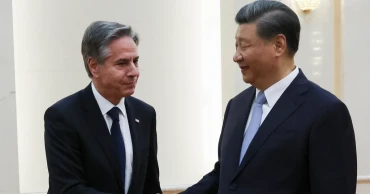
US and China are talking at a high level again, but their rivalry remains unchecked
The United States and China may be back to talking at a high level, but their battle for global power and influence remains unchecked and mutual suspicion still runs deep.
U.S. Secretary of State Antony Blinken set low goals for his visit to Beijing this week, and he met them. About the most the rivals can hope for these days is to stop things getting much worse.
Blinken pointed to difficult days ahead, while China’s foreign ministry warned the relationship was in a downward spiral.
“It was clear coming in that the relationship was at a point of instability, and both sides recognized the need to work to stabilize it,” Blinken said of the reason for his trip. “And specifically, we believe that it’s important to establish better lines of communication, open channels of communication, both to address misperceptions, miscalculations and to ensure that that competition doesn’t veer into conflict.”
The two-day visit to the Chinese capital helped restore top-level ties, but China rebuffed a U.S. request to resume military-to-military contacts. Neither government appears convinced of the other's honesty.
While the two countries say they're not enemies intent on harming each other, they're not pretending to be friends.
Blinken and Xi pledge to stabilize deteriorated US-China ties, but China rebuffs the main US request
After meeting with Chinese President Xi Jinping on Monday, Blinken acknowledged entrenched differences. “We have no illusions about the challenges of managing this relationship. There are many issues on which we profoundly, even vehemently, disagree,” he said.
Xi sounded a similar note, but suggested that the rivalry could be overcome.
“The competition among major countries is not in line with the trend of the times and cannot solve the problems of the United States itself and the challenges facing the world,” he told Blinken. “China respects the interests of the United States and will not challenge or supplant the United States. Similarly, the United States should also respect China and not harm its legitimate rights and interests.”
Danny Russel, the top U.S. diplomat for Asia during the Obama administration who is currently vice president of the Asia Society Policy Institute in New York, said these so-called “negative assurances” -– that China respects the U.S. and is not looking to displace the United States. and that the U.S. is not trying to contain or hinder China -– are important to prevent a collapse in ties.
Blinken to meet Xi, State Department says, in bid to ease US-China tensions
“Both sides clearly used the visit to help stabilize the relationship, which has been lurching toward dangerously intense confrontation,” he said. And, although both the U.S. and China mentioned specific disagreements, especially about Taiwan, Russel said that “the public statements by the two sides were notably positive, particularly by recent standards.”
But Washington and Beijing remain deeply suspicious of each other's actions and intentions.
From the U.S. perspective, China’s rise has challenged its global position.
Washington is racing to repair and shore up its relationships in regions where China has made inroads, particularly Africa and the Indo-Pacific, where the U.S. has opened or plans to open at least five new embassies this year.
Behind the scenes, the U.S. believes China has ulterior and perhaps nefarious motives.
An internal U.S. State Department document prepared earlier this year that focuses on China’s role at the United Nations and other international organizations said Beijing “believes that the People’s Republic of China must dominate and shape international institutions, standards and values in order to advance both its domestic and global agenda.”
“It views the established rules and norms in the U.N. system and other international organizations as privileging Westerns countries, supporting liberal democratic principles, and posing a threat to its monopoly on domestic political power and assertive global ambitions,” said the document, which is marked “SBU,” which means “sensitive but unclassified” and was obtained by The Associated Press.
The document accuses China of having “undertaken a systematic campaign to subvert existing principles and standards, promote authoritarian ideology and policy (and) reprioritize economic development over human rights and democratic governance.”
In addition, it says China is working “to undermine or reshape international law and standards, institutions, and values to legitimize its own development and governance models, including related to human rights (and) using its economic and political influence to compromise institutions’ transparency, effectiveness, independence and alignment with foundational norms and values.”
From the Chinese perspective, the U.S. is clinging to fading glory as the world's lone superpower, and seeking to sabotage China's development and growing international stature by sowing mistrust about Beijing's intentions.
China's top diplomat Wang Yi demanded on Monday that the U.S. stop “hyping the ‘China threat theory’" and “urged the United States not to project on China the template that a strong country must seek hegemony.”
He also said China should not be judged “in the vein of traditional Western powers,” concluding that a change of perspective “is the key on whether the U.S. policy towards China can truly return to objectivity and rationality.”
The rivals are now trying to negotiate more visits: Chinese Foreign Minister Qin Gang agreed in principle to an invitation to visit Washington and U.S. Treasury Secretary Janet Yellen plans to visit China later this summer, while there are also discussions about a new meeting between Xi and President Joe Biden.
But it’s not clear if China and the U.S. have found any issue of substance they can negotiate about. More talks could help with short-term easing of tensions, but it's unlikely to change the fact of a global rivalry.
2 years ago

What we know about the Titanic-bound submersible that's missing with 5 people onboard
A search is underway for a deep-sea vessel that went missing with five people aboard after it dived toward the deteriorating wreck site of the Titanic ocean liner.
The U.S. Coast Guard is leading the search for the small craft, named Titan, in the North Atlantic Ocean. The remote area is where the Titanic struck an iceberg and sank in 1912, killing all but about 700 of the roughly 2,200 passengers and crew.
This was OceanGate Expeditions' third annual voyage to chronicle the deterioration of Titanic since 2021. The sunken ship is about 2.4 miles (3.8 kilometers) below the surface.
Read: Himalayan glaciers could lose 80% of their volume if global warming isn't controlled, study finds
The undersea exploration company has been chronicling the ship's decay as well as the underwater ecosystem that has sprung up around it over the last century.
What we know so far:
WHEN AND WHERE DID THE TITAN GO MISSING?
The craft submerged Sunday morning, and its support vessel lost contact with it about an hour and 45 minutes later, according to the Coast Guard.
The vessel was reported overdue about 435 miles (700 kilometers) south of St. John’s, Newfoundland, according to Canada’s Joint Rescue Coordination Centre in Halifax, Nova Scotia.
The Titan was being launched from an icebreaker that was hired by OceanGate and formerly operated by the Canadian Coast Guard. The ship ferried dozens of people and the submersible craft to the North Atlantic wreck site, where the Titan makes multiple dives.
David Concannon, an adviser to OceanGate, told The Associated Press on Monday that the submersible had a 96-hour oxygen supply. He said officials are working to get a remotely operated vehicle that can reach a depth of six kilometers (3.7 miles) to the site as soon as possible.
WHO WAS ON BOARD?
The Coast Guard said there was one pilot and four “mission specialists” aboard. “Mission specialists” are people who pay to come along on OceanGate’s expeditions. They take turns operating sonar equipment and performing other tasks in the five-person submersible.
An initial group of tourists in 2021 paid $100,000 to $150,000 apiece to go on the trip. OceanGate’s website described the “mission support fee” for the 2023 expedition as $250,000 a person.
Read: Biden ready to welcome Modi, looking past human rights record and ties to Russia
British businessman Hamish Harding, who lives in Dubai in the United Arab Emirates, was one of the mission specialists, according to Action Aviation, a company for which Harding serves as chairman.
Harding is an adventurer who holds three Guinness World Records, including the longest duration at full ocean depth by a crewed vessel. In March 2021, he and ocean explorer Victor Vescovo dived to the lowest depth of the Mariana Trench. In June 2022, he went into space on Blue Origin’s New Shepard rocket.
Shahzada Dawood and his son Suleman, members of one of Pakistan's most prominent families, were also on board, according to a family statement sent to the AP. Their eponymous firm invests in agriculture, industries and the health sector. Shahzada Dawood also is on the board of trustees for the California-based SETI Institute that searches for extraterrestrial intelligence.
WHAT KIND OF DEEP-SEA VESSEL WAS IT?
Titan is capable of diving four kilometers (2.4 miles) “with a comfortable safety margin,” according to documents filed by the company in April with a U.S. District Court in Virginia that oversees Titanic matters.
Read: Mass shootings and violence leave dead and injured across the US this weekend
In a May 2021 court filing, OceanGate said the Titan had an “unparalleled safety feature” that assesses the integrity of the hull throughout every dive. At the time of the filing, Titan had undergone more than 50 test dives, including to the equivalent depth of the Titanic, in deep waters off the Bahamas and in a pressure chamber, the company said.
During its 2022 expedition, OceanGate reported that the submersible had a battery issue on its first dive and had to be manually attached to its lifting platform, according to a November court filing.
WHAT WAS THE TITAN'S MISSION?
The goal of OceanGate's expeditions has been chronicling the Titanic's deterioration as well as the underwater ecosystem that shipwrecks often spawn.
What's left of the Titanic is slowly succumbing to metal-eating bacteria that consumes hundreds of pounds of iron a day. Holes pervade the wreckage, while the crow’s nest is already gone. Some have predicted the ship could vanish in a matter of decades as holes yawn in the hull and sections disintegrate.
The company outfitted the Titan with high-definition cameras and multi-beam sonar equipment. Charting the wreck's decomposition can help scientists predict the fate of other deep-sea wrecks, including those that sank during the world wars. Another focus is the sea life: Hundreds of species have only been seen at the wreck.
"The ocean is taking this thing, and we need to document it before it all disappears or becomes unrecognizable,” Stockton Rush, president of OceanGate Expeditions, told the AP in 2021.
2 years ago

Poorest countries show strong support for IFAD in global efforts to combat hunger and poverty
Ahead of the New Global Financing Pact Summit in Paris, several of the world's poorest countries are increasing their support for the International Fund for Agricultural Development (IFAD), signaling the severe impact of climate catastrophes, inflation, and persistent hunger.
These nations recognize the long-term benefits of agricultural development in creating resilient rural economies.
IFAD is currently undergoing its 13th replenishment of core resources (IFAD13), during which representatives from its 177 member states establish strategic priorities and commit funds for the organization's work from 2025 to 2027.
Noting the strong support generated by early pledges, IFAD President Alvaro Lario urged all member states to demonstrate ambition in their financial commitments to improve the lives of small-scale farmers and impoverished rural communities.
Alvaro Lario emphasized that IFAD member states have committed to eliminating poverty and hunger by 2030 while transforming food systems. Recognizing the challenging times, Lario stressed that higher funding for agriculture and food systems is crucial.
This statement was made during the second consultation with member states.
Also read: IFAD President lauds Bangladesh's remarkable achievements in food production, climate-smart agriculture
Several low- and lower-middle-income countries have already made early pledges, including Cambodia ($1 million), Côte d'Ivoire ($1 million), the Democratic Republic of the Congo ($0.5 million), Niger (approximately $0.164 million), and South Sudan ($0.1 million). While many of these nations receive concessional loans from IFAD, they also contribute to the Fund to demonstrate their support and encourage others to do the same.
Josephine Joseph Lagu, Minister of Agriculture and Food Security in South Sudan, encouraged other countries to contribute to IFAD13, highlighting the significant benefits that outweigh the contributions.
IFAD is the sole United Nations development organization and international financial institution dedicated to transforming rural economies and food systems to be more inclusive, productive, resilient, and sustainable.
Also read: G20: IFAD President Alvaro Lario advocates for increased investment in rural transformation
During the meeting, Rania Al-Mashat, Egypt's Minister of International Cooperation, expressed the collective sentiment by rallying behind IFAD's 13th Replenishment and recognizing the urgent need to support its mission.
She acknowledged the undeniable impact of IFAD's work.
Small-scale food producers play a critical role in supplying one-third of the world's food and up to 70 percent of food consumed in certain low- and middle-income countries. Paradoxically, they are disproportionately affected by hunger, poverty, conflict, and climate change.
These farmers earn only $0.06 for every $1 worth of food they produce, while 80 percent of the world's poorest people reside in rural areas, according to a press release.
Also read: Bangladesh, IFAD sign financing deal for USD 31 million project to diversify agriculture
Lario reminded member states that investing in agriculture and rural development is one of the most effective ways to combat hunger, poverty, fragility, migration, and the loss of ecosystems and biodiversity.
He expressed pride in IFAD's reputation as one of the highest-rated development organizations globally, offering a unique value proposition with extensive reach, outstanding results, and an exceptional return on investment.
IFAD's commitment and relevance to global food security were recently recognized in the G7's Hiroshima Action Statement.
Ahead of the session, traditional IFAD donors, including Germany, expressed their commitment to IFAD's work.
Also read: Placing small-scale farmers, rural populations at heart of climate discussions: IFAD at COP 27
Jochen Flasbarth, State Secretary of Germany's Federal Ministry for Economic Cooperation and Development (BMZ), emphasized the need for sufficient funding for IFAD, linking efforts to climate change adaptation and building climate-resilient agriculture.
Flasbarth also emphasized the importance of empowering women within supply chains and food systems for increased resilience.
Manuel Nogales, Executive Director of Acodea, the Spanish agency for international development cooperation and a long-term IFAD partner, highlighted the necessity of increasing food production through inclusive and sustainable food systems.
IFAD plays a vital role in helping countries feed their people while promoting economic and social development in rural areas sustainably.
Today's consultation will be followed by another session in November, with a final pledging meeting with member states scheduled for December.
2 years ago

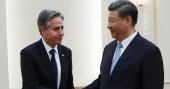
Xi meets Blinken in Beijing
Chinese President Xi Jinping met with U.S. Secretary of State Antony Blinken at the Great Hall of the People on Monday.
Xi said that Wang Yi, director of the Office of the Foreign Affairs Commission of the Communist Party of China Central Committee, and Chinese State Councilor and Foreign Minister Qin Gang described their talks with Secretary Blinken as candid and in-depth.
Also Read: Blinken to meet Xi, State Department says, in bid to ease US-China tensions
"The Chinese side has made its position clear, and the two sides have agreed to follow through on the common understandings President Biden and I reached in Bali," said Xi, adding that the two sides also made progress and reached agreement on some specific issues.
Also Read: Blinken opens second day of talks in Beijing on mission to ease soaring US-China tensions
State-to-state interactions should always be based on mutual respect and sincerity, said Xi. "I hope that Secretary Blinken, through this visit, could make positive contributions to stabilizing China-U.S. relations."
Also Read: Blinken opens second day of talks in Beijing on mission to ease soaring US-China tensions
2 years ago

Amazon, Marriott and other companies vow to hire thousands of refugees in Europe
Multinational companies including Amazon, Marriott and Hilton pledged Monday to hire more than 13,000 refugees, including Ukrainian women who have fled the war with Russia, over the next three years in Europe.
Just ahead of World Refugee Day on Tuesday, more than 40 corporations say they will hire, connect to work or train a total of 250,000 refugees, with 13,680 of them getting jobs directly in those companies.
"Every number is a story of an individual family who left everything, seeking safety, seeking protection and wanting to be able to rebuild as quickly as possible," said Kelly Clements, U.N. deputy high commissioner for refugees. "So the commitments that businesses are going to make on Monday are absolutely essential."
Also Read: Ukrainian refugees safe, but not at peace, after year of war
She says 110 million people have been displaced worldwide, with an estimated 12 million from Ukraine, nearly half of whom are living in Europe after the continent's largest movement of refugees since World War II.
The hiring push in Europe was organized by the Tent Partnership for Refugees, a nonprofit founded by Chobani CEO Hamdi Ulukaya that connects businesses and refugees, and is being unveiled at a gathering in Paris. The group's first summit in the U.S. last year led to commitments to hire 22,725 refugees.
In the new round, Amazon leads the pack, vowing to hire at least 5,000 refugees over the next three years in Europe, followed by Marriott and Hilton with 1,500 each, Starbucks and ISS with 1,000 each, and smaller commitments from brands like Adidas, Starbucks, L'Oreal, PepsiCo and Hyatt.
Also Read: UN agencies face funding challenges in feeding Rohingya refugees in Bangladesh, official says
"This is good for us as a company because the opportunity to add diversity to our workforce will continue to make us a stronger company," said Ofori Agboka, Amazon vice president overseeing human resources. "With diversity brings innovation, creativity, different insights."
He said the vast majority of jobs will be hourly roles at fulfillment and storage centers and in transport and delivery.
Amazon announced 27,000 job cuts earlier this year, part of a wave of layoffs after tech companies ramped up hiring during the COVID-19 pandemic. Those layoffs primarily affected salaried office jobs, Agboka said.
Also Read: Afghan refugees in Pakistan protest delay in US resettlement
Daria Sedihi-Volchenko fled Kyiv last year and now works in Warsaw, Poland, as a senior program manager for an Amazon Web Services program providing free tech training for Ukrainians. She says about 40% of those in the program have no tech background.
"I went through the same way as many of our learners ... are going through," she said. "I had to learn, and I took a commitment on my interview. I said that 'OK, if we can agree and I can start working for you, I promise to learn Polish and I promise to learn technical skills.'"
A year ago, Sedihi-Volchenko woke up to explosions from Russia's invasion.
"I was terrified. I was so scared for Ukraine, for the nation, for the future, for my own life," she said. "But also that was a shocking moment when I understood that everything in my life is changing."
She began living in basements but left as Russian forces approached Kyiv. She drove 40 hours to reach Moldova, thankful that she "didn't drive on a single land mine and nobody shot into my car."
She went to Poland to find work, embarking on an IT path after working as a project manager for government ministries and as an economist in Ukraine.
Companies are hoping refugees can fill staffing needs after the economy bounced back from the pandemic. In Europe, unemployment is at its lowest since the euro currency was introduced in 1999.
Also Read: UN agencies seek $5.6B to help Ukraine, its refugees abroad
"We're seeing record levels of demand for our properties across many markets here in Europe," Marriott International CEO Anthony Capuano said. "And so we are hiring aggressively to make sure we can accommodate our guests as demand ramps up."
Marriott's jobs will largely be hourly positions like housekeepers, kitchen staff and front desk attendants.
European nations have welcomed Ukrainians, and while Clements applauded opening schools, workplaces and other opportunities to them, she said the same should be offered to others fleeing conflict and crises in places like Syria, Sudan and Afghanistan.
Sedihi-Volchenko knows the challenges ahead for refugees, even as some companies offer help with language skills, counseling and training. Job listings can be difficult to decipher, and like her, they may have difficulty securing a stable internet connection or work clothes.
"It's important to give a refugee just time to learn the language, but the person can start working because if you bring experience with IT systems or finance or project management or any other area, naturally, you understand, it's not so much about the language. You understand the flow of work," she said.
2 years ago
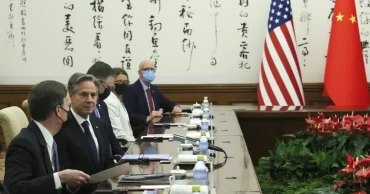
Blinken to meet Xi, State Department says, in bid to ease US-China tensions
U.S. Secretary of State Antony Blinken will meet with Chinese President Xi Jinping at 4:30 p.m. Monday, the State Department said, as America's top diplomat wrapped up a two-day visit to Beijing aimed at easing soaring tensions.
A Blinken-Xi meeting had been expected, but neither side had confirmed it would happen until just an hour before the talks, which are seen as key to the success of the trip. A snub by the Chinese leader would have been a major setback to the effort restore and maintain communications at senior levels.
Blinken is the highest-level U.S. official to visit China since President Joe Biden took office, and the first secretary of state to make the trip in five years. His visit is expected to usher in a new round of visits by senior U.S. and Chinese officials, possibly including a meeting between Xi and Biden in the coming months.
Also Read: Blinken opens second day of talks in Beijing on mission to ease soaring US-China tensions
The encounter with Xi comes on the second and second and final day of Blinken's critical meetings with senior Chinese officials. The two sides have thus far expressed willingness to talk but have showed little inclination to bend on hardened positions that have sent tensions soaring.
Blinken met earlier Monday with China's top diplomat Wang Yi for about three hours, according to a U.S. official.
Also Read: Blinken kicks off meetings in Beijing on high-stakes mission to cool soaring US-China tensions
Neither Blinken nor Wang made any comment to reporters as they greeted each other and sat for their discussion.
China's Ministry of Foreign Affairs wrote in a statement that Blinken's visit "coincides with a critical juncture in China-U.S. relations, and it is necessary to make a choice between dialogue or confrontation, cooperation or conflict," and blamed the "U.S. side's erroneous perception of China, leading to incorrect policies towards China" for the current "low point" in relations.
It said the U.S. had a responsibility to halt "the spiraling decline of China-U.S. relations to push it back to a healthy and stable track" and that Wang had "demanded that the U.S. stop hyping up the 'China threat theory', lift illegal unilateral sanctions against China, abandon suppression of China's technological development, and refrain from arbitrary interference in China's internal affairs."
Also Read: Attempt to cool US-China tensions: Blinken in Beijing on high-stakes diplomatic mission
Despite Blinken's presence in China, he and other U.S. officials had played down the prospects for any significant breakthroughs on the most vexing issues facing the planet's two largest economies.
Instead, these officials have emphasized the importance of the two countries establishing and maintaining better lines of communication.
The State Department said Blinken "underscored the importance of responsibly managing the competition between the United States and the PRC through open channels of communication to ensure competition does not veer into conflict."
In the first round of talks on Sunday, Blinken met for nearly six hours with Chinese Foreign Minister Qin Gang after which both countries said they had agreed to continue high-level discussions. However, there was no sign that any of the most fractious issues between them were closer to resolution.
The two sides both said Qin had accepted an invitation from Blinken to visit Washington but Beijing made clear that "the China-U.S. relationship is at the lowest point since its establishment." That sentiment is widely shared by U.S. officials.
Blinken is the highest-level American official to visit China since President Joe Biden took office and his two-day trip comes after his initial plans to travel to China were postponed in February after the shootdown of a Chinese surveillance balloon over the U.S.
Biden and Xi had made commitments to improve communications "precisely so that we can make sure we are communicating as clearly as possible to avoid possible misunderstandings and miscommunications," Blinken said before leaving for Beijing.
His talks could pave the way for a meeting in the coming months between Biden and Xi. Biden said Saturday that he hoped to be able to meet with Xi in the coming months to take up the plethora of differences that divide them.
That long list incudes disagreements ranging from trade to Taiwan, human rights conditions in China and Hong Kong to Chinese military assertiveness in the South China Sea and Russia's war in Ukraine.
In his meetings on Sunday, Blinken also pressed the Chinese to release detained American citizens and to take steps to curb the production and export of fentanyl precursors that are fueling the opioid crisis in the United States.
Xi offered a hint of a possible willingness to reduce tensions Friday, saying in a meeting with Microsoft Corp. co-founder Bill Gates that the United States and China can cooperate to "benefit our two countries."
Since the cancellation of Blinken's trip in February, there have been some high-level engagements. CIA chief William Burns traveled to China in May, while China's commerce minister traveled to the U.S. And Biden's national security adviser Jake Sullivan met with senior Chinese foreign policy adviser Wang Yi in Vienna in May.
But those have been punctuated by bursts of angry rhetoric from both sides over the Taiwan Strait, their broader intentions in the Indo-Pacific, China's refusal to condemn Russia for its war against Ukraine, and U.S. allegations from Washington that Beijing is attempting to boost its worldwide surveillance capabilities, including in Cuba.
And, earlier this month, China's defense minister rebuffed a request from U.S. Defense Secretary Lloyd Austin for a meeting on the sidelines of a security symposium in Singapore, a sign of continuing discontent.
Meanwhile, the national security advisers of the United States, Japan and the Philippines held their first joint talks last week and agreed to strengthen their defense cooperation, in part to counter China's growing influence and ambitions.
This coincides with the Biden administration inking an agreement with Australia and Britain to provide the first with nuclear-powered submarines, with China moving rapidly to expand its diplomatic presence, especially in the Indian Ocean and the Pacific island nations, where it has opened or has plans to open at least five new embassies over the next year.
The agreement is part of an 18-month-old nuclear partnership given the acronym AUKUS — for Australia, the United Kingdom and the United States.
2 years ago

Global Covid-19 cases now over 690 million
The overall number of Covid-19 cases around the world has now surpassed 690 million.
According to the latest global data, the total Covid-19 case count is 690,481,202, while the death toll reached 6,892,593 this morning.
The US has reported 107,243,887 Covid-19 cases so far, while 1,167,334 people have died from the virus in the country — both highest counts globally.
Read: After long waits, new pilgrims prepare for Hajj's return, the first major one since COVID-19
India recorded 108 new coronavirus cases, raising the tally to 4.49 crore, while the active cases decreased to 1,983, according to the Union health ministry.
The death toll due to the viral disease stood at 5,31,893, the data showed.
France and Germany have registered 40,124,619 and 38,428,685 Covid-19 cases so far, occupying the third and fourth positions in the world number-wise, and 167,548 and 174,352 people have died in the European countries, as per Worldometer.
Read: Billions of dollars in Covid-19 relief aid stolen or wasted in the US
Covid-19 situation in Bangladesh
Bangladesh reported two more Covid-19-linked deaths and 230 fresh cases in 24 hours till Sunday morning.
With the new numbers, the country's total fatalities rose to 29,457 and caseload to 2,041,470, according to the Directorate General of Health Services (DGHS).
Read: Covid-19 numbers keep rising: 114 more cases reported
The daily case test positivity rate increased to 7.75 per cent from Saturday’s 5.41 as 2,967 samples were tested.
2 years ago

Kamau, 'charismatic and iconic' African lion at California's Sacramento Zoo, dies at 16
Kamau, the African lion who was a star attraction at California's Sacramento Zoo, has died at age 16, officials said.
The zoo said Kamau was euthanized Saturday, a day after the big cat was pulled off an exhibit because of declining health due to his advanced age.
READ: Oldest Magellanic penguin at San Francisco Zoo dies at 40
The lion was considered elderly with worsening gastrointestinal problems, "and the difficult decision to proceed with humane euthanasia was made when medical treatment options failed to provide sufficient relief from his condition," the zoo said in a statement.
The statement called Kamau one of the zoo's “most charismatic and iconic animals.”
READ: Tiger couple gives birth to 4 more rare white cubs in Ctg Zoo
He came to Sacramento from the San Diego Zoo in 2008 and in the years since attracted crowds who hoped to hear his impressive roar.
In 2014, the lion sired a litter of cubs. A few years later, his habitat doubled in size, and a glass viewing wall allowed guests to get “nose-to-nose” with both Kamau and his mate, Cleo, the zoo said.
READ:Message to Zoo Visitors: Don't feed the Wildlife your food for the good of both you and them
Cleo, now 18, is in good health. African lions typically live 10 to 15 years, the zoo said, but they can live up to 25 years in captivity.
2 years ago
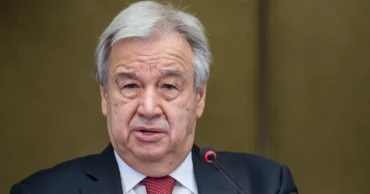
Eliminate legal barriers to women owning land: UN chief
UN Secretary-General Antonio Guterres has urged all governments to eliminate legal barriers to women owning land, and to involve them in policymaking.
“Support women and girls to play their part in protecting our most precious resource. And together, let’s stop land degradation by 2030,” he said in a message marking the World Day to Combat Desertification and Drought that falls on June 17.
The UN chief said unsustainable farming is eroding soil 100 times faster than natural process can restore them. “We depend on land for our survival. Yet we treat it like dirt.”
And, he said, up to 40% of our planet’s land is now degraded: imperiling food production; threatening biodiversity; and compounding the climate crisis.
“This hits women and girls the hardest. They suffer disproportionately from the lack of food, water scarcity, and forced migration that result from our mistreatment of land. Yet they have the least control,” said the UN chief.
In many countries, he said, laws and practices block women and girls from owning land. “But where they do, they restore and protect it: increasing productivity; building resilience to drought and investing in health, education and nutrition.”
Guterres said equal land rights both protect land and advance gender equality; and that is why this Desertification and Drought Day puts the focus on “her land, her rights”.
2 years ago