Foreign-Affairs

'Intruder guy': Chief Adviser's Special Assistant Mahfuj Alam refers to third youth on stage at CGI event
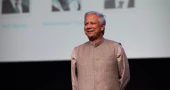
Chief Adviser's Special Assistant Mahfuj Alam has spoken about the third youth sharing the stage with them, former US President Bill Clinton, and Prof Yunus, identifying him as the "intruder guy."
"Apologies to the leaders, co-ordinators, and fighters of the movement and mass uprising. I couldn't deter him from the treacherous act of sabotage," Mahfuj wrote on his verified Facebook account about the Clinton Global Initiative (CGI) Event.
He said the person at the event was an “intruder and a dishonest person.”
The third youth, besides Mahfuj and Tithi, joined the CGI event in his own capacity.
"We, including the members of the delegation there, didn't know about his presence and intention. He didn’t contact anyone from the delegation," Mahfuj Alam said.
"When Sir (Prof Yunus) called us up on the stage, he stood hastily and ran towards the stage before us. I couldn't resist that guy from going on at stage, though I was suspicious. Again, I was helpless among world leaders and dignitaries," Mahfuj wrote.
It seems that, it was a “pre-designed act of sabotage from fascist ilk,” he added.
Mahfuj said they will be very cautious about the representation of the mass uprising in the coming days.
At the CGI event, Prof Yunus introduced Mahfuj Alam as the “person behind the July-August revolution.”
Prof Yunus sought support for them to implement their dreams of building a new Bangladesh.
"Please help them, support them, so that their dreams come true. This is the responsibility we take together," Prof Yunus said, taking three youngsters on the stage including Mahfuj Alam and Brac University student Aysha Siddiqua Tithi amid rounds of applause from the floor.
The Chief Adviser shared the stage with former US President Bill Clinton at the Clinton Global Initiative 2024 meeting in New York on Tuesday afternoon (NY time).
1 year ago

Sweden provides additional USD 1.85 million in humanitarian aid for flood-affected communities in Bangladesh
Sweden is providing USD 1.85 million, or Tk 22.2 crore, of vital humanitarian assistance through Norwegian Refugee Council (NRC), Islamic Relief, Danish Refugee Council (DRC) and Action Against Hunger (AAH) to communities affected by the floods in eastern Bangladesh.
The humanitarian support will be utilized to provide cash assistance to affected families, helping nearly 95,000 individuals access essential needs such as food, shelter, and livelihood opportunities, according to a press release.
Additionally, 5,800 children will be given the chance to return to school.
The Norwegian Refugee Council (NRC) will through Uttaran, Young Power in Social Action (YPSA) and Resource Integration Centre (RIC) provide cash grants to 3,015 households, shelter kits to 1,500 households and cash for work to facilitate the reopening of 29 schools in eastern Feni, Cumilla and Noakhali districts.
Islamic Relief will provide cash grants and hygiene kits to 6,500 households in Feni and Noakhali districts.
The Danish Refugee Council (DRC) will through Uttaran provide cash grants to 750 households, agriculture inputs to 1,200 households, and cash for work opportunities to repair and clean community infrastructure including drinking water points, irrigation channels, fishponds, agricultural roads, and individual shelters in Noakhali and Cox’s Bazar districts. Action Against Hunger (AAH) will through Uttaran and Shushilan provide cash grants to 1,000 households and cash support to 120 pregnant women, essential health services to 1,000 children and nutrition vouchers for 180 children, menstrual hygiene kits to 640 women, rehabilitate 250 water points and 280 latrines, and mental health and psychosocial support to 2,000 individuals in Feni and Noakhali districts.
Furthermore, Sweden’s flexible funding enabled the World Food Programme (WFP) to initiate its emergency response within days of the floods, providing essential food aid to over 130,000 people in Cumilla, Feni, Noakhali, Maulvibazar, Lakshmipur, and Cox’s Bazar.
As one of the largest humanitarian donors globally, Sweden is also the leading contributor to the UN's Central Emergency Response Fund (CERF), which recently allocated USD 4 million to assist with the eastern floods.
With this latest contribution, Sweden’s total humanitarian aid to Bangladesh for 2024 reaches USD 12.2 million (approximately Tk. 146 crore).
1 year ago

‘Hasina should be extradited, brought to justice’: Prof Yunus
Chief Adviser Prof Muhammad Yunus has said former Prime Minister Sheikh Hasina should be extradited and brought to justice if she committed crimes.
"Why shouldn't be? If she committed crimes, she should be extradited and brought to justice… She should be facing justice too," he said while responding to a question at "The New York Times Climate Forward Event."
Referring to Hasina, Law Affairs Adviser Dr Asif Nazrul recently said Bangladesh will definitely seek extradition of any convicted person under the extradition treaty with India once trials begin.
“We have an extradition treaty with India. As per the extradition treaty, if any convicted person stays in India, we can seek his or her extradition. We will soon let you know through the Law Ministry,” he told reporters while responding to a question at a media briefing in Dhaka.
Sheikh Hasina, who left the country on August 5, is facing a number of cases.
The government has taken some steps and there are some visible progress including formation of investigation and prosecution teams.
Asked whether he will run in the election, the Nobel Peace Laureate Prof Yunus said, "No way, that's not me."
He said that he had no plans to run for office. “Do I look like someone who would run?”
Responding to a question on “street justice,” Prof Yunus said people abroad are getting “exaggerated news” and invited journalists to come and report whatever they see with their own eyes.
Regarding the election, Prof Yunus said it should not be too far as reform initiatives have been undertaken.
Commissions formed towards achieving reforms are: Electoral System Reform Commission headed by Dr Badiul Alam Majumdar, Police Administration Reform Commission headed by Sarfaraz Hossain, Judiciary Reform Commission headed by Justice Shah Abu Naeem Mominur Rahman, Anti-Corruption Reform Commission headed by TIB’s Dr Iftekharuzzaman, Public Administration Reform Commission headed by Abdul Mueed Chowdhury and Constitution Reform Commission headed by Distinguished Prof at Illinois State University Dr Ali Riaz.
These commissions will start working from October 1 and they will submit their reports by December 31.
‘You are the cause, we are the result.’
Prof Yunus also said, the Paris Agreement, the global accord for limiting the effects of climate change, won’t work as long as the world sticks with the current economic system.
That system, he said, is centered on maximizing profits, creating wealth for a tiny group of people and generating massive waste.
“The economic system we have built is key to the destruction of this planet,” said Yunus, adding that humans had created a “self-destructive civilization.”
Speaking at the New York Times Climate Forward summit, Yunus, a pioneer of microfinance, said that no matter what changes were made to the agreement, it would not make a difference until the world’s underlying systems were redesigned.
Developing countries like Bangladesh should not have to bear the burden of the climate damage done by their wealthier counterparts, he said.
“Why should we carry the burden of all the destruction that you put on us?” Yunus said. “You are the cause, we are the result.”
He added that individuals should also bear the responsibility of producing less waste and shrinking their fossil fuel footprint.
Prof Yunus spoke about the challenges of leading a country experiencing some of the worst effects of climate change.
Asked what rich countries owe to countries like his, Yunus said the global framework for climate action needed radical change, with a focus on net-zero emissions and the elimination of extreme wealth inequality.
The New York Times on Wednesday brought together innovators, activists, scientists and policymakers for an all-day event of live journalism examining the actions needed to confront climate change.
The event, Climate Forward, included frank discussions of the political and policy challenges surrounding climate change.
It featured some of the world’s leading newsmakers — including Jane Goodall, Muhammad Yunus and R.J. Scaringe — to share ideas, work through problems and answer tough questions about the threats presented by a rapidly warming planet.
1 year ago
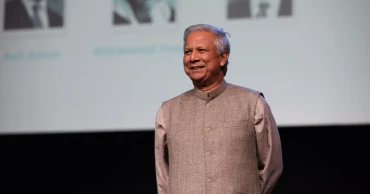
Bangladesh to uphold human rights, freedom of speech: Prof Yunus
Chief Adviser Professor Muhammad Yunus on Wednesday said that his government is committed to upholding human rights and freedom of speech in Bangladesh.
He made the comments when senior officials of more than half a dozen top global human rights groups met him at a hotel in New York.
During the meeting, justice and accountability for the atrocities and human rights abuses committed during the July-August mass uprising and also during Sheikh Hasina's 15 year long dictatorship were discussed.
Human rights officials stressed the need for more investigations into some 3,000 extrajudicial killings carried out during the dictatorship, according to the Chief Adviser's press wing.
They also called for security sector reforms, repeal of the Cyber Security Act and deeper probe, unfettered access to and accountability for the detention centres where the victims of enforced disappearances were kept during the dictatorship.
Kerry Kennedy, president of the Robert F Kennedy Human Rights, led the delegation of nine HR officials. Agnes Callamard, Secretary General of Amnesty International, also joined the meeting.
Callamard said the Interim Government should send "a powerful message demonstrating that this is a new Bangladesh."
Chief Adviser Professor Muhammad Yunus briefly outlined how civil liberties and human rights were denied during the autocratic regime and what his government has so far done to establish human rights in the country.
The Chief Adviser said his government has set up several commissions, including one on the police, to carry out vital reforms and institutional changes in Bangladesh.
He said his government would welcome any criticism of its activities and vowed that the interim administration would uphold freedom of speech.
"This government isn't bothered by any criticism. In fact, we are inviting criticism," he said, adding the government "won't restrict any voices" in the country.
Mohammad Ashrafuzzaman, formerly a Hong Kong-based human rights activist, and Julia Bleckner, a senior researcher of Human Rights Watch, also spoke during the meeting.
1 year ago

Prof Yunus seeks Gates Foundation's enhanced support for Bangladesh's health sector
Chief Adviser Prof Muhammad Yunus urged the Bill & Melinda Gates Foundation, the world's leading charitable organization, to come forward with an enhanced support for the health sector of Bangladesh.
Global CEO of the Gates Foundation Mark Suzman shared Foundation's burgeoning engagements and vision for wider engagements in healthcare, nutrition, youth technologies and agriculture in Bangladesh with Chief Adviser Prof Muhammad Yunus in New York on Wednesday (NY time).
"Chief Adviser has requested the Gates Foundation to increase its cooperation in health and other sectors in Bangladesh," Chief Adviser's Press Secretary Shafiqul Alam told UNB.
Mark Suzman responded positively to this and showed interest in increasing their involvement in Bangladesh.
Gates Foundation conducts financial support and charitable programs in the health sector worldwide.
The institute is involved in vaccine production and ICDDRB in Bangladesh.
Referring to the meeting, Alam said Gates Foundation's interest in increasing their support in the health sector of Bangladesh means increasing the quality of health services in Bangladesh and creating new jobs.
During the meeting, the Chief Adviser called for the management of social business in other sectors as well as health care in Bangladesh.
Guided by the belief that every life has equal value, the Bill & Melinda Gates Foundation works to help all people lead healthy, productive lives.
In developing countries, it focuses on improving people's health and giving them the chance to lift themselves out of hunger and extreme poverty.
1 year ago

US launches Young South Asian Leaders Initiative
Acting Under Secretary for Public Diplomacy Lee Satterfield and Assistant Secretary for South and Central Asian Affairs Donald Lu have launched the Young South Asian Leaders Initiative (YSALI).
This will bring together youth from Bangladesh, Bhutan, India, Maldives, Nepal, Pakistan, and Sri Lanka to address shared issues of importance, including economic opportunity, environmental resilience, and civic participation, according to the US Department of State.
With more than 420 million young people across South Asia, YSALI will provide networking opportunities, leadership training, and professional exchanges and academic fellowships to support their efforts to drive positive impact in their home countries and across the region.
The announcement made on Wednesday (US time) at an event on the margins of the United Nations General Assembly brought together government officials from across South Asia, private sector and civil society partners, and students, demonstrating the United States’ continued commitment to engage and empower young people globally by expanding the youth network model to South Asia.
YSALI joins regional youth networks from across the globe, including the Young African Leaders Initiative (YALI), the Young Southeast Asian Leaders Initiative (YSEALI), and the Young Leaders of the Americas Initiative (YLAI).
1 year ago

WB to provide USD 3.5 billion to support Bangladesh's reform initiatives: Ajay Banga
President of the World Bank, Ajay Banga, has said the bank would provide 3.5 billion US dollars to Bangladesh to support the Interim Government's reform initiatives, including reforms in the financial sector.
The World Bank President announced the support during a meeting with Bangladesh Chief Adviser Prof Muhammad Yunus on the sideline of the UN General Assembly at the UN Headquarters on Wednesday afternoon (NY time).
Banga, a long time friend of Prof Yunus, said at least two billion US dollars would be fresh lending and another 1.5 billion dollars would be repurposed from the existing programmes.
World Bank would support reforms in digitisation, liquidity, energy and power and transport, said Chief Adviser's Press Secretary Shafiqul Alam quoting the World Bank President.
During the meeting, Professor Yunus sought the World Bank support for the wide-range reforms the Interim Government had undertaken.
He asked the World Bank to be creative about its lending programme.
"It is a big opportunity to rebuild the country," Prof Yunus said.
The World Bank President discussed the energy sector cooperation in South Asia and how hydroenergy produced in Nepal and Bhutan could be shared by neighbours such as India and Bangladesh.
Energy and Power Adviser Fouzul Kabir Khan was also present in the meeting.
1 year ago

China wants to invest in solar panels manufacturing; deepen ties with Bangladesh
Chinese Foreign Minister Wang Yi has said his country wants to invest in solar panels manufacturing in Bangladesh and further deepen trade and economic ties with Bangladesh.
He made the announcement when he called on Bangladesh Chief Adviser Prof Muhammad Yunus on the sideline of the UN General Assembly at the UN headquarters on Wednesday afternoon (NY time).
"If Chinese investment comes to Bangladesh for solar panels manufacturing, it will be a milestone as it's a massive investment and will help create huge jobs," said Chief Adviser's Press Secretary Shafiqul Alam after the meeting.
He said Bangladesh will make benefit out of that investment, and Bangladesh would be a major exporter of solar panels.
Alam said China wants to strengthen "comprehensive strategic cooperative partnership" with Bangladesh.
The Chinese foreign minister described Prof Yunus as "an old friend of the Chinese people," and he congratulated the Chief Adviser for assuming the leadership of the Interim Government.
"We have full confidence in you that you will live up to the expectations of the people," he said, adding that he would unite the country.
Wang Yi said China would attach importance to Prof Yunus's call to Chinese solar panel manufacturers to set up plants in Bangladesh.
The Chief Adviser made the call when the Chinese ambassador to Dhaka paid a courtesy call on with him last month.
The Chinese foreign minister said Beijing would also encourage greater cooperation and partnership between the companies of two nations.
He said Bangladesh would also benefit from Chinese decision to allow zero tariff access to all goods from the Least Developed Countries.
He said Chinese Red Cross has sent a team of doctors to treat the students and people who were grievously injured during the July-August mass uprising. Wang Yi also said China would welcome more students from Bangladesh.
Prof Yunus thanked China for the gesture. He also praised "amazing" Chinese efforts to lift hundreds of millions of people out of poverty.
He said Chinese solar companies could invest in a bigger way in Bangladesh, which enjoys preferable market access to many rich nations.
Prof Yunus also called other Chinese manufacturers to relocate their factories to Bangladesh.
The Chief Adviser stressed closer relations with China and opening "a new chapter" in the ties between the two nations.
He also called for increasing technological collaboration between the companies of both nations.
"We will love to collaborate with Chinese companies. We have a lot of scope to wirk together," Prof Yunus said.
1 year ago
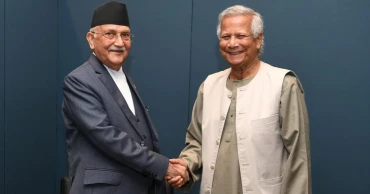
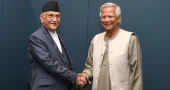
Prof Yunus, PM Oli seek enhanced cooperation in energy, trade, transit
Chief Adviser Prof Muhammad Yunus and Nepal's Prime Minister K P Sharma Oli have discussed enhancing business, energy and transport collaboration between Bangladesh and Nepal.
During a meeting on the sidelines of the United Nations General Assembly on Wednesday afternoon (NY time), they acknowledged the growing presence of Nepal's students in Bangladesh.
"Delighted to meet with Chief Adviser Prof Dr Muhammad Yunus. Discussed Nepal-Bangladesh relations, focusing on eenergy and transit cooperation, tourism, cultural exchanges, educational ties, and cooperation in regional/multilateral forums," Prime Minister Oli said.
Chief Adviser Prof Yunus called for increased trade and economic cooperation with Nepal.
Energy cooperation, trade and people to people interactions between the two South Asian nations featured prominently during the talks.
Prof Yunus stressed the need for increased energy trade between two nations, saying Nepal is endowed with a huge amount of renewable energy.
Bangladesh is expected to sign a 40 megawatt power purchase agreement with Nepal next month.
Chief Adviser's Press Secretary Shafiqul Alam said Bangladesh is expected to sign a 40 megawatt power purchase agreement with Nepal next month.
Alam said the two countries have a deep relationship with strong people to people contacts.
Nepalese delegates at the meeting said the country would be able to export more electricity in a few years.
Energy, power and transport Adviser Fouzul Kabir Khan and senior secretary and SDG Affairs Coordinator Lamiya Morshed we're also present during the meeting.
Prof Yunus also met with USAID - US Agency for International Development - Administrator Samantha Power; Prime Minister of Pakistan Shehbaz Sharif; UN Human Rights Commissioner Volker Turk; World Bank President Ajay Banga; global CEO of Bill and Melinda Gates Foundation Mark Suzman.
Prof Yunus also addressed a UN high-level event on Social Business, Youth and Technology, and met with a group of human rights CSOs.
He also joined a conversation on climate change by The New York Times (livestreamed from NYT studio).
1 year ago
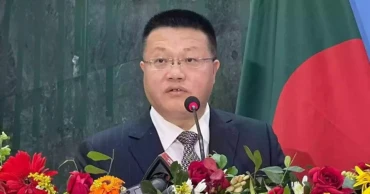
A nation prospers only when its young people thrive: Chinese Ambassador Yao Wen
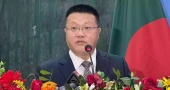
Celebrating the 75th anniversary of the founding of China, Chinese Ambassador to Bangladesh Yao Wen on Wednesday said a nation will prosper only when its young people thrive.
"Young people are the most energetic and full of dreams. Youth are the hope and will be the leaders of the future," he said.
The ambassador said youth are living in a remarkable time, and enjoy a promising prospect to fulfill their dreams. “I expect the young people to devote themselves to China-Bangladesh cooperation, passing the torch of friendship from generation to generation.”
Next year is also “China-Bangladesh Year of People-to-People Exchanges”.
"We will come out with dozens of functions in the sectors of political exchange, economic and trade cooperation, culture, education, tourism, sports, public health, youth, women, media, academic interactions," said Ambassador Yao.
"All the celebrations aim at improving the friendly relations between us, delivering more benefits to the peoples of both countries, especially the young people," he said.
Commerce and Finance Adviser Dr Salehuddin Ahmed joined the reception as the chief guest. Foreign Secretary Md Jashim Uddin was also present.
China and Bangladesh are traditionally friendly neighbors and comprehensive strategic cooperative partners.
"Our bilateral relations are based on the Five Principles of Peaceful Coexistence, with full respect to the independence, sovereignty, territorial integrity of Bangladesh," said Ambassador Yao.
He said they believe no one but the Bangladeshi people have the right to choose their path of development. "No matter what changes have taken place inside Bangladesh, China’s commitment to develop our bilateral relations remains unchanged."
China sincerely hopes that under the leadership of the interim government, Bangladesh will carry out state reform, maintain political stability, advance economic development and improve people’s livelihood.
To support the development of Bangladesh, he said, China will unilaterally open its market and decided to grant zero-tariff treatment on 100% of taxable items to Bangladesh, which means China will substantially increase import of cereals, sugar, edible oil, rubber and rubber products, wood products, jute and jute products, paper and paper products,wool and cotton from Bangladesh from December 1, 2024.
China will also import Bangladeshi mangoes.
To combat the flood, China is about to provide rescue facilities and equipment to Bangladesh.
During the last one and a half months since the establishment of the interim government, the Chinese enterprises have invested more than 85 millions US dollars, demonstrating the confidence China holds for the future development of Bangladesh and relations between the two countries.
"I also want to stress that at the request of the Interim Government, China has sent the National Emergency Medical Team to provide assistance in treatment of those injured in the recent uprising. They are all top medical experts in China from West China Hospital. Today we are honored to have them attend our celebration," said the ambassador.
Next year marks the 50th anniversary of diplomatic ties between China and Bangladesh.
"China is looking forward to working closely with Bangladesh to cement our traditional friendship, deepen friendly exchanges and mutually-beneficial cooperation in various areas, promote high-quality Belt and Road cooperation, and further advance the comprehensive strategic cooperative partnership to a new height," he said.
1 year ago