Foreign-Affairs
Germany to support Bangladesh reforms; pledges 600 million Euro for renewable enegery
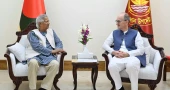
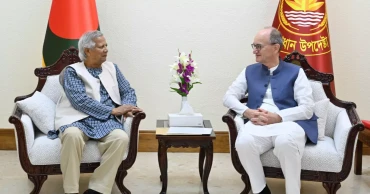
German Ambassador to Bangladesh Achim Tröster on Wednesday said Germany will support the reform initiatives of the Interim Government and promised 600 million Euro for renewable enegery in Bangladesh.
The German Ambassador expressed his country's support when he paid a courtesy call on Bangladesh Chief Adviser Prof Muhammad Yunus at his office at Tejgaon in Dhaka.
The envoy said Germany had a long-standing relationship with Bangladesh, and in recent years, it became one of the largest development partners of the country, with a aid amounting to over one billion euro.
Tröster said the German support to Bangladesh would be demand-driven.
Germany has already proposed a concrete 50 million euro aid for renewable energy in Bangladesh, he said.
The ambassador said Germany would also lend 600 million Euro over a period of eight years for renewable energy, said the Chief Adviser's press wing.
"This is a privileged programme," he said, adding Bangladesh is one of a handful of countries who have got this project aid.
1 year ago
ADB delegation meets with Planning Adviser to discuss ongoing projects and economic strategy
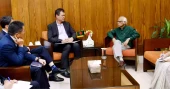
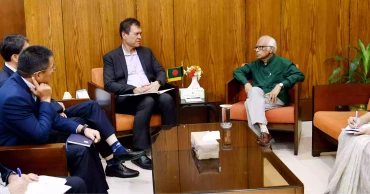
A delegation from the Asian Development Bank (ADB) met with Planning Adviser Dr. Wahiduddin Mahmud on Wednesday afternoon at his office to discuss ongoing and upcoming projects funded by the ADB.
The delegation, led by Senior Adviser Edimon Ginting and newly appointed Country Director Hoe Yun Jeong, briefed the Planning Adviser on the progress of ongoing projects and those in the pipeline. Both sides agreed on the need to streamline project costs and reduce timelines for completion.
The adviser informed the delegation that the government has already formed a task force to reassess economic strategies and identify necessary resources to meet development goals. The ADB delegation expressed its commitment to providing full cooperation in support of these efforts.
Also present at the meeting were ADB Deputy Country Director Jiangbo Ning and Country Economist Chandan Sapkota.
1 year ago
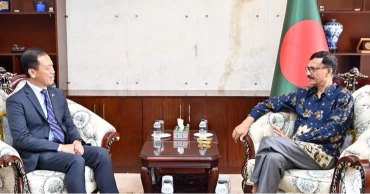
Dhaka, Jakarta want conclusion of PTA; boost trade and investment
Bangladesh and Indonesia on Wednesday underscored the need for strengthening trade and investment relations, especially by concluding pending agreements like Preferential Trade Agreement (PTA).
The two countries also emphasized on the necessity of direct air connectivity between Dhaka and Jakarta to strengthen the people-to-people contacts.
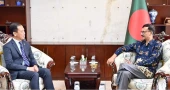
Ambassador of Indonesia to Bangladesh Heru Hartanto Subolo paid a courtesy call to Foreign Adviser Md Touhid Hossain at the Ministry of Foreign Affairs and discussed the issues.
The Foreign Adviser flagged the importance of resuming "visa on arrival" for the Bangladeshi nationals in Indonesia, according to the MoFA.
The Ambassador congratulated the Foreign Advisor on assuming the new responsibility.
Referring to strong bilateral relations between Bangladesh and Indonesia, both discussed on the whole arrays of bilateral cooperation including trade and investment, renewable energy, connectivity and people to people contact.
The Indonesian envoy appreciated the expanding trade and investment between the two countries.
Foreign Adviser Hossain thanked Indonesia for its potential engagements with Bangladesh in the area of power, energy and energy security.
Both reaffirmed a strong partnership between the countries paving the way for deeper collaboration in areas of mutual benefits.
1 year ago

11th Asian Tourism Fair begins in Dhaka Thursday with Maldives’ strong presence
The 11th Asian Tourism Fair (ATF) will be held at the International Convention City Bashundhara (ICCB) from September 19-21 with strong presence from the partner country Maldives.
Parjatan Bichitra is hosting the fair with the support and cooperation of the Ministry of Civil Aviation and Tourism, Bangladesh Tourism Board, Bangladesh Tourism Corporation, and the Tourist Police Bangladesh.
High Commissioner of Maldives to Bangladesh Shiuneen Rasheed said the people-to-people connections between the countries are robust and can be traced back to centuries.
“It is the essence of our current bilateral agenda. We are therefore excited to witness an exponential increase in the number of tourist arrivals from Bangladesh,” she said.
This is indeed the beginning of a new chapter of relations between Maldives and Bangladesh, said the High Commissioner, adding that the main purpose of having such a strong presence at ATF this year is to show that Maldives is ready to warmly welcome our Bangladesh friends to our shores.
This year 23 companies from Maldives are participating in this fair.
They are Sun Siyam Travels, Sky Beach Dhiffushi, Holiday Inn Resort Kandooma Maldives, Kaani Palm Beach, Ryoko Maldives, ITAW Travel & Tours, Island life Travel Pvt Ltd, Heritance Aarah, HulhuVilla Beach, ARENA BEACH, Tatabye Maldives Pvt Ltd, Stone Hotels, V Travels and Tours, Inner Maldives Pvt Ltd, Zaha Travels, Secretariat of the Maafushi Council, IASL, Naalis Travels & Tours Pvt Ltd, Season Holiday, Crossroads, Silver Oasis, Ostrov Maldives and Triton Prestige.
The objective of the Asian Tourism Fair (ATF Dhaka) is to link regional tourism. It is both a B2B and B2C event for inbound and outbound tourism.
The fair will help connect industry partners, service providers and travellers said the organizers.
Asian Tourism Fair is a comprehensive tourism showcase for better business networking, coordination of private sectors, government organisations and development agencies among the countries.
Deputy Managing Director, Maldives Marketing and Public Relations Corporation Zihuny Rasheed said the Maldives' presence at ATF 2024 reflects their commitment to strengthening ties with the emerging Bangladeshi market.
“With a growing economy, Bangladesh is a promising source market for the Maldives. Tourist arrivals from Bangladesh to the Maldives have increased by at least 38% this year, demonstrating the market's resilience and potential for further growth for the Maldives tourism industry,” Zihuny said.
1 year ago

Russia assures Bangladesh of successful completion of Rooppur plant
Foreign Secretary Md Jashim Uddin on Wednesday thanked Russian Ambassador to Bangladesh Alexander Vikentyevich Mantytskiy for Russian Federation's ongoing support, particularly in the implementation of the Rooppur Nuclear Power Plant (RNPP) project.
Ambassador Mantytskiy assured him of continued cooperation to ensure the successful completion of the project.
The Foreign Secretary also thanked the Russian Federation for increasing the number of scholarships awarded to Bangladeshi students pursuing higher education in Russia and encouraged further efforts to enhance people-to-people exchanges.
The Ambassador paid a courtesy call on the Foreign Secretary and congratulated him on his assumption of office and reiterated Russian government support for the interim government of Bangladesh.
During the courtesy call, the issues of mutual interest including energy security, food security, trade and investment, cooperation in the multilateral forum and also bilateral cooperation in the area of ICT, education and culture were discussed.
Both sides expressed satisfaction at the current state of bilateral relations between Bangladesh and the Russian Federation and committed to further strengthening ties in coming days.
1 year ago
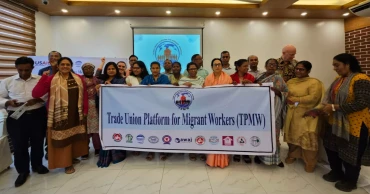
Trade Union Platform for Migrant Workers starts operation
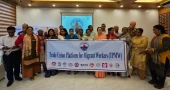
Trade Union Platform for Migrant Workers (TPMW), Bangladesh’s first-ever trade union for migrant workers - began its operation on Wednesday.
The platform has 11 members, including seven federations comprising workers in readymade garment factories and domestic workplaces.
The four other members are non-government organisations advocating for migrant workers' trade union rights.
The TPMW was formed in September last year to protect the rights of migrant workers. Ever since its formation, the platform engaged in activities to develop its capacity and logistic planning to fulfill its objective.
The members of the TPMW also visited the Maldives to learn about Bangladeshi expatriates in the country.
The TPMW hopes to collaborate with trade union bodies and the government in the Maldives to help Bangladeshi migrants live a dignified life.
Run by its constitution, the TPMW also compiled information deemed necessary to understand the country’s migration sector in a booklet, which was released at the ceremony held on Wednesday morning.
The TPMW is connecting Bangladeshi migrants through social networking platforms enabling them to share their experiences and become aware of their rights.
“We announce the beginning of our operation in full swing,” said Chandon Kumar Dey, coordinator, TPMW.
The TPMW included Bangladesh Garments and Industrial Workers Federation, Bangladesh Independent Garment Workers Union Federation, Bangladesh Revolutionary Garments Workers Federation, Sammilito Garments Sramik Federation, Ekota Garments Sramik Federation, Garments Sramik Sanghati Federation and National Domestic Women Workers Union.
The TPMW also included four associate organisations without giving them any voting power. They are Solidarity Center – Bangladesh, Bangladesh Center for Workers Solidarity, Awaj Foundation and Bangladeshi Ovhibashi Mohila Sramik Association.
The TPMW aims at creating an environment in which migration is safe. The TPMW wants to work with workers at home and abroad to make them aware of all discrimination.
“The initiative is unique for it sees the emergence of a body owned by migrant workers. Before its emergence, migrant workers' rights were discussed by civil society organisations,” said AKM Nasim, country program director, Solidarity Center – Bangladesh.
Lily Gomes is the member secretary of the TPMW.
The program was also attended, among others, by Monika Hartsel, deputy country program director, Solidarity Center – Bangladesh, USAID deputy director Blair King and representatives from various international organisations advocating for the rights of migrant workers.
1 year ago

World Bank Vice President for South Asia Region to meet CA, Finance Adviser
The World Bank Vice President for the South Asia Region, Martin Raiser arrived in Dhaka on Wednesday.
During his two-day visit, Raiser will meet with Chief Adviser Prof Muhammad Yunus, Finance Adviser Dr SalehuddinAhmed, Adviser for the Ministry of Power, Energy and Mineral Resources Muhammad Fouzul Kabir Khan, Bangladesh Bank Governor Dr Ahsan H. Mansur, and other senior government officials, said the lending agency on Wednesday.
The World Bank was among the first development partners to support Bangladesh after its independence. Since then, the Bank has committed about $44 billion to Bangladesh, mostly in grants or concessional credits.
Bangladesh currently has the largest ongoing programme supported by the World Bank Group’s International Development Association (IDA).
1 year ago
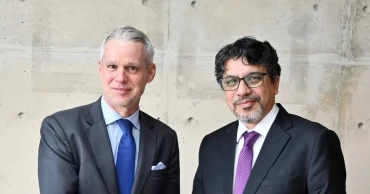
Bangladesh seeks more Swiss investment; assures addressing challenges
Foreign Secretary Md Jashim Uddin on Tuesday invited more Swiss investment into Bangladesh for mutual benefit.
The Foreign Secretary assured Ambassador of Switzerland to Bangladesh Reto Siegfried Renggli of cooperation in eliminating the challenges faced by the Swiss investors when the envoy paid a courtesy call on him (FS).
The Swiss Ambassador acknowledged Bangladesh as a tremendously potential market and stressed on a level playing field to attract new Swiss investments.
Both sides also discussed early implementation of the Bangladesh-Switzerland MoU on Knowledge and Skills Enhancement.
The two sides also discussed the Rohingya crisis and the repatriation of the Rohingyas to their homeland- Myanmar, with safety, security and rights.
The Swiss Ambassador assured more humanitarian support to the Rohingyas as well as to the host communities in Cox’s Bazar, according to the Ministry of Foreign Affairs.
The Foreign Secretary highlighted the Interim Government’s priorities and reform initiatives, including formation of 6 (six) commissions in this regard.
He appreciated the Swiss government for its pledge to support the Interim Government’s reform measures. The Foreign Secretary and the Swiss Ambassador expressed the two countries’ desire to transform Bangladesh-Switzerland bilateral relations into a broad-based economic partnership.
The Foreign Secretary sought strong Swiss support at WTO in deciding Bangladesh’s post LDC graduation trading terms.
He also expected that the Swiss government would extend DFQF market access to Bangladeshi products at least until 2029.
The Swiss Ambassador assured to convey Bangladesh’s request to the appropriate Swiss authorities.
He also hoped that Bangladesh would consider setting up its resident diplomatic mission in Swiss capital Bern following its LDC graduation.
The Foreign Secretary lauded contributions of SMEs in the Swiss economy and sought Swiss support in upgrading Bangladesh’s SME sector through institutional collaboration.
The Swiss Ambassador informed that around 98% of Swiss companies belong to the SME category and assured to look into possible collaboration in this regard.
The Foreign requested for cooperation of the Swiss authorities in identifying and returning illegal assets deposited in the Swiss banks by some Bangladeshi nationals.
The Swiss Ambassador assured all possible cooperation in this regard as per international standards and procedures.
1 year ago

Maldives will soon initiate regularization process for undocumented Bangladeshis: Envoy
High Commissioner of Maldives to Bangladesh Shiuneen Rasheed on Tuesday said the government of Maldives will soon initiate the regularization process for the undocumented Bangladeshi expatriates living in the Maldives.
She paid a courtesy call on Foreign Affairs Adviser Md Touhid Hossain at the Ministry of Foreign Affairs.
The Adviser for Foreign Affairs thanked the government of Maldives for providing employment opportunities to the Bangladeshi workforce in the Maldives, according to the Ministry of Foreign Affairs.
The High Commissioner congratulated the Adviser for Foreign Affairs on assuming his new responsibilities.
Referring to the excellent bilateral relations between Maldives and Bangladesh, the High Commissioner reiterated the commitment of Maldives to continue engagements, cooperation and collaboration with Bangladesh.
The High Commissioner Rasheed appreciated the contributions of Bangladeshi migrant workers to the socio-economic development of the Maldives.
Both the Foreign Affairs Adviser and the High Commissioner underscored the need to strengthen regional cooperation and continue collaborating on issues such as climate change.
1 year ago
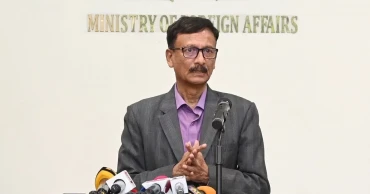
“Everything doesn’t go by the law”: Foreign Adviser on Hasina’s stay in India
Foreign Affairs Adviser Md Touhid Hossain on Tuesday said that the Indian government has given shelter to former Prime Minister Sheikh Hasina and she has been staying there.
“We will have to see this matter this way,” he said, adding that everything “does not go by the law.”
The adviser made this remark while responding to a question on Hasina’s status in India as her diplomatic passport has been cancelled.
He said Bangladesh has not learnt anything officially from the Indian side except what the country’s External Affairs Minister S Jaishankar said after her entry in India.
It has been over a month since Sheikh Hasina hurriedly landed at a military base near Delhi after a chaotic exit from Bangladesh.
Hasina’s dramatic departure on August 5 followed weeks of student-led protests which spiraled into deadly, nationwide unrest.
She was initially expected to stay in India for just a short period, but reports say her attempts to seek asylum in the UK, the US and the UAE have not been successful so far, according to the BBC.
1 year ago