Foreign-Affairs
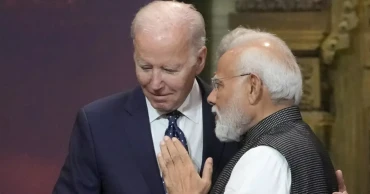
Biden, Modi “shared concerns” over safety of people in Bangladesh: White House
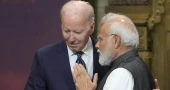
During a recent call with Indian Prime Minister Narendra Modi, US President Joe Biden raised concerns about the safety and security of people in Bangladesh and the future of its democratic institutions, the White House has confirmed.
John Kirby, the White House National Security Council spokesperson, addressed the media on Wednesday, stating that both leaders "shared concerns" about the recent developments in Bangladesh.
In his post on X, Modi mentioned, "We discussed the situation in Bangladesh and underscored the importance of restoring normalcy and ensuring the safety and security of minorities, especially Hindus, in Bangladesh."
1 year ago

EU releases €1.1 million emergency assistance for flood victims in Bangladesh
The European Commission has released €1.1 million in humanitarian aid after devastating floods hit Bangladesh in recent weeks.
This funding complements the ongoing distribution of hygiene and sanitary items, shelter tools, and kitchen sets from EU-funded emergency stockpiles, said the European Union (EU) Embassy in Dhaka on Thursday.
Janez Lenarcic, Commissioner for Crisis Management, said the floods in Bangladesh have had a devastating impact on the affected communities.
“We are making European Union funding available and have released contingency stocks that will help our humanitarian partners save lives during this emergency.”
The funding announced today comes in addition to over €33.5 million already allocated in EU humanitarian assistance to Bangladesh in 2024.
This assistance mainly funded support to Rohingya refugees living in Cox's Bazar, but also the response to other emergencies in the country, such as heatwaves, cyclones and flooding, as well as anticipatory actions.
1 year ago
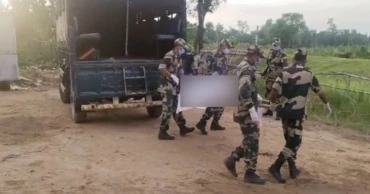
Dhaka lodges strong protest over killing of minor Bangladeshi girl by BSF
Bangladesh has lodged a formal protest to the Government of India over the killing of a 13-year-old Bangladeshi girl by Border Security Force (BSF) of India.
Shwarna Das, of Juri upazila of Moulvibazar district, was shot dead by BSF troops on September 1.
In the protest note sent to the Indian High Commission in Dhaka on Thursday, Bangladesh strongly protested and condemned such ruthless acts and expressed deep concern over the incident.
The Government of Bangladesh reminded that such incidents of border killing are undesirable and unwarranted and such actions are in violation of the provisions of the Joint Indo-Bangladesh Guidelines for Border Authorities, 1975.
The Government of Bangladesh called upon the Government of India to stop repetition of such heinous acts and conduct enquiries into all border killings, identify the responsible persons and bring them to justice.
1 year ago
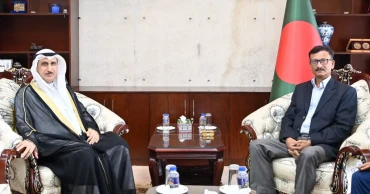
Bangladesh seeks Kuwait’s support to navigate current challenges
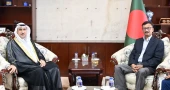
Foreign Adviser Md Touhid Hossain on Thursday lauded the enduring fraternity and solidarity between Bangladesh and Kuwait, underscoring Kuwait’s instrumental role in facilitating Bangladesh’s integration to greater Muslim community in 1974.
Outgoing Ambassador of the State of Kuwait to Bangladesh Faisal Mutlaq Al Adwani paid a courtesy call on the Foreign Adviser at the Ministry of Foreign Affairs and discussed issues of mutual interest.
The Foreign Adviser highlighted the recent political transition in Bangladesh, expressing optimism that, with Kuwait’s steadfast support, Bangladesh will adeptly navigate its current challenges, according to the Ministry of Foreign Affairs.
In response, the outgoing Kuwaiti envoy reiterated Kuwait’s readiness to bolster recruitment of skilled professionals from Bangladesh, particularly engineers, medical practitioners, and nurses, in an effort to reinforce the already robust bilateral partnership.
Ambassador Al Adwani also expressed Kuwait’s interest in financing joint development initiatives through the Kuwait Fund for Arab Economic Development (KFAED), highlighting the mutual benefits such projects would entail.
The Foreign Adviser commended the Ambassador’s pivotal contributions, particularly in facilitating the reciprocal exchange of diplomatic plots, and expressed hope that construction of the Kuwait Chancery and Ambassador’s residence would commence soon.
During the meeting, the Ambassador recalled the vital role played by the Bangladesh Armed Forces during Kuwait’s liberation in 1991 and reaffirmed Kuwait’s unwavering support for Bangladesh’s development.
Before concluding, the Foreign Adviser called upon the outgoing Ambassador to serve as a goodwill ambassador for Bangladesh upon his return to Kuwait.
1 year ago
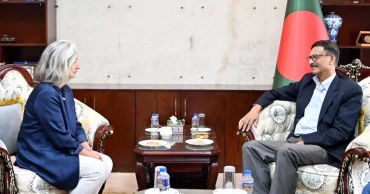
France offers 3-way assistance to Bangladesh in implementing reform agenda
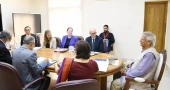
Ambassador of France to Bangladesh Marie Masdupuy on Thursday offered “technical, legal and institutional” assistance to Bangladesh in implementing the reform agenda of the interim government, particularly in the areas of curbing corruption, reforming governance and financial system.
She paid her maiden courtesy call on Foreign Affairs Adviser Md Touhid Hossain and handed over the original congratulatory message from the French Minister for Europe and Foreign Affairs Stephane Sejourne at the latter’s office.
The Adviser highlighted the long-standing Bangladesh-France bilateral relations and welcomed France’s interest in providing technical support to the interim government’s reform agenda.
He assured that the interim government is determined to bring visible and sustainable reforms to promote business and FDI with substantial improvement in the labour sector and human rights domain, according to the Ministry of Foreign Affairs.
The France Ambassador informed that more and more French companies are expressing interest to do business with and invest in Bangladesh with the gradual improvement of the business environment as well as positive changes in different sectors in the country under the interim government.
As raised by the French Ambassador, the Foreign Adviser expressed firm commitment to preventing human trafficking and migrant-smuggling from Bangladesh to Europe.
On the Rohingya issue, he also underlined the need for international pressure on Myanmar authorities for a durable solution of the Rohingya crisis through safe, secure and dignified return of the Rohingyas to their homeland, Myanmar.
1 year ago
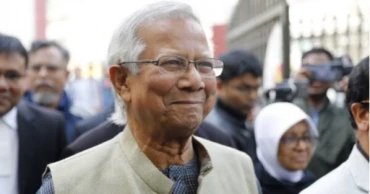
Global leaders extend strong support for people of Bangladesh, interim government
Global leaders have announced strong support for the new Bangladesh government led by Chief Adviser Prof Muhammad Yunus, stressing that they stand ready to help in any way they can to support the efforts of Bangladesh and the interim government to lead the world in creating a new and better civilization, as Prof Yunus has repeatedly called for.
In a letter to the people of Bangladesh and “citizens of goodwill” around the world, 197 global leaders including 92 Nobel Laureates wished Prof Muhammad Yunus, the Chief Adviser to the Interim Government of Bangladesh and the people of Bangladesh "peace and success in the months and years ahead."
“We the undersigned are excited to publicly share our congratulations and heartfelt good wishes to Nobel Peace Prize winner Muhammad Yunus, the new interim Prime Minister of Bangladesh. Professor Yunus, like others in Bangladesh, has suffered under the yoke of autocracy,” reads the letter.
They applauded the interim government’s commitment to bring free and fair elections back to Bangladesh and its commitment to allowing democracy to flourish.
“We stand ready to help in any way we can to support the efforts of Bangladesh and the interim government to lead the world in creating a new and better civilization, as Professor Yunus has repeatedly called for,” the letter reads.
They said they have been proud to have supported Prof Yunus over the years. “It is the beginning of an exciting new dawn for Bangladesh, and we wish him and the people of Bangladesh peace and success in the months and years ahead.”
The global leaders said they are excited to see Professor Yunus finally free to work for the uplift of the entire country, especially the most marginalized, a calling he has pursued with great vigor and success across six decades.
“Just as the nation’s young people have inspired him, we know that he will inspire them to play a leadership role in bringing a bright new future to Bangladesh. We are also confident that he will inspire millions of young people around the world, including those in the Bangladeshi diaspora, to improve society for the better,” the letter reads.
In a letter to the people of Bangladesh and citizens of goodwill around the world, 197 global leaders including 92 Nobel Laureates wished Muhammad Yunus, the Chief Adviser to the Interim Government of Bangladesh and the people of Bangladesh "peace and success in the months and years ahead."
Referencing what Yunus and others have called Bangladesh's "second liberation" the leaders, including former U.S. President Barack Obama, businessman Richard Branson, and activist Jane Goodall, wrote, "Just as the nation's young people have inspired [Muhammad Yunus], we know that he will inspire them to play a leadership role in bringing a bright new future to Bangladesh."
A violent response by the then-Prime Minister Sheikh Hasina's forces to a student-led protest resulted in the students' call for her resignation and ultimately to Hasina fleeing the country on August 5.
Muhammad Yunus was then asked by the student leaders to lead the Interim Government. Yunus and the other Advisers, including two student leaders, were sworn in by Bangladesh's President on August 8.
"We applaud the interim government's commitment to bring free and fair elections back to Bangladesh," the letter from world leaders continued, "and its commitment to allowing democracy to flourish. We stand ready to help in any way we can to support the efforts of Bangladesh and the interim government to lead the world in creating a new and better civilization, as Professor Yunus has repeatedly called for."
Bangladesh is coming out of an extended period of repression and autocratic rule. In September 2023 Amnesty International Secretary General Agnès Callamard wrote about "the beleaguered state of human rights in Bangladesh."
Callamard continued, "The abuse of laws and misuse of the justice system to settle vendettas is inconsistent and incompatible with international human rights treaties."
In addition to the letter of support from world leaders, messages of support have poured in from sitting heads of state and government and leaders of international institutions. For example, UN Secretary General António Guterres wrote this to Professor Yunus: "Bangladesh stands at a crucial juncture in its history. The United Nations fully supports the effort toward an inclusive and prosperous democracy and remains committed to working with your government and to extend support, as may be requested…."
Former United Nations Secretary General Ban Ki-moon, one of the letter's signers, said, "I sincerely hope that, under Muhammad Yunus's leadership, the people of Bangladesh will be able to enjoy freedom and that he will help Bangladesh become a free and democratic country. It has been an honor to join with global leaders and people of goodwill around the world in supporting Dr. Yunus and the people of Bangladesh's efforts to secure a flourishing democracy."
Sam Daley-Harris, the founder of Civic Courage, urged citizens around the world to add their names to those of the global leaders.
The letter was released on September 4, 2024 online, in a full-page ad in the Washington Post, and through a press release.
The letter was released on September 4, 2024 online, in a full-page ad in the Washington Post, and through a press release.
1 year ago

Hasina must ‘keep quiet’ while in India, Yunus tells PTI
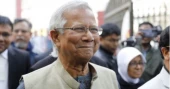
Chief Adviser Muhammad Yunus has said that former prime minister Sheikh Hasina making political remarks from India is an “unfriendly gesture”, asserting that she must remain silent to prevent discomfort to both countries until Dhaka requests her extradition.
“If India wants to keep her until the time Bangladesh (government) wants her back, the condition would be that she has to keep quiet,” he said.
In an interview with the Press Trust of India at his official residence in Dhaka, Yunus, who was appointed the country’s Chief Adviser after Hasina’s ouster, stressed that while Bangladesh values strong ties with India, New Delhi must move “beyond the narrative that portrays every other political party except Awami League as Islamist and that the country will turn into Afghanistan without Sheikh Hasina.”
“No one is comfortable with her stance there in India because we want her back to try her. She is there in India and at times she is talking, which is problematic. Had she been quiet, we would have forgotten it; people would have also forgotten it as she would have been in her own world. But sitting in India, she is speaking and giving instructions. No one likes it,” he said.
Yunus was apparently referring to Hasina’s statement on August 13 in which she demanded “justice”, saying those involved in recent “terror acts”, killings and vandalism must be investigated, identified and punished.
“It is not good for us or for India. There is discomfort regarding it,” he told PTI.
Following unprecedented anti-government protests that peaked on August 5, Hasina resigned as prime minister and fled to India. Her presence in India for nearly four weeks has fuelled speculation in Bangladesh.
When asked whether Bangladesh has communicated its stance to India, Yunus said it has been conveyed verbally and quite firmly that she should keep quiet.
“Everyone understands it. We have said quite firmly that she should keep quiet. This is an unfriendly gesture towards us; she has been given shelter there and she is campaigning from there. It is not that she has gone there on a normal course. She has fled following a people’s uprising and public anger,” he said.
Yunus stated that the interim government is committed to ensuring justice for the people of Bangladesh against the atrocities, and justice requires that she be brought back to the country.
“Yes, she has to be brought back or else the people of Bangladesh won’t be at peace. The kind of atrocities she has committed, she has to be tried in front of everyone here,” he emphasised.
Discussing the future of the India-Bangladesh relationship, Yunus expressed a desire for good ties with India but insisted that New Delhi must abandon the narrative that only Hasina’s leadership ensures the country’s stability.
“The way forward is for India to come out of the narrative. The narrative is that everybody is Islamist, the Bangladesh Nationalist Party (BNP) is Islamist, and everyone else is Islamist and will make this country into Afghanistan. And Bangladesh is in safe hands with Sheikh Hasina at the helm only. India is captivated by this narrative. India has to come out of this narrative. Bangladesh, like any other nation, is another neighbour,” he said.
Referring to the recent incidents of alleged attacks on Hindu minorities in the country and India raising concerns about it, Yunus said this is just an excuse.
“The issue of trying to portray the conditions of minorities in such a big way is just an excuse,” he said.
Indian Prime Minister Narendra Modi, in his Independence Day address on August 15, expressed hope that the situation in violence-hit Bangladesh would return to normal soon and stated that 1.4 billion Indians are concerned about the safety of Hindus and minorities in the neighbouring country.
Yunus, the 84-year-old Nobel laureate emphasised the need for India and Bangladesh to work together to improve their currently strained relationship.
When asked about ways to improve the Indo-Bangla relations, Yunus said both the countries need to work together, and that it is at a low presently.
“We need to work together to improve this relationship, which is now at a low,” he said.
Speaking about the future of bilateral treaties with India, Yunus said there are demands for a relook at certain treaties such as transit and the Adani electricity deal.
“Everybody is saying that it is needed. We will see what is on paper and, second, what is actually happening on the ground. I can’t answer it specifically. If there is any need to review, we will then raise questions about it,” he said.
1 year ago
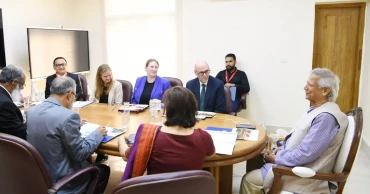
USAID to contribute to Bangladesh’s democratic, economic growth
USAID Mission Director Reed Aeschliman and his team had "productive discussions" with Chief Adviser Professor Muhammad Yunus on Wednesday and pledged to contribute to Bangladesh’s democratic and economic growth more fully.
They explored ways that USAID can maximize their investments to support the interim government and reach their shared vision of helping Bangladeshis build brighter and more prosperous futures for themselves.
The USAID team said they will continue to harness local expertise and look forward to the journey ahead to make sure people in every corner of the country have equitable opportunities to thrive.
"Great meeting with Chief Adviser to discuss how we can maximize USAID investments and build upon our two countries’ long-standing partnership to help Bangladeshis build brighter and more prosperous futures for themselves. Looking forward to the journey ahead," USAID said in a message through its X after the meeting held at Chief Adviser's Office.
1 year ago

Indian High Commissioner optimistic about future of Dhaka-Delhi ties
The High Commission of India hosted a send-off event on Wednesday for Bangladesh students who are leaving for India to pursue higher studies on ICCR scholarship.
Indian High Commissioner to Bangladesh Pranay Verma expressed optimism about the future of India-Bangladesh ties with youth in both countries playing a pivotal role in nation-building and becoming a valuable stakeholder in their shared quest for peace, prosperity and development.
Addressing the assembled students on this occasion, High Commissioner Verma welcomed them on the new journey of their career and highlighted the important role education and educational exchanges play in building stronger people-to-people links between the two countries.
Around 550 students from Bangladesh have been awarded the prestigious ICCR scholarship for various academic courses this year.
The awardees will have the opportunity to pursue higher studies in some of the most prestigious Indian institutions, including the Indian Institutes of Technology (IITs), National Institutes of Technology (NITs), Delhi University etc. in graduation, post-graduation and PhD courses across wide-ranging disciplines such as engineering, medicine, law, linguistics, fine arts, social sciences etc.
The ICCR scholarship programme plays a vital role in enhancing mutual understanding and cooperation between India and Bangladesh, said the High Commission.
The High Commission of India said it remains committed to supporting this programme and promoting robust educational exchanges between our two countries.
1 year ago

A month after Hasina’s exit, host India faces question what next
Tomorrow marks exactly one month since former Prime Minister Sheikh Hasina resigned amid student-led mass uprising and fled to India leaving the country in a leadership vacuum for a couple of days.
The country was in a state of lawlessness until Nobel laureate Prof Muhammad Yunus returned home from Paris and took oath as Chief Adviser of the interim government on August 8, chosen by the student leaders and backed by the army.
Hasina’s fall was so dramatic that she had only 45 minutes to leave her official residence Ganobhaban, which was stormed by jubilant protesters shortly after her exit.
The student protests began in July against a quota system in government jobs that critics said favoured people with connections to Hasina’s party.
3 more murder cases filed against 80 including Sheikh Hasina
Since her exit, Hasina is facing more than 100 cases, nearly all of them filed by aggrieved members of those killed by law enforcement agencies during the massive protests. The unprecedented violence left over 1000 people – many of them children and youth – killed and thousands injured. She is also facing complaints filed before the International Crimes Tribunal accusing her of mass killings.
While 76-year-old Hasina is reportedly lodged in a safe house in an Indian air base in Gaziabad on the outskirts of New Delhi, calls for her extradition to Bangladesh to face justice are growing.
The Yunus-led interim government is yet to make any decision on whether it will request for extradition of Hasina, New Delhi’s closest ally during her 15-year rule.
Indian Prime Minister Narendra Modi was the first among the foreign leaders to congratulate Prof Yunus on social media platform X. Modi expressed the hope that the two countries will continue to work with their shared vision for boosting the bilateral relations.
Separately, Indian External Affairs Minister S Jayshankar recently commented, “We will deal with the government of the day…need to look for mutuality of interest.”
Complaint lodged against 53 including Hasina, 28 journalists for inciting genocide
Diplomatic sources in both the capitals believe Hasina’s continued presence in India may become a headache for New Delhi in its bid to build a rapport with Yunus-led administration. They also warn of public sentiments against India following the recent massive floodings in eastern Bangladesh with many blaming it on the neighbouring country. New Delhi had to clarify it was not responsible for the floods in Feni and other nearby districts.
In reply to a question, Foreign Adviser Touhid Hossain recently reiterated that the government will definitely try to bring back Hasina from India if the legal system wants.
“There are legal processes. If our legal system wants, we will definitely try (to bring her back),” he said.
After the interim government revoked her diplomatic passport, questions have now arisen as to how long Sheikh Hasina can stay in India and whether she will face a possible extradition. The approval for Hasina to go to India was granted at a short notice, according to the Indian Ministry of External Affairs.
As Hasina faces a number of murder cases, it is now uncertain what future holds for her if she needs to return to Bangladesh. But it depends on India whether they will hand her over under the extradition agreement between the two countries if Bangladesh wants her back.
On the other hand, the leaders of the Anti-Discrimination Students' Movement on Wednesday announced that they will hold a "Shaheedi March" on September 5 across the country, to commemorate the martyrs one month after the fall of the Sheikh Hasina regime.
Sarjis Alam, one of the movement's coordinators, made the announcement at the TSC auditorium.
"We think it is time to remember those who lost their lives for the cause,” he said, inviting the families of every martyr to take part in it.
“We want tomorrow to be a nationwide tidal wave. Shaheedi March will begin centrally from Raju Memorial Sculpture at 3:00pm," he added.
1 year ago