foreign-affairs

Upholding, protecting freedoms for all Bangladeshis necessary to ensure true democratic future: US
The United States has called for upholding and protecting "freedom of expression, peaceful assembly, and association" for all, including dissenting and opposition voices in Bangladesh.
"Upholding and protecting these freedoms for all Bangladeshis is necessary to ensure a true democratic future for the country," said Vedant Patel, principal deputy spokesperson at the US Department of State, at a regular briefing in Washington on November 12.
He said they routinely communicate that support to all their partners, including the interim government of Bangladesh.
Patel said they support the freedom of expression, peaceful assembly, and association for all, including dissenting and opposition voices.
"These freedoms, in our point of view, are essential elements of any democracy," he said.
Regarding cancellation of press accreditation cards by the interim government, Patel said he had not seen that reporting.
"Of course, if it’s true, would be unfortunate," he said, adding that it is their "strong point of view" that an "engaged free press" is vital to covering any situation, including, the situation in Bangladesh.
He said press freedom and media freedom is important to the US president and US secretary of state, according to the US Department of State.
"We would encourage and want to ensure that the rights and freedoms of all journalists are being appropriately respected, Patel said.
1 year ago
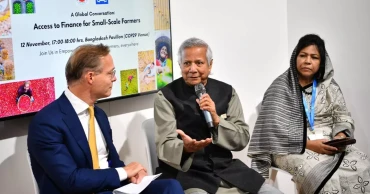
"A farmer can be an entrepreneur with access to credit"
Chief Adviser Professor Muhammad Yunus said on Tuesday the countries should redesign the banking system by following the Grameen Bank model to make credit accessible to farmers, a considerable number of whom are women.
“Every country should have a social business banking law,” he said, while appreciating that currently at least 110 universities across the globe are teaching social business as a course.
Prof Yunus said credit is a human right as it relates to the livelihood of people.
“You can not establish the right of livelihood without ensuring the right to credit,” said the Chief Adviser.
He made the comments while speaking to a side event at the COP29 in Azerbaijan capital Baku.
Bangladesh and the Netherlands jointly hosted the event titled A Global Conversation: Access to Finance for Small Scale Farmers at the Bangladesh Pavilion of the conference.
Bangladesh willing to work with ‘Climate Club’ to catalyse int’l cooperation: Prof Yunus
Additional Foreign Secretary Riaz Hamidullah moderated the event, which was also attended by Dutch Prince Jaime Bernardo of Bourbon-Parma, also the climate envoy of the Netherlands.
The Dutch prince highlighted how credit, insurance, investment, research, and finance increased agricultural output while insisting that millions of farmers across the globe now needed this support.
Speaking at the event, Yvonne Pinto, the Director General of the International Rice Research Institute, said that rice production grew globally ever since credit was made accessible to farmers.
Jorim Schraven, a director of the Dutch entrepreneurial development bank FMO, hailed Professor Yunus for the moral support he extended on debt rights, adding it was related to people’s rights to know.
Farhana Haque Rahman, Senior Vice President of Inter Press Service and Executive Director IPS Noram, said that currently, 550 million small household farmers feed two billion people around the world.
Professor Yuunus said a farmer can be an entrepreneur if he or she is given access to credit.
“Every business needs money and investment,” he said, adding that a farmer not only grows crops but also sells them to market.
If he was given access to credit, he could buy crops from other farmers and sell them to improve his life, said Professor Yunus, who is hailed globally as a microcredit pioneer.
1 year ago

Nazrul's works are a shared cultural heritage of Bangladesh, India: Pranay Verma
High Commissioner of India to Bangladesh Pranay Verma on Tuesday said national poet of Bangladesh Kazi Nazrul Islam's works are a shared cultural heritage of Bangladesh and India and give them a unique platform to forge closer people-to-people and cultural connection between the two countries.
He was speaking at a musical evening of Shyama Sangeet by Kazi Nazrul Islam, organized by the Indira Gandhi Cultural Center (IGCC) of the Indian High Commission on Tuesday at the Indian Cultural Center in Dhaka.
Kazi Nazrul Islam is equally popular in India and Bangladesh.
Nazrul has composed more than a hundred devotional songs on Goddess Maa Kali, which is called Shyama Sangeet.
Renowned artists Tito Munshi, Mridula Samadder, and Bijon Chandra Mistry performed selected works of Nazrul's Shyama Sangeet in the event.
Prominent persons from the field of art and culture in Bangladesh joined the programme.
1 year ago
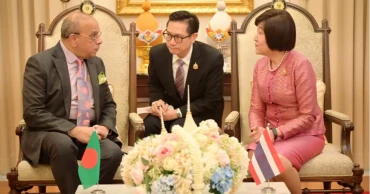
Bangladesh and Thailand Chief Justices meet to discuss potential judicial collaboration
Chief Justice of Bangladesh Dr Justice Syed Refaat Ahmed met with his counterpart Chanakarn Theeravechpolkul, Chief Justice and President of the Supreme Court of Thailand.
The meeting held in Bangkok on Tuesday, marks a groundbreaking start for potential judicial collaboration between Bangladesh and Thailand, with the apex courts at the core.
The Chief Justice of Bangladesh stressed the possibility for the two countries’ judiciaries to exchange and learn from each other's best practices and areas of strength.
He briefed his counterpart about some of the judicial reform initiatives he has undertaken since assuming office in the aftermath of the July revolution in Bangladesh.
Chief Justice Syed Refaat expressed satisfaction at the progress made on reducing case backlogs, enhancing transparency, and improving access to justice through digitization.
He flagged the possibility of sharing expertise in arbitration, mediation, reconciliation, and digital solutions.
Chief Justice Syed Refaat congratulated Justice Chanakarn on being recently appointed the third female President of the Thai Supreme Court.
He appreciated Thailand’s achieving near gender parity within its judiciary.
He shared that after assuming office, he appointed three female judges as heads of the three Constitutional Benches in the High Court Division.
The Thai Chief Justice noted that sustained improvements in the Supreme Court are essential for strengthening public trust in judicial institutions.
She acknowledged the possibility of establishing a bilateral judicial exchange programme involving both the Bar and the Bench.
Chief Justice Syed Refaat invited his Thai counterpart to visit and explore Bangladesh at a mutually convenient time.
Upon arriving at the Supreme Court premises, the Chief Justice was received ceremonially by senior court officials, and was ushered to sign the Visitors’ Book.
Earlier, the Chief Justice of Bangladesh met with the Minister of Justice of Thailand Tawee Sodsong.
They outlined a blueprint for prospective areas of cooperation between Bangladesh and Thailand. They focused on collaboration in judicial training, capacity-building for Alternative Dispute Resolution (ADR), and addressing the gender dimensions of judicial processes.
Minister Sodsong invited the Bangladesh Chief Justice to deliver lectures at Thai universities, including those based in southern Thailand in the Muslim-majority provinces.
Chief Justice Syed Refaat visited Thailand to give a keynote address at a conference titled “Achieving Just Societies: Inclusive Justice Pathways for People and Planet in Asia and the Pacific,” held at the UN Conference Centre in Bangkok.
1 year ago
Report: IFAD expands its climate finance for more resilient rural populations
The International Fund for Agricultural Development (IFAD), a UN specialized agency and international financial institution, has both increased and exceeded its goals in concretely delivering financing to rural and vulnerable populations.
It came at a time when the transformation of food systems in the face of climate change requires unprecedented levels of funding and financial innovation.
As of today, IFAD has invested more than US$1.28 billion in projects supporting small-scale farmers to adapt to climate change and produce food sustainably for the period 2022-2024.
This represents 47 per cent of the Fund’s Programme of Loans and Grants (PoLG), and exceeds the target set at 40 per cent, said IFAD on Tuesday.
IFAD’s Climate Action Report 2024, entitled “Green Horizons: A Year of Climate Action for People, Resilience and Biodiversity” was released today, highlighting IFAD’s strengthened commitment to supporting the world’s most vulnerable small-scale farmers.
The report documents IFAD’s efforts to help these farmers adapt to climate change impacts, protect ecosystems, and promote sustainable agriculture.
"Climate change affects us all, but small farmers — who grow nearly half our food — are on the front lines with the least resources to adapt," said IFAD President Alvaro Lario.
"These farmers aren’t just food producers; they are the backbone of rural economies, pillars of global food systems, and guardians of biodiversity. Investing in their success isn’t just moral — it’s smart economics. That’s why IFAD is ramping up support and channeling more funds to rural communities."
In response to the growing urgency to take climate action, IFAD decided to boost its spending for climate-related adaptation and mitigation projects from 25 per cent of its PoLG during the 2019- 2021 period to 40 per cent from 2022 to 2024.
IFAD’s next financing cycle, from 2025 to 2027, will increase the share of climate-related activities in its loans and grants even further, to 45 per cent.
The Report shows that IFAD spent US$502.7 million in climate adaptation and mitigation finance during 2022-2023. Showing strong acceleration, the latest figures reveal that in 2024 so far IFAD invested more than US$750 million of climate finance for IFAD projects supporting small-scale farmers to build their resilience to a changing climate.
In 2022-2023, 78 per cent of the projects were designed to improve adaptive capacity of small-hold farmers. Projects in East, West, Central and Southern Africa received US$ 330.4 million of the total.
IFAD’s Climate Action Report 2023 is filled with real-life examples of the projects that IFAD funds across the world, from sustainable water and pasture management to ecosystem restoration.
For example, the Pro-Semi-arid Project in Bahia in Brazil promotes agrobiodiversity through backyard gardens and creole seeds and breeds.
The project works with 20 traditional collective grassland communities, or fundos de pasto, to provide training on land restoration and biodiversity conservation, re-establish soil cover with native vegetation and develop nurseries for the production of seedlings.
It also promotes sustainable agroforestry systems using native species and combat bush fires. It reached 75,000 rural families.
1 year ago

Bangladesh willing to work with ‘Climate Club’ to catalyse int’l cooperation: Prof Yunus
Chief Adviser Prof Muhammad Yunus on Tuesday said Bangladesh is willing to work with the ‘Climate Club’ to catalyse international cooperation in terms of capacity building, technology transfer and concessional decarbonisation finance.
“LDCs will need preferential treatment owing to their special circumstances and development needs,” he said while attending the high-level ‘Climate Club Leader’s Meeting’ jointly hosted by Germany and Chile on the sidelines of COP29, UN's biggest climate conference.
COP29: Bangladesh to advocate for action, increased financial commitments
The Chief Adviser will deliver a speech at the opening session of the ‘World Leaders Climate Action Summit” at COP29 expectedly between 1:30 pm to 3:00 pm (Bangladesh time) on Wednesday.
The ‘Climate Club’ is an open and inclusive high-ambition intergovernmental forum for cooperation on accelerating industry decarbonisation.
Responding to a question, Prof Yunus said emissions-intensive production shifts to countries with less stringent climate policies, while potentially undermining global emissions reductions can impact competitiveness, with firms relocating operations to areas with lower environmental costs, leading to job losses in regions with stricter policies.
He said carbon leakage can dilute incentives for innovation in low-carbon technologies globally, as some sectors might prioritise cost over sustainable practices.
“To mitigate these risks, policies such as carbon border adjustments and international cooperation are essential to balance decarbonisation efforts with economic stability,” Prof Yunus said.
Conversely, he said, these policies can affect the competitiveness of the companies of particularly vulnerable developing countries like Bangladesh as strong emission policies will cause higher production costs, making them less competitive globally.
“Hence, preferential treatments are required for LDCs owing to their unique circumstances and development needs,” he said.
The Chief Adviser said advancing ambitious mitigation policies in a fragmented way is leading to emitting industrial activities moving to regions with less stringent or no carbon pricing policies, which leads to carbon leakage and thus may hamper the global goal of reducing overall global emissions.
Carbon Border Adjustment Mechanisms (CBAMs), as proposed by the EU, could incentivise countries to strengthen their climate policies by indirectly applying emissions standards to exported goods and prevent carbon leakage, he observed.
Prof Yunus said most vulnerable countries with limited decarbonisation capacity need to have adequate financial and technical support to develop green industries.
International collaboration is required to foster economic growth and create new job opportunities in emerging markets, supporting a just and inclusive transition, he said.
Responding to another question, Prof Yunus said dDeep, rapid and sustained reduction in GHG emissions and comprehensive international action are required for reducing global GHG emissions by 43% by 2030, reaching net-zero by 2050 to limit warming to 1.5°C.
To demonstrate and deploy proven low-emissions technologies, particularly in emerging markets and developing economies, where most industry investments are set to take place to respond to growing demand, including both the public and private sectors, he said.
“Many decarbonisation technologies require significant upfront investment. These high capital costs can be a barrier for industries, particularly in most vulnerable developing countries like Bangladesh, with limited access to financing,” said the Chief Adviser.
He laid emphasis on developing financial vehicles to finance the industrial decarbonisation fostering access to concessional finance for the private sector industries in the emerging developing economies like Bangladesh.
Prof Yunus called for an increased financial commitment for research and innovation.
“This can include national and international research programmes, in collaboration with the private sector and financial support from the developed countries will accelerate innovation and shared learning," said the CA.
He highlighted the importance of ensuring international cooperation, capacity building and technology transfer under Article 6.8 of the Paris Agreement.
Prof Yunus said international agreements on carbon pricing or border adjustment taxes will create a level playing field by imposing equivalent carbon costs on imports.
1 year ago
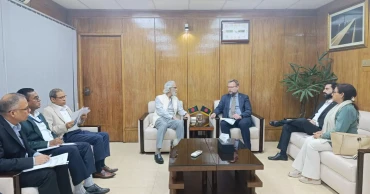
Clean Water: 3mn city dwellers to benefit from partnership with Denmark
Danish Ambassador to Bangladesh Christian Brix Moller has reiterated Danish support for addressing the need for clean water for the increasing population in Dhaka.
“We reaffirm our commitment to the government of Bangladesh in Saidabad Water Treatment Plant Project, Phase III,” said Ambassador Moller when he met with interim government adviser AF Hassan Ariff.
Once completed and in operation, the Phase III of the treatment plant will serve an additional 3 million city dwellers with treated and clean surface water instead of ground water.
This initiative addressed the needs of communities in Bangladesh and also strengthens the partnership between the two countries, said the Embassy on Tuesday.
Representatives from Local Government Division, Department of Public Health Engineering and Dhaka Water Supply and Sewerage Authority (Dhaka WASA) were also present during the meeting.
Denmark has been a long standing and trusted partner of Dhaka WASA and continues to expand its partnership.
Through a series of Saidabad Water Treatment Plant projects under Dhaka WASA, Denmark is supporting strategies for shifting from ground water usage to surface water sources, and is financing the design and construction of the treatment plant in its third phase.
This will lead to additional capacity of the plant to treat 450,000 cubic meter water per day. In addition, the sludge treatment plant will be designed to serve the full capacity of the entire plant.
The financing amount from Denmark is up to USD 300 million including a grant of USD 92 million, making it the largest water infrastructure financing project globally for the Danida Sustainable Infrastructure Finance in Copenhagen.
1 year ago
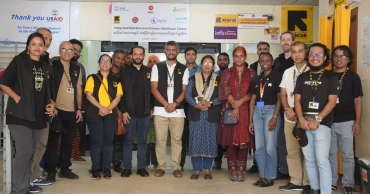
Climate change a critical challenge for both Bangladeshis, Rohingyas: IRC
Regional Vice President (Asia) of the International Rescue Committee (IRC) Adnan bin Junaid has said the IRC is committed to enhancing resilience and helping both Bangladeshis and the Rohingyas adapt to environmental shocks.
“IRC recognises that climate change is a critical challenge for both the Rohingya and host communities in Cox’s Bazar and southern Bangladesh, including Satkhira, Khulna, Barishal, and Patuakhali,” he told UNB in an interview, adding that the hardship of these communities further exacerbates by climate-induced disasters like flooding, cyclones and extreme weather events.
President Erdoğan invites Prof Yunus to visit Turkey, assures full support
The IRC senior leader said their strategies include disaster preparedness training for community members and local authorities, ensuring early warning systems are in place, and conducting evacuation drills.
“We also support climate-smart agriculture initiatives that improve food security and generate income for both refugees and host communities in Cox’s Bazar and Southern Bangladesh,” he said.
Besides, Junaid said, they collaborate closely with the government of Bangladesh, local authorities and communities to develop Local Adaptation Plans (LAPAs) that address specific climate risks in regions like Satkhira and Barishal.
These plans prioritise sustainable resource management, climate risk reduction and community participation to create long-term strategies for managing the impacts of climate change.
“Additionally, we are expanding our impact through cash transfer programmes, providing direct financial assistance to the most vulnerable populations in Cox’s Bazar and southern Bangladesh,” Junaid said.
The IRC advocates for global support for climate adaptation funding and policies to help reduce vulnerability.
“Through these efforts, we aim to strengthen resilience, ensuring that both refugees and host populations can thrive despite the compounded challenges of climate change,” Junaid said.
In line with their broader goals, the IRC Vice President said they are also advocating for increased global attention to the climate crisis in Bangladesh, calling for stronger international support for climate adaptation funding, resilience-building programs and policy changes that can help reduce the vulnerability of at-risk populations, including refugees and host communities.
“Looking ahead, we are excited to build on our initiatives in climate adaptation, climate-smart agriculture, and green skills development. By leveraging our expertise from 44 countries, we will enhance coordination among donors, organisations, government entities and local communities,” he said.
Through this collaborative approach, the IRC aims to ensure that the Rohingya and host populations in Cox’s Bazar and Southern Bangladesh are not only able to survive but also thrive in the face of the climate crisis while building long-term resilience for future generations.
Responding to a question, Junaid said as the Rohingya crisis enters its eighth year, the IRC is adapting its strategy to ensure sustainable support despite declining international funding and the prolonged displacement of Rohingya communities.
Recognising the complexity of the situation, he said, they are focusing on short-term programmes to ensure basic services and long-term resilience building for both the Rohingya and host communities.
This includes strengthening partnerships with local actors and authorities to ensure the continuity and effectiveness of services.
“By prioritising community-based approaches, we are enhancing local capacity to respond to ongoing needs while creating more sustainable solutions,” he said.
In response to the funding challenges, the IRC is also advocating for flexible, long-term funding commitments from donors to ensure that programs can continue without disruption.
“We are expanding efforts to mobilize resources from a diverse range of funding sources, including through public-private partnerships, to address the growing needs of the Rohingya and host populations,” he said.
IRC is focusing on strengthening resilience through programs that promote livelihoods, education, mental health support, protection and climate adaptation, ensuring that the affected communities can withstand shocks and improve their long-term prospects.
By adapting to the shifting landscape of humanitarian aid, the IRC aims to continue its support for those in need while advocating for sustained global attention to the crisis.
Responding to a question, Junaid said IRC believes that the resolution of the Rohingya crisis lies in Myanmar, however, the current conditions in Myanmar, especially in Rakhine State, remain volatile and conflict-ridden, making safe repatriation highly challenging.
Given the geopolitical complexities, he said, a realistic approach to the Rohingya crisis must consider sustainable alternatives to repatriation that uphold the dignity, self-reliance, and resilience of Rohingya communities while also supporting host communities.
1 year ago
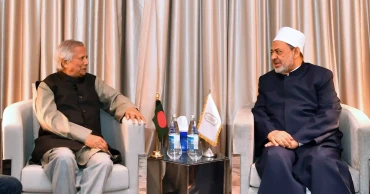
Grand Imam of Al-Azhar invites Prof Yunus to deliver speech at the millennium-old institution
Ahmed Eltayeb, the Grand Imam of the Al-Azhar Al Sharif, on Tuesday said Bangladesh would prosper and grow under the leadership of the country's Chief Adviser Professor Muhammad Yunus.
The head of one of the most respected Islamic religious institutions also invited Professor Yunus to deliver a speech at the millennium-old institution, saying the Al-Azhar University would announce new fully funded scholarships for Bangladeshi students.
Erdoğan invites Prof Yunus to visit Turkey, assures full support to build a prosperous Bangladesh
The Al-Azhar Grand Imam made the comments when he called on Professor Muhammad Yunus at the Ritz Carlton Hotel in the Azerbaijan capital Baku on Tuesday.
"We are optimistic about the future of Bangladesh under your leadership. You are a man of wisdom," Eltayeb said, adding the country would reach a new height after the revolution.
"I salute you for adopting a wiser approach," he said.
Professor Yunus thanked the Grand Imam for the invitation. He also invited the Grand Imam to visit Bangladesh and to see for himself the profound changes brought in by the student-led mass uprising.
During the meeting, the Chief Adviser spoke about the mass uprising and the reform initiatives undertaken by the Interim Government.
The Grand Imam hoped that Bangladesh would carry out the reforms. He praised Professor Yunus's leadership, his social services, Grameen Bank's pioneering role as a microlender, and his lifelong efforts to combat poverty.
Professor Yunus expressed his gratitude to Al-Azhar, saying that way back in the early 1980s when he launched the Grameen Bank, the top Sunni Islamic institution decreed that the microlender's interest system was not in conflict with Islamic teachings.
The Chief Adviser handed a copy of the Art of Triumph, the celebrated art book on the wall murals and graffiti painted during the revolution, to the Grand Imam.
The Grand Imam appreciated the artistic skills of Bangladesh students. He also praised the Bangladeshi students who are now studying at Al-Azhar University.
1 year ago

President Erdoğan invites Prof Yunus to visit Turkey, assures full support
Turkish President Recep Tayyip Erdoğan has invited Prof Muhammad Yunus to visit Turkey and assured Bangladesh of all possible help in its journey to carry out deep reforms and build a prosperous country.
Prof Yunus met the Turkish President and the Turkish First Lady at the summit of the world leaders at the COP29 venue on Tuesday.
Grand Imam of Al-Azhar invites Prof Yunus to deliver speech at the millennium-old institution
Prof Yunus also invited them to visit Bangladesh soon.
Chief Adviser Prof Yunus had a busy day at the opening day of the COP29 global climate change summit in the Azerbaijan capital Baku.
The Bangladesh interim leader and 2006 Nobel Peace laureate met at least 20 top leaders of countries across the globe and heads of international agencies.
The Chief Adviser also met UAE President Sheikh Mohamed bin Zayed Al Nahiyan.
He thanked the UAE president for releasing 57 Bangladeshi nationals who were imprisoned for staging protests in solidarity with the students in July.
Prof Yunus met and greeted Shehbaz Sharif, the Prime Minister of Pakistan; Mohamed Muizzu, the President of the Maldives; Tshering Tobgay, the Prime Minister of Bhutan; and Ramchandra Paudel, the President of Nepal.
Prof Yunus has been calling for the revival of Saarc as a top platform for South Asia's eight countries. Saarc revival will be a key cornerstone of his foreign policy, he earlier said.
Among others, he met the Prime Minister of Belgium, President of Ghana, Prime Minister of Bosnia Herzegovina, President of Rwanda, Prime Minister of Albania, President of Montenegro, Prime Minister of Barbados, Vice Presidents of Brazil and Iran, President of FiFA, and Director General of IOM.
1 year ago