foreign-affairs
FIFA President to Join Youth Festival in January
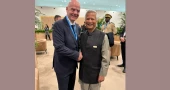
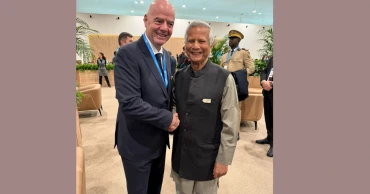
FIFA President Gianni Infantino has said he will join the youth festival set to be held in Bangladesh in January.
Infantino accepted an invitation extended by Chief Adviser Prof Muhammad Yunus, who briefed him on the festival’s goals and sought his support in bringing renowned women's football teams to Bangladesh for the event.
The FIFA President was among several global leaders and key officials who met Prof Yunus on the sidelines of COP29 on Tuesday.
1 year ago

Chief Adviser Yunus engages with global leaders at COP29 to address climate crisis
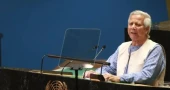
Chief Adviser Prof Muhammad Yunus on Tuesday had brief interactions separately with a number of leaders as COP29, UN's biggest climate conference, is underway.
Prof Yunus met with Prime Minister Daniel Risch of Liechtenstein and Prime Minister Tshering Tobgay of Bhutan.
He also met with President Mohamed Muizzu of the Maldives and President Denis Becriovic of Bosnia and Herzegovina.
Read: COP29: “Won’t revert back to the energy system of the 1950s,” says US top climate negotiator
1 year ago
CA to join 'World Leaders Climate Action Summit' in Baku
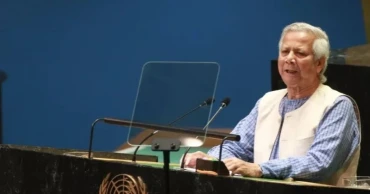
Chief Adviser Prof Muhsammad Yunus will join the "World Leaders Climate Action Summit" at COP 29 on Tuesday, convening world leaders to present national statements on how they are advancing the Paris Agreement on climate change.
President of the Republic of Azerbaijan Ilham Aliyev invited Heads of State and Government (HoS/G) to participate in the two-day World Leaders Climate Action Summit (WLCAS).
The invitation to the WLCAS in the Republic of Azerbaijan during COP 29 signifies the importance for world leaders to engage and enhance ambition and enable action to reduce emissions, adapt to climate change, and address loss and damage, to implement and transform key climate related decisions into concrete actions and credible plans to tackle climate change, said the organizers.
The Summit aims to build consensus and momentum around the COP 29 plan to enhance ambition and enable action and demonstrate to all stakeholders a clear political will to deliver.
It will address raising ambition for mitigation and adaptation through nationally determined contributions (NDCs), National Adaptation Plans (NAPs), and long-term low-emission development strategies (LT-LEDS), enabling action with the New Collective Quantified Goal on Climate (NCQG), and other means of implementation and support.
Prof Yunus is expected to meet Al Azhar Grand Imam Ahmed el Tayyeb at a hotel in Baku on Tuesday morning before attending the opening session of the World Leaders Climate Action Summit at Nizami Plenary Hall, Baku Stadium, a senior official accompanying the Chief Adviser told UNB.
Dhaka's efforts will be to include concerns, demands in COP29 declaration: Prof Yunus
He will join a closed door Climate Leaders Meeting hosted by Germany and Chile.
Prof Yunus will also join a roundtable on "Access to Finance for Smallscale Farmers" to be co-hosted by Bangladesh and the Netherlands.
During the event, the Presidency will co-host a methane and non-carbon dioxide (non-CO2) greenhouse gas (GHG) summit with the US and China.
Earlier, the Chief Adviser arrived in Baku to attend the UN's biggest climate conference, COP29, which is seen as a "pivotal opportunity" to accelerate action to tackle the climate crisis.
Bangladesh Ambassador to Turkey Amanul Haq, among others, was present at the airport to receive the Chief Adviser upon his arrival at 5:15pm (Baku time) on Monday.
Prof Yunus is leading a small delegation and will return home on November 14, a senior official at the CA's office told UNB.
Global leaders and diplomats from across the world are joining the annual climate summit to discuss how to avoid increasing threats from climate change in a place that was one of the birthplaces of the oil industry.
The 29th Conference of the Parties to the UN Framework Convention on Climate Change (COP29) is taking place from November 11 to 22.
1 year ago
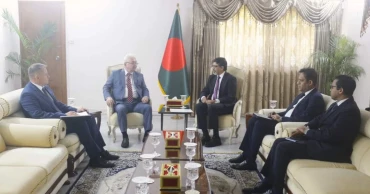
Outgoing Russian envoy hopes for ties to keep getting stronger
Foreign Secretary Md Jashim Uddin has emphasized the need to enhance people-to-people ties and mutual understanding with Russia to further strengthen bilateral relations.
The Foreign Secretary hosted a farewell lunch in honour of the outgoing Ambassador of the Russian Federation Alexander Mantytskiy at State Guest House Padma on Sunday.
In his speech, the Foreign Secretary acknowledged the contributions of the outgoing Ambassador in strengthening Bangladesh-Russia relations and highlighted the important role he played in facilitating several milestone events and achievements in bilateral relations between the two countries.
Ambassador Mantytskiy thanked the Government of Bangladesh for the support he received during his tenure and also discussed several areas, such as education, energy, food, and fertiliser where the two countries continue to cooperate.
He expressed his hope for stronger relations between Bangladesh and Russia in the future.
After serving for over three years as Russia’s Ambassador to Bangladesh, Ambassador Mantytskiy is expected to depart soon.
1 year ago
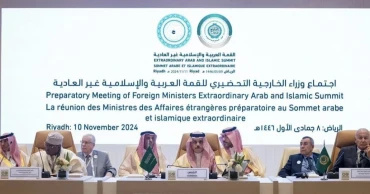
OIC calls for Israel to stop cycle of war from expanding
Organisation of Islamic Cooperation (OIC) Secretary General Hissein Brahim Taha has reiterated the need to intensify individual and joint efforts at this critical stage to mobilize the international community’s responsibility towards stopping the crimes of genocide, settlement and organized terrorism practiced by the Israeli occupation in the Palestinian territories.
He also called for preventing the Israeli occupation from expanding the war cycle and destabilizing the region, as well as supporting efforts to implement the General Assembly resolution on the advisory opinion of the International Court of Justice on the illegality of the Israeli occupation and accelerating the materialization of the two-state solution.
During the meeting, foreign ministers delivered statements and discussed the draft resolution that will be submitted to the upcoming summit tomorrow for adoption.
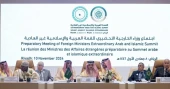
Foreign Affairs Adviser Touhid Hossain led the Bangladesh delegation at the “Preparatory Meeting of Foreign Ministers for the Extraordinary Arab and Islamic” Summit held in Riyadh on Sunday.
1 year ago
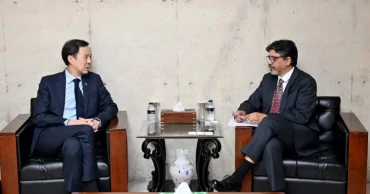
Bangladesh, Singapore launch FTA talks
Bangladesh and Singapore on Monday expressed satisfaction with the launching of Free Trade Agreement (FTA) negotiation and hoped that FTA would facilitate more economic engagements between the two countries.
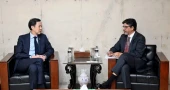
Derek Loh Eu-Tse, Non-resident High Commissioner of Singapore to Bangladesh, called on Foreign Secretary Ambassador Md Jashim Uddin at the Ministry of Foreign Affairs and discussed issues of mutual interest.
The Foreign Secretary briefed on the reform initiatives taken by the interim government and sought Singapore’s support in experience sharing and technical cooperation.
The Foreign Secretary stressed Singapore's role under the umbrella of ASEAN to ensure repatriation of the Forcibly Displaced Myanmar Nationals to Myanmar.
He also briefed the Envoy on the adverse impacts of the prolonged stay of the large Rohingya population in the southern part of the country.
The Foreign Secretary also sought Singapore's support for Bangladesh’s bid to become ASEAN Sectoral Dialogue Partner.
1 year ago

Dhaka's efforts will be to include concerns, demands in COP29 declaration: Prof Yunus
Chief Adviser Prof Muhammad Yunus on Monday asked the Bangladesh officials and NGO and civil society leaders to put in extra efforts to highlight the country's climate crisis concerns at the COP29 that is underway.
He made the call in Baku just after he arrived in the Azerbaijan capital to lead Bangladesh in the annual UN-led climate change summit.
"Our main efforts will be to include our concerns and demands in the final declaration of the COP29," he told the Bangladesh delegation during a coordination meeting at a hotel in Baku.
1 year ago

USAID Trade Activity's Easy Export Series Equips Bangladeshi Exporters with Essential Food Safety Knowledge for Successful Export in EU, GCC, and US Markets
The USAID-funded Feed the Future Bangladesh Trade Activity completed a day-long awareness program on Monday that focused on enhancing Bangladeshi exporters' understanding of food safety, sanitary and phytosanitary requirements.
Held in Chattogram, the event brought together key stakeholders and specialists to address the challenges exporters face in meeting regulatory standards for exporting agro-processed foods to the European Union, Gulf Cooperation Council countries, and the United States. This initiative provided participants with practical tools to navigate complex international markets, to boost compliance and competitiveness for Bangladesh’s agro-processed food industry.
Commenting on the event, the Deputy Director and Project Director of the Plant Quarantine Wing of the Department of Agricultural Extension (DAE) S.M. Khalid Shaifullah highlighted the importance of this initiative, stating, "Ensuring compliance with international food safety standards is vital for expanding our presence in global markets. This program provides a clear roadmap for our exporters, helping them understand and meet the rigorous demands of the EU, GCC, and the USA. markets."
The event was also graced by the Member of the Bangladesh Food Safety Authority - Dr. Mohammad Shoeb and the Director of the Export Promotion Bureau – Abu Mukhles Alamgir Hossain. They shared their optimism about Bangladesh’s vast potential to grow its agro-processed food exports and build a robust foundation for food safety that aligns with domestic and international expectations.
Through initiatives like the Easy Export Series and this awareness programme, the Bangladeshi food & agro-export sectors are empowered to raise their standards, reach new markets while maintaining compliance with international standards, and reinforce Bangladesh's reputation as a reliable source of high-quality agro-processed goods.
1 year ago
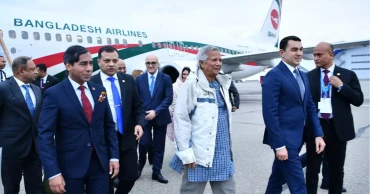
COP29: Chief Adviser Yunus reaches Azerbaijan
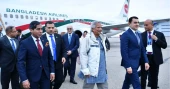
Chief Adviser Prof Muhammad Yunus reached Baku, Azerbaijan on Monday evening (local time) to attend the UN's biggest climate conference, COP29, which is seen as a "pivotal opportunity" to accelerate action to tackle the climate crisis.
Bangladesh Ambassador to Turkey Amanul Haq, among others, was present at the airport to receive the Chief Adviser upon his arrival at 5:15pm (Baku time).
A flight of Biman Bangladesh Airlines, carrying the Chief Adviser and his entourage, left Hazrat Shahjalal International Airport around 11am (local time).
Prof Yunus is leading a small delegation and will return home on November 14, a senior official at his office told UNB.
Global leaders and diplomats from across the world are joining the annual climate summit to discuss how to avoid increasing threats from climate change in a place that was one of the birthplaces of the oil industry.
The 29th Conference of the Parties to the UN Framework Convention on Climate Change (COP29) is taking place from November 11 to 22.
Environment, Forest and Climate Change Adviser Syeda Rizwana Hasan, who will be attending the COP29, stressed the urgent need for global unity in tackling climate change.
Adviser Rizwana Hasan urged developed countries to fulfill their climate finance commitments and provide technological support to nations most vulnerable to climate impacts.
"It’s time that developed nations uphold their commitments to support the most affected countries," she asserted, highlighting the disproportionate challenges faced by vulnerable nations like Bangladesh.
It was in Baku where the world’s first oil fields were developed in 1846 and where Azerbaijan led the world in oil production in 1899.
Sandwiched between Iran in the south and Russia in the north, Azerbaijan is on the Caspian Sea and was part of the Soviet Union from 1922 to 1991.
COP29: Chief Adviser Yunus on his way to Azerbaijan to discuss how to avoid increasing threats from climate change
Nearly all of Azerbaijan’s exports are oil and gas, two of the world’s leading sources of planet-warming carbon dioxide emissions.
President of Azerbaijan Ilham Aliyev described them in April as a “gift of the gods.”
Aliyev said it is a “big honor” for Azerbaijan to host the conference.
He has also said he wants his country to use more renewable energy at home so that it can export more oil and gas abroad, according to the AP.
With global temperatures hitting record highs, and extreme weather events affecting people around the globe, COP29 will bring together leaders from governments, business and civil society to advance concrete solutions to the defining issue of time.
A key focus of COP29 will be on finance, as trillions of dollars are required for countries to drastically reduce greenhouse gas emissions and protect lives and livelihoods from the worsening impacts of climate change, according to the host.
The conference will also be a key moment for countries to present their updated national climate action plans under the Paris agreement, which are due by early 2025.
If done right, these plans would limit global warming to 1.5°C above pre-industrial levels and double as investment plans advancing the Sustainable Development Goals.
With climate impacts inflicting growing human and economic costs in every country, every COP is a vital global moment that must deliver major progress, and COP29 is no exception.
1 year ago
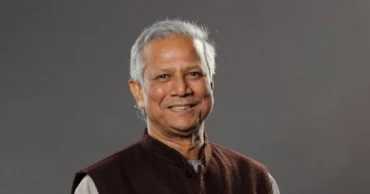
COP29: Chief Adviser Yunus on his way to Azerbaijan to discuss how to avoid increasing threats from climate change
Chief Adviser Prof Muhammad Yunus left here for Baku, Azerbaijan on Monday to attend the UN's biggest climate conference, COP29, which is seen as a "pivotal opportunity" to accelerate action to tackle the climate crisis.
A flight of Biman Bangladesh Airlines, carrying the Chief Adviser and his entourage, left Hazrat Shahjalal International Airport around 11am.
Prof Yunus is leading a small delegation and will return home on November 14, a senior official at his office told UNB.
Global leaders and diplomats from across the world are joining the annual climate summit to discuss how to avoid increasing threats from climate change in a place that was one of the birthplaces of the oil industry.
The 29th Conference of the Parties to the UN Framework Convention on Climate Change (COP29) is taking place from November 11 to 22.
Environment, Forest and Climate Change Adviser Syeda Rizwana Hasan, who will be attending the COP29, stressed the urgent need for global unity in tackling climate change.
Adviser Hasan urged developed countries to fulfill their climate finance commitments and provide technological support to nations most vulnerable to climate impacts.
"It’s time that developed nations uphold their commitments to support the most affected countries," she asserted, highlighting the disproportionate challenges faced by vulnerable nations like Bangladesh.
It was in Baku where the world’s first oil fields were developed in 1846 and where Azerbaijan led the world in oil production in 1899.
Sandwiched between Iran in the south and Russia in the north, Azerbaijan is on the Caspian Sea and was part of the Soviet Union from 1922 to 1991.
Nearly all of Azerbaijan’s exports are oil and gas, two of the world’s leading sources of planet-warming carbon dioxide emissions.
President of Azerbaijan Ilham Aliyev described them in April as a “gift of the gods.”
Aliyev has said it is a “big honor” for Azerbaijan to host the conference.
He has also said he wants his country to use more renewable energy at home so that it can export more oil and gas abroad, according to the AP.
With global temperatures hitting record highs, and extreme weather events affecting people around the globe, COP29 will bring together leaders from governments, business and civil society to advance concrete solutions to the defining issue of time.
A key focus of COP29 will be on finance, as trillions of dollars are required for countries to drastically reduce greenhouse gas emissions and protect lives and livelihoods from the worsening impacts of climate change, according to the host.
The conference will also be a key moment for countries to present their updated national climate action plans under the Paris agreement, which are due by early 2025.
If done right, these plans would limit global warming to 1.5°C above pre-industrial levels and double as investment plans advancing the Sustainable Development Goals.
With climate impacts inflicting growing human and economic costs in every country, every COP is a vital global moment that must deliver major progress, and COP29 is no exception.
1 year ago