foreign-affairs

Fact-finding mission probing allegations of attacks against minorities: Türk
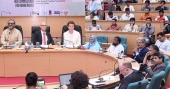
UN High Commissioner for Human Rights Volker Türk on Wednesday said their fact-finding mission is investigating allegations of attacks against minorities between 5 and 15 August.
“It is vital that the authorities respond quickly to any incidents reported, by conducting thorough investigations and holding perpetrators accountable,” he said at a press conference.
Türk said this will help build trust with minority communities, especially in light of troubling campaigns of misinformation and disinformation as well as hate campaigns on social media.
He said transitions are always fraught with risk – and this is all the more pronounced for vulnerable groups. “I commend the efforts made by students and others to protect minorities.”
The UN human rights chief said an inclusive approach, where every voice is heard and valued irrespective of class, gender, race, political ideology, identity or religion, will be key – reflecting the aspirations and diversity of the movement that sparked this transition.
“Women are at the heart of social justice movements, including the protests in July. And I pay tribute to them,” he said, adding that they must be at the forefront during the transition and beyond.
“Any killing needs to be investigated”: UN Rights Chief
“Women need to be visible, particularly in leadership and decision-making positions,” Türk said.
The participation of ethnic and religious minorities in the reform structures, as well as of “indigenous peoples”, is also crucial, he said.
Türk said the interim government has inherited massive challenges on all fronts, including economic, development, social, political and the rule of law.
“Transitions are always complex. And expectations are high. Time is of the essence, but longstanding issues take time to resolve,” he said.
In his discussions with the interim authorities, Türk also expressed support and solidarity for Bangladesh in hosting Rohingya refugees.
“The situation in Rakhine State, which I’m sure all of you are following, is only growing worse, and I was told there are new arrivals to Bangladesh.” He said.
It is important to take a flexible and humanitarian approach, and to ensure non-refoulement and the protection of new arrivals, the rights body chief said.
He mentioned that it is critical to ensure security in the camps, as well as access to livelihoods and education.
“I am doing everything I can to galvanise the international community to focus on this issue, to support Bangladesh, and to step up the search for solutions,” Turk said.
UN Human Rights Office spokesperson Ravina Shamdasani and UN Resident Coordinator in Bangladesh Gwyn Lewis were also present.
1 year ago
Hopeful of finalising report by 1st week of Dec: UN rights chief tells CA
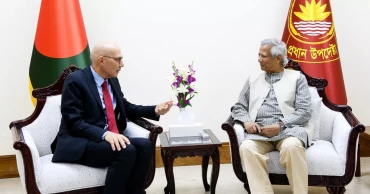
UN High Commissioner for Human Rights Volker Türk has conveyed to Chief Adviser Prof Muhammad Yunus that the independent UN fact-finding mission, which is investigating atrocities committed during the July-August mass uprising, would hopefully finalise its report by the first week of December.
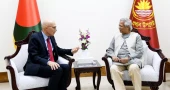
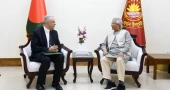
He called on the Chief Adviser at his office at Tejgaon in Dhaka on Wednesday and briefed him (Chief Adviser) about the work of the UN fact-finding mission and his meetings in Dhaka with advisers, the Chief of Army Staff, heads of Reform Commissions, students, and officials.
Briefing the reporters at the Foreign Service Academy, Chief Adviser’s Press Secretary Shafiqul Alam said the UN team is doing their work independently and they have no influence over that.
Alam also said that the fact-finding mission will hand over the report to the chief adviser, and later they will also hand the report over to the relevant ministries and advisers.
Deputy Press Secretaries Apurba Jahangir and Mohammad Abul Kalam Azad Majumder also spoke at the media briefing.
The UN rights chief also discussed the work of the International Crimes Tribunal of Bangladesh that is now investigating heinous crimes and crimes against humanity committed during the revolution and Reform Commissions set up by the Interim Government to conduct meaningful reforms of the country's institutions.
Volker Türk @DU: 'No repetition, no going back. You must draw a clear line in the stand'
"There are so many that need to be fixed," he said, adding that he has also spoken to the members of the Inquiry Commission investigating hundreds of cases of enforced disappearances that occurred during the dictatorship.
1 year ago

“Any killing needs to be investigated”: UN Rights Chief
UN Human Rights High Commissioner Volker Türk on Wednesday laid emphasis on investigating all killings and highlighted the importance of freedom of assembly, expression and political participation.
“When it comes to any killings – they need to be investigated irrespective of perpetrators. That’s very clear. All killings need to be investigated, that is what human rights demands. We cannot allow killings to happen with impunity," he said while responding to a question at a media briefing wrapping up his two-day visit.
UN Human Rights Office spokesperson Ravina Shamdasani and UN Resident Coordinator in Bangladesh Gwyn Lewis were also present.
It is crucial that the strong winds of change are harnessed and directed with human rights as the compass, said the UN rights chief.
He said criminal justice is key, but it is crucial to ensure that charges are not brought in haste, and that due process and fair trial standards are upheld throughout, including in the International Crimes Tribunal (ICT).
“I found the interim government to be aware of the problems with the proceedings in the International Crimes Tribunal in the past. My Office has provided comments on amending the ICT law, to bring it into line with international standards and to ensure the right to fair trial, and that justice is served without compromising due process,” he said.
Turk said they will be looking at other ways that they can accompany and support this process.
“I hope there will also be a public discussion on the use of the death penalty in the future. My own view, informed by the law and by evidence, is clear: the death penalty should be relegated to the past,” he added.
The UN rights chief said it is key that criminal cases are not filed against individuals solely on the basis of their previous political affiliation, including members or supporters of Awami League.
There are concerns that some charges are not founded on proper investigation, including a large number of murder charges against journalists. It is important not to repeat the patterns of the past, he said.
“I welcome the creation by the interim government of a committee to look into this matter as a tool to address the possible proliferation of false cases. It is essential to prioritize due process,” he mentioned.
Türk said to restore social cohesion and trust in institutions of the state, it will be crucial to rebuild the civic space that was progressively strangled in recent years.
“This will require reforming repressive laws, as well as state institutions that have been in the habit of stifling dissent,” he said, adding that old habits die hard – only systemic change will ensure that the freedoms of expression, of association and peaceful assembly, and the right to political participation are respected.
Asked about the banning of Awami League's students wing - Chhatra League using the Anti-Terrorism Act, the UN rights chief said there have been a lot of discussions about terrorism laws and the so-called war on terror.
"We have seen the consequences of it because, unfortunately, the labelling of terrorism has been done in a way that has often also included people who disagree, who are political dissidents," Turk said.
“So, let's not forget that Nelson Mandela, our big hero who has been healing a whole country, was considered a terrorist by the South African apartheid regime,” he added.
About the proposal of banning the Awami League for the July-August killings, Turk said they hope that human rights remain the compass of any process.
“And human rights law is clear about it - it promotes the freedom of assembly, the freedom of association, the freedom of political participation. Non recurrence of the past means that you are when it comes to political participation, for example, that you are guided by the very clear provision of human rights law,” said the UN human rights chief said.
“You need accountability. You need justice. As I mentioned, you need truth telling. You need memorial, and you need what I mentioned as well, the non-recurrence of the past.”
On the healing process, he said there needs to be national ownership for national healing to happen.
“The national healing process has always to be one that is homegrown.”
“This unique, unprecedented moment in the history of Bangladesh is the result of young men and women having taken to the streets – at great personal risk – to express that they had had enough of being ignored and marginalized,” he added.
The UN rights chief welcomed steps taken to repeal the Cyber Security Act, and to withdraw old cases of speech crimes under this law and the Digital Security Act.
He also welcomed statements by Chief Adviser Prof Muhammad Yunus that reinforce Bangladesh’s commitment to human rights, to social justice, and accountability, that acknowledge the need for comprehensive reforms in various institutions, including law enforcement, as well as the need to address economic inequalities.
The rapid establishment of commissions to recommend reforms in the judiciary, the election system, the administration, police, the constitution, and Anti-Corruption Commission is commendable, Türk said.
“I understand further commissions are being formed on health, media, labour rights and women’s affairs. In my discussions today with several of the commissioners, we discussed the importance of trust-building, inclusivity and the lessons that Bangladesh can draw from experiences in other countries that have grappled with similar issues,” he added.
Türk said all these reforms could be a powerful step towards easing decades of intense political division in the country and curbing the patronage politics that have weakened its democratic foundations.
The pursuit of justice for the brutal violence against protestors and other people – including children – killed and seriously wounded in July and August is a priority, he said.
He was encouraged that in many of the discussions, there was a call for enhanced support of his office, including through a strengthened presence.
“We look forward to concluding the discussions on the modalities of our enhanced presence in Bangladesh with the interim government,” said the UN rights chief.
The invitation for his office to deploy a fact-finding mission on human rights violations in the context of protests which took place in July and August this year was an important initiative by the interim authorities.
“A stronger presence in Bangladesh will enable my office to accompany and support the transition process in this area and in other areas, including by offering advice on legal, institutional, economic and social reforms, transitional justice, reconciliation, and healing,” Türk said.
It is a priority for his office to support this dynamic, diverse country and its people through this period of transition, and to do everything they can to help ensure the protection and promotion of human rights for all in Bangladesh, he said.
The UN team might take a month to submit its report on human rights violations committed from July 1 to August 15.
Earlier, the UN rights chief received an official invitation from the Chief Adviser to conduct an impartial and independent fact-finding mission into human rights violations committed from July 1 to August 15.
The office deployed a fact-finding team to Bangladesh, with a view to reporting on violations and abuses perpetrated during the protests, analysing root causes and making recommendations to advance justice and accountability and for longer-term reforms.
1 year ago
Technology equips journalists with speed, accuracy: US Embassy Spokesperson
Technology equips journalists with the speed and accuracy necessary to uphold public trust in election reporting, said Asha C. Beh, US Embassy Spokesperson.
“Through ICT tools, journalists can counter false narratives and ensure transparent coverage for the public," she said.
Dr Heather Ashby, a US foreign policy and national security expert, highlighted the role of artificial intelligence and data tools in real-time fact-checking to safeguard electoral processes.
Volker Türk @DU: 'No repetition, no going back. You must draw a clear line in the stand'
Asha C. Beh underscored the value of US education.
“The quality of U.S. education is globally recognized, offering diverse opportunities for students to excel in fields such as journalism and technology. I encourage students to explore the resources provided by EducationUSA for guidance on studying in the United States.”
This U.S.-backed initiative aims to equip Bangladesh’s future journalists with the skills to deliver credible and transparent reporting and support democratic values.
They attended the events alongside Stamford University’s Vice-Chancellor and Department Chair.
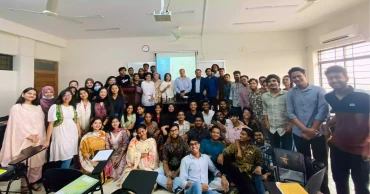
In collaboration with the University of Dhaka and Stamford University, the U.S. Embassy in Dhaka hosted the two sessions with Dr Heather Ashby, a specialist in Information and Communication Technology (ICT) and media integrity, to discuss the vital role of technology in election reporting.
These events, attended by students, faculty, and journalists, focused on how ICT tools can enhance transparency, combat misinformation, and uphold electoral integrity.
1 year ago

No decision taken yet over opening of UN Human Rights body office: Touhid
Foreign Affairs Adviser Md Touhid Hossain on Wednesday said there has been no decision regarding opening of an office of the UN Human Rights body in Dhaka.
"There was a discussion only and there has been no formal or written proposal (from the UN). But we are scrutinising this," he told reporters after his meeting with the High Commissioner for Human Rights Volker Türk at the Ministry of Foreign Affairs.
Responding to a question, Adviser Touhid said the UN team might take a month to submit its report on human rights violations committed from July 1 to August 15.
Turk held a series of meetings discussing human rights issues.
He also held meetings with senior officials and civil society representatives among others.
The High Commissioner is scheduled to meet Chief Adviser Prof Muhammad Yunus today before meeting the press in the evening.
Earlier, the UN rights chief received an official invitation from the Chief Adviser to conduct an impartial and independent fact-finding mission into human rights violations committed during the period.
The office deployed a fact-finding team to Bangladesh, with a view to reporting on violations and abuses perpetrated during the protests, analysing root causes and making recommendations to advance justice and accountability and for longer-term reforms.
Volker Türk made a phone call to Bangladesh interim government Chief Adviser Prof Muhammad Yunus in August.
During his recent visit to New York, Chief Adviser Prof Yunus sought support from foreign friends for Bangladesh's new journey towards a happy and prosperous future, stressing that they do not want to miss the opportunity to build a new Bangladesh.
As part of an ongoing engagement with the interim government, an advance team of the UN rights body visited Bangladesh from August 22-29 and met student leaders of the recent protests, as well as a wide range of advisers in the Interim Government, the Chief Justice, senior officers of the police and armed forces, lawyers, journalists and human rights defenders, representatives of political parties, and minority and indigenous communities.
Talking to reporters on Tuesday, Social Welfare and Women and Children Affairs Adviser Sharmeen S Murshid said the United Nations Human Rights office will set up a office in Dhaka soon.
She said that if the office is set up, the UN Human Rights office will be able to directly investigate human rights violations in Bangladesh.
Türk said citizens must be able to participate in democratic governance and have a real say in decision-making.
While delivering his speech at a programme in Dhaka University on Tuesday, he also said that "free and fair" elections require an environment where freedom of expression, association and peaceful assembly are respected.
This is an opportunity for inclusive, sustainable development policies that benefit everyone, Turk said.
He said inequality, cycles of revenge and retribution, marginalization, corruption, and gross human rights violations must be consigned to the past.
"There must be no repetition, no going back. The present and future belong to equality, to justice," Turk said, adding that Bangladesh is a rich tapestry of promise, culture, and creativity.
The UN human rights chief said it is full of potential and ideas and justifiable demands for a better present and a brighter future and to realise that potential, Bangladesh must draw a clear line in the sand.
"I take inspiration from your commitment to democracy and human rights. Keep it at the forefront of your struggle and lives. I stand together with all of you, as you look to build a more equal, more inclusive, and more just Bangladesh for all," Türk said.
1 year ago
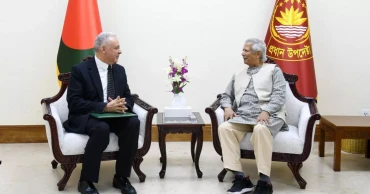
Chief Adviser invited to attend D-8 Summit in Cairo this December
Egypt has invited Chief Advisor Prof Muhammad Yunus to attend the D-8 Summit to be held in the North African country in December.
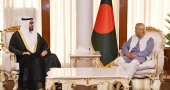
Egyptian Ambassador to Bangladesh, Omar Fahmy, handed over the invitation of the Egyptian President Abdel Fattah El-Sisi to the Chief Adviser at the Chief Adviser’s office in Tejgaon, Dhaka, on Wednesday.
The ambassador said government heads from at least five countries—Turkey, Indonesia, Malaysia, Pakistan and Nigeria—had confirmed their participation in the summit to be held from December 16 to 19 in Cairo.
He said an important sideline meeting in the summit will discuss the way to support Palestinians against Israeli aggression.
The ambassador also conveyed his government's support for Bangladesh's Interim Government in its efforts for democratic transition after the student-led mass uprising in July-August.
Prof Yunus welcomed the support and expressed his hope that Egypt and Bangladesh will work hand-in-hand in different international fora, such as the OIC and D-8.
The Chief Adviser said he would seriously consider participating in the D-8 summit in Egypt.
Ambassador Fahmy hoped that business delegates from Bangladesh would also visit Egypt during the D-8 Summit.
He said that Egypt wants to benefit from Bangladesh's experience in ready-made garment and pharmaceutical sectors and also learn jute cultivation.
He said that the two countries should expedite work on pending agreements and MoUs in the fields of agriculture, textiles, and pharmaceuticals.
The ambassador confirmed Egypt's support for Bangladesh's candidature to the non-permanent seat of the UN Security Council for 2031-32.
He also sought Dhaka's support for Cairo's candidacy for the post of the Director General of the UNESCO.
He also emphasised the renewal of the Foreign Office Consultations between Bangladesh and Egypt.
The first FOC between the two countries was held in 2018, but the second FOC has remained pending since 2021.
1 year ago
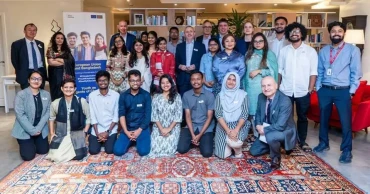
Bangladesh calls for equitable climate solutions, global support to enhance its resilience
Environment, Forest, and Climate Change, and Water Resources Adviser Syeda Rizwana Hasan has emphasised the role of youth, stating that youth in Bangladesh have always been powerful change makers, as history shows, and called for equitable climate solutions and global support to enhance Bangladesh’s resilience.
She highlighted the government’s commitment to further engage youth in climate action and urged all developed countries to follow through on their commitments to climate finance and technological support for countries on the frontlines of climate vulnerability.
The EU Delegation to Bangladesh and the Embassy of Sweden in Dhaka co-organised a roundtable on “Youth as Agents of Change.”
The aims were to discuss the role of youth in addressing climate change ahead of this year’s international climate summit, COP29, and to highlight how young leaders can influence policies and actions in Bangladesh and abroad.
The EU Ambassador, Michael Miller, and Swedish Ambassador, Nicolas Weeks, along with the Italian Ambassador, Antonio Alessandro, and representatives from the EU Member States Germany, France, Denmark and the Netherlands, offered a platform for an open and equal dialogue with 18 youth representatives from various organisations, each actively engaged in the COP process.
The central theme throughout the dialogue was that climate change mitigation and adaptation need to go hand in hand.
All parties must make greater efforts to integrate and mainstream climate change adaptation and resilience into relevant existing policies, strategies, and actions, they said.
“The EU calls for an ambitious and balanced COP29 outcome that keeps the 1.5°C temperature goal within reach, in light of the best available science, moves us all forward towards long-term resilience, and includes agreement on an effective, achievable, and ambitious new collective quantified goal,” said EU Ambassador Miller, who also emphasized the importance of following through with the outcomes of COP28 in Dubai.
At COP29, the EU will continue to stress the importance of scaling up mitigation ambition and implementation in this critical decade. This is the only way we can achieve the goal of limiting global warming to 1.5°C. If we do not reach this goal, the consequences will be severe for climate- and disaster-vulnerable countries like Bangladesh, added Swedish Ambassador Weeks.
“Financing from the Global North shouldn’t hinder the right to development for any country, including the country who will finance. At the same time, the right to development should address the most vulnerable,” said Farzana Faruk Jhumu, Youth Advocate from UNICEF Bangladesh.
“We, the youth, want to ensure climate justice for Bangladesh and the world. We need to be integrated into the government processes, especially the NDCs (Nationally Determined Contributions) in a more formalised way. The government needs to provide youth with avenues to become well-informed in order for youth to contribute more meaningfully,” said youth climate activist, Amanullah Porag, who founded and heads the initiative, Youth4NDCs.
The event brought together civil society, academia, Team Europe partners and youth climate leaders, as well as representatives from the Ministry of Environment, Forest, and Climate Change, and the Ministry of Water Resources.
The EU and its Member States are major financiers of climate adaptation.
Their climate partnerships are rooted in the belief that all parties should protect, respect, and promote human rights; the right to a clean, healthy, and sustainable environment; and the rights of Indigenous Peoples, local communities, migrants, children and youth, older persons, persons with disabilities, and people in vulnerable situations.
These partnerships also emphasize gender equality, the empowerment of women and girls, and intergenerational equity.
Through the EU-Bangladesh partnership, the EU supports the reform ambitions of the Interim Government and its efforts to empower youth for climate action.
1 year ago
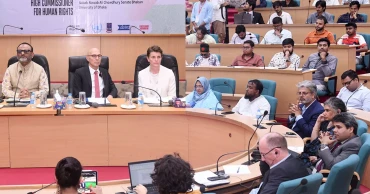
Volker Türk @DU: 'No repetition, no going back. You must draw a clear line in the sand'
United Nations High Commissioner for Human Rights Volker Türk has said citizens must be able to participate in democratic governance and have a real say in decision-making.
While delivering his speech at a programme in Dhaka University on Tuesday, he also said that "free and fair" elections require an environment where freedom of expression, association and peaceful assembly are respected.
This is an opportunity for inclusive, sustainable development policies that benefit everyone, Turk said.
He said inequality, cycles of revenge and retribution, marginalization, corruption, and gross human rights violations must be consigned to the past.
"There must be no repetition, no going back. The present and future belong to equality, to justice," Turk said, adding that Bangladesh is a rich tapestry of promise, culture, and creativity.
The UN human rights chief said it is full of potential and ideas and justifiable demands for a better present and a brighter future and to realise that potential, Bangladesh must draw a clear line in the sand.
"I take inspiration from your commitment to democracy and human rights. Keep it at the forefront of your struggle and lives. I stand together with all of you, as you look to build a more equal, more inclusive, and more just Bangladesh for all," Türk said.
The students and faculty of Dhaka University have a long, rich history of activism – mobilising powerfully over the past 80 years for independence, freedom of expression and language rights, for equal representation – and against military rule.
"And now, for democracy, accountability, and equality. As your distinguished Professor, Serajul Islam Chowdhury, once observed, this university has encouraged people to not only dream about freedom and equality, but to take action to move that dream closer to reality," he said.
Together with other students from both private and public universities, from madrasahs, colleges and schools, together with people from across the country, Turk said, they have shown great courage in standing up for justice and equality for the people of Bangladesh.
"So I am truly honoured to be speaking here today – at a pivotal time, and in a symbolic place. And I am humbled and inspired by your stories of bravery, resilience, solidarity, and commitment to human rights," said the UN human rights chief.
Young people, everywhere, are facing a tumultuous world, filled with deepening inequality and ongoing economic crises and uncertainty.
"Your present and future are being threatened by climate chaos that is becoming more destructive and ferocious every day. In Bangladesh, you know this better than most," Turk said.
He said Bangladesh now has an historic opportunity to renew and revitalise a genuine democracy.
"To deliver deep reform. To start a process of truth, justice and healing. To ensure that the benefits of development are enjoyed by all people. And to rebuild your country on a foundation of equality – where every voice is heard and valued, irrespective of class, gender, race, political ideology or religion," Turk said.
The pursuit of justice must also go beyond trials of those responsible, and address the root causes to achieve the broader social transformation to which you aspire, he said, adding that they need to look forward, not only backwards.
Such an approach should begin with a broad-based national dialogue to design a pathway towards truth, accountability, reparation, and national healing, Turk said.
"It must be inclusive and centered on survivors and victims. Let me also stress that psychosocial support is crucial following the trauma that many of you, your fellow students and loved ones have experienced, and I will be urging the international community to support you in this healing process," he mentioned.
Second, Turk said, at a broader level, Bangladesh has an important opportunity to confront longstanding human rights violations, rebuild an open, diverse and tolerant civic space, and reform key State institutions.
"This is essential to rebuild social cohesion, restore trust in institutions and ensure such abuse of power can never happen again," he said.
Bangladesh will have to grapple with decades of divisive politics that have not served its people well, Turk said, adding that a human rights approach calls for a level playing field that enables all political parties to participate freely.
1 year ago
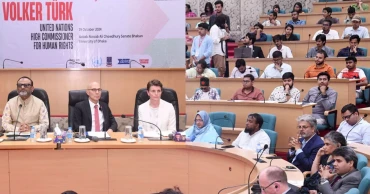
UN High Commissioner for Human Rights Volker exchanges views with student movement coordinators
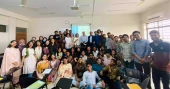
Volker Turk, the United Nations High Commissioner for Human Rights, held a views-exchange meeting with coordinators of the student movements from before the 24- mass uprising at Nabab Nawab Ali Chowdhury Senate Building of Dhaka University on Tuesday.
DU Vice Chancellor Prof Dr. Niaz Ahmed Khan delivered the welcoming address, with the university proctor Saifuddin Ahmed, officials from the UN Resident Coordinator’s Office in Dhaka also in attendance.
Emphasizing the need for justice regarding recent and past human rights violations in Bangladesh, Volker Turk said that the country has an opportunity to address human rights violations sustainably and to reform key state institutions.
He noted that it is essential to establish a democratic process grounded in human rights, saying, “An open environment is necessary for journalists, laborers, community workers, and other human rights defenders to work freely and independently.
DP World, Abu Dhabi Ports keen to invest in Bangladesh: UAE Envoy
The courage and sacrifice of Bangladesh’s youth inspire them. They are ready to accompany and support these young people on their journey, he said, adding that they have already begun their work with them (youths) through information-gathering and fact-finding missions.”
“We aim to assist the interim government in building institutions from a human rights perspective, restoring civil rights, ensuring accountability, and facilitating processes for progress,” he added.
VC Niaz shared that a committee has been formed to identify those involved in the brutal events of July and August on campus. This committee will provide all possible cooperation to the UN’s fact-finding team to bring the perpetrators to justice.
Referring to Dhaka University as the “AP Center” of the student movement, the VC expressed a desire to move forward with students and coordinators in building a new Bangladesh.
He reiterated the university's commitment to upholding human rights and humanitarian values, announcing the establishment of a “July Revolution Corner” on campus to honor the dignity of the July-August uprisings. Academic conferences and workshops will be organized centered around this uprising.
Afterward, the UN High Commissioner answered various questions from the students.
Earlier, the High Commissioner for Human Rights accompanied by others visited the DU campus to observe murals and graffiti created by youth during the July uprising.
1 year ago
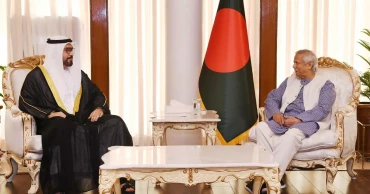
DP World, Abu Dhabi Ports keen to invest in Bangladesh: UAE Envoy
Ambassador of the United Arab Emirates (UAE) to Bangladesh Abdulla Ali Abdulla AlHmoudi on Tuesday said the DP World, one of the world's largest port operators, and Abu Dhabi Ports are very interested to invest in Chittagong port to help boost the country's export competitiveness to the world.
He said Masdar, another top firm in the UAE, is also interested to invest in renewable energy, including floating solar projects, the kind of which it has built in Indonesia.
The UAE is very keen to invest in Bangladesh's logistics, ports, aviation and renewable energy sector and expressed readiness to support the interim government of the country, said Ambassador of the Gulf nation when he called on Chief Adviser Prof Muhammad Yunus at the State Guest House Jamuna in Dhaka.
Bangladesh urges UAE to address visa issues ensuring smoother mobility for workforce
Prof Yunus said his government has already rolled out business-friendly policies and would be happy to see more investments from the UAE and visit of more Emirati businesspeople to Bangladesh, according to the Chief Adviser's press wing.
During the meeting, Prof Yunus thanked UAE President Mohamed bin Zayed Al Nahiyan for the release of 57 Bangladeshi people after they were convicted and sentenced by a UAE court recently.
"It was a wonderful gesture. The whole nation was very happy," said the Chief Adviser.
He also thanked the UAE government for hosting some 1 million Bangladeshi migrants.
Ambassador AlHmoudi expressed his government support for Bangladesh at a "critical time of the country" and said the UAE would stand by the interim government and its pro-business policies and reform agenda.
1 year ago