foreign-affairs
Prof Yunus scheduled to return home early Sunday
Wrapping up very engaging stay and series of meetings with global leaders, Chief Adviser Prof Muhammad Yunus on Friday night left for Dhaka.
Prof Yunus and his delegation members left JFK International Airport at 9:30pm (NY time) and are scheduled to reach Hazrat Shahjalal International Airport at 2:15am (Dhaka time) on September 29.
The Chief Adviser attended around 40 big events on the sidelines of the United Nations General Assembly during his four-day stay here, his Press Secretary Shafiqul Alam told UNB.
Alam said Prof Yunus attended the highest 16 events on September 26 and met at least 12 global leaders, including US President Joe Biden.
The Chief Adviser called upon the international community to engage with ‘new Bangladesh’ anew that aims to realise freedom and democracy for everyone.
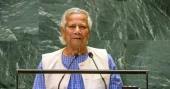
The call came from Yunus' address to the 79th session of the United Nations General Assembly (UNGA), his first since a student-led upsurge brought him at the helm of Bangladesh's interim government last month.
Speaking in Bangla, the Nobel peace laureate said youth in Bangladesh have showed that upholding freedom, dignity and rights of people regardless of distinction and status cannot just remain aspirational. "It is just what everyone deserves."
"This was a epoch-making speech," said the Press Secretary, adding that the speech covered global and regional issues apart from Bangladesh issues.
1 year ago
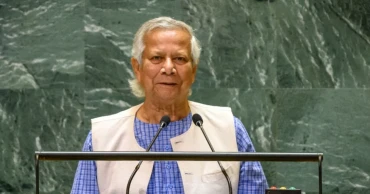
Invest in your young citizens, Prof Yunus urges global leaders
Paying tribute to the role of youth in his country, Chief Adviser Prof Muhammad Yunus has urged the president global leaders at the UN General Assembly to invest in the potential of their own countries’ younger generations to shape a fairer, more equitable world.
“I stand in this parliament of nations thanks to an epochal transformation that Bangladesh witnessed this July and August,” said the Nobel Laureate.
The “power of populace,” in particular the youth, helped liberate Bangladeshis from an autocratic and undemocratic regime, he said, crediting that youth-led movement with propelling Bangladesh into a new phase of political consciousness, while championing human dignity, freedom and social justice.
While speaking at the United Nations General Assembly on Friday, Prof Yunus stressed that this transformation is not without challenges, but the resilience of the people, especially the youth, is steering the country forward: “their determination is laying the foundation for a more equitable and prosperous future.”
Throughout his address, the Chief Adviser reiterated the importance of upholding democratic values and ensuring human rights for all citizens and reiterated his country’s continued commitment to peace, development, and upholding human rights.
He also stated that the principles of freedom and dignity remain central to the country’s governance and international stance, as he referred to the historical context of Bangladesh’s struggle for independence, where freedom was the ultimate goal.
“Our people have fought for independence and for their rights with remarkable courage, and today’s youth continue that fight by demanding justice, equality, and a voice in their future,” he said in his speech, urging an environment where young people can thrive, innovate and lead.
At the global level, Prof Yunus spoke about the vital connection between youth empowerment and the achievement of Sustainable Development Goals (SDGs), according to UN news.
He stated that young people, not just in Bangladesh but across the world, are central to solving pressing global challenges such as poverty, climate change, and inequality.
He called on international leaders to invest in the potential of their young citizens to create a world that is more inclusive, just, and sustainable.
Prof Yunus concluded his remarks by reflecting on the legacy of youth activism in Bangladesh and its future trajectory.
Highlighting how the lessons learned from the country’s struggles for independence still resonated in the actions and aspirations of today’s youth, he said “the world may be changing rapidly, but the values that our youth are upholding remain timeless.”
“The youth in Bangladesh have shown that upholding freedom, dignity, and the rights of people, regardless of distinction and status, can not just remain aspirational. It is what everyone deserves.”
Wrapping up very engaging stay and series of meetings with global leaders, Chief Adviser Prof Muhammad Yunus on Friday night left for Dhaka.
Prof Yunus and his delegation members left JFK International Airport at 9:30pm (NY time) and are scheduled to reach Hazrat Shahjalal International Airport at 2:15am (Dhaka time) on September 29.
The Chief Adviser attended around 40 big events on the sidelines of the United Nations General Assembly during his four-day stay here, his Press Secretary Shafiqul Alam told UNB.
Alam said Prof Yunus attended the highest 16 events on September 26 and met at least 12 global leaders, including US President Joe Biden.
The Chief Adviser called upon the international community to engage with ‘new Bangladesh’ anew that aims to realise freedom and democracy for everyone.
The call came to Yunus' address to the 79th session of the United Nations General Assembly (UNGA), his first since a student-led upsurge brought him at the helm of Bangladesh's interim government last month.
Speaking in Bangla, the Nobel peace laureate said youth in Bangladesh have showed that upholding freedom, dignity, and rights of people regardless of distinction and status can not just remain aspirational. "It is just what everyone deserves."
"This was an epoch-making speech," said the Press Secretary, adding that the speech covered global and regional issues apart from Bangladesh issues.
1 year ago
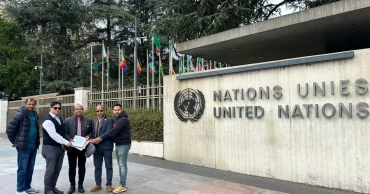
A section of Bangladeshi expatriates demand lifting cases against Hasina
A group of Bangladeshi expatriates in Europe has submitted a dossier at the office of Volker Türk, United Nations High Commissioner for Human Rights, on what they alleged gross rights abuses, wholesale arrests, filling of false murder charges and assault on minorities reportedly taking place in the aftermath of August 5.
They cited specific instances of abuses of rights and demanded withdrawal of cases filed against the former prime minister Sheikh Hasina alongside thousands of Awmi League activists, alongside journalists, writers and rights activists.
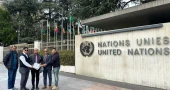
On Tuesday, they went at the office of UN rights chief on Geneva where another UN official on behalf of Volker Turk received the dossier, according to a message received here.UNB could not independently verify the submission of the dossier with the UN office.
According to the dossier, attention has been sought to dig out in details on the violent campaign including attacks on liberal politicians, killing of Awami League members, destruction of public properties, attacks on police stations and cops that allegedly praising plunged the country and its citizens on the edge.
The arson and looting at the historic residence of founding father Sheikh Mujibur Rahman at Dhanmondi 32, a symbol of resilience of country’s struggle for independence and a structure, and inaction to bring the attackers to justice is a dangerous precedence for the posterity, they observed.
At the same time, a breakdown of law and order including rising tide of lynching and murder under cover of mob justice, release of convicted militants and crime lords and looting of armories have further put the lives of citizens in jeopardy, they said.
Downplaying the scale of communal violence, statements have been issued by advisers calling attacks exaggerated and rising tide of call of Islamic rule, let alone unbridled freedom for campaign of Calipahte by banned outfits like Hizbut Taharir held potent to turn Bangladesh into a failed state and earn the tag as safe haven for terrorists, they added.
On the other hand, a barrage of repressive measures including impunity for killing and attacking residences of citizens affiliated with Awami League and burning down of party offices.
They also claimed their families, living in Bangladesh, are living in fear of lives alongside receiving threats of attacks regularly but no legal action has been taken to ensure their protection.
All European Awami League president Nazrul Islam, Switzerland AL General Secretary Shyamol Khan among others were part of the delegation.
1 year ago

Protracted crisis in Myanmar poses growing risks with national and regional security implications for Bangladesh: Prof Yunus
Chief Adviser Prof Muhammad Yunus on Friday called for creating pathways for the Rohingyas to return to their ancestral home in Rakhine State, with safety and rights.
"Looking at the evolving ground situation in Myanmar, Bangladesh is ready to work with the international community to create an environment for dignified and sustainable return of the Rohingyas to their homeland," he said drawing global attention to the Rohingya crisis.
Delivering his speech at the UNGA in Bangla, the Nobel Peace laureate said the protracted crisis in Myanmar also poses growing risks with national and regional security implications for Bangladesh, both traditional and non-traditional security challenges.
Seven years on, he said, Bangladesh has been hosting over 1.2 million Rohingyas on humanitarian ground, incurring significant social-economic-environmental costs.
"We remain committed to supporting the forcibly displaced Rohingyas from Myanmar in Bangladesh," Prof Yunus said.
He said they need continued support of the international community towards the Rohingyas in carrying out the humanitarian operations and their sustainable repatriation.
Equally important is to ensure justice for the grave human rights violations committed against the Rohingyas, through the ongoing accountability processes in the ICJ and the ICC, he said.
Bangladesh recognises and appreciates the efforts of the Secretary General and the United Nations system in creating a conducive environment for Rohingyas so that they can lead a free and dignified life.
Maintaining Peace
Bangladesh views that maintaining peace and addressing conflicts is central to peoples’ progress.
"During the recent Revolution, our valiant armed forces have once again shown their commitment to peace by standing firmly with the people in fulfilling their aspirations for freedom during a most difficult time in our history," Prof Yunus said.
This was possible thanks to their commitment to place human rights at the core of peacekeeping, he said.
"Bangladesh remains equally committed to peace-building, from the inception of the UN Peace-building Commission," Prof Yunus said, adding that they look forward to promoting and enhancing Bangladesh’s value-driven contributions to the UN peace-keeping operations.
As the third largest troop contributing country, Bangladeshi peacekeepers had served across 63 Missions in 43 countries, to date.
About 168 Bangladeshi peacekeepers had laid their lives, from Bosnia to Congo.
"We do hope that Bangladesh defense forces would continue to be called upon in the future UN peace operations, regardless of the challenges or circumstances," said Prof Yunus.
Genocide in Gaza
In a world of poly-crisis, wars and conflicts are leading to erosion of rights and widespread abuses, Prof Yunus said.
The genocide in Gaza continues unabated despite global concerns and condemnation, he said.
"The situation in Palestine just does not concern the Arabs or Muslims at large rather the entire humanity," he said.
"Palestinians are no expendable people. All those responsible for the crimes against humanity against the Palestinian people must be held accountable," said the chief adviser.
Bangladesh calls for an immediate and complete ceasefire to protect the Palestinian people from the brutalities, particularly against the children and women.
International community, including the UN, needs to act in earnest to implement the two-state solution that remains the only path to bring lasting peace in the Middle-East, he said.
The two and half year long war in Ukraine has claimed far too many lives, Prof Yunus said.
The war has impacted far and wide, even lending deeper economic implications in Bangladesh.
"We would urge both sides to pursue dialogue to resolve the differences and end the war," said the chief adviser.
1 year ago

Prof Yunus calls for channeling robust resources for climate adaptation in Bangladesh
Chief Adviser Prof Muhammad Yunus on Friday called for channeling robust resources for climate adaptation in the climate-vulnerable countries like Bangladesh.
"It is moreover crucial to operationlize Loss and Damge Fund by leveraging innovative solutions and additional finance," he said in his speech at the 79th United Nations General Assembly.
Speaking in Bangla Prof Yunus said they equally need access to technologies and increased capacity.
"To be specific, we need access to live-saving technologies, particularly in agriculture, water or public health, where trickle of modest solutions or innovations can save millions of vulnerable population," he said.
Tackling climate crisis has to go hand in hand with getting global economy in order as well, Yunus mentioned.
Climate change poses existential threats to all and the record-breaking heat wave this summer starkly reminded the world of the climate-induced changes.
"What we need is climate justice – so that the irresponsible choices or, indifferent actions or, harms caused are accounted for," said the chief adviser.
"Long-term damages leave irreparable damages all-around: we are losing bio-diversity; changing pathogens leading to newer diseases; farming is under stress; shrinking water wealth threatening habitat; rising sea level and salinity decimating eco-systems," he added.
The damages in terms of rising intensity and frequency of cyclones or floods can hardly be ignored.
The climatic risks are faced far deeper by our small farmers and artisanal livelihood-holders.
"As I speak, over five million people witnessed a most devastating flood in their living memory, in eastern Bangladesh," Prof Yunus said.
Yet, Secretary General Guterres showed that under the “current trajectory”, the world is heading for a +2.7°C scenario.
"The world is increasingly focussed on de-carbonisation. In order for such a shift to be beneficial to majority of global population, the transformative vision of a NetZero world has to redeem for countries like Bangladesh as well," Prof Yunus said.
"Else, we risk falling short on our pledge to ‘shared prosperity’ through ‘shared responsibility’," he added.
He believes, the world needs to engage on a shared vision of ‘three zeroes’ that they can materialize together, targeting zero poverty, zero unemployment, and, zero net carbon emissions.
"Where a young person anywhere in the world will have opportunities to grow not as a job seeker but as entrepreneur; where a young person can unleash his or her latent creativity despite all limitations; where an entrepreneur can optimally balance social benefits, economic profits and responsibility towards nature; where social business can help an individual transcend beyond consumerism and can ultiumately catalyse in social and economic transformation," he said.
Time demands new attitudes, new values, new compact(s), across communities and countries, across developed and developing countries alike, across all actors and stakeholders, said the chief adviser.
"If we are to realize such course correction, in full, the United Nations system, national and sub-national governments, non-governmental organizations, business, philanthropies have to walk together," he said.
"If we accept and accommodate ‘social business’ within existing economic structures, we can bring meaningful changes in the lives of the bottom half of population, in every society."
He said if they can realistically position social business, we can stem much of climate-insenstive distortions within the existing market economy.
Prof Yunus invited the attention of Secretary General Antonio Guterres on that score.
1 year ago

US Senate Majority Whip Durbin continues to express support for Dr Yunus
US Senate Majority Whip Dick Durbin (Democrat, representing Illinois) has met with Nobel Peace Prize Laureate Dr Muhammad Yunus, who was recently appointed to lead the Bangladesh interim government following the resignation of Sheikh Hasina as prime minister.
Durbin has been a steadfast supporter of the work of Yunus for almost two decades, and greeted his appointment as leader of Bangladesh's interim government with a speech on the floor of the Senate.
Durbin first met Dr. Yunus more than 20 years ago during a trip to Bangladesh.
“Dr. Yunus’ ideas changed the world and helped earn him a Nobel Peace Prize. Tragically, his ideas also earned him the wrath of then-Bangladeshi Prime Minister, Sheikh Hasina, whose government harassed Dr. Yunus for years with questionable legal charges and threatened jail time,” said Durbin.
“Thanks to the Bangladeshi people who believed in a better future, they demanded Dr. Yunus lead their interim government. Today, I once again offered my unweaving support for Dr. Yunus and urge President Biden to support him as well. I know Dr. Yunus has the best interests of the Bangladeshi people at heart and will do his utmost in this challenging time.” In July, Durbin led three colleagues in releasing a statement denouncing the harassment against Dr. Yunus, calling on the Bangladeshi government to end the mistreatment of Dr. Yunus, and pull down the dubious charges he is facing.
The statement followed a letter sent by Durbin and his colleagues calling on then-Bangladeshi Prime Minister Sheikh Hasina to end the harassment against Dr. Yunus.
During his Senate speech earlier this month, Durbin had hoped Yunus could make it to Washington during his trip to New York for the UNGA. In the end, he made the trip the opposite way to have the meeting with his old friend.
The harassment campaign against Dr. Yunus was denounced by more than 100 Nobel Prize winners, including former President Obama.
Durbin led the effort in the United States Congress to award Dr. Yunus the Congressional Gold Medal in 2010, recognizing his pioneering contributions in the fight against global poverty.
The Medal was later presented to Dr. Yunus in 2013.
Durbin also visited Bangladesh in 2017, during which he visited with Rohingya refugees who had fled violence in neighboring Burma.
1 year ago
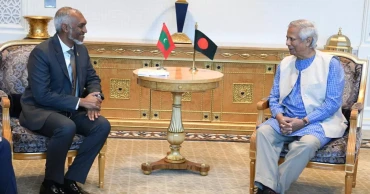
Bangladesh and Maldives seek enhanced trade, investment, tourism ties
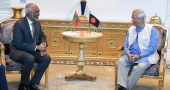
Bangladesh’s Chief Adviser Professor Muhammad Yunus on Friday stressed the need for closer ties with the Maldives when he met Mohamed Muizzu, president of the island nation, on the sidelines of the UN General Assembly at the UN Headquarters in New York.
The two leaders discussed ways to expand trade, investment, tourism, activation of SAARC, climate change research collaboration, and people-to-people interactions during the talks.
The Chief Adviser called for "closer" relations with the Maldives, saying that the two nations have many things in common, including a serious impact of climate change.
"Our whole existence is at stake," Professor Yunus said, referring to the dangers posed by the climate crisis.
The Maldives president praised Bangladeshi workers' role in the country's construction and tourism sectors.
Muizzu said both nations could work together in tourism, fisheries, and climate change research. He called for expanded trade and economic cooperation between the two nations.
"If our two countries work together, it will be beneficial to two peoples," the Maldives president said.
The Chief Adviser said he would like to see the activation of the SAARC as a platform for economic cooperation and closer integration of the South Asian region.
"We shall be closer. We should not remain distant," Professor Yunus said.
1 year ago
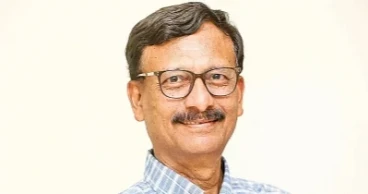
Foreign Affairs adviser urges UN Security Council to take decisive action to solve Rohingya crisis
Foreign Affairs Adviser Md Touhid Hossain has urged the UN Security Council to take decisive action in response to the Rohingya crisis in Bangladesh and the ongoing suffering of Myanmar's citizens amid intensified conflict in Rakhine State.
While addressing the UN Security Council Open Debate on “Leadership for Peace,” he also shared Bangladesh's perspectives on fostering peace and stability.
The adviser noted that Bangladesh is currently hosting over 1.2 million Rohingyas who fled their homes due to horrific atrocities.
He also said in the past month alone, more than 20,000 additional Rohingyas have crossed into Bangladesh as the conflict in Rakhine State has escalated.
“Unfortunately, our capacity is simply overstretched. This Council can no longer remain indifferent to this question and let the civilians suffer most agonizingly,” Touhid said.
He said the UN must prioritize political solutions in Myanmar and promote an Inclusive and sustainable peace process.
“The Council has to remain seized on the situation in Myanmar, through periodic briefings. Regional actors need to be engaged too in addressing the root causes of conflict in Myanmar be it political or socio-economic,” the adviser said.
He said the elected members shoulder responsibility to build consensus on critical issues before the Council. “They have to bridge divides and act as honest brokers, ensuring that the voices of smaller nations and developing countries are not lost in the complex geopolitical calculus."
The Adviser said that engaging the regional organisations is an increasingly crucial partner in maintaining international peace and security.
Stating that fostering regional cooperation is essential in reinforcing the Council's efforts, he said the Council need to further empower regional entities, in Asia, Africa and Latin America, that their initiatives receive adequate support, in terms of political backing and resources.
“Cooperation with organizations like ASEAN, ECOWAS, and African Union, for example, need to be deepened to address regional discords effectively and prevent their escalation,” Touhid observed.
He said Bangladesh, led by Nobel Peace Laureate Professor Muhammad Yunus, remains committed to contributing to the UN's collective endeavours for peace, including through robust participation in UN peacekeeping and peacebuilding. “Let us work together to ensure that multilateralism delivers to today's challenges.”
1 year ago

Engage with ‘new Bangladesh’ anew that aims to realise freedom, democracy: Prof Yunus urges global leaders at UNGA
Chief Adviser Prof Muhammad Yunus on Friday called upon the international community to engage with ‘new Bangladesh’ anew that aims to realise freedom and democracy for everyone. The call came in Yunus' address to the 79th session of the United Nations General Assembly (UNGA), his first since a student-led upsurge brought him at the helm of Bangladesh's interim government last month.
Speaking in Bangla the Nobel peace laureate said youth in Bangladesh have showed that upholding freedom, dignity and rights of people regardless of distinction and status cannot just remain aspirational. "It is just what everyone deserves."
"I would, therefore, call on the international community to continue and deepen engagements with Bangladesh in meeting our people’s quest for democracy, rule of law, equality, prosperity, so that we can emerge as a just and inclusive democratic society," he said.
Yunus said international cooperation should create space for the developing countries in ways that can bring transformative applications or solutions for jobs, endemic socio-economic challenges, or livelihoods.
"We need newer forms of collaboration where global business and knowledge-holders connect to people’s needs," he said.
"In this assembly of nations, Bangladesh would assure that we would and continue to deliver our bit, at international, regional and national levels, in securing peace, prosperity and justice, for everyone," said the chief adviser.
As this great hall reverberates with crying call for peace, security, justice, inclusivity and equitable distribution of wealth, as states, he said they need to reflect on how they embolden men and women today, create space for them to grow as entrepreneurs tomorrow.
The world has more than enough of capacity, resources and solutions. Let us redeem all the pledges we made, nationally or internationally, Prof Yunus said.
"Let us work together to end all forms of inequality and discrimination, within and among nations, especially in advancing the proposition of social business in our economic interactions," said the chief adviser.
Prof Yunus calls for channeling robust resources for climate adaptation in Bangladesh
In the beginning of his speech, Yunus expressed deep appreciation to the Secretary-General, Antonio Guterres, for his unwavering commitment to deliver on the UN mandates and address the global challenges.
"I particularly applaud his vision in convening the Summit of the Future," he said, noting that the Pact for the Future and the Declaration on Future Generations could help in setting pathways beyond Agenda 2030.
Bangladesh believes that the summit’s outcome will serve as a guiding framework in materializing our shared aspirations and re-thinking collaboration, for posterity.
"I stand in this parliament of nations thanks to an epochal transformation that Bangladesh witnessed this July and August. The 'power of the ordinary people', in particular our youth, presented to our nation an opportunity to overhaul many of our systems and institutions," Prof Yunus said.
The uprising led by the students and youth was initially aimed at ending discrimination.
"Progressively the movement evolved into a people’s movement. The world eventually saw how people-at-large stood against autocracy, oppression, discrimination, injustice and corruption, both on the streets and online," said Prof Yunus.
He said people, particularly youth, gained them independence from an autocratic and undemocratic regime with their exceptional resolve and capability.
"That collective resolve should define Bangladesh of the future and place our nation as a responsive and responsible state in the comity of nations," he said.
This was indeed a movement that primarily brought together people who were long left in politics and development.
"Who asked ‘prosperity’ to be shared, to be inclusive. The people aspired for a just, inclusive and functioning democracy for which our new generations made supreme sacrifice."
Prof Yunus said they were moved by the wisdom, courage and conviction the youth showed.
"Even braving bullets, bare chest. Young girls were fiercely vocal against the illegitimate state power. School-going teenagers laid down their lives," Prof Yunus said.
Hundreds lost their eyes, forever. Mothers, day labourers and scores of people across cities lent their shoulders, for “their children”.
"Defying sweat, rain and fear of death, they defeated all the evil designs and machinations of the few who manipulated the state machinery against truth and just aspirations of people for years," Prof Yunus said.
The people’s movement left an estimated over eight hundred martyrs in the hands of the autocratic regime, he said.
"Bangladesh was born because of her people’s profound belief in liberalism, pluralism, secularism. Decades later, our ‘Generation Z’ is making us re-visit and re-imagine the very values that our people Bangladesh stood for back in 1971. As our people also did in 1952, to defend our mother language, Bangla," Prof Yunus said.
He said they believe, the ‘monsoon revolution’ that the world witnessed in Bangladesh in the span of few weeks, may inspire many across communities and countries, to stand for freedom and justice, he mentioned.
Prof Yunus said their youth and people together entrusted him and his colleagues in the Council with enormous responsibilities to re-construct a decaying state apparatus.
"As we took to the office, to our utter shock and dismay, we discovered how endemic corruption a ‘functioning democracy’ was brought to farce, how key institutions were ruthlessly politicised, how public coffers were reduced to rubble, how oligarchs took over business, how ‘chosen few’ concentrated wealth in their hands and amassed and laundered wealth out of Bangladesh," he described.
In all, justice, ethics and morality, almost at every level, reached a low, said the chief adviser.
Under such circumstances, he said, they were asked to re-build Bangladesh and give back the country to the people. "To correct the ills of the past as also build a competitive and agile economy, and a just society."
In a drastically changed scenario, all political parties are now free to voice their views and opinions, he said.
Protracted crisis in Myanmar poses growing risks with national and regional security implications for Bangladesh: Prof Yunus
"A key priority for us is also to make all in public positions and institutions to account for their decisions and actions," said Prof Yunus.
He said they are committed to promote and protect the fundamental rights – for people to speak in freedom, to assemble without fear or inhibition, to vote whosoever they choose, to uphold the independence of the judiciary and freedom of press, including in the cyber domain.
"In order to ensure that child of a farmer or worker can scale the highest in the society, we prioritise allocation in education and health sectors over grandiose infrastructure development," he said.
The interim government also aims at ensuring good governance, across all sectors.
Prof Yunus assured that their government shall adhere to all international, regional and bilateral instruments that Bangladesh is party to. "Bangladesh will continue to remain an active proponent of multilateralism, with the UN at the core."
Bangladesh is open to nurture friendly relations with all countries based on mutual respect, upholding "our dignity and pride and shared interests", he reiterated. In just seven weeks, the government has initiated several actions.
At interim government's request, UN High Commissioner for Human Rights has dispatched a Fact-Finding Mission to investigate into the gross human rights violations during the people’s movement and to suggest for sustainable course correction.
That mission has already started work on the ground in Bangladesh.
"I wish to register my deep appreciation to High Commissioner Volker Turk," Prof Yunus said.
The government has acceded to the International Convention for Protection of All Persons from Enforced Disappearance, within two weeks in office.
"The required national legislation is underway so that we can effectuate its early implementation. An Inquiry Commission has started investigating into all the cases of enforced disappearances reported during the past decade and a half," Prof Yunus said.
In order to restore people’s trust and confidence, and to ensure that the tragic past never recur in future Bangladesh, the government has initiated reforms in certain prioritised sectors.
In that direction, the government launched independent Commissions to reform electoral system, constitution, judicial system, civil administration, law and order sectors .
A few more Commissions are on the cards to reform other sectors, including press and media, he said.
In order to create a conducive environment for business, the government has rolled out extensive reforms in banking and financial sectors.
"We affirm not to let any foreign business interest to be affected," Prof Yunus said.
Beyond rhetoric and numbers, he said they aim to establish effective safeguard mechanisms to ensure the sustainability of these reforms and create an enabling environment towards conduct of free, fair and participatory elections.
1 year ago

Accelerate steps against antimicrobial resistance: Adviser Fouzul Kabir urges int'l community
Adviser of the interim government, Fouzul Kabir Khan, has called upon the international community to accelerate their response against the antimicrobial resistance (AMR), as it is threatening to disrupt a century of progress in medicine.
“AMR is considered the next super pandemic and one of the top 10 global public health threats facing humanity. We need committed and coherent actions for an accelerated response in combating AMR,” he said.
Eenergy, Roads, and Railways Adviser Fouzul Kabir was addressing a high-level meeting on antimicrobial resistance here at United Nations Headquarters in New York on Thursday, which was convened by the President of the United Nations General Assembly.
Fouzul Kabir said Bangladesh welcomes the draft political declaration on AMR.
He said the AMR is leaving a menacing impact on human health, food production, animal health, and the environment. It is a critical challenge that intersects with multiple SDGs, making it a global priority, he said.
“The Global South has been experiencing an increasing number of multidrug-resistant typhoid and other bacterial diseases. It is estimated that around 5 million people die annually due to AMR, and by 2050 it will result in 10 million, he said.
The adviser said Bangladesh is a signatory to the Jaipur Declaration on AMR. “Our National Action Plan on AMR aligns with the WHO Global Action Plan on AMR. We are providing comprehensive AMR surveillance data to the WHO GLASS Platform,” he said.
He said Bangladesh has also developed the National Strategic Plan (NSP) and National Action Plan (NAP) on AMR 2021-2026 with a "National AMR Containment Program." National AMR surveillance for human health, animal health, and AMC (antimicrobial consumption) surveillance is ongoing.
He said extensive advocacy, communication, and social mobilisation initiatives have been launched nationwide. “We have formed the Bangladesh AMR Response Alliance (BARA) for rational use of antibiotics,” he said.
Fouzul Kabir said Bangladesh has taken the model pharmacy scheme, adherence to good manufacturing practices, and elevated the Drug Act, coupled with the formulation of a national antibiotic policy and a blueprint for national AMS implementation guidelines.
“One health framework is crucial to addressing AMR. We must adopt a global mechanism where communication, coordination, collaboration, and coalition would be at the centre,” he said.
Bangladesh has a national One Health Strategy that recognises AMR as a multisectoral problem, he added.
“We must break institutional silos and work across governments, international organisations, agencies, civil society, and private sectors. We must enhance financial flow, scientific research, and awareness, as well as develop strategies to minimise environmental exposure,” said the adviser.
1 year ago