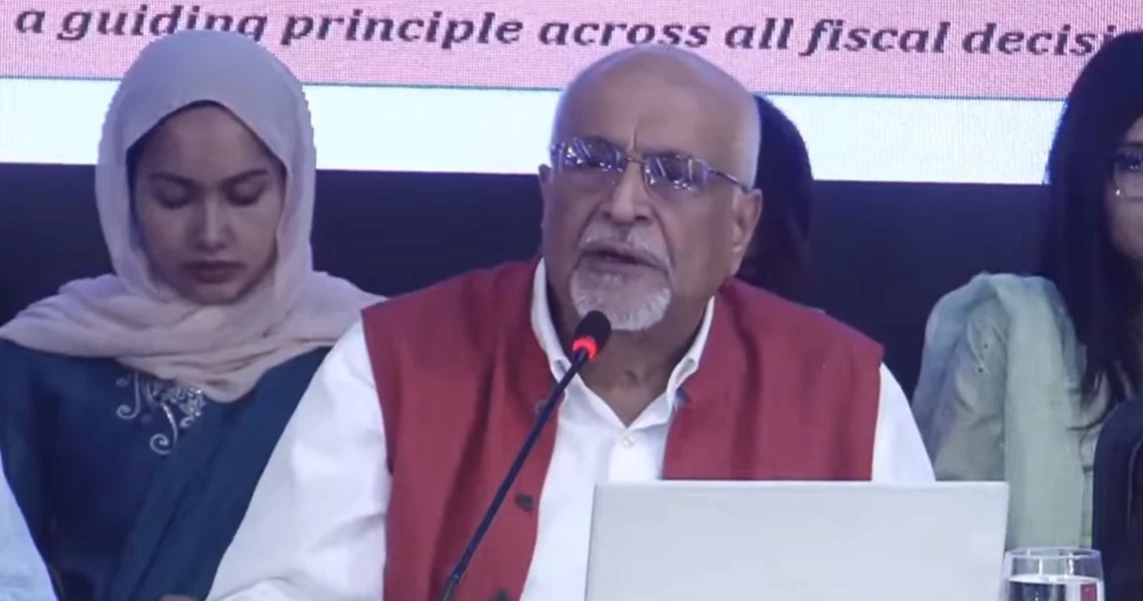
Dr Debapriya Bhattacharya, Distinguished Fellow at the Centre for Policy Dialogue (CPD) and Convener of the Citizen's Platform on Monday said the budget's fiscal architecture remains "devoid of realism" despite its welfare-oriented rhetoric.
The national budget, while thoughtfully designed in its policy framework, falls critically short in reaching the country's most disadvantaged citizens, he said while presenting a detailed analysis at a media briefing at BRAC Centre in Mohakhali.
"The real budget question is not how much we are spending, but whose vulnerabilities we are choosing to protect," he said.
Debapriya said FY26 economic growth of 4.14 percent became "exclusionary", failing to lower prices, raise real wages or create jobs where disadvantaged people actually work.
He noted that headline CPI inflation reached 9.42 percent in May 2026 while wage growth stood at only 8.13 percent, leaving real wages negative and domestic savings also fell sharply from 25.76 percent of GDP in FY23 to 21.38 percent in FY26, weakening household resilience.
Large-scale manufacturing growth collapsed to 1.76 percent in FY26, he said, while RMG export receipts fell 1.9 percent between July and April, threatening livelihoods across a sector employing millions of low-income workers, particularly women.
The budget targets revenue mobilisation at 10.2 percent of GDP and public expenditure at 13.7 percent, while aiming to contain the deficit at around 3.5 percent of GDP.
Debapriya described the macroeconomic framework as prepared "without proper professionalism," noting the budget requires a 52.9 percent revenue growth from a base that missed its FY26 target by 22.7 percent.
He raised concern over the revenue mix, pointing out that 59 percent of incremental revenue relies on indirect taxes: VAT, customs duty and supplementary duty, which burden all consumers equally regardless of income. VAT alone accounts for 32.9 percent of the FY27 revenue target, with an incremental share of 41.2 percent.
"This raises serious concerns about tax justice and equity," he said.
On the positive side, Citizen's Platform acknowledged that 59.5 percent of the incremental budget has been directed toward education, health, and social security marking what it called a "decisive shift" in expenditure priorities.
Social protection allocation has risen to 2.11 percent of GDP and 15.39 percent of the national budget, the highest share on record.
The platform welcomed the consolidation of social security programmes from 95 to 90, the expansion of the Government-to-Person (G2P) digital payment system to over 3.26 crore beneficiaries across 29 programmes, and the introduction of the Family Card and Farmers Card as pro-poor flagship initiatives.
However, it cautioned that civil service pension alone accounts for 24.51 percent of the social protection budget, an occupational entitlement for government employees rather than a universal right.
Combined education, health and social protection spending amounts to only 4.82 percent of GDP, roughly 15 percent of the benchmark maintained in welfare states, the platform noted.
The budget raises the tax-free income threshold from Tk 3.5 lakh to Tk 3.75 lakh and removes import duties on 60 essential food items including rice, wheat, fish, potatoes, and edible oil, steps the platform acknowledged may ease inflationary pressure on low-income households.
Duty exemptions were also extended on 21 categories of assistive devices for persons with disabilities, 51 active pharmaceutical ingredient inputs and nine cancer drug raw materials.
But Debapriya said persons with disabilities, the third gender, Dalit communities, indigenous peoples, climate-vulnerable households and urban slum dwellers, the most marginalised groups received the least targeted support.
He also flagged that doubling of advance tax on savings certificates from 5 percent to 10 percent and reduction of the tax rebate on listed securities investments would hurt middle-income savers who depend on such instruments.
The platform criticised the budget for leaving wealth tax and inheritance tax untapped as revenue sources while offering no unemployment insurance for workers who lose jobs, and no dedicated social protection architecture for urban or informal sector workers.
"Bangladesh is deploying welfare state vocabulary without a welfare state fiscal architecture," Debapriya said.
He called on the government to publish credible real-time data, require the Finance Minister to present quarterly statements to parliament under the Public Finance and Budget Management Act 2009, and ensure that Leave No One Behind remains a guiding principle across all fiscal decisions.
The Citizen's Platform said it has set up a Reform Tracker to monitor progress not only in fiscal terms but against the reform measures and their outcomes.