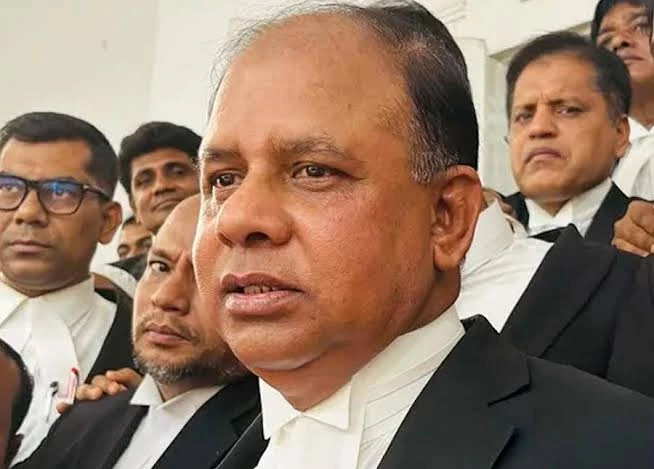
Former Prime Minister Sheikh Hasina will face the legal process for execution of her death sentence if she returns to Bangladesh as she did not appeal against the verdict in a crimes against humanity case, International Crimes Tribunal Chief Prosecutor Md Aminul Islam said on Tuesday.
There is no legal scope for Hasina, a convicted fugitive, to obtain a Bangladeshi passport, he said at a press briefing at the tribunal.
Explaining the legal grounds for denying her a passport, Aminul Islam referred to Article 6 of the Bangladesh Passport Order, 1973, which restricts passport issuance to individuals convicted within the preceding five years and sentenced to imprisonment for at least two years.
He said crimes against humanity fall under offences involving moral turpitude and that Hasina's passport had been cancelled on this ground.
The Chief Prosecutor said a combined reading of sub-clauses A, B, C and E of Article 6 leaves no authority for passport officials to issue a passport to a convicted person in such circumstances.
Referring to Article 36 of the Constitution, which guarantees citizens the right to enter and leave Bangladesh, he said the provision did not give a person who had evaded judicial proceedings the right to obtain a passport.
“Hasina has avoided the judicial proceedings against her. An arrest warrant has been issued to bring her back to the country and other legal steps have also been taken, including the publication of notices in newspapers,” he said.
He further cited sub-clause E of Article 6 of the Passport Order, saying a person who evades ongoing judicial proceedings or remains a fugitive cannot be issued a passport.
He also questioned the reported application for a passport on Hasina's behalf by a London-based law chamber.
He said a passport application must be submitted by the individual concerned but neither Hasina herself nor her party had filed any such application.
Instead, a London-based law firm submitted it on her behalf.
Aminul Islam questioned how a law chamber based in London could apply for a passport on behalf of someone staying in India and whether there was any legal agreement between them.
He said no copy of such an agreement had been made public and questioned how the law chamber could act on Hasina's behalf without a formal agreement with its client.
The Chief Prosecutor said the Bangladesh Passport Order, 1973, was enacted by the country's first government after independence.
Issuing a passport or travel document to a convicted person by the state or government would amount to a form of betrayal of the judicial process, he added.