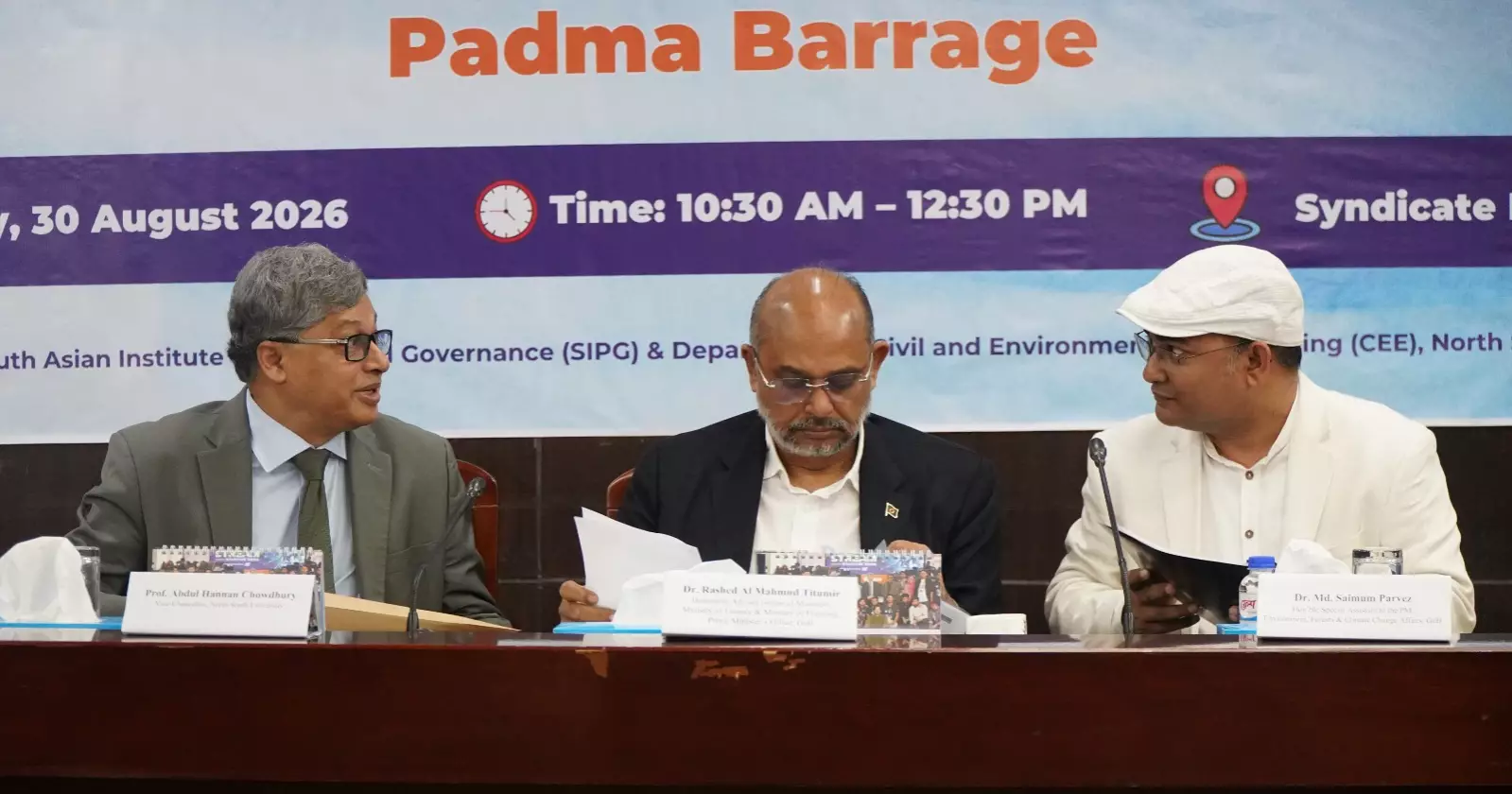
Speakers at a national seminar on transboundary water issues have stressed the need for Bangladesh to pursue water diplomacy and management based on national interest, scientific evidence, fairness and long-term planning.
They said Bangladesh must address both flood-season water abundance and dry-season scarcity through stronger river-basin management, scientific planning, political commitment and coordinated diplomacy.
“The issues are technical, but the solutions must ultimately be political and guided by our national interest,” said Prime Minister Finance and Planning Adviser Dr. Rashed Al Mahmud Titumi while speaking as the chief guest.
The seminar titled “Transboundary Water Sharing Issues and Padma Barrage” was held at North South University on Sunday that called for national preparedness, evidence-based water diplomacy, regional dialogue, technically sound river management, and coordinated policy action to protect Bangladesh’s water security, ecological balance, and sustainable development.
Political Commitment
Dr Titumir said Bangladesh must address both flood-season abundance and dry-season scarcity through long-term planning, political commitment, and scientific management.
Referring to the ecological value of rivers, he observed, “A river should not be understood merely by its number, but by its ecosystem and the wider impacts it creates.”
The economist said the proposed Padma Barrage is not only an engineering project, but also a national development concern linked to agriculture, livelihoods, and the future of western and southwestern Bangladesh.
Economic Implications
Special Assistant to the Prime Minister, Environment, Forests and Climate Change Affairs Dr. Md. Saimum Parvez highlighted the government’s environmental priorities, including tree plantation, canal digging, waste-to-wealth initiatives, renewable energy, and a greener Bangladesh.
“Efficient water use and regional power trade can create pathways for mitigating transboundary water disputes,” he said.
Water-sharing challenges need to be understood through both river-basin dynamics and their economic implications, Parvez said.
The keynote speech was delivered by Dr. Mohammad Abul Hossen, former Member of the Joint Rivers Commission.
He discussed river-basin management, hydro-economic modelling, benefit sharing, efficient water use, and regional power trade as possible pathways for reducing transboundary water disputes.
A policy and diplomacy presentation was delivered by Mohammad Sufiur Rahman, Senior Research Fellow at South Asian Institute of Policy and Governance (SIPG), NSU.
He stressed the need to build synergy with relevant Indian stakeholders and restore natural river flows through fair and cooperative water-sharing arrangements.
Shared Resource
Former Ambassador Sufiur said water should be treated as a shared resource, not as a commercial commodity.
“Equity, fairness, and the principle of causing no harm to either party must remain at the heart of water-sharing negotiations,” he added.
The discussion featured eminent experts, including Engr ANH Akhter Hossain, former Secretary, Government of Bangladesh; Dr. Md. Ataur Rahman, Professor, Department of Water Resources Engineering, BUET.
Discussants called for a stronger national framework combining engineering knowledge, environmental protection, legal preparedness, basin-level planning, and diplomacy.
Shafik Islam, Professor of Tufts University, described the issue as “engineering diplomacy, where rigor meets reality,” noting that “the treaty is only the tip of the iceberg; understanding the patterns, structures, and mental models beneath it is essential.”
The session was chaired by Professor Abdul Hannan Chowdhury, Vice-Chancellor of North South University.
He said, “When the glass remains empty in downstream water sharing, we must find scientific and engineering solutions to manage our own water resources.” He added that Bangladesh’s water resources must be managed for national benefit while supporting sustainable living.
Professor Md. Sirajul Islam, Professor of CEE, NSU, highlighted the focus of the seminar and said, “For Bangladesh, water-resource planning must consider seasonal river changes, sedimentation, transparency, and expert opinion before major interventions are made.”
Delivering the concluding remarks and vote of thanks, Professor Sk. Tawfique M. Haque, Director of SIPG, NSU, urged policymakers to prepare for multiple negotiation scenarios.
He said, “We need greater cohesion and civility in South Asia, in all kinds of negotiation.” He further cautioned, “Policymakers must be prepared with Plans A, B, and C; treaty renewal should not be taken for granted.”
The seminar was jointly organised by SIPG and the CEE, NSU, at North South University.
It brought together policymakers, water experts, engineers, diplomats, academics, and civil society representatives to discuss Bangladesh’s water security, the Ganges Water Sharing Treaty, the Teesta issue, and the proposed Padma Barrage.