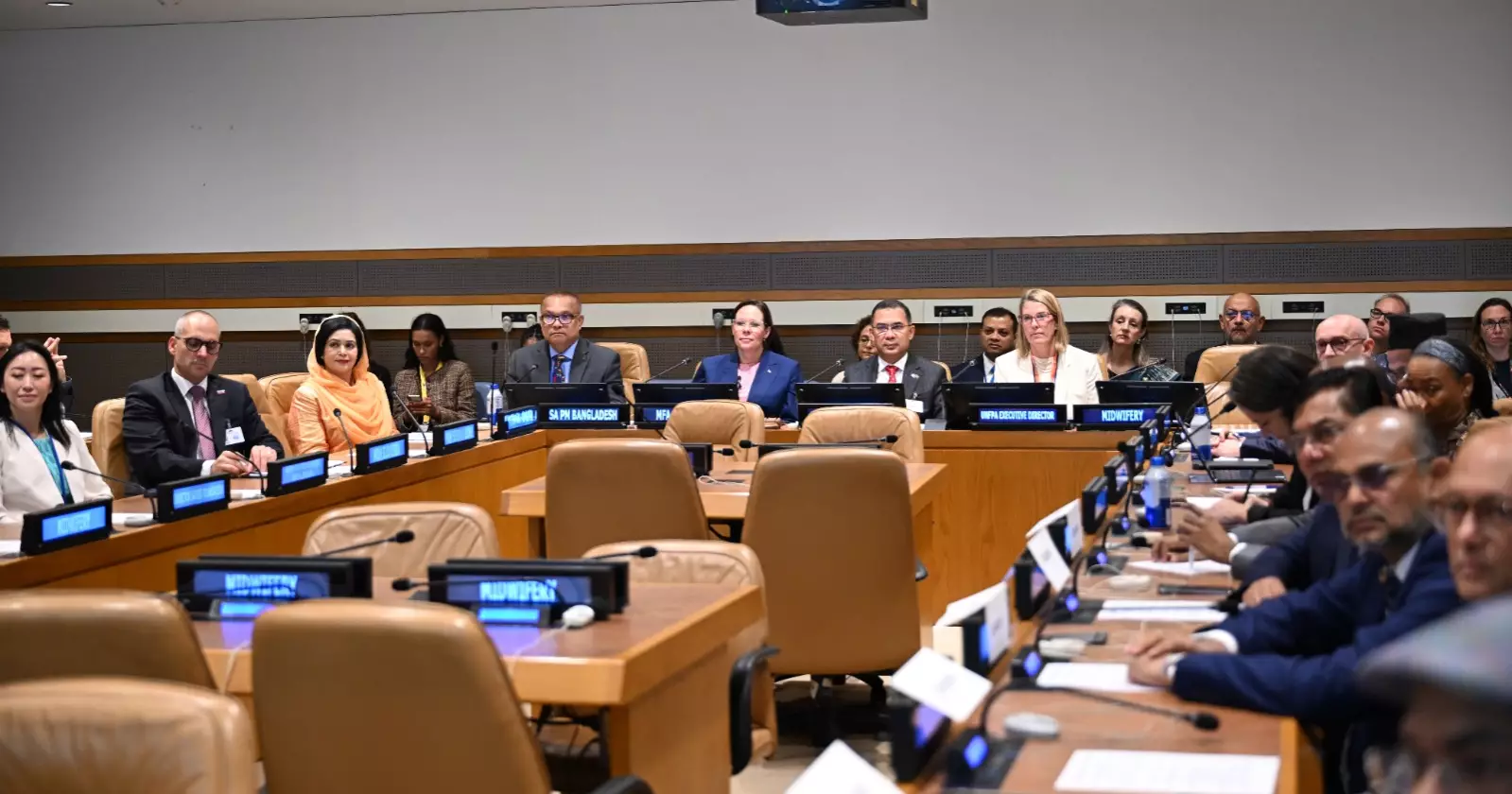
Prime Minister Tarique Rahman on Thursday said his government is transforming Bangladesh’s health system with a focus on prevention, placing primary healthcare at the foundation of its reform agenda and giving priority to women and children.
“My government is transforming our health system, guided by a simple principle: ‘Prevention is better than cure.’ We want to build a healthy Bangladesh, where healthcare begins in the home and community,” he said.
The Prime Minister made the remarks while opening a high-level side event titled “From Commitment to Action: Integrating Midwifery into Primary Health Care to End Preventable Maternal and Newborn Deaths” at the UN Headquarters in New York.
Bangladesh co-hosted the event with Sweden in partnership with UNFPA on the margins of the 81st session of the UN General Assembly.
Tarique Rahman said political commitment becomes meaningful when translated into investment, institutions, skilled people and better lives.
He said his government intends to recruit 100,000 additional health workers, 80 percent of whom will be women.
“They will connect families with the health system, identify risks early, and support timely care,” he said.
Highlighting the role of midwives, the Prime Minister said a professional midwife is much more than a skilled birth attendant and could become a woman’s trusted health professional from preconception through the postnatal period.
“My government has taken the decision to recruit 25,000 professional midwives across Bangladesh, and that process has begun,” he said.
“We want them to become an integral part of multidisciplinary Primary Health Care teams,” Tarique Rahman added.
The midwives will provide essential reproductive care, support antenatal care, promote safe and respectful childbirth, identify complications early, facilitate referrals and care for mothers and newborns, including breastfeeding, immunisation and healthy childhood development, he said.
The Prime Minister said Bangladesh has built an important foundation for professional midwifery, including professional midwifery education, stronger regulation, and the deployment of midwives across district, sub-district, and union-level facilities.
“We now have more than 11,000 licensed midwives, with the objective of reaching 25,000 by 2030,” he said.
Tarique Rahman said Bangladesh’s partnership with Sweden and UNFPA had made an important contribution to the sector.
With UNFPA’s cooperation, Bangladesh has expanded midwifery-led care across 22 districts, where skilled midwives supported more than 154,000 births and managed critical maternal cases, he said.
“These are not merely statistics. They represent mothers returning home safely, and newborns beginning life with hope,” the Prime Minister said.
He also outlined the government’s plan to build an integrated digital health ecosystem.
“Our vision is that every citizen will have a Health Card linked with a digital health record and electronic referral system,” Tarique Rahman said.
He said the system will allow a woman in rural Bangladesh to have her care registered close to home, her visits tracked and her risk factors recorded.
“If referred to a higher-level hospital, the necessary information should travel with her,” the Prime Minister said.
He said the government’s vision for women’s health extended beyond pregnancy and childbirth.
“We must address women’s health across the life course, including adolescent health, reproductive health and family planning, and prevention and early detection of cervical and breast cancers,” Tarique Rahman said.
He said midwifery must be part of a broader platform for women’s health within primary healthcare, while the next phase should be driven by national ownership and sustainable domestic investment.
“As we open today’s discussion, I leave you with one ambition: Every woman should have access to a skilled professional midwife as part of her Primary Health Care team, close to where she lives,” the Prime Minister said.
“For Bangladesh, this means deploying midwives nationwide, strengthening community health services and referral pathways, and connecting citizens through a modern digital health system,” he said.
“Together, these steps will help us build a healthy, thriving Bangladesh. And this is how we move from commitment to action,” Tarique Rahman added.
Prime Minister wife Dr Zubaida Rahman also spoke at the programme.