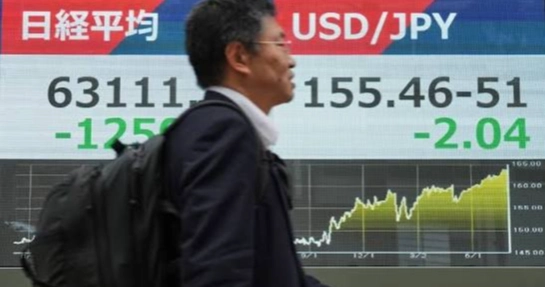
Asian stock markets traded mixed on Monday after the United States and Japan confirmed they had intervened to support the Japanese yen, pushing the currency to its strongest level against the US dollar since late last year.
The yen strengthened after US President Donald Trump and Japanese officials confirmed they had stepped into the currency market last week to slow the dollar's sharp rise. The dollar fell to as low as 155.20 yen, compared with nearly 164 yen last week.
A weaker yen usually benefits Japanese exporters by increasing the value of their overseas earnings when converted into yen. However, it also raises the cost of imports such as oil and raw materials, adding pressure on Japan's economy.
The euro edged up slightly to $1.1533 from $1.1528.
Oil prices dropped sharply after Trump said he would instruct US forces not to carry out attacks on Iran, saying an agreement to end the conflict in the Middle East was close.
US benchmark crude fell 4.8% to $80.58 a barrel in early trading, while Brent crude, the international benchmark, dropped 5% to $83.87 a barrel.
In Asian markets, Japan's Nikkei 225 index fell 1.9% to 63,140.68, while South Korea's Kospi dropped 4.5% to 6,298.75.
The Kospi had surged 17.9% on Friday, its biggest single-day gain on record, after heavy losses earlier in the week. Shares of Samsung Electronics and SK Hynix, which had jumped more than 25% on Friday, fell 8% and 7.8%, respectively, in early Monday trading.
Hong Kong's Hang Seng index rose 0.6% to 26,038.92, while China's Shanghai Composite index slipped 0.5% to 3,812.97.
Australia's S&P/ASX 200 declined 0.2% to 8,961.30, while Taiwan's Taiex gained 0.7%.
On Friday, US stocks ended a volatile July on a positive note. The S&P 500 gained 0.7%, the Dow Jones Industrial Average rose 0.5%, and the Nasdaq Composite advanced 1%.
Wall Street has experienced sharp swings in recent weeks due to rising oil prices linked to the Iran conflict and investor concerns over whether heavy spending on artificial intelligence will generate enough profits to justify soaring technology stock prices.
Amazon led Friday's rally, jumping 15.3% after reporting quarterly earnings that far exceeded analysts' expectations. The company said profits more than tripled from a year earlier, helped by strong growth in its cloud computing business. It also raised its investment outlook, suggesting its AI spending is beginning to deliver results.
Microsoft saw a similar market reaction a day earlier after reporting signs that its AI investments were also boosting profits.
Chipmakers remained volatile. Micron Technology erased an early gain of 6.4% to end the day down 5.9%.
Apple, however, fell 7.4% despite reporting better-than-expected quarterly earnings. Investors were disappointed by its weaker revenue forecast, which the company attributed to supply shortages of key components amid strong AI-related demand.