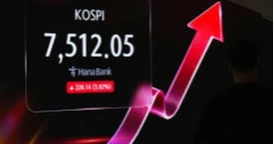
Most Asian stock markets closed higher on Friday, supported by gains in technology shares, while oil prices declined as investors kept a close watch on the latest developments in the Iran war.
U.S. stock futures were mixed.
Market sentiment remained cautious after tensions between Iran and the United States intensified this week. President Donald Trump declared that the Iran war ceasefire agreement was "over," while both countries continued exchanging attacks.
South Korea's Kospi index climbed 2.5% to 7,475.94, recovering part of the losses recorded earlier this week. However, shares of memory chipmaker SK Hynix slipped 0.3% in Seoul ahead of its Nasdaq debut in New York later on Friday.
Japan's Nikkei 225 gained 1.2% to close at 68,557.73. SoftBank Group, a major investor in OpenAI, surged 10.7%, while chip equipment manufacturer Tokyo Electron rose 2.7%.
Hong Kong's Hang Seng Index added 0.5% to 24,156.29. In mainland China, the Shanghai Composite Index erased early gains and ended 1% lower at 3,996.16.
Australia's S&P/ASX 200 advanced 0.5% to 8,806.00, while India's Sensex rose 1%.
Oil prices moved lower after fluctuating sharply, as concerns persisted over global oil supplies due to the limited number of vessels able to pass through the Strait of Hormuz, one of the world's most important energy shipping routes.
Brent crude, the international benchmark, fell 0.8% to $75.66 a barrel, compared with around $72 before the war began in late February. U.S. benchmark crude dropped 0.9% to $71.47 a barrel.
On Wall Street, the S&P 500 gained 0.8% on Thursday, while the Dow Jones Industrial Average rose 0.3%. The tech-heavy Nasdaq Composite climbed 1.3% to 26,206.89.
Technology stocks, especially semiconductor companies, led the gains. Micron Technology jumped 4.5% after announcing plans to expand its U.S. investments, citing strong demand for memory chips driven by artificial intelligence.
Advanced Micro Devices (AMD) rose 5.7%, while Marvell Technology gained 5% and ON Semiconductor added 4.4%.
In currency trading early Friday, the U.S. dollar fell to 161.70 Japanese yen from 162.37 yen, while the euro edged up to $1.1439 from $1.1430.
The Japanese yen strengthened after Finance Minister Satsuki Katayama said the government would encourage major pension funds to invest more in domestic assets denominated in yen.