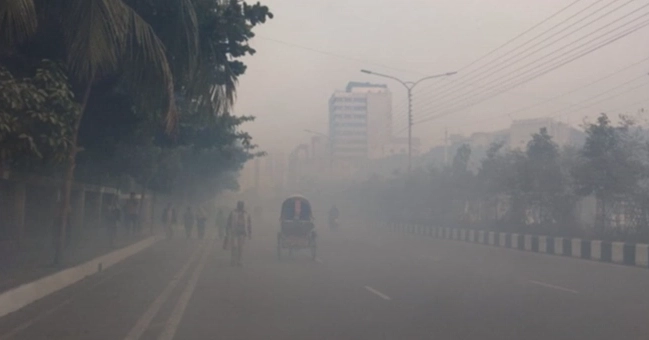
Dhaka, the overcrowded capital city of Bangladesh, has ranked 12th on the list of cities with the worst air quality with an AQI score of 153 at 9:21 am this morning (January 06, 2026).
The capital's air was classified as ‘unhealthy’, according to the AQI index.
India’s Delhi, Egypt’s Cairo, India’s Kolkata and Pakistan’s Lahore occupied the first, second, third and fourth spots on the list, with AQI scores of 215, 192, 181 and 174, respectively.
An AQI score between 50 and 100 is considered ‘moderate’, usually prompting sensitive individuals to limit prolonged outdoor exertion. A score between 101 and 150 is considered ‘unhealthy for sensitive groups’, 150 to 200 is ‘unhealthy’, 201 to 300 is ‘very unhealthy’, and a reading of 301 or more is considered ‘hazardous’, posing serious health risks to residents.
Read more: Adviser Rizwana calls for effective regional action to combat trans-boundary air pollution
The AQI, an index for reporting daily air quality, informs people how clean or polluted the air of a certain city is and what associated health effects might be a concern for them.
The AQI in Bangladesh is based on five pollutants: particulate matter (PM10 and PM2.5), NO2, CO, SO2, and ozone.
Dhaka has long been grappling with air pollution issues. Its air quality usually turns unhealthy in winter and improves during the monsoon.
Read more: What is Carbon Trading? How does it work?
As per World Health Organization (WHO), air pollution kills an estimated seven million people worldwide every year, mainly due to increased mortality from stroke, heart disease, chronic obstructive pulmonary disease, lung cancer, and acute respiratory infections.