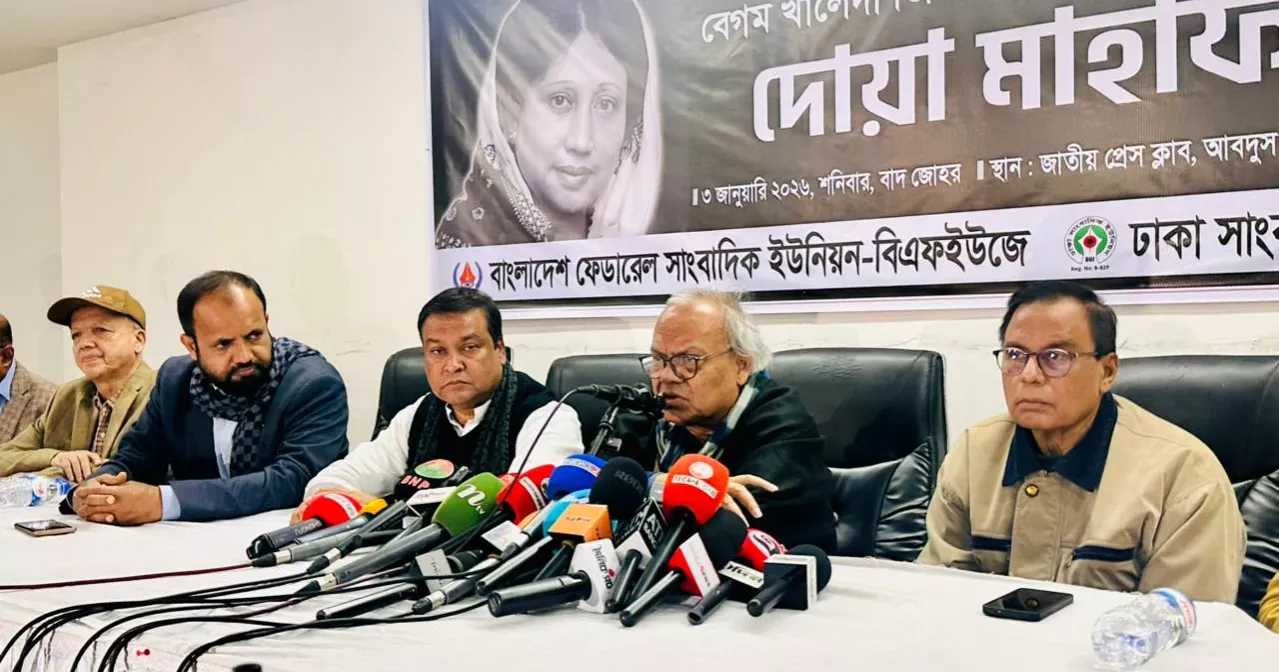
BNP Senior Joint Secretary General Ruhul Kabir Rizvi on Saturday said Bangladesh can advance by embracing the vision and principles of former Prime Minister Khaleda Zia.
“Khaleda Zia stood by the people of the country, facing crises with immense patience and strong determination. Following the path she showed is the way for the country to move forward,” he said.
The BNP leader made the remarks while speaking at a condolence meeting and doa mahfil organised by Bangladesh Federal Journalists Union (BFUJ) and Dhaka Journalists Union (DUJ) in memory of BNP Chairperson and former three-time Prime Minister Khaleda Zia at the Jatiya Press Club.
Fakhrul visits ailing Mostafa Jamal Haider at LabAid
Describing the media as the fourth pillar of the state, Rizvi said no leader had a deeper ideological and personal relationship with the media than Khaleda Zia.
He recalled that under the leadership of martyred President Ziaur Rahman, the foundations of multi-party democracy, freedom of expression and press freedom were firmly established in the country.
The BNP leader said the press had faced varying degrees of control since the Pakistan era, but the suppression of newspapers during the BAKSAL period was unprecedented. Many families who depended on journalism or writing for their livelihood lost everything when all but four newspapers were shut down by the then Awami League regime.
“Ziaur Rahman restored press freedom, and Khaleda later strengthened and expanded it further, building a deep and inseparable relationship with journalists and the newspaper industry,” he added.
Recalling a personal memory, Rizvi said Khaleda attended a programme at the Jatiya Press Club soon after her release from prison in 2008, responding to journalists’ request without hesitation.
Tarique to lead nation forward following Khaleda Zia’s path: Rizvi
“We have seen her up close. Her personality was immense. The outpouring of grief, emotion and love following her passing shows how deeply she touched people’s lives. The massive crowd at her janaza was spontaneous. People from all walks of life came on their own out of love and respect,” he said.
As soon as news of her death spread, Rizvi said ordinary people came out onto the streets of their own accord. “Government officials, clerks, street vendors, and people from all walks of life attended, drawn by their heartfelt respect.”
He observed that many observers remarked no janaza since Imam Khomeini’s had seen such a huge turnout. “It felt as if the entire city of Dhaka was flowing with people. This was not mere formality—it was a true expression of love and respect from the people.”
The BNP leader described Khaleda as a towering leader whose presence gave people a sense of protection and confidence. “With her passing, we have lost that sense of guardianship.”
He said Khaleda always showed restraint and balance, even during difficult times such as the 1/11 political crisis. “She never responded to insults with insults, choosing dignity and silence instead.”
Rizvi alleged that the Awami League government deliberately pushed Khaleda Zia towards death by denying her adequate medical treatment in prison. “The DGFI and NSI monitored her personal doctors and even issued threats,” he said.
BNP leaders, activists offer prayers at Khaleda Zia’s grave after Jum'a prayers
He also said it was precisely because of Khaleda Zia’s leadership that the Awami League was unable to destroy the BNP despite all their efforts. “Despite all adversities, she remained steadfast for the people of the country. The example she left behind is the path for Bangladesh’s progress.”