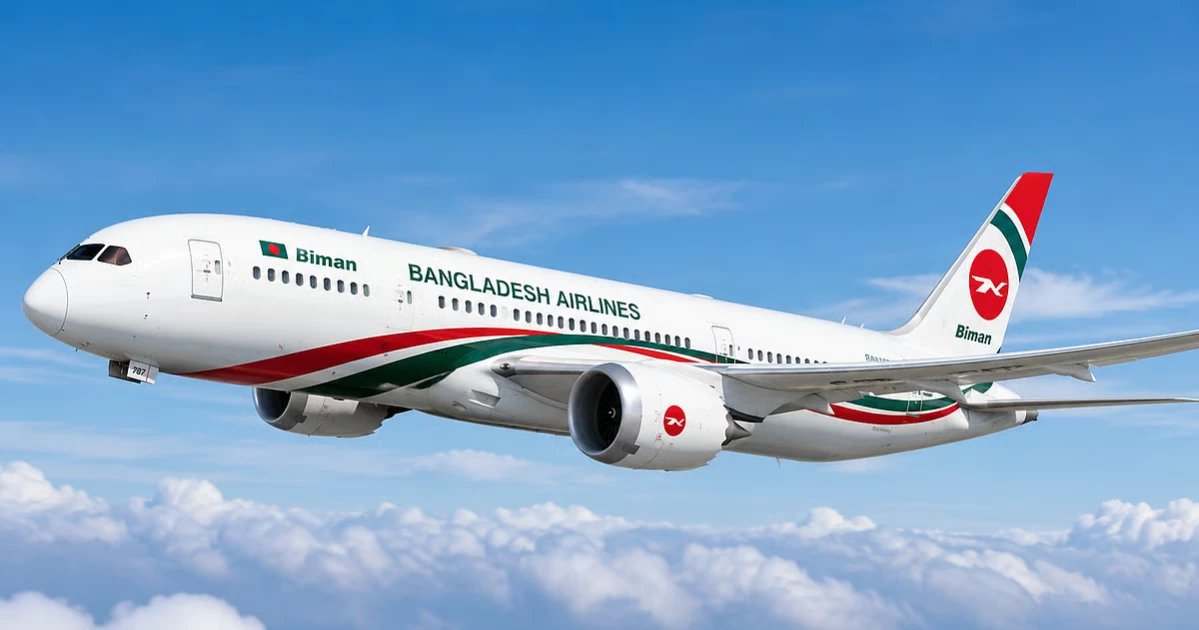
State-run Biman Bangladesh Airlines has floated a fresh Request for Proposal (RFP) to dry lease three Boeing 787-9 Dreamliners for six years after failing to secure the aircraft under a previous tender.
According to Biman sources, the response for the first Request for Proposal (RFP) is poor that pushed the national flag carrier to float the fresh one.
Biman issued the new RFP on Aug 10, setting the deadline for submission of proposals at 10:00am BST (0400 GMT) on Aug 25, according to the airline’s Corporate Planning Department.
The national flag carrier had floated the previous tender on July 15, with a submission deadline of Aug 9.
Under the new RFP, Biman seeks three Boeing 787-9 aircraft for a 72-month lease, with immediate induction preferred and delivery by Jan 1, 2027.
Aircraft offered for delivery up to Feb 28, 2027, will also be considered during the technical evaluation.
A dry lease means the lessor provides the aircraft while the airline assumes responsibility for its operation, including pilots, cabin crew, maintenance and insurance.
Biman has specified that the aircraft must not be more than 15 years old as of June 30, 2027, and should be powered by GEnx-1B74/75 engines with a maximum take-off weight of 254, 000 kg. Preference will be given to sister-ship aircraft offered by the same lessor.
Each aircraft must have a two-class configuration with more than 300 seats, including 180-degree full-flat Business Class seats and at least 31-inch seat pitch in Economy Class. All seats must be new, it said.
The aircraft must be delivered in fully operational condition with valid Certificates of Airworthiness and Registration and immediately after a fresh C-check.
Biman also stipulated that major scheduled maintenance, including heavy maintenance checks and landing gear overhauls, should not become due within the first 24 months of the lease.
The aircraft must be painted in Biman’s official livery at the lessor’s expense and based at Hazrat Shahjalal International Airport in Dhaka.
The RFP also specifies advanced avionics and safety systems, including Engine Health Monitoring, Aircraft Health Monitoring, Flight Data Monitoring, upgraded flight recorders, TCAS Version 7.1, ACARS, Terrain Awareness and Warning Systems, satellite communications and GPS/GNSS navigation.
The aircraft must comply with applicable FAA, EASA and Civil Aviation Authority of Bangladesh regulations.
Biman expects each aircraft to operate around 4,000 flight hours annually.
Financial proposals must separately quote monthly lease rentals, maintenance reserves for major components and security deposits.
The evaluation will give 25 percent weight to technical criteria and 75 percent to financial viability, based on the Net Present Value of cash flows over the 72-month lease period.
Technically responsive bidders will subsequently enter into negotiations with Biman in Dhaka.
Biman has reserved the right to accept or reject any or all proposals without assigning any reason.
The airline currently has 19 aircraft in its fleet, comprising four Boeing 777-300ERs, four Boeing 787-8s, two Boeing 787-9s, four Boeing 737s and five Dash 8-400s.
Biman began modernising its fleet with new-generation aircraft after signing agreements with Boeing in April and May 2008 to purchase four 777-300ERs, four 787-8s and two 737-800s.
The four 777-300ERs joined the fleet between October 2011 and March 2014, while the 737-800s were inducted in 2015 and 2019. Four Boeing 787-8s were added between 2018 and 2019.
Biman also acquired three Dash 8 aircraft under a government-to-government agreement between Bangladesh and Canada. The aircraft joined the fleet in December 2020, February 2021 and March 2021.