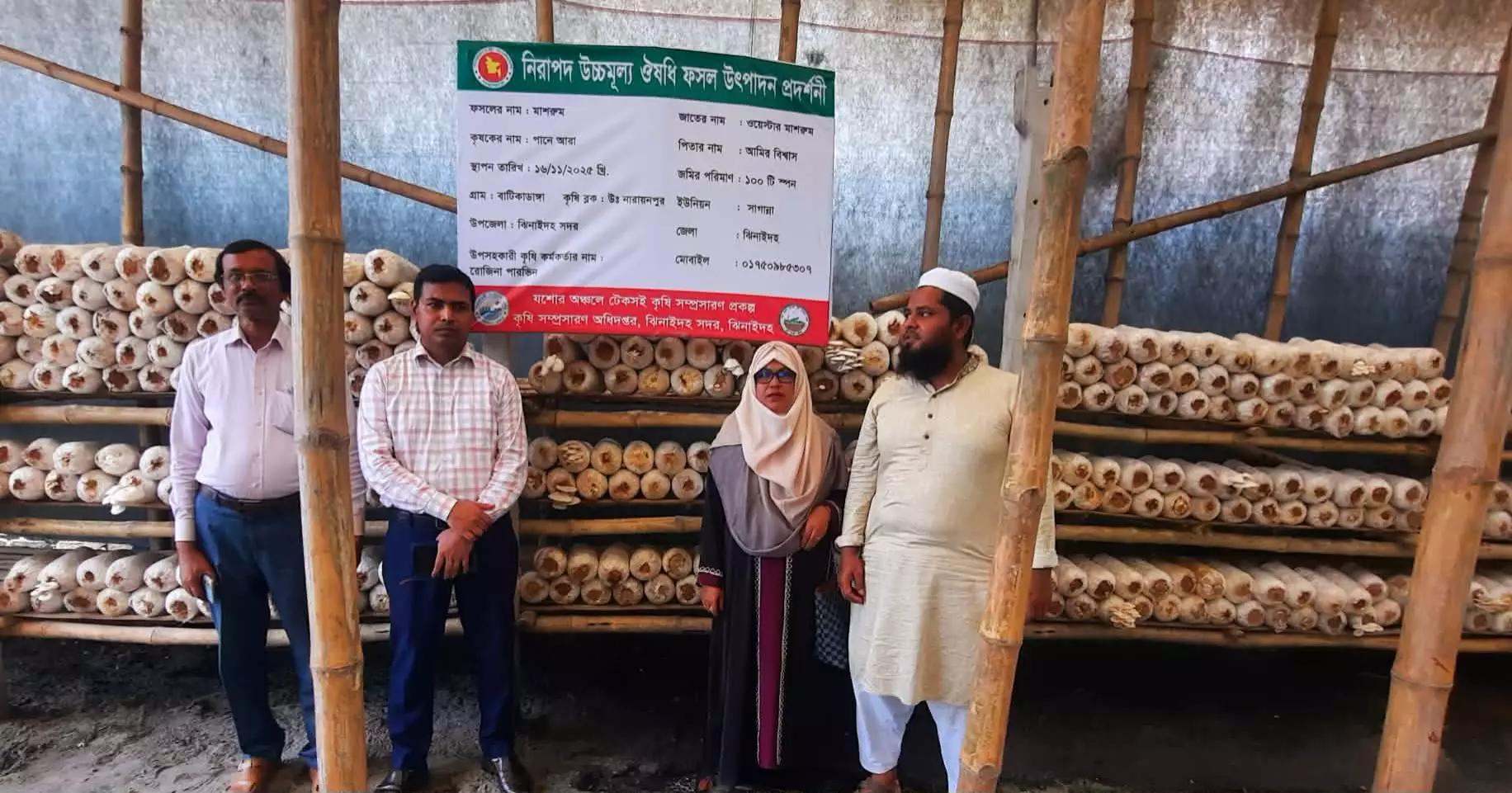
A young entrepreneur from Jhenaidah has transformed his fortunes through mushroom farming after quitting a private-sector job, building a thriving business that now also provides employment for four others.
Shahjalal, from Batikadanga village in Sadar upazila, started his mushroom farm with an investment of just Tk 20,000 and 200 spawn packets after receiving training in mushroom cultivation.
His farm now houses around 5,000 spawn packets worth an estimated Tk 2.5 lakh.
Mushrooms produced at the farm are supplied not only to local markets in Jhenaidah but also to Dhaka, Chattogram and several other districts across the country.
Shahjalal said he sells mushrooms worth around Tk 150,000 every month, earning a net profit of Tk 50,000 to Tk 60,000 after meeting production costs.
He sells mushrooms at Tk 250 per kg wholesale and Tk 300 per kg retail.
In addition to mushroom production, he has introduced an environment-friendly method of utilising used spawn packets by converting them into high-quality organic fertiliser through the Farmyard Manure (FYM) process.
The organic fertiliser is sold at Tk 10 per kg, providing him with an additional source of income.
Shahjalal said he started the venture with the aim of supplying safe and nutritious food to consumers. He has employed four workers at his farm.
He now plans to expand the farm and establish an inoculation laboratory but requires equipment such as a laminar airflow cabinet and an autoclave machine.
The youth expressed hope that government support will help him increase production several-fold and create more employment opportunities.
Jhenaidah Sadar Upazila Agriculture Officer Md Nur-e-Nabi and Sub-Assistant Agriculture Officer Rojina Khatun described Shahjalal as a hardworking and promising entrepreneur.
They said he achieved success by adopting modern farming techniques with support from the Department of Agricultural Extension and added that government assistance and modern equipment will enable him to expand the business further.
The officials also said mushroom cultivation has strong potential to generate employment while contributing to improved nutrition across the country.