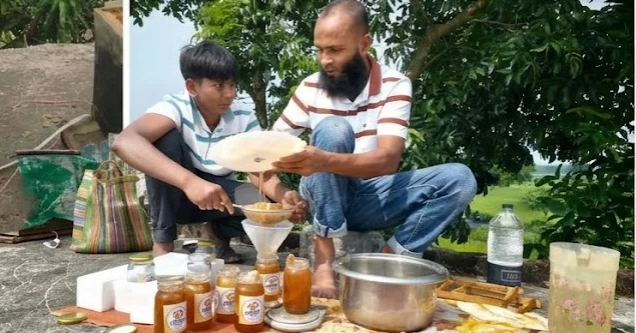
Amid concerns over adulterated honey in the market, Saddam Hossain, a young entrepreneur from Chhupria village in Sadar upazila of Satkhira district, is pursuing an unusual dream — placing a beehive in every home so people can enjoy naturally collected, pure honey.
Over the past decade, Saddam has turned his passion for beekeeping into a small but growing business, installing 200 wooden beehive boxes on house rooftops, mosque ledges, institutional buildings and beside gardens across different parts of Satkhira.
Using small bees that naturally nest in tree hollows and crevices, he collects honey from the boxes, bottles it and sells it through his enterprise, 'Moumachi Kutir', established with approval from the Bangladesh Small and Cottage Industries Corporation (BSCIC).
His venture now earns him around Tk 3.5 lakh to Tk 4 lakh annually. Alongside running the business, he is training 10 young people in beekeeping to help them become self-reliant.
“My main goal is to raise awareness about pure honey and make it available to every household. If each home has a beehive, family members can collect natural honey for their own needs,” Saddam said.
He believes the initiative can do more than provide a source of nutritious food. Expanding bee populations can also support pollination, help maintain ecological balance and create income opportunities for rural communities.
Inspired by Saddam's work, around 80 people have already installed beehive boxes at their homes and institutions. They collect honey for their families, reducing their dependence on commercially available products.
For Saddam, the idea of a beehive in every home is not simply a business ambition. It is an effort to reconnect people with nature and encourage them to take responsibility for the quality of the food they consume.
Many consumers find it difficult to distinguish pure honey from adulterated products. Saddam's approach allows people to observe honey collection directly and gain confidence in its natural origin.
Several people, including government officials, have visited his beehives, watched the collection process and purchased honey after tasting it.
Mizanur Rahman, Officer-in-Charge of Kalaroa Police Station, said he had never previously witnessed honey being collected directly from a beehive. He purchased honey along with a beehive from Saddam for his family.
Such experiences, Saddam hopes, will encourage more families to adopt small-scale beekeeping and understand the value of bees in the natural environment.
Saddam's initiative is also creating opportunities for young people seeking alternative sources of income.
Young trainees said they were learning beekeeping to become financially independent and eventually establish their own ventures.
By combining practical training with commercial production, Saddam hopes to spread the practice beyond his own business and build a community of small-scale beekeepers.
Gourab Das, deputy manager of BSCIC in Satkhira, described Saddam's work as an exemplary initiative that demonstrates the potential of small-bee farming in the district.
Around 600 registered beekeepers are currently operating in Satkhira, he said, adding that beekeepers are receiving support through training and access to loans.
Gourab also stressed the importance of expanding beekeeping in coastal Satkhira, where climate change and environmental risks make the conservation and growth of bee populations increasingly significant.
An initiative is being considered to promote beekeeping, training and public awareness in several coastal districts, including Satkhira, he said.
Despite its potential, Saddam's initiative faces resistance from some orchard owners.
He said many owners of jujube orchards in Satkhira were reluctant to allow beehive boxes near their gardens because they feared the bees might damage flowers or reduce fruit production.
Saddam believes the opposite is true: bees play an important role in pollination and can contribute to improved agricultural productivity.
He has called for coordinated efforts by researchers, the agriculture department and relevant authorities to dispel misconceptions among farmers and encourage cooperation between orchard owners and beekeepers.
Jamal Uddin, additional deputy director of the Satkhira Department of Agricultural Extension, said bees were beneficial to flowers and crops.
He noted that some mustard and jujube growers, due to a lack of awareness, sometimes destroy beehive boxes or cause losses to beekeepers.
Agricultural field officers have been instructed to raise awareness among farmers about the benefits of bees, he said.
According to Jamal Uddin, more than Tk 2 crore worth of honey is collected annually in Satkhira from mustard and jujube flowers alone.
The activity generates income for beekeepers, creates employment and can improve crop production through pollination, he added.
While demand for pure honey is growing, unscrupulous traders are taking advantage of consumers by producing and selling adulterated products, leaving buyers vulnerable to fraud.
BSCIC officials have advised consumers to inform the administration if they have specific information about the sale of adulterated honey.
Saddam believes that encouraging household beekeeping could help build greater awareness of natural honey and reduce people's dependence on products whose authenticity may be difficult to establish.
For him, the ultimate measure of success will not be the number of boxes he owns or the income his business generates, but the number of families that embrace the idea.
With 200 beehive boxes already in operation and dozens of households inspired by his work, Saddam is steadily moving towards his goal.
His dream is simple: one day, every home will have a beehive, every family will have access to naturally collected honey, and more young people will find a sustainable livelihood by working with nature