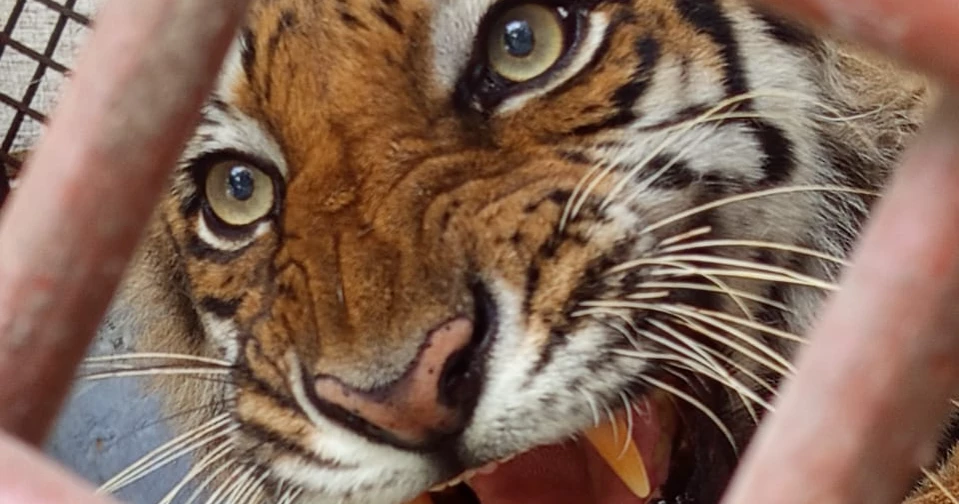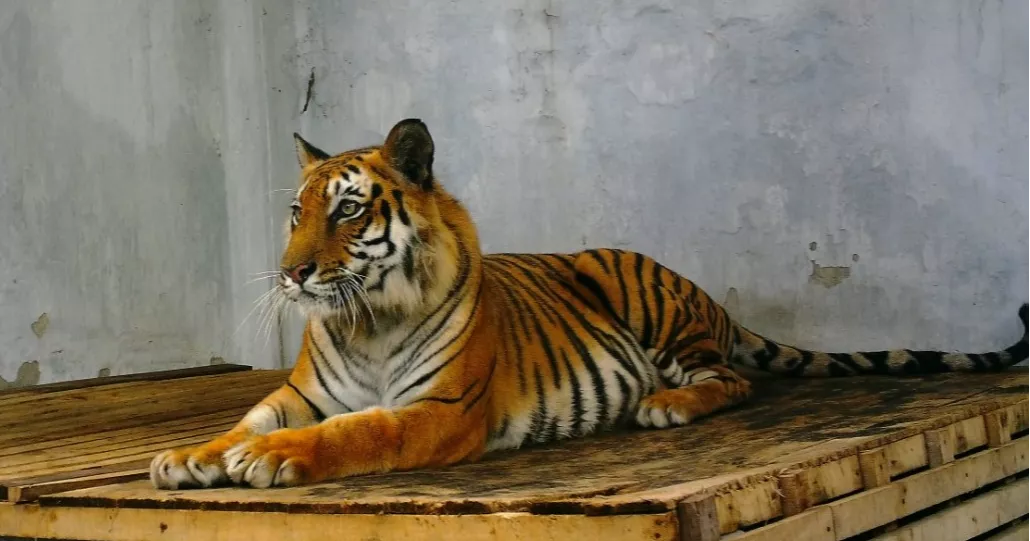
A female Royal Bengal tiger rescued from a poachers’ snare in the Sundarbans and nursed back to health in a rehabilitation centre in Khulna is set to return to its natural habitat later this month.
The tiger, estimated to be between nine and 10 years old, was found trapped in an illegal snare near Bairagi Bari, adjacent to Sharkir Khal in the Sundarbans East Forest Division under Mongla upazila of Bagerhat district in early January.
Forest officials rescued the tiger on January 4 after tranquilising it with a dart gun.
By then, the animal had spent several days trapped in the snare, suffering severe injuries to its front left leg where deep wounds had become infected and begun to rot.
The tiger was taken to the Wildlife and Nature Conservation Division’s rehabilitation centre in Khulna, where a six-member medical board was formed to oversee its treatment.
Veterinary Officer Dr. Julkar Nain of Gazipur Safari Park, who was involved in the treatment, said the tiger’s condition was critical when it was rescued.
“The left leg had sustained extensive damage and infection. From January through March, the tiger received continuous treatment, including antibiotics, injections and wound dressing. It started recovering in April and is now fully healthy,” he said.
Dr. Nain said the tiger has resumed normal feeding habits and has regained the physical ability and predatory instincts necessary to hunt in the wild.
Chief Conservator of Forests Amir Hossain Chowdhury said a meeting of tiger experts held in May decided that the animal should be released back into the Sundarbans.
“The tiger has fully recovered and will be released into the forest by the end of June,” he said.
Forest officials had also discussed fitting the tiger with a satellite collar to monitor its movements after release.
However, experts attending the meeting could not reach a consensus on the proposal and the plan was ultimately dropped.
Divisional Forest Officer (DFO) of the Sundarbans East Forest Division Md Rezaul Karim Chowdhury said the tiger’s injuries had affected skin, muscle and tissue across much of its front left leg.
“Through intensive care and proper treatment, the tiger has made a complete recovery. It has regained its natural aggression and hunting behaviour and is ready to return to the wild,” he said.
The DFO said the Forest Department has strengthened anti-poaching efforts across the Sundarbans.
Officials now conduct extensive foot patrols in remote forest areas, while eight drones are being used to monitor illegal activities. Smart patrolling systems have also been introduced, they said.
According to forest department data, authorities recovered around 116,000 feet of illegal snares from the Sundarbans over the past year. The traps had been set by poaching gangs targeting deer and tigers.
“The activities of poaching networks have declined significantly due to intensified enforcement,” Rezaul Karim said.
Wildlife expert and Chief Executive of WildTeam Professor Anwarul Islam, who attended the expert meeting on the tiger’s future, praised the Forest Department for saving the animal despite limited resources.
“The tiger should be able to resume a normal life in the forest. It may face some challenges hunting because of its age, but even then, a tiger should be allowed to live and die as a tiger,” he said.
He added that equipping the tiger with a satellite collar would have helped researchers monitor its adaptation to the wild.
Professor Islam also stressed the need to strengthen the institutional capacity of the Forest Department.
“Without stronger conservation efforts, neither the Sundarbans nor its wildlife will survive in the long term. Fortunately, wildlife protection in the forest has improved significantly in recent years,” he said.
Forest Department surveys show that the tiger population in the Bangladesh portion of the Sundarbans has been gradually increasing.
According to the latest camera-trap survey conducted in October 2024, the forest is home to 125 tigers, up from 114 recorded in 2018 and 106 in 2015.