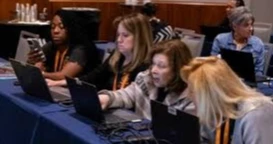
Artificial intelligence is changing the way administrative assistants work, raising concerns about future job losses while also creating new opportunities for those willing to adapt.
Secretaries and administrative assistants, a profession largely made up of women, have already seen their numbers decline over the past two decades. Now, AI tools such as ChatGPT, Claude and Microsoft Copilot are expected to automate many routine office tasks, adding to concerns about the future of the profession.
Still, many administrative professionals are embracing the technology, saying it helps them work faster and focus on more valuable responsibilities.
Deanna Danger, 43, who has worked as an administrative professional since 2003, believes adapting to new technology has always been part of the job.
"All you have to do is evolve," she said.
Danger, executive assistant to Vanderbilt University's chief information officer, began using AI at work in 2022. Today, AI tools take meeting notes for her, allowing her to actively participate in discussions instead of focusing on typing everything being said.
She said tasks that once took hours can now be completed in less than five minutes.
Despite these productivity gains, government data shows the profession has been shrinking for years. About 3.5 million people worked as secretaries and administrative assistants in the United States in 2004, with women making up nearly 97% of the workforce. By 2024, that number had dropped to around 2.1 million, even as the overall workforce grew.
The U.S. Bureau of Labor Statistics expects most administrative support jobs to continue declining through 2034, although medical secretaries and administrative assistants are projected to grow because of increasing demand in the healthcare sector.
The unemployment rate for office and administrative support workers rose to 4% in June from 3.6% a year earlier, according to the U.S. Labor Department.
Emily Rolen, lead economist for employment projections at the Bureau of Labor Statistics, said technology has steadily reduced demand for administrative workers over many years.
Word processing software, speech-to-text programs, digital scheduling tools and similar technologies have all made office work more efficient while reducing the need for some traditional administrative roles.
A January report by the Brookings Institution found that clerical and administrative workers could be among the groups most affected by AI because many have limited financial resources, fewer opportunities to switch careers and narrower skill sets. Women account for about 86% of the six million workers in these occupations.
The report also noted that many administrative workers are older than the average U.S. employee, earn below the national median wage and often enter the profession with only a high school diploma.
However, many assistants argue that the data does not reflect their ability to adapt.
Danger regularly hosts online discussions through the American Society of Administrative Professionals, where members share ways they use AI to design flyers, plan executive events, write social media posts, prepare standard operating procedures and complete other routine tasks.
Some participants have also raised concerns about data privacy, security and the lack of clear AI regulations. Many agreed that AI cannot replace human qualities such as emotional intelligence, relationship management and sound judgment.
Fiona Young, founder of AI training company Carve and a former executive assistant, said demand for AI training has increased sharply since 2023. She has trained administrative professionals at companies including Google, Amazon, Uber, Salesforce and LinkedIn.
According to Young, employers increasingly expect staff to make AI part of their everyday work rather than simply understand the technology.
Oana Manolache, founder and CEO of webinar platform Sequel.io, has strongly encouraged employees to use AI. However, she said the technology cannot replace her executive assistant, Stephanie Martinez.
Instead, Martinez uses AI to handle repetitive tasks such as note-taking and meeting preparation, giving her more time to focus on building relationships, supporting executives and making informed decisions.
Working remotely from El Salvador through Viva Talent, Martinez also used AI to analyse customer communications, identify satisfied clients and draft emails requesting product reviews, saving significant time while allowing her to focus on creative problem-solving.
Melissa Peoples, an executive assistant coach based in Austin, Texas, said many assistants want to use AI but often lack the time, training or support from employers to do so.
She added that workplace culture also plays a role. While some executives encourage assistants to develop new skills, others still treat them as support staff with limited opportunities to contribute.
Peoples said proper AI training can help administrative professionals strengthen their skills, increase their value to employers and remain competitive as AI becomes more common in the workplace.