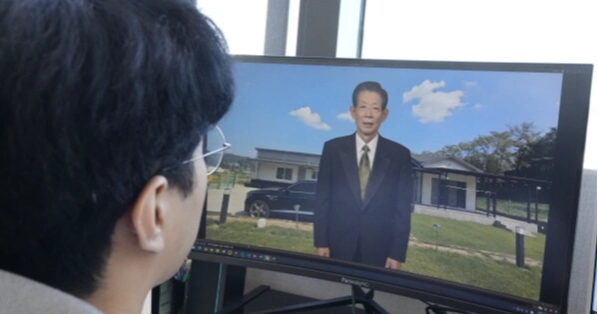
More South Koreans are turning to artificial intelligence to create lifelike video messages of deceased family members, hoping to find comfort in their grief. But the growing trend is also sparking debate over ethics, mental health and the rights of the dead.
When 28-year-old office worker Lee Geon Hui wanted to give his father a meaningful gift, he chose an AI-generated video featuring his late grandfather, who died before Lee was born.
Using a script written by Lee, a Seoul-based technology company created a video in which a digital version of his grandfather spoke directly to his father, calling him "my most precious son." The AI character apologised for making him work on the family farm as a child and for opposing his decision to become a hairstylist.
"My father said he wouldn't watch the video. But then he did, and he shed tears. So I felt rewarded," Lee said.
Lee said he wrote the script to express feelings that he believed his grandfather would have wanted to share.
Several South Korean startups now offer AI services that recreate deceased people using photos and voice recordings. Television programmes have also featured AI versions of late singers and actors, helping the technology gain wider public attention.
Experts say the technology has the potential to comfort grieving families but also raises difficult ethical, legal and psychological questions.
"It's a double-edged sword because it deals with human emotions," said Yong Man Ro, an artificial intelligence expert at the Korea Advanced Institute of Science and Technology.
One of the companies providing the service, Vaice, says it serves about 300 customers every month. Most clients are people in their 40s and 50s who want AI videos of their late parents, while others commission videos of grandparents as gifts for their parents.
Vaice CEO Jeongu Won said the company only needs a few photographs and short voice recordings to create a digital version of the deceased. A three- to five-minute video costs about 600,000 won ($390).
According to Won, many families play the videos during memorial ceremonies or traditional holidays. Most customers include messages of love, while others use the videos to express regret over unresolved family conflicts.
Lee said his grandfather died in a car accident before he was born and that his father had always wished he could have shown his father that he had built a successful life and family.
"I don't know much about my grandfather. But when I saw tears running down my father's face, I realised he still misses him," Lee said.
Although interest in AI memorial videos is growing, experts say the technology must be used carefully.
Choung Wan, an emeritus professor at Kyung Hee University Law School, said South Korea needs laws to protect the dignity and rights of deceased people. He argued that AI recreations should not be made if a person objected to such use before their death and that there should be clear rules governing the commercial use of people's images and voices.
Experts are also closely watching the development of so-called "griefbots" or "deathbots" that allow users to have two-way conversations with AI versions of deceased loved ones.
Choung warned that such technology could make it harder for grieving people to accept the loss of a loved one.
"A healthy mourning process involves accepting the absence of the deceased," he said. "Talking with an AI system that imitates them could interfere with that process and leave people trapped in a fantasy."
Won said his company has not introduced AI chatbots because unsupervised conversations could create unexpected ethical problems.
Technology continues to improve rapidly. Choi Yu Ha, an executive at another AI company, JL Standard, said today's systems can recreate facial details, including wrinkles and skin texture, with remarkable accuracy.
Ro, the AI expert, said he created a one-minute AI video of his own parents after they died last year and showed it to his siblings during a family gathering.
The digital versions of their parents told the family, "Don't worry" and "Take care," leaving everyone deeply moved.
But Ro said the family watched the video only once.
"One time was enough to honour our late parents," he said. "We moved on."