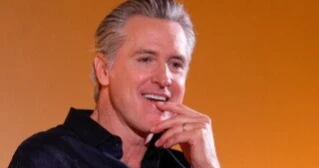
California Gov. Gavin Newsom signed several laws Wednesday aimed at protecting workers from potential risks associated with artificial intelligence, including job losses and workplace surveillance.
The new laws prohibit employers from using AI and biometric data to predict workers' emotional states. They also require employers to provide written notices when AI is involved in mass layoffs and prevent companies from relying on AI to make decisions about firing employees.
Newsom also signed an executive order directing state agencies to continue using the term “artificial intelligence” rather than “super intelligence,” a term President Donald Trump recently instructed US diplomats to use.
“AI should expand opportunity — not come at the expense of workers and families,” Newsom said in a statement. “As this technology reshapes the workplace, California is putting people at the center.”
At a news conference Wednesday, Newsom criticized the Trump administration for not adopting comprehensive federal rules on AI. Trump said Tuesday that major technology companies had agreed to voluntarily regulate AI development.
California earlier this month approved a law requiring AI chatbot operators to conduct risk assessments before launching their products. Newsom also issued an executive order directing the state to consult experts on stronger oversight of the technology.
“We have to do a lot more in the absence of federal leadership,” Newsom said, leaving open the possibility of calling lawmakers into a special session to consider additional AI measures.
Wednesday was Newsom's final day to sign or veto legislation before leaving office in January. He also signed a law creating tax credits to help local news organizations, including newspapers, digital outlets and television stations, hire and retain journalists.
Newsom criticized what he described as Trump's actions against the press, citing restrictions placed on news organizations at the White House.
He also discussed the November midterm elections, which will determine control of Congress. Newsom has been involved in Democratic efforts over congressional redistricting and said the election would have implications for the 2028 presidential race.
“There will not be a free and fair election in 2028 unless we take back the House of Representatives,” he said.
Asked whether he had set a deadline to decide if he would run for president in 2028, Newsom said, “That moment will arrive when it arrives.”
Former Democratic presidential nominee Kamala Harris has also said she is considering a 2028 presidential campaign. Newsom recently told CNN that he would not run if Harris entered the race. He said Wednesday that they had not spoken since that interview.
Newsom also discussed a November ballot proposal to temporarily increase taxes on billionaires, which he has opposed. He said he respected supporters of the measure, including Vermont Sen. Bernie Sanders, who want to address income inequality.
“He's spot on about the balance between the rich and the poor,” Newsom said of Sanders. “On this issue, we fundamentally disagree.”
Newsom's remarks came hours before a gubernatorial debate between Democrat Xavier Becerra and Republican Steve Hilton.
Asked whether he planned to watch the debate, Newsom replied, “No.”