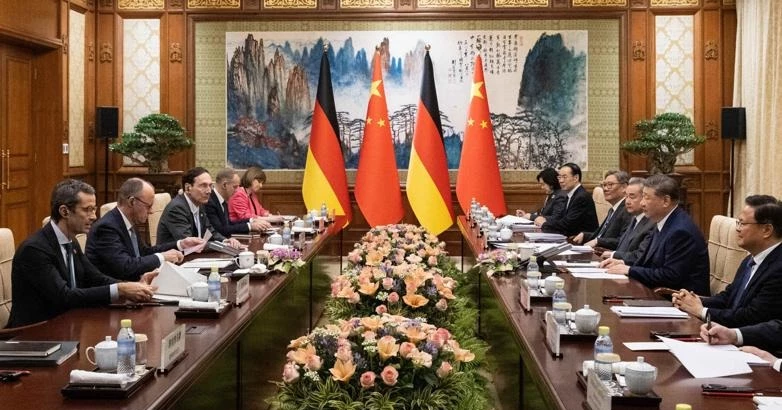
China and Germany on Wednesday pledged to strengthen ties despite major differences, including over Russia’s war in Ukraine, as both sides seek stability in a turbulent global environment.
The commitment came as German Chancellor Friedrich Merz met separately in Beijing with Chinese President Xi Jinping and Premier Li Qiang. The leaders of the world’s second- and third-largest economies stressed the need for deeper communication and trust at a time of rising geopolitical tensions and shifting global dynamics.
Xi said that the more complex and uncertain the world becomes, the more China and Germany should enhance strategic communication and mutual trust. He also noted that the world is facing the most profound changes since World War II.
Merz responded that while challenges and disagreements exist, both countries should focus on shared interests and tackle global challenges together.
On his first China visit since taking office in May, Merz highlighted Beijing’s key role in addressing global issues, including the Ukraine conflict. After the meetings, he said he had urged Chinese leaders to use their influence to help end the war, noting that signals from Beijing are taken seriously in Moscow.
China reiterated support for a political settlement, saying any solution must address the legitimate concerns of all sides and involve equal participation.
The visit comes as many world leaders head to Beijing while China seeks broader support against US tariff policies introduced by President Donald Trump and challenges to the post-World War II global order.
Merz stressed that Europe wants a balanced, reliable and fair partnership with China. However, trade imbalances remain a concern. Germany’s imports from China rose 8.8% to 170.6 billion euros last year, while exports to China fell 9.7% to 81.3 billion euros.
European leaders also want more Chinese investment in local manufacturing and reduced industrial overcapacity in sectors like electric vehicles and solar panels.
Merz said he was satisfied with the talks and pointed to potential business cooperation, including a possible Chinese order for up to 120 Airbus planes. He also plans to visit Hangzhou’s tech hub, including robotics firm Unitree, before heading to Washington for further talks.