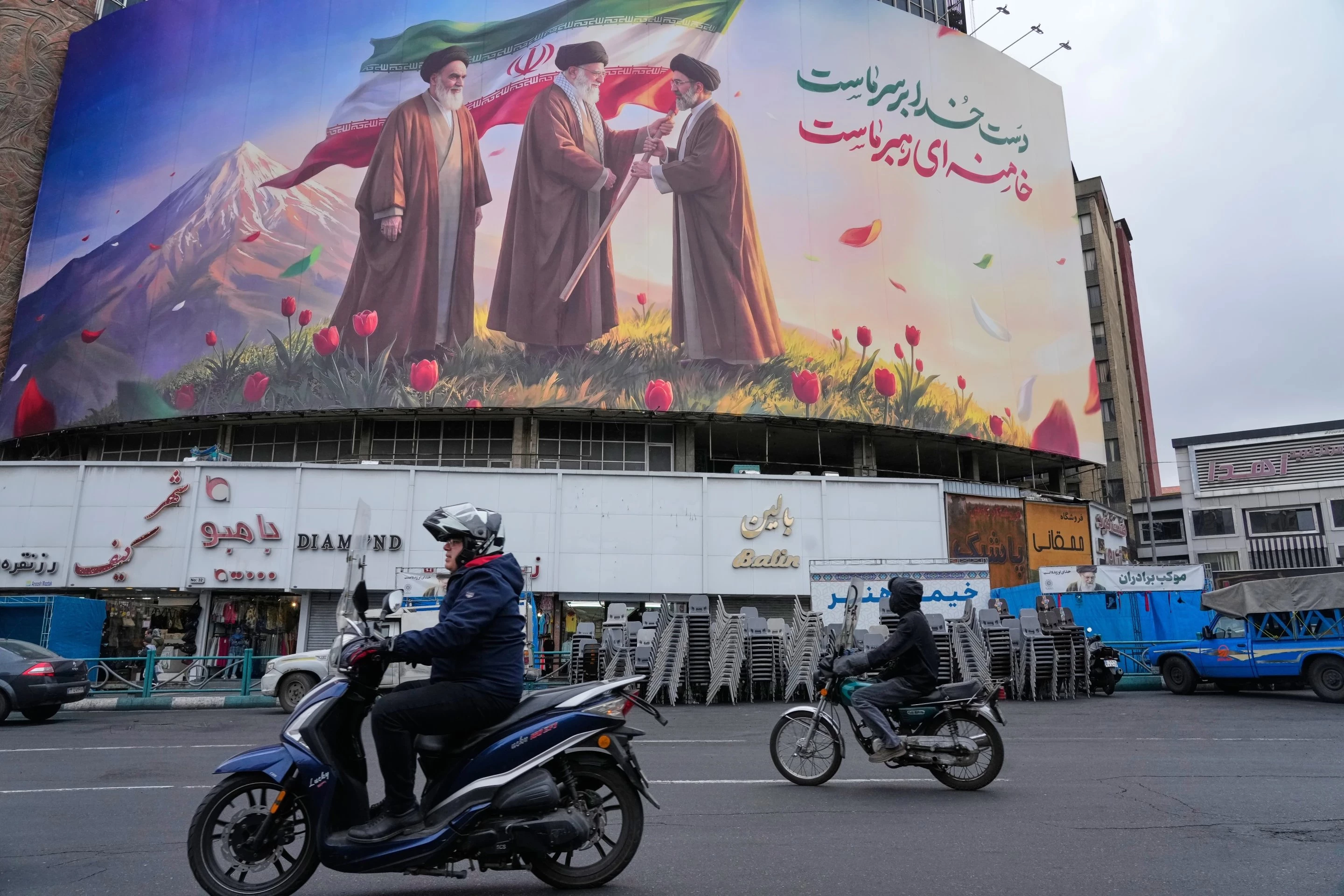
Six months into a devastating war, Iran’s leadership has consolidated around a group of senior military commanders and clerics with deep roots in the country’s ruling system, signaling preparations for a prolonged standoff with the United States while moving aggressively to prevent unrest at home.
The development is a sharp departure from US President Donald Trump’s early expectation that the Islamic Republic could be toppled, followed by his later assertion that regime change had brought more moderate figures into Iran’s leadership.
Iran’s new ruling circle appears deeply skeptical of reaching an agreement with Trump after being attacked twice while negotiations were underway. Officials may also be preparing for renewed US strikes after Washington replenishes its stocks of missile interceptors. At the same time, Iran has warned it could intensify the conflict as a US blockade and planned sanctions place additional pressure on an economy already struggling.
“If Trump wants to act, we will respond on a seismic scale,” Mohsen Rezaei, Iran’s newly appointed secretary of the Supreme National Security Council, said last weekend. In a post on X, he warned that continued economic warfare could result in Iran stopping all oil exports from the Persian Gulf.
Iran moves to prevent another wave of unrest
Rezaei was among a series of appointments announced by Supreme Leader Ayatollah Mojtaba Khamenei to establish the country’s new senior leadership and military command structure. His father, Ayatollah Ali Khamenei, and many senior officials were killed in the US-Israeli bombing campaign that began Feb. 28.
The appointment of Hossein Taeb as head of the Basij, the Revolutionary Guard’s volunteer force used to maintain order on the streets, was particularly significant. The Basij played a major role in suppressing nationwide protests in January, when thousands were killed.
Taeb, a hard-line cleric and former intelligence chief, was also involved in an earlier major crackdown during protests in 2009.
His return to a prominent security position suggests Iran’s leadership is determined to prevent fresh demonstrations as economic hardship and public dissatisfaction increase.
The 56-year-old supreme leader has not appeared publicly or in recorded video or audio since Israeli attacks killed his father, who had led Iran for nearly four decades. Mojtaba Khamenei is also believed to have been injured. His absence could be linked either to extensive security precautions because he remains a potential Israeli target or to the severity of his injuries.
Khamenei relies on longtime hard-line allies
Through appointments announced Aug. 11 and 12, Khamenei brought several longtime allies into key positions, including Rezaei and Taeb.
The appointments appear to strengthen a group of veteran commanders who have worked together for decades, said Sascha Bruchmann, an analyst with the International Institute for Strategic Studies’ Middle East office in Bahrain.
Rezaei, 71, commanded Iran’s Revolutionary Guard during much of its early development, including the 1980-88 Iran-Iraq war, and remained in the position until 1997. He has repeatedly sought the presidency as a hard-line candidate since 2009.
Brig. Gen. Ahmad Vahidi, 68, was formally confirmed as commander of the Revolutionary Guard after serving as acting chief following the death of his predecessor alongside the elder Khamenei.
Gen. Ali Ozmaei was confirmed as acting commander of the Guard’s naval forces, while Gen. Ali Abdollahi retained his position as military chief of staff.
Bruchmann noted that Rezaei had commanded Vahidi for years, describing the appointments as an effort to reinforce unity within the leadership.
“It looks like internal cohesion, with hard-core figures being brought into the inner circle,” he said.
Economic pressure fuels calls for restraint
Homayoun Falakshahi, Kpler’s leading oil analyst, said the appointments of Rezaei and Vahidi indicated growing influence for officials favoring a tougher approach.
However, he said a further escalation was not unavoidable. Iran could struggle to restore deterrence through military action without provoking a response that would leave the country in an even weaker position.
A ceasefire agreed in June quickly unraveled as Iran, the US and Israel exchanged strikes. Tehran has demanded the release of billions of dollars in frozen assets under the agreement and has also sought formal control over the Strait of Hormuz.
President Masoud Pezeshkian remains among the most prominent officials advocating negotiations. His supporters warn that continuing the conflict could worsen Iran’s already fragile economy.
“It would be better to end the war,” Pezeshkian said last week, arguing that Iran had demonstrated its strength and gained international recognition while the United States had become widely disliked.
He has also defended the June ceasefire agreement against hard-line critics who say Tehran made excessive concessions.
Rezaei, unlike some ultra-hard-liners who reject negotiations outright, has left the door open to a potential agreement if Washington changes course. On Monday, he told Pakistani mediator Gen. Asim Munir that the United States should alter its approach and take concrete steps to fulfill the ceasefire conditions.
Tehran-based political analyst Ahmad Zeidabadi said the country’s leadership faces “serious differences” over its future direction.
Writing in the pro-Pezeshkian newspaper Hammihan, Zeidabadi said hard-liners oppose restoring normal relations with Washington because their political survival is tied to continued confrontation and hostility.
Basij appointment highlights concern over protests
There have so far been no indications of a fresh protest movement, even as rising economic pressures make basic necessities increasingly difficult for many Iranians to afford.
Taeb’s appointment to lead the Basij indicates that the leadership wants to deal with possible unrest before it develops, Bruchmann said.
Taeb, 63, previously headed the Basij during the suppression of large demonstrations following hard-line President Mahmoud Ahmadinejad’s disputed reelection in 2009. Dozens of people were killed during the unrest.
He later became chief of the Revolutionary Guard’s intelligence organization, holding the post for nearly 13 years before being removed in 2022 amid a reported shake-up following Israeli intelligence successes inside Iran.
The Basij operates a nationwide volunteer network with a presence in streets, government institutions and cultural centers. Its role includes promoting loyalty to Iran’s theocratic system and monitoring ideological conformity.
In the decree appointing Taeb, Khamenei instructed him to expand the Basij’s involvement in Iranian society, make greater use of technology and promote the force internationally in opposition to what he described as “Zionist-American arrogance.”
That wording could indicate an effort to expand the Basij’s connections with Iranian-backed groups abroad.
The force increased its presence during the war, while hard-line supporters organized nightly rallies in Tehran and other cities to demonstrate loyalty to the government and discourage dissent.
It remains unclear how Taeb intends to expand the Basij’s role. But in a recent speech, he appeared to advocate greater influence over Iranian society.
He said US economic pressure was designed to divide the country and argued that stronger community ties centered around mosques could help preserve national unity.
“If the mosque becomes the center of the neighborhood, the nation will protect its unity,” he said, describing that unity as a stronger deterrent than any missile.