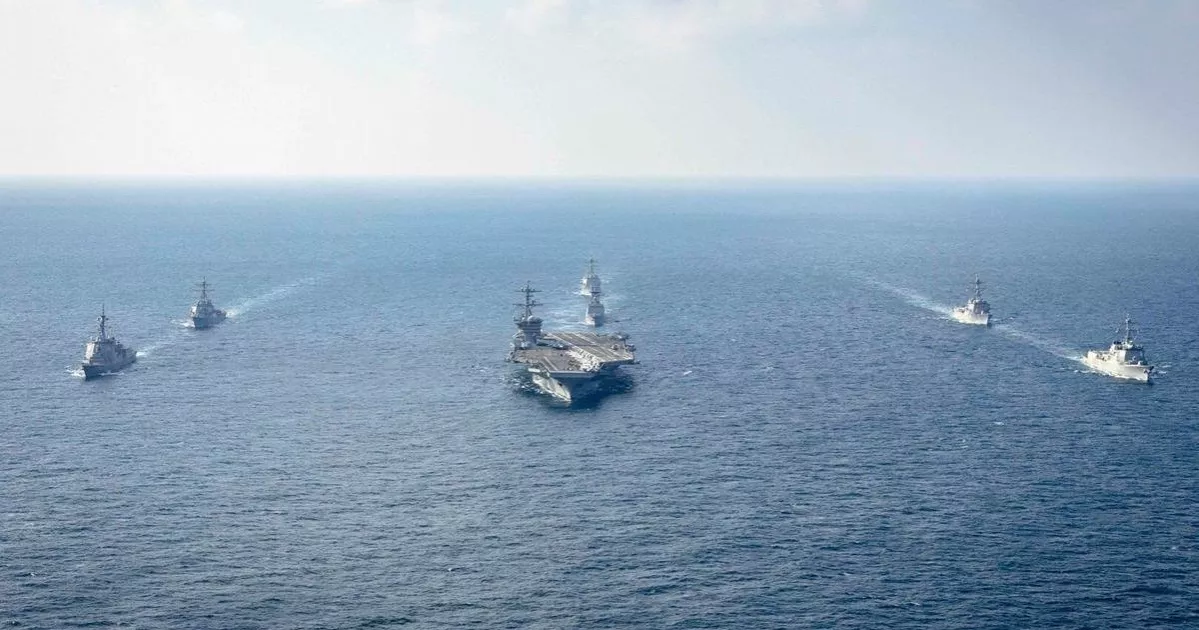
The United States, South Korea and Japan will hold a five-day trilateral military exercise next month as they seek to strengthen their response to North Korea’s nuclear and missile threats, South Korean officials said Friday.
The announcement came a day after North Korea warned that it would take “serious, immediate and powerful” action against what it described as hostile moves by the United States.
The planned exercise could further reduce the chances of an early restart of talks between Washington and Pyongyang, despite US President Donald Trump’s recent decision to reduce the scale of a major military exercise with South Korea.
South Korea’s military said the Freedom Edge exercise will begin September 7 in waters near the southern island of Jeju. It described the drill as defensive and said it aims to improve the three countries’ ability to respond to North Korean nuclear and missile threats while supporting regional peace and stability.
North Korea has repeatedly condemned the trilateral exercise, calling it a “reckless show of strength.” Pyongyang has also accused the US and its allies of using the drill to pressure China and Russia.
Launched in 2024, Freedom Edge combines air and naval exercises to improve cooperation in areas including ballistic missile defence, anti-submarine warfare and surveillance.
Last week, US and South Korean forces ended their annual Ulchi Freedom Shield exercise six days earlier than planned after Trump said he had ordered the Pentagon to “substantially reduce” the drill. North Korea considers such exercises preparations for an invasion.
Trump cited his relationship with North Korean leader Kim Jong Un when announcing the reduction. But Pyongyang rejected the gesture, saying shortening the exercise did not change its “provocative, aggressive nature.”
North Korea subsequently fired about 10 short-range ballistic missiles into the sea, apparently in response to the US-South Korean military exercise.
Pyongyang has said it will not return to talks with Washington unless the US drops its demand for North Korea to give up its nuclear weapons as a condition for negotiations.
Since talks with Trump broke down in 2019, Kim has expanded North Korea’s nuclear arsenal and strengthened ties with Russia amid the war in Ukraine. Experts say Pyongyang could now seek major concessions from Washington, including recognition as a nuclear-armed state and broad sanctions relief, in exchange for giving up part of its nuclear programme.
On Thursday, North Korea’s Foreign Ministry accused Washington of carrying out a series of hostile actions, including a possible plan to sell air-to-air missiles and related equipment to South Korea.
It warned that Pyongyang would respond strongly to what it called hostile acts in various areas.