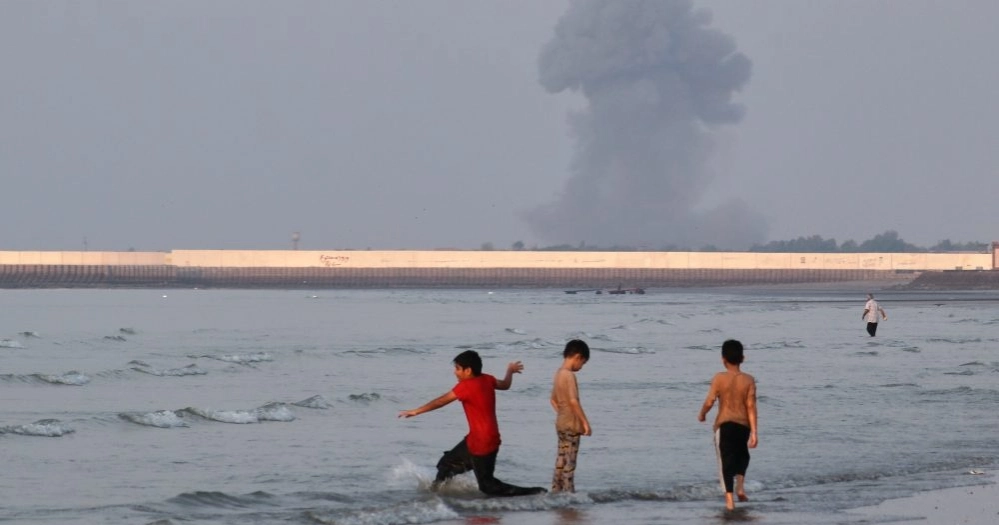
The United States carried out fresh airstrikes on Iran early Tuesday, hours after President Donald Trump announced that Washington was "reinstating" a blockade on Iran in the Strait of Hormuz and suggested that other countries' ships could be charged for safe passage through the strategic waterway.
Iran responded by launching attacks on Bahrain and Jordan and targeting two United Arab Emirates-linked oil tankers passing through the Strait of Hormuz. The attacks killed one sailor and injured eight others, while the UAE warned it could retaliate against Tehran, raising fears of a wider regional conflict.
The latest escalation comes as the US and Iran struggle for control of the Strait of Hormuz, a key global shipping route that has carried about one-fifth of the world's traded crude oil and natural gas during peacetime.
Oil prices reacted quickly, with Brent crude rising above $84 a barrel in early Tuesday trading, its highest level in a month. Although still below the nearly $120 seen during the height of the conflict, the increase could push up energy costs worldwide.
The renewed fighting has also further weakened a temporary ceasefire between Washington and Tehran. The two sides were nearly halfway through a 60-day period meant to produce a permanent agreement addressing Iran's disputed nuclear programme and other issues.
According to the US military's Central Command, the strikes targeted Iranian coastal defence systems, missile and drone sites, and maritime facilities around Abu Musa, Bandar Abbas, Bushehr, Chahbahar, Jask and Konarak.
Iran confirmed that the areas had come under attack but did not immediately report casualties or damage.
The US military said the operation was intended to reduce Iran's ability to attack civilians and commercial vessels in the Strait of Hormuz.
Speaking at the White House shortly after the strikes, Trump described the operation as "another major attack."
"We're hitting them very hard. And it'll continue, and we'll see what happens," he told reporters. He also claimed the US was taking control of the strait and restoring the blockade.
Trump also expanded on his earlier proposal to charge ships for using the Strait of Hormuz, marking a major shift from longstanding US policy supporting free navigation through international waterways without tolls.
Such a move would challenge long-established international maritime practices and could further disrupt global trade and increase tensions in the region.
Meanwhile, the UAE's Defence Ministry said Iran fired two cruise missiles at the oil tankers Mombasa and Al Bahiyah in the Strait of Hormuz. Both vessels caught fire, but the blazes were later brought under control.
The UAE said one Indian sailor was killed while six Indian and two Ukrainian crew members were injured. Abu Dhabi warned that it reserved the right to respond.
Iran's Revolutionary Guard claimed responsibility for the attack, saying the ships had ignored repeated warnings and entered what it described as a minefield.
Bahrain also reported fresh Iranian missile attacks early Tuesday, sounding air raid sirens three times and urging residents to seek shelter.
Jordan's military said it intercepted four Iranian missiles. The country hosts US military forces and has been targeted by Iran several times in recent days.
Earlier Monday, Trump said the interim agreement reached with Iran last month had been designed to test Tehran's intentions, accusing the Iranian government of failing to honour its commitments.
Iran, however, maintains that it has the right to regulate shipping through the Strait of Hormuz and potentially impose fees under the interim agreement, a claim rejected by Washington.
The US military and the International Maritime Organization have tried to establish an alternative shipping route along Oman's coast outside Iranian control, but Iran has also attacked vessels using that route, prompting repeated US military responses and further exchanges of fire.
On social media, Trump said the US was restoring the Iranian blockade while insisting that other countries would continue to have open access to the strait. He also proposed that the US recover security costs by collecting 20% of cargo values from commercial shipping, although no details were provided. Secretary of State Marco Rubio, who is visiting the region, said there would be no fees for ships using the waterway.
The US military said its blockade of Iranian ports would resume from midnight Wednesday local time in Dubai.
Separately, Israeli and Lebanese delegations were scheduled to meet in Rome on Tuesday for US-mediated talks aimed at advancing a framework agreement announced last month. The deal calls for the withdrawal of Israeli forces from southern Lebanon in exchange for the disarmament of the Iran-backed Hezbollah group, although implementation has stalled.
A ceasefire remains in place in Lebanon, but uncertainty persists over whether it can survive if the conflict between the United States and Iran expands into a full-scale war.