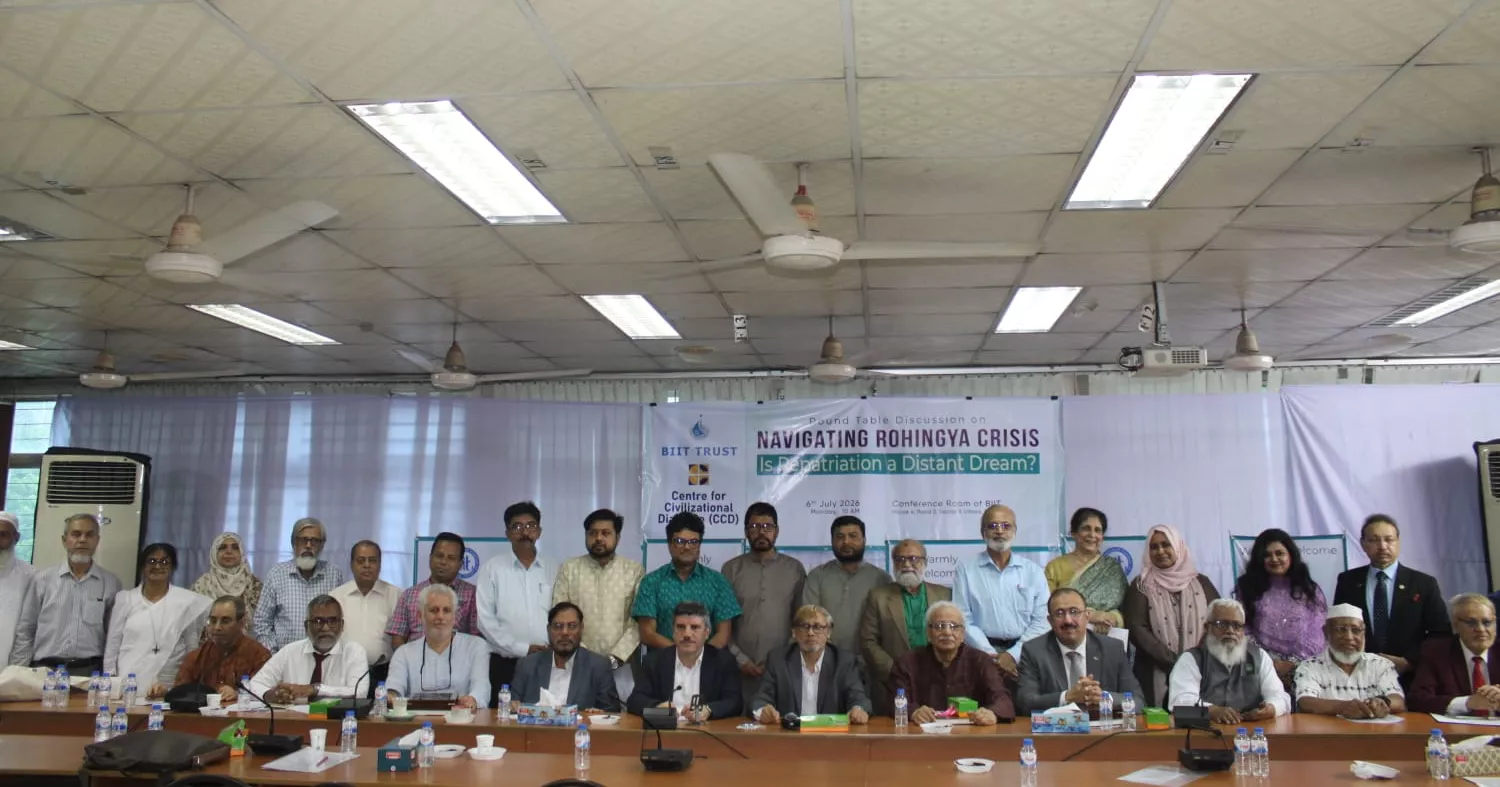
Speakers at a discussion meeting on Monday called upon the international community to play a more effective role in ensuring safe, dignified, and sustainable repatriation of Rohingya refugees sheltered in Bangladesh.
The call was made at a roundtable discussion titled "Navigating the Rohingya Crisis: Is Repatriation a Distant Dream?" held at the conference hall of the Bangladesh Institute of Islamic Thought (BIIT) in Uttara, Dhaka.
UN food relief agency steps up aid for Rohingays amid heavy rains
The event was jointly organized by the Center for Civilizational Dialogue (CCD) and the BIIT Trust.
Professor Yasin Aktay, a prominent Turkish academic, social thinker, and former chief advisor to Turkish President Recep Tayyip Erdogan, attended the program as the chief guest. Professor Dr. M. Abdul Aziz, founding President of CCD and Director General of BIIT, chaired the session.
In his speech, Professor Yasin Aktay highly praised Bangladesh’s humanitarian role in sheltering an immense number of Rohingya refugees.
"The friendship and partnership between Bangladesh and Turkey are long-standing. Turkey has always stood by Bangladesh in managing the Rohingya crisis and will continue to do so in the future," Aktay said.
Emphasizing that Turkey advocates for a safe, voluntary, and dignified repatriation of the Rohingya people, he assured further acceleration of humanitarian activities, including food aid, education, healthcare, and skill development training for the refugees.
Dr. M. Abdul Aziz termed the Rohingya tragedy as one of the major humanitarian crises for the Muslim world.
"This issue is no longer confined between two countries; it has evolved into a global challenge involving human rights, international law, security, and geopolitical stability," Dr. Aziz said.
He stressed the need for international solidarity, effective diplomatic initiatives, and coordinated efforts between think tanks and civil society to achieve a permanent solution.
Speakers at the roundtable expressed deep concern that the Rohingya issue has become significantly sidelined in recent times. They noted that despite severe resource constraints and high population pressure, Bangladesh set an unprecedented humanitarian example by sheltering nearly 1.4 million (14 lakh) displaced Rohingyas.
However, the prolonged crisis is now exerting immense socio-economic, environmental, and security pressures on the local communities in Cox’s Bazar and Bhasan Char.
Furthermore, issues like human trafficking, transnational crimes, and security lapses in maritime routes are threatening the regional stability of South and Southeast Asia, they added.
The discussants highlighted that creating a favorable political environment, ensuring safety, granting citizenship, and restoring peace in the Rakhine State are critical prerequisites for a sustainable repatriation process. To this end, they urged for stronger solidarity among the United Nations, ASEAN, OIC, and Muslim-majority nations, while requesting Turkey to take an even more proactive role in international forums.
The roundtable featured prominent speakers, including Dr. Badiul Alam Majumdar, Founder-Secretary of Shushashoner Jonno Nagorik (SHUJAN), Prof. Dr. Anisuzzaman, former VC of Global University, Prof. Dr. Mohammed Fozli Ilahi, former VC of UITS, Dr. Nakib Muhammad Nasrullah, former VC of Islamic University, Dr. Abul Hasan M. Sadeq, Founder VC of Asian University, Isam Shehadat, Senior Editor of Daily Sabah (Turkey), Dr. Ayman Zeidan, Deputy Director General of Al-Quds International Institution, Colonel (Retd) Mohammad Abdul Haque, Political Analyst, Mostafa Kamal Majumder, former Editor of The New Nation, Masud Mannan, former Ambassador of Bangladesh to Turkey
Prof. Dr. Abdul Latif Masum, VC of Patuakhali Science and Technology University.
Besides, researchers, human rights activists, and think-tank representatives of different sectors were also present at the event.