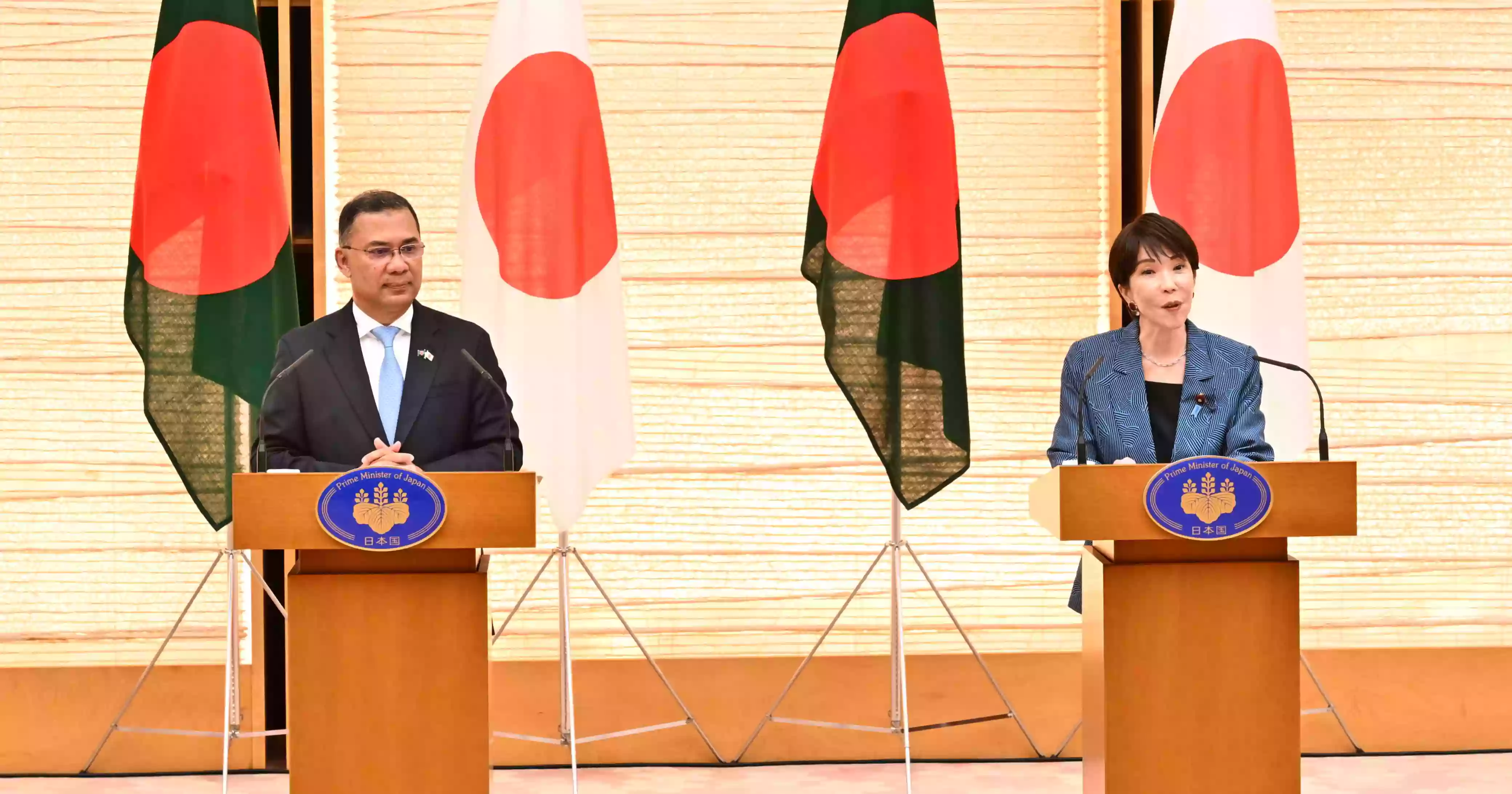
Japan is eying private investment of up to 1 trillion yen (about US$6.34 billion) in Bangladesh over the next five years, with the potential to create 200,000 jobs, as the two countries agreed to deepen economic cooperation, strengthen supply chains and upgrade their flagship development initiative to “BIG-B for Shared Prosperity”.
The projection was announced in a joint statement following a bilateral summit between Bangladesh Prime Minister Tarique Rahman and Japanese Prime Minister Sanae Takaichi in Tokyo on Tuesday.
According to the statement, Sanae Takaichi welcomed the projection of Japanese private investment in Bangladesh, which can generate 200,000 jobs over the next five years, and praised the efforts of Tarique’s administration to promote foreign direct investment.
The two leaders welcomed major investments expected to be announced during the visit and agreed on the importance of developing complementary and resilient supply chains in manufacturing, food and agriculture, information and communication technology (ICT), and pharmaceuticals.
Building upon past bilateral cooperation in the ICT sector, including IT & Information Technology Enabled Services (ITES), human resource development and digital collaboration, they underscored the importance of exploring further possibilities for cooperation to promote digital transformation, develop highly skilled ICT professionals, and secure and reliable digital connectivity.
The two sides also welcomed the signing of the Japan-Bangladesh Economic Partnership Agreement (EPA), reaffirming their commitment to bringing it into force at an early date to boost bilateral trade and investment and support Bangladesh’s smooth and sustainable graduation from the least developed country (LDC) category.
Recalling progress under the Bay of Bengal Industrial Growth Belt (BIG-B), the two leaders agreed to upgrade the initiative to “BIG-B for Shared Prosperity” in response to changing global conditions, supply chain risks, rapid technological innovation and mounting social challenges.
They noted that the "BIG-B for Shared Prosperity" aims to integrate the development of power, energy, deep-sea port, industrial and ICT infrastructure, build a major nexus for industrial value chains, develop into a trade and supply gateway and generate growth and prosperity, by enhancing connectivity, enhancing resilience against risks including natural disasters and geopolitical uncertainties, public-private partnership in co-creating opportunities for economic growth and rulemaking, and stepping up cooperation for peace and stability.
The two leaders concurred on working together to develop the Matarbari-Maheshkhali area as a major hub for logistics, energy and industry, centred at the Matarbari Deep Sea Port.
They also agreed to advance preparations for the early operationalisation of the third terminal at Hazrat Shahjalal International Airport in Dhaka and pursue the early construction of Dhaka's mass rapid transit (MRT) lines.
They also agreed to discuss future cooperation on the operation and management of Matarbari Deep Sea Port.
On energy security, the two leaders welcomed Japan’s 50 billion yen emergency support loan to strengthen Bangladesh’s economic resilience and ensure a stable energy supply.
Tarique Rahman appreciated the loan, the first yen-loan project under Japan’s Partnership on Wide Energy and Resources Resilience Asia (POWERR Asia), while Takaichi reaffirmed Japan’s continued support for Bangladesh’s energy infrastructure to help bridge the gap between supply and demand.
As part of combating climate change, the two Prime Ministers underlined the deepening of cooperation between the two countries in the development of a long-term low-emission development strategy, increasing energy efficiency and energy capacity, and promoting renewable energy.
They welcomed the signing of a letter of intent on climate change cooperation between their respective environment ministries.
To improve the investment environment, Tarique Rahman highlighted his government’s initiatives and committed to facilitating it, including by enhancing rulemaking, transparency and predictability of the operational procedures related to taxation, customs clearance, remittances, and licensing.
The leaders welcomed a memorandum of cooperation between Japan’s Ministry of Economy, Trade and Industry and Bangladesh’s Economic Relations Division on economic relations and the improvement of the business environment.
They also welcomed two memorandums of cooperation to strengthen and expand mutual cooperation to enhance business and attract investment in the areas of food, agriculture, fisheries, and livestock, as well as a proposed yen-loan project to improve the investment environment.
The two leaders reiterated the importance of upholding a free, fair and rules-based international economic order.
In this context, they welcomed the signing of the Japan-Bangladesh Economic Partnership Agreement (EPA) and reaffirmed their commitment to the early entry into force of the agreement with the aim of bringing its mutual benefits to the peoples of both countries.
They once again expressed their commitment to promoting trade and investment between the two countries, as well as industrial diversification through the EPA, thereby supporting Bangladesh's smooth, sustainable, and resilient transition from LDC status.
Prime Minister Takaichi stated that Japan looks forward to the furtherance of discussions on Bangladesh's request for accession to the Regional Comprehensive Economic Partnership (RCEP) Agreement.
The two leaders expressed concerns over the worsening crisis in Myanmar and its impact on regional security, the displacement of all people, including the Rohingyas, and the increase in transnational crimes.
The two leaders called for an immediate cessation of violence, the release of detainees, humanitarian access and dialogue among all parties and affected groups.
In this context, Prime Minister Rahman underlined that the Rohingya problem originated in Myanmar and its solution lies in Myanmar. The two Prime Ministers shared the view that an ultimate solution to the Rohingya crisis is to realise a voluntary, safe, dignified and sustainable return of the displaced persons, including the Rohingyas, to Myanmar.
The leaders further agreed to strengthen cooperation in education, public health, disaster management, local governance and human resource development.
Prime Minister Takaichi highly appreciated vibrant democracy in Bangladesh and welcomed the successful general election in February 2026, held in a credible and peaceful manner as witnessed by an election observer mission dispatched by the Government of Japan. She congratulated Prime Minister Rahman on assuming office.
Tarique Rahman thanked the Japanese government and people for their warm welcome and gracious hospitality and invited Takaichi to visit Bangladesh at a mutually convenient time.