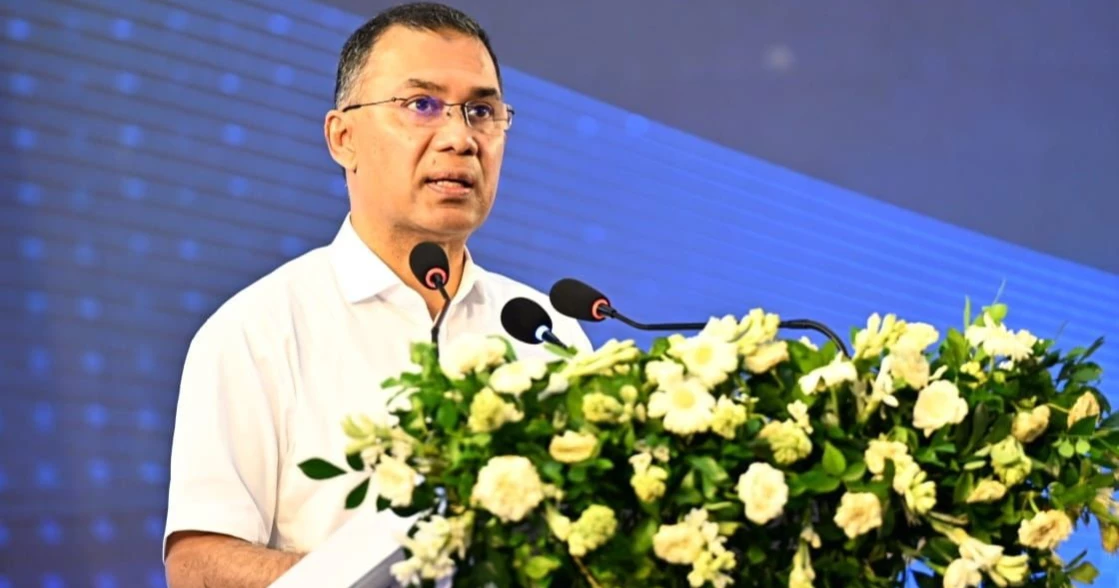
Prime Minister Tarique Rahman on Sunday stressed the need for mandatory internships, apprenticeships and stronger industry-academia collaboration to make higher education more job-oriented and reduce unemployment among graduates.
“Many graduates remain unemployed despite completing higher education. One of the main reasons, many believe, is that while students earn academic qualifications, they often fail to acquire the practical, applied and technological skills,” he said.
The Prime Minister made the remarks while inaugurating a national training programme, titled “Inclusion of Skills-Based Education in National University Curriculum”, at the Bangladesh-China Friendship Conference Centre in the capital.
Considering the situation, he said, the government wants to take effective steps to expand apprenticeship and internship opportunities and strengthen collaboration between universities and industries to make higher education more practical and relevant to the needs of the job market.
“To make the higher education system more technology-driven and employment-oriented, greater coordination between universities and the industrial sector, as well as mandatory internship and industry-academia linkage programmes, is now the demand of the time,” Tarique Rahman said.
Initially, he said the programme will be implemented through partnerships between universities in divisional cities and local industries and business establishments.
As a result, the Prime Minister said, students will be able to gain practical skills alongside their academic studies while still studying, reducing the likelihood of unemployment after completing their education.
He said the government is also taking initiatives to create entrepreneurs directly from campuses.
As part of the plan, Tarique Rahman said, the government has decided to provide “seed funding” or “innovation grants” on a competitive basis for the commercialisation of innovative business ideas in colleges and universities.
He expressed hope that many young entrepreneurs will emerge through these initiatives and contribute to the country’s economy instead of waiting for jobs after graduation.
The programme was organised by the National University as part of its initiative to train 12,000 college teachers across the country in vocational and technical education.
Highlighting the importance of developing skilled human resources, the Prime Minister said Bangladesh could emerge as a global role model if its youth and student population are transformed into a workforce equipped with knowledge, science and technology-based skills.
“The day is not far when Bangladesh can become a prosperous and self-reliant nation if we succeed in building a skilled generation,” he said.
Addressing young people, Tarique Rahman urged them to prepare themselves for the challenges of a rapidly changing world through education, skills and character building.
He encouraged students to acquire technological knowledge while remaining committed to the country’s long-standing religious, social and moral values.
The Prime Minister also underscored the importance of learning foreign languages, saying proficiency in a third language alongside Bangla and English will significantly enhance employment opportunities both at home and abroad.
He said the government is committed to building a knowledge-based and merit-based state and society where education, research, creativity, competence and innovation receive the highest priority.
Tarique Rahman called upon teachers, educationists and students to work together for national development, describing it as a collective endeavour rather than the responsibility of any single institution or individual.
“The government expects cooperation from universities, teachers, students, parents, civil society and the industrial sector in this journey,” he said.
The Prime Minister expressed confidence that the country’s progress will remain unstoppable if all stakeholders work in unity.
“Let us build an employment-oriented education system that will not only award certificates but also create skilled human resources. It will transform our population into productive assets,” he said.
Tarique Rahman also said education should not merely produce job seekers but should also nurture entrepreneurs. “It should serve not only as a driver of economic growth but also as a foundation for social transformation, accelerating national prosperity beyond individual or group interests.”
Referring to the rapid technological transformation worldwide, he said the world has already entered the era of the Fourth Industrial Revolution, where artificial intelligence (AI) is creating both challenges and opportunities.
“Automation and AI-driven technologies have put many traditional jobs at risk, while at the same time creating opportunities in many new sectors,” the Prime Minister observed.
He also stressed that subjects like artificial intelligence, cybersecurity, forensic science, programming, digital entrepreneurship, leadership, communication skills and financial literacy should become integral parts of modern education curricula.
Tarique Rahman mentioned emerging fields such as genetic engineering, biotechnology, quantum computing, nanotechnology, 3D printing and fifth-generation wireless technology, saying success in future workplaces will become difficult without knowledge of such areas.
He said the government has already begun reforming the curriculum from primary to higher education levels to make it more practical, technology-oriented and employment-focused. “Curriculum reform is a continuous process in this age of research, innovation and technological advancement.”
The Prime Minister appreciated the National University authorities for taking steps to modernise and update the curriculum in line with present-day demands.
He urged them to give greater importance to students’ mental health, social inclusion, environmental protection and ethical development alongside technological advancement.
“There is no alternative to moral education in becoming a compassionate and responsible human being,” Tarique Rahman said.
Speaking about the National University, he said the institution could play the most important role in expanding modern and technology-based higher education because it has more than 2,000 affiliated colleges and nearly 40 lakh students across the country.
The Prime Minister recalled that former Prime Minister Begum Khaleda Zia established the National University in 1992 to expand access to higher education for students in both urban and rural areas.
He formally inaugurated the training programme by pressing a button on a laptop around 11:25am.
During the programme, NU Vice-Chancellor Prof Dr ASM Amanullah and other teachers presented the Prime Minister with a commemorative crest and a sapling.
Education Minister Dr ANM Ehsanul Hoque Milon, Prime Minister’s Adviser on Education, and Primary and Mass Education Mahdi Amin, and Amanullah also addressed the programme.