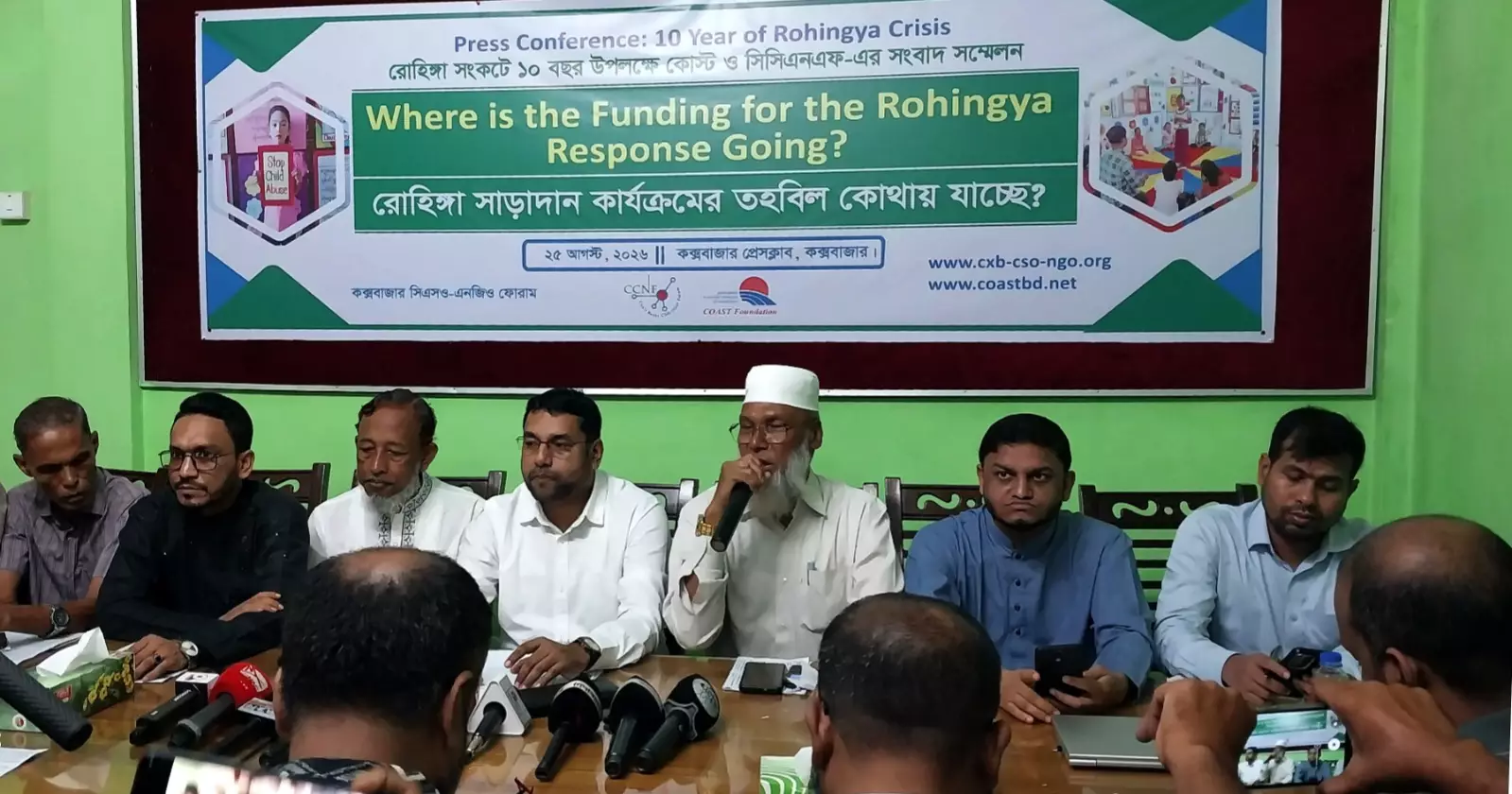
Nearly 88 percent of the funding under the 2026 Joint Response Plan (JRP) for the Rohingya humanitarian response is held by UN agencies, while local NGOs receive only 2.5 percent of the funding allocated for the refugee camps, according to research presented at a press conference here on Tuesday.
The findings were presented at a press conference titled “Where Is the Funding for the Rohingya Response Going?” organised by the Cox’s Bazar CSO-NGO Forum (CCNF) and COAST Foundation at the Cox’s Bazar Press Club.
Local stakeholders urge Rohingya repatriation roadmap, greater inclusion of NGOs in JRP
Speakers at the event called for greater inclusion of local organisations in the Rohingya humanitarian response and demanded their meaningful participation in decision-making and implementation processes.
Md Shahinur Islam of COAST Foundation presented the research findings, saying USD 710.5 million is required to assist 1.56 million people under the 2026 JRP.
Of the funding, 87.96 percent is held by UN agencies, 7.78 percent by international NGOs and 4.26 percent by national NGOs, while local NGOs have no funding as appealing partners in the JRP, according to the presentation.
Within funding allocated for the Rohingya camps, 63.6 percent goes to international NGOs, 33.9 percent to national NGOs and only 2.5 percent to local NGOs, it said.
The presentation also showed that of USD 150 million in funding from the United States, 92 percent went to UN agencies and 8 percent to international NGOs.
Speakers said funding is being channelled through UN agencies and international NGOs, whose operational costs are also significantly high.
Anjuman Ara Begum of Rokeya Foundation called for meaningful engagement of local NGOs in humanitarian response efforts and demanded that at least 25 percent of humanitarian funding be provided directly to local NGOs.
Helal Uddin, executive director of local NGO Agrajatra, said local organisations have no access or only very limited access under the current JRP and Pooled Fund mechanism.
He demanded that local organisations be included as appealing partners in the JRP so they can directly access the funds.
Nurul Islam Helali, president of Journalist Association Cox’s Bazar, said funding to local NGOs is not charity but the right of local organisations.
Speakers also raised concerns over the impact of the Rohingya crisis on the host community and the environment.
Nurul Kabir, a member of Rajapalong Union Parishad, said local people living in areas inside the camps are receiving no assistance, while nearby Rohingya are receiving various forms of support.
Robiul Alam, president of the Ukhiya Rights Implementation Committee, focused on environmental protection, surface water preservation and restoration of agricultural land.
Helal Uddin also said waste from the camps is damaging local farmland and called for a permanent solution to the problem.
Nasir Uddin said there has been no progress in repatriation and that frustration and uncertainty among the host community continue to grow.
He also said the Rohingya crisis has significantly affected the education sector in Cox’s Bazar and stressed the need for long-term investment in education and skills development for the local population.
CCNF Member Secretary Zahangir Alam said peaceful coexistence is not possible without a sustainable solution to the crisis.
Jafor Alam, general secretary of the Ukhiya Imam Somity, called for greater involvement of ASEAN, China and other regional and international organisations in resolving the crisis.
Momtaz Uddin Bahari, general secretary of the Cox’s Bazar Press Club, stressed the need for an effective and sustainable solution to the Rohingya crisis.
The event was moderated by Zahangir Alam. Members of CCNF and journalists from print and electronic media were present.
The Rohingya crisis has entered its 10th year since the influx began in 2017, with nearly 1.2 million Rohingya refugees currently sheltered in Cox’s Bazar, according to the organisers.