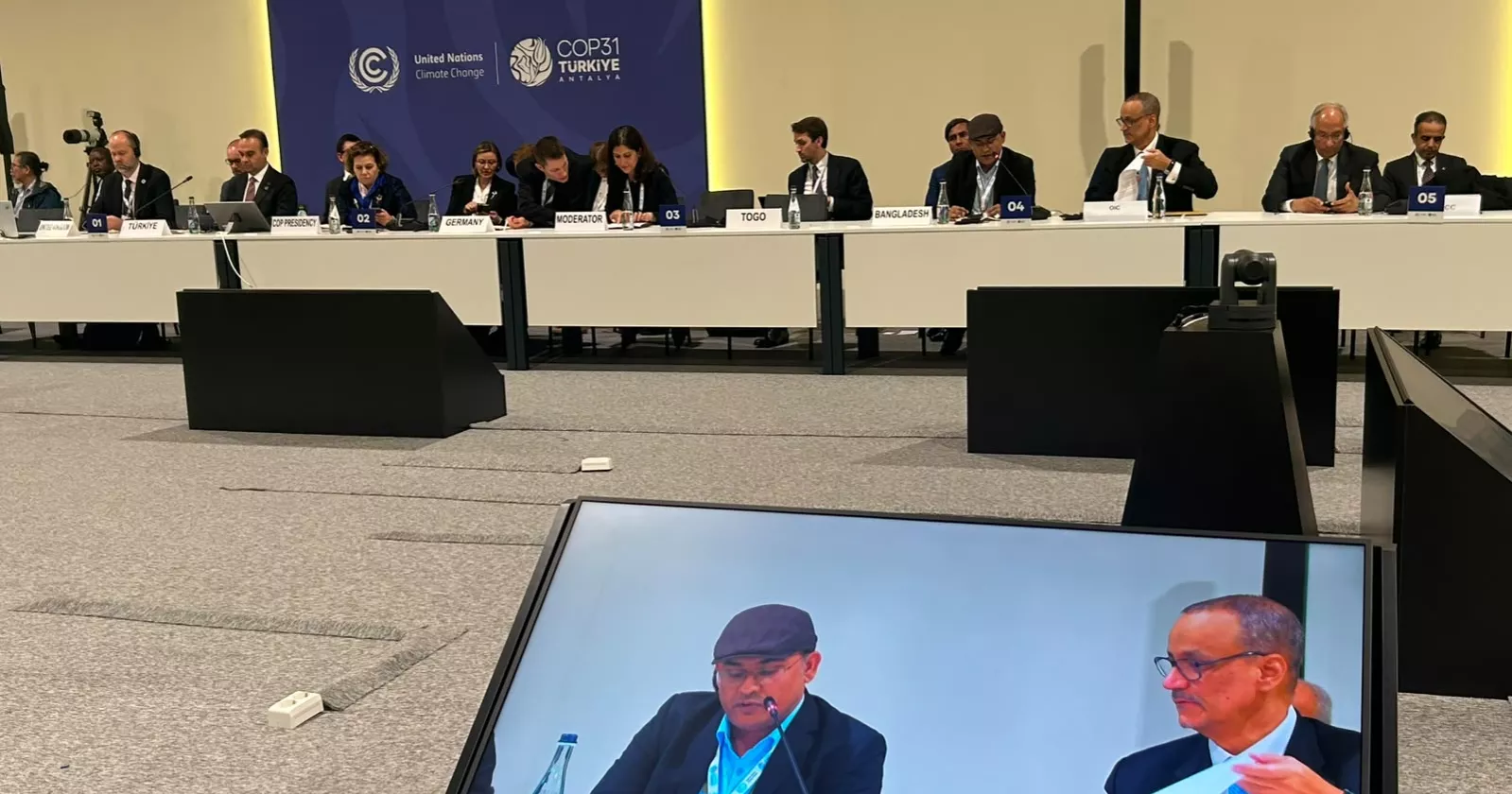
Prime Minister's Special Assistant Dr Saimum Parvez on Wednesday called for concessional long-term financing, fair prices for green products and supportive trade rules to help vulnerable countries move towards green industrialisation.
Speaking at a session on green industry at the UN Climate Change Conference (COP31) in Antalya, he also said Bangladesh had already demonstrated that green industrialisation was possible even for a least developed country.
The country's garment industry had more than 290 LEED-certified factories, the highest number in the world, with over 120 holding the Platinum rating, the special assistant said.
He also said more than half of the world's 100 highest-rated green factories were in Bangladesh, including the highest-scoring garment factory ever certified. “Industries in the country have also installed more than 600 megawatts of rooftop solar capacity, mostly in garment and textile factories.”
“These achievements were made by a least developed country, by its entrepreneurs and by four million workers, most of them women. It proves that green industry is not a privilege of the rich,” Saimum said.
He said the government was building on this foundation through a renewable energy strategy targeting 10,000 megawatts of solar power and 20 percent of electricity from renewable sources by 2030, rising to 30 percent by 2040.
The special assistant said the government had removed duties and taxes on solar equipment, introduced low-cost financing and guaranteed a fair price for rooftop electricity sold to the grid.
Bangladesh was also developing a national carbon market, planting 250 million trees and restoring 20,000 kilometres of rivers and canals, he added. “Garments built our first growth story. Green industry, from jute to electric mobility, will build the next.”
Saimum urged international buyers and brands to share the cost of the green transition by offering fair prices and stable orders to factories that meet high environmental standards.
He also called for new environmental standards in major markets to be introduced with adequate time and support so that they create opportunities rather than barriers for developing countries.
This is particularly important as Bangladesh prepared to graduate from the least developed country category in 2029, the special assistant said.
He said Bangladesh accounted for less than 0.5 percent of global greenhouse gas emissions but has chosen to lead by example.
“Invest in that choice. Bangladesh is your ready partner for a green industrial future of jobs, dignity and growth,” Saimum said.