As the United States prepares to mark its 250th anniversary, the legacy of Thomas Jefferson continues to spark debate, with historians saying no other American founder reflects the country's ideals and contradictions more than the author of the Declaration of Independence.
Pulitzer Prize-winning historian Jon Meacham says defining what it means to be "Jeffersonian" is far from simple because Jefferson's ideas have been interpreted differently across generations.
Meacham notes that before the civil rights movement, Jefferson was often associated with states' rights and limited government. He also points out that President Franklin D. Roosevelt once described Jefferson as an "apostle of liberty" whose principles supported America's fight against Nazi Germany during World War II.
According to Meacham, Jefferson represented both "the very best and the very worst" of the United States.
His greatest contradiction remains central to American history. Jefferson famously wrote that "all men are created equal" while owning enslaved people throughout his life. At the same time, he promoted ideas that continue to shape debates over government, individual freedom, agriculture, innovation and national expansion.
Historian Andrew Burstein says Jefferson is perhaps the most adaptable figure from early American history, with politicians across the political spectrum claiming his legacy. In his book Democracy's Muse, Burstein argues that Jefferson has been portrayed over time as everything from a Roosevelt-style liberal to a Reagan conservative and even a favorite of the Tea Party movement.
Historian Peter S. Onuf says there were periods when almost every American considered themselves Jeffersonian, yet Jefferson remained a deeply controversial figure.
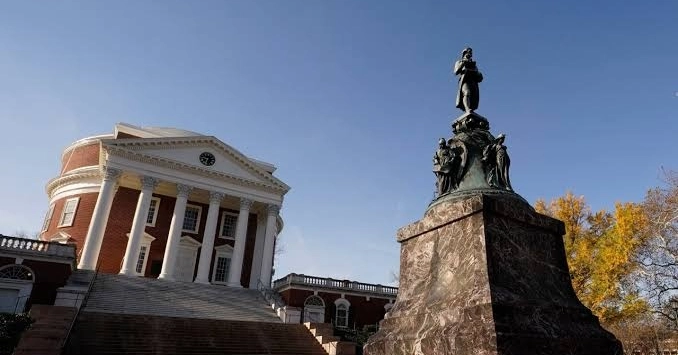
That debate is especially visible at University of Virginia, the university Jefferson founded, where a memorial now honors thousands of enslaved people who lived and worked there.
At Monticello, Jefferson's historic estate, visitors are reminded not only of his role in writing the Declaration of Independence but also of the hundreds of enslaved people who lived there. The site includes a burial ground for enslaved people and an exhibit about Sally Hemings, with whom historians widely believe Jefferson had six children.
Brandon Dillard, Monticello's director of historic interpretation and audience engagement, says the site's mission is to present an honest account of America's complex origins and its ongoing struggle to live up to the ideals expressed in the Declaration.
Monticello also reflects modern challenges. Climate change has altered the estate's landscape, while the site has adopted environmentally friendly technologies, including geothermal heating systems and green-energy standards.
The estate has also faced questions about diversity among its staff. Dillard acknowledged that the lack of racial diversity among museum guides reflects a broader issue across museums and historical institutions in the United States.
Jefferson's influence has stretched across nearly every major political era in US history.
Supporters of the Confederacy and later segregationists cited his support for states' rights, while Abraham Lincoln and civil rights leaders embraced his declaration that all people are created equal.
In 1963, Jefferson's words were used by both segregationist George Wallace and civil rights leader Martin Luther King Jr. during one of the most pivotal years of the American civil rights movement.
Roosevelt relied on Jefferson's ideas to support the New Deal, while President Ronald Reagan later portrayed him as an advocate of limited government and lower public spending.
More recently, President Donald Trump has quoted Jefferson's criticism of newspapers to support his attacks on what he calls "fake news." Meanwhile, scholars such as Ibram X. Kendi have argued that Jefferson's views on colonisation and race continue to influence debates over immigration and discrimination.
Despite current political divisions over immigration, Monticello continues its long-standing tradition of hosting Independence Day citizenship ceremonies. This year's keynote speaker is scheduled to be Abigail Spanberger.
Each year, hundreds of thousands of people visit Monticello for different reasons. Some come to learn about Jefferson's achievements, while others seek a deeper understanding of America's history, including its legacy of slavery.
Among them is Duane Cromwell, who said she grew up in South Carolina learning a version of history that downplayed slavery. Visiting Monticello, she hoped to better understand the realities of America's past.
Reflecting on her experience, Cromwell compared racism to kudzu, an invasive plant common across the US South that becomes so widespread people often stop noticing it. She believes society has made progress through greater interaction among people from different backgrounds but says learning the full history remains essential.
For Cromwell, visiting Monticello was not just about understanding Jefferson. It was about understanding America itself.