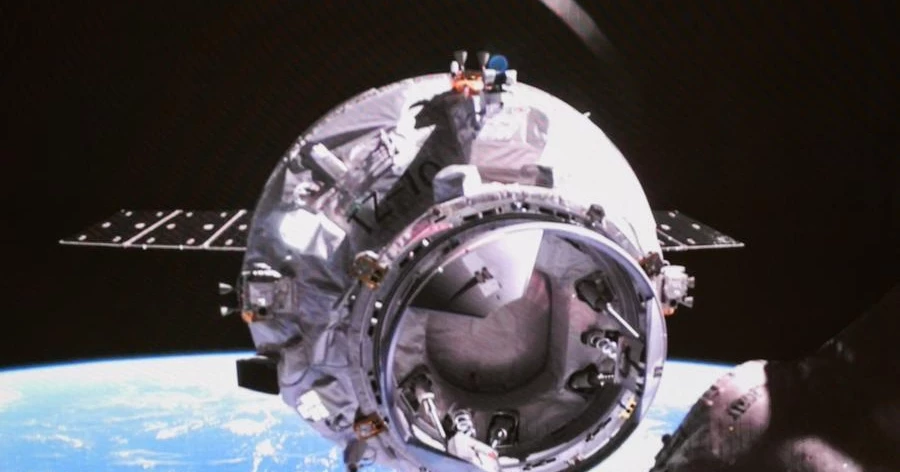
Scientists in China are studying how life develops in space after mouse embryo samples brought back from the country’s space station returned to Earth, in a step that could help future research on human reproduction during long-term space travel.
The samples were returned aboard the Shenzhou-22 on May 29 after completing experiments on China’s space station. Researchers say the findings may provide important scientific clues about how early life forms behave in a microgravity environment.
The project was carried out by the Shenzhen Institutes of Advanced Technology (SIAT) under the Chinese Academy of Sciences, focusing on how mammalian embryos develop before implantation in space, including possible damage to mitochondria and changes in genetic regulation.
Scientists say the experiment is designed to better understand whether space conditions can support normal early-stage development of life.
During the mission, researchers successfully cultured mouse embryos at different stages inside an onboard biotechnology experiment system. They used a specially designed microfluidic chip that allowed multiple embryo cultures and real-time imaging under limited space and resources.
Lead researcher Lei Xiaohua said the main challenge was developing a system that could handle embryo culture and imaging simultaneously within the constraints of spacecraft conditions.
Another research team led by Men Yongfan helped design the chip-based culture system, which included multiple small chambers to support parallel experiments and was compatible with the station’s automated systems.
After ground testing, scientists confirmed that embryo development, preservation and imaging systems worked successfully in orbit, and that the collected data met research requirements.
Following the return of the samples, they were transported under controlled refrigeration to Beijing for detailed laboratory analysis.
Researchers will now compare the space-grown embryos with control samples kept on Earth. The study will include genetic analysis, protein studies, and high-resolution imaging to examine how space conditions may affect early development.
Scientists say the findings could help determine whether space travel impacts key early biological processes, including genome activation in embryos and the possibility of normal development in microgravity.
China has carried out similar experiments before, including studies on early embryo imaging in space in 2006 and further development experiments aboard satellites in 2016, where mouse embryos were observed progressing to later developmental stages in orbit.