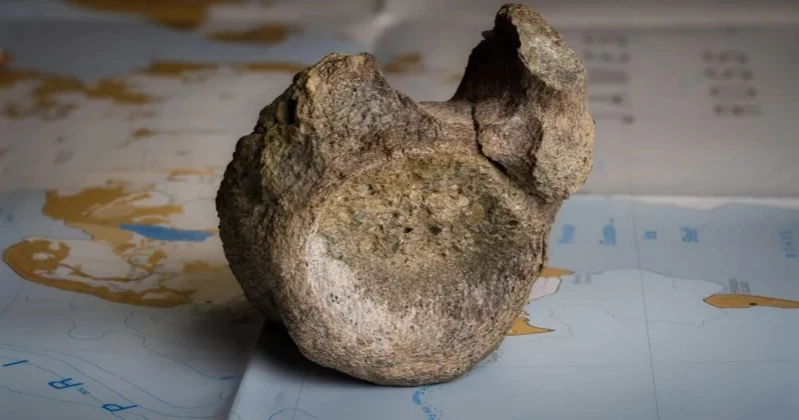
A fossil that sat unnoticed in a museum drawer for nearly 40 years has been identified as the first dinosaur bone ever discovered in Antarctica, giving scientists new clues about the continent's prehistoric past.
The fossil was found in 1985 on James Ross Island during a British Antarctic expedition. At the time, researchers were unsure what it was and labelled it simply as the vertebra of a "large reptile." It was later stored in the geology collection of the British Antarctic Survey (BAS) in Cambridge, where it remained largely forgotten.
The mystery was solved after Dr Mark Evans, collections manager at BAS, came across the fossil while reviewing thousands of specimens collected over decades of Antarctic expeditions.
Curious about the bone, Evans asked experts to examine it more closely.
Palaeontologist Professor Paul Barrett of the Natural History Museum confirmed that the fossil is a tail vertebra belonging to a Titanosaur, a group of giant, long-necked plant-eating dinosaurs that included some of the largest animals ever to walk the Earth.
Although the fossil appears ordinary, Barrett said its distinctive ball-and-socket joint structure made it easy to identify.
"As soon as I saw it, I knew it was a Titanosaur," he said, noting that the bone has features unique to this dinosaur group.
Because the fossil was collected in December 1985, scientists now believe it represents the first dinosaur fossil ever discovered in Antarctica.
More than 100 Titanosaur species have been identified worldwide. These dinosaurs walked on four legs, had long necks and tails, and some grew over 35 metres long and weighed around 60 tonnes.
Based on the size of the Antarctic tail bone, researchers estimate the dinosaur was about seven metres (23 feet) long, making it much smaller than its giant relatives.
Scientists believe it may have been either a young dinosaur or a smaller adult species.
The dinosaur lived about 82 million years ago during the Late Cretaceous Period, when Antarctica looked very different from today. Instead of being covered in ice, the continent had forests and a much warmer climate that supported a wide variety of plant and animal life.
Researchers say the discovery is important because dinosaur fossils are extremely rare in Antarctica, where thick ice covers much of the ancient rock.
The rediscovered fossil also highlights the scientific value of museum collections, showing that important discoveries can still be made from specimens collected decades ago.
Barrett said the finding helps scientists better understand the ecosystems that existed near the South Pole millions of years ago, proving that what is now one of the world's harshest environments was once home to thriving wildlife.
Source: BBC