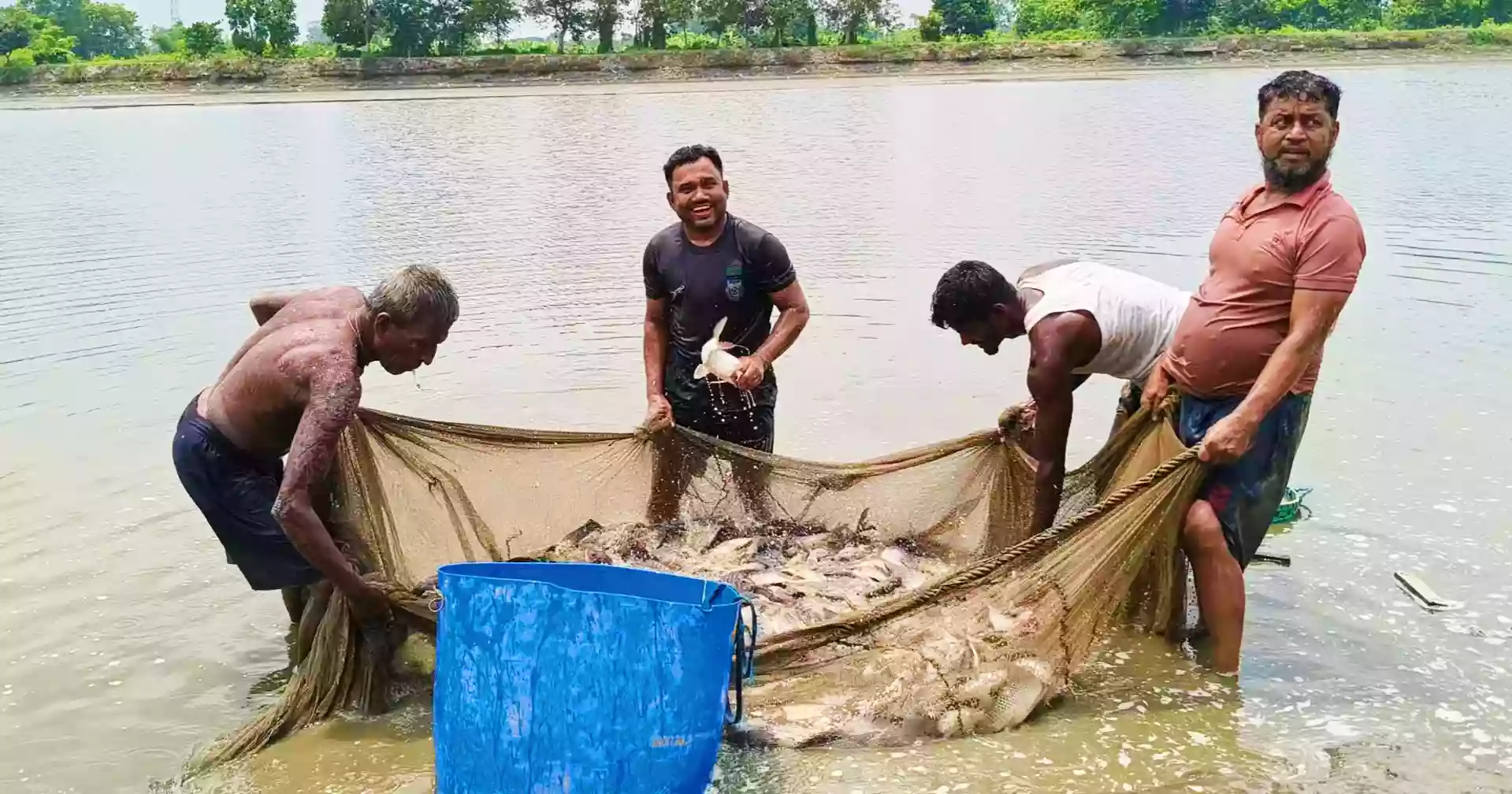
What was once largely waterlogged and unproductive farmland for eight to nine months a year has turned into one of the country’s major fish-producing areas, with fish worth around Tk 2,500 crore being produced annually in the floodplains of Daudkandi upazila.
The transformation has reshaped the local economy, creating jobs and income opportunities for thousands of farmers, traders and others involved in the fisheries value chain.
At least 115 fish farming projects have been developed in villages including Eliotganj, Adampur, Putia, Basra, Raipur, Singula, Lakshmipur and Shuhilpur along the Dhaka-Chattogram highway.
According to local fisheries sector sources, around 200,000 tonnes of fish are produced annually on nearly 50,000 hectares of floodplain areas under these projects.
The farms produce a variety of fish, including ruhi, mrigal, catla, silver carp, sarputi and tilapia, supplying markets in Dhaka, Chattogram and other parts of the country.
A visit to the area found fish markets bustling from early morning, with traders weighing and loading fresh fish for wholesalers. Pickup vans and trucks were seen carrying fish to different destinations, while farmers and traders were busy selling their produce.
From waterlogged fields to thriving fish farms
Local people said the floodplain lands once remained unused for most of the year because of prolonged waterlogging. In many cases, farmers could grow only one crop annually.
The shift began in 1986 when Sunil Kumar Roy of Banuakhola village started commercial fish farming in the floodplain, according to local sources.
His initiative gradually inspired others to adopt fish farming, eventually turning large parts of the floodplain into a major fisheries zone.
Md Nuruddin Ahmed, a fish project owner and operator, said he has been involved in fish farming for the past eight years.
Starting on a small scale, he has now expanded his project to around 600 bighas of land.
“Land that could previously produce only one crop is now being used for fish farming,” he said.
However, rising feed prices have become a major concern for farmers.
“The price of fish feed has increased nearly threefold, making it difficult to make a profit. If the government paid more attention to this sector and took action against syndicates, we could do much better,” Nuruddin said.
Scope for further growth
Prof Matin Saikat, a four-time national award-winning fisheries expert, said growing both rice and fish on the same land has become a reality in Daudkandi.
“Floodplain areas that were once abandoned have now turned into a model fisheries zone,” he said, adding that millions of people are connected directly or indirectly with the sector.
He said reducing the price of fish feed and establishing cold-storage facilities could help the industry expand further.
Md Ruhul Amin, a caretaker of a fish farming project, said they raise rohu, pangas, carp and tilapia.
“We have to provide around 80 sacks of feed twice a day, in the morning and afternoon. We have invested heavily this year, but there is still uncertainty about profits,” he said.
He also called for measures to reduce the price of fish feed.
Lack of cold storage a major challenge
People involved in the sector said the lack of modern cold-storage facilities remains one of the biggest obstacles to the sustainable growth of fish farming in the area.
As farmers cannot preserve fish for sale at a better time, they are often forced to sell their produce at lower prices when supply is high.
They also suggested re-excavating dead and silted-up canals in the area to improve water management and increase fish production.
Daudkandi Upazila Senior Fisheries Officer Sabina Yasmin Chowdhury said fish production in the floodplains has exceeded the expected level.
“Fish farming has reached such a stage that production from the floodplains is higher than what we had expected,” she said.
She said Mohammad Rahmat Ali, a local fish farmer, received a national gold medal for his contribution to fish farming, which has encouraged other farmers to take up the practice.
“Following the recognition, many farmers have become more interested and are coming forward to engage in fish farming,” she said.
Sabina said various government support programmes are currently being implemented to develop the fisheries sector, while the issue of establishing cold-storage facilities has already been brought to the attention of higher authorities.