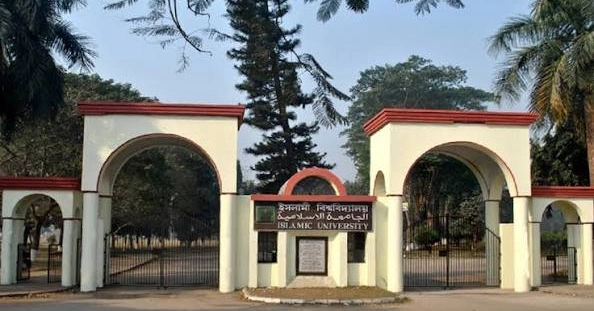
Nearly 80 percent of students at Islamic University (IU) in Kushtia lack residential accommodation, forcing many to live off campus, where several female students have alleged harassment by outsiders.
Despite being established with the aim of providing residential facilities for all students, the university has failed to ensure accommodation for everyone, even after 47 years.
According to university sources, IU has 19,669 students, but its residential halls can accommodate only 3,973, leaving nearly 16,000 without university housing.
The university has 11,889 male and 7,780 female students across 36 departments under nine faculties. It has five residential halls for male students and three for female students.
Located about 24 kilometres from Kushtia town and 22 kilometres from Jhenaidah town, the university is relatively distant from both urban centres.
Students have to travel considerable distances every day to attend classes and examinations, while many others live in rented accommodation near the campus.
The situation is particularly difficult for female students. Some reportedly have to stay in overcrowded common rooms in residential halls and share beds, while others are forced to find accommodation outside the campus.
Overcrowding in the female residential halls has affected students’ sleep, studies and personal space.
Those living off campus face additional safety concerns, particularly while travelling to and from the university.
Female students report harassment by outsiders
Several female students have recently alleged sexual harassment by outsiders on the university campus, on local buses, at nearby markets and in surrounding areas.
Many victims have refrained from filing formal complaints with the university’s Anti-Sexual Harassment Committee, citing fear, social stigma and difficulties in identifying the alleged perpetrators.
A female student of the Department of Folklore and Social Studies said she had experienced unwanted touching by outsiders on local buses on several occasions.
A student of the Department of Physical Education and Sports Science, enrolled in the 2023-24 academic session, alleged that she was harassed on campus one evening.
She said several people followed her, whistling and repeatedly calling out to her around Maghrib. Unable to find any transport, she eventually ran away out of fear.
Jinnat Maliat Sima, a student of the Department of Folklore and Social Studies from the 2021-22 academic session, alleged that the university’s sexual harassment committee was ineffective and claimed that its members themselves harassed students.
She advised victims not to approach the committee.
Committee member Prof Dr Hamida Khatun told UNB that the committee had undertaken several awareness initiatives, including distributing guidelines on preventing sexual harassment and filing complaints during orientation programmes, putting up banners at important locations and organising awareness activities.
IU Proctor Prof Dr Shahinuzzaman said the university administration was trying to address such incidents and would take appropriate action if written complaints were submitted.
“We are trying to prevent sexual harassment on campus. However, it is difficult to address these types of incidents outside the campus. The committee against sexual harassment is working on the issue,” he said.
Provost Council President Prof Dr Aynul Haque Akand said the current administration was working to resolve the accommodation crisis.
Student Adviser Prof Dr Mamun Al Rashid said he had not received any complaints of such incidents since taking charge.
“If any student becomes a victim of such an incident and lodges a complaint to me, I will certainly take necessary action with help from the Vice-Chancellor. I will always stand by the students,” he said.
IU Vice-Chancellor Prof AKM Motinur Rahman could not be reached despite repeated attempts.
Work on several new residential halls is expected to be completed soon.
Students hope the additional facilities will ease the accommodation shortage to some extent.
Some students, however, said constructing new halls alone would not be enough. They called for safer transport for female students living in nearby towns, stronger security on isolated roads and better measures to protect students while commuting between their residences and the university.