Ecuadorian football fans are holding on to hope that the national team can deliver a strong World Cup run, offering a rare moment of joy as the country grapples with worsening violence and instability.
Across the country, many provinces remain under a state of emergency. Security forces are deployed in large numbers to combat rising crime linked to drug trafficking. Night curfews are common, a fuel crisis has disrupted daily life, and tensions remain high along the border with Colombia.
Despite the turmoil, optimism around Ecuador’s national team, La Tri, remains strong.
The team qualified second in South America behind world champions Argentina, losing only twice in 18 matches, both narrow away defeats in Argentina and Brazil. Fans believe this squad has the potential to go further than ever before, possibly beyond their best performance of reaching the round of 16 in the 2006 World Cup in Germany.
“I bought a giant TV on credit so I could watch Ecuador win the World Cup,” said Mario Uquillas, a 43-year-old shopkeeper in downtown Guayaquil. “At the very least, I hope they reach the quarterfinals. This team deserves it.”
In markets like La Bahía in Guayaquil, merchants are cashing in on World Cup excitement, selling jerseys featuring stars such as Arsenal defender Piero Hincapié, Chelsea midfielder Moisés Caicedo, and Paris Saint-Germain defender Willian Pacho.
Hincapié recently drew attention after Arsenal won the Premier League title for the first time in 22 years, adding to national pride. Fans may soon see more success stories as Hincapié and Pacho prepare to meet in the Champions League final next weekend.
However, the backdrop to Ecuador’s football dream is a grim one.
Local football has not escaped the country’s violence. Five players were killed last year and three others died in separate attacks.
One of the most shocking incidents happened last December in northern Guayaquil, when gunmen killed Mario Pineida, a former national team player and defender for Barcelona SC. He was shot while at a butcher shop with his mother and partner. His partner died and his mother was injured. The motive remains unclear.
Guayaquil, located about 270 kilometers southwest of Quito, is ranked among the most violent cities in the Americas, according to Numbeo’s crime index. Ecuador recorded 9,216 violent deaths last year, with a rate of 50.1 per 100,000 people, according to the Ecuadorian Observatory of Organized Crime.
Rising insecurity has changed daily life, especially in poor neighborhoods where children once played freely in the streets but now often stay indoors after dark due to fear of shootings and robberies.
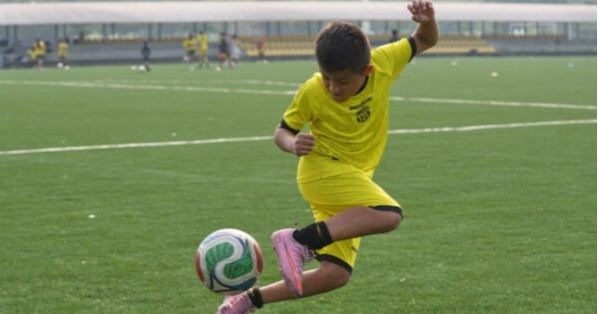
Still, football continues to offer hope, particularly through clubs like Barcelona SC, the country’s most popular team. Its youth academy provides a rare safe space for children, including nearly 300 trainees.
“My dream is to play for PSG or Real Madrid,” said 10-year-old Piero Ortega, who has trained at the academy for five years. “I want to become a professional footballer.”
Another young player, Washington Vera, also dreams of representing Ecuador internationally. “I want to play for the national team and score goals as a right winger,” he said.
Academy coordinator Enrique Benavides said insecurity has forced families to rely on such structured programs. “Fear has entered every community. Nobody feels safe anymore,” he said. “Now children can only train here, because playing in the streets is no longer possible.”
For many Ecuadorians, the World Cup represents more than football. It is a brief escape from daily fear and hardship.
“Earlier we only dreamed of qualifying. Now we hope for the quarterfinals or even semifinals,” said Guayaquil lawyer Daniel Sánchez.
Barcelona SC sporting director Matías Oyola also believes the national team can continue its strong form. “What they did in qualifying was excellent. The World Cup could be a continuation of that,” he said.