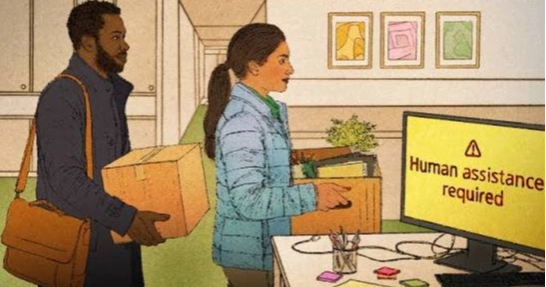
Companies worldwide are increasingly blaming artificial intelligence (AI) for job cuts, raising concerns that machines could replace more workers in the coming years.
Microsoft, Barclays Bank and supermarket chain Kroger are among the companies that have announced AI-related job cuts this year. Some have eliminated positions they consider unnecessary, while others have reduced their workforce to save money for investment in AI technology.
However, some companies are discovering that AI tools cannot perform certain tasks as well as expected. As a result, they are bringing back workers whose jobs were previously eliminated, a trend known as the “AI boomerang.”
“Two years ago, we said, ‘Would this happen?’ and now we're saying, ‘Yes, it is happening in real time,’” said Lucy Beaumont, a global senior vice president at UK-based technology company SHL, which develops employment assessment tools.
Earlier this year, hiring managers in finance, marketing, law and healthcare told recruitment firm Robert Half that their companies had cut jobs because of AI or automation but later recruited workers for the same or similar positions.
The main reasons for rehiring included the need for more human supervision than expected and AI's inability to replace employees' knowledge of company operations and practices.
“When you need critical thinking, collaboration, creativity, institutional knowledge, those are things that AI just can't replicate,” said Bill Driscoll, a senior district president at Robert Half.
He said companies were beginning to realise that they still needed people to perform these jobs.
Swedish financial technology company Klarna, which offers buy-now, pay-later services, began recruiting human customer service representatives again last year. Chief Executive Sebastian Siemiatkowski acknowledged in an interview with Bloomberg News that the company's reliance on an AI chatbot to reduce costs had gone too far.
In June, Ford said it had hired or promoted 350 experienced engineers after AI tools used for quality control failed to perform as expected.
“AI utilization has been an important part of our quality gains and that — along with deep technical expertise of our teams — is a powerful combination,” a Ford spokesperson told The Associated Press.
However, companies do not always publicly acknowledge when they reverse decisions to replace employees with AI, Beaumont said.
She suggested that some companies might be reluctant to admit their mistakes after presenting workforce reductions to shareholders as a way to improve efficiency.
Management experts have offered advice for workers as companies continue to adopt AI and reassess their staffing needs.
Human skills remain difficult to replace
When companies use AI to handle tasks previously performed by employees, they often overlook the additional work people do beyond their official responsibilities, said Betsy Summers, a principal analyst on the Future of Work team at research and advisory firm Forrester.
Such work includes understanding colleagues' emotions, holding informal discussions, building relationships and making extra efforts when motivated or inspired.
“We don't know all the work that's required to do things well within the organization,” Summers said.
She explained that teamwork, trust and maintaining good relationships are essential to an organisation's success but are difficult to measure or include in formal job descriptions.
Removing employees and expecting AI systems to deliver the same results can therefore lead to problems.
Another challenge is that companies do not always have clear written procedures for tasks such as data processing and bookkeeping, experts said.
“Organizations are not spending enough time doing the up-front work to really truly understand workflows and where humans add value in the process,” said Brooks Holtom, a professor of management at Georgetown University's McDonough School of Business.
In customer service, for example, AI chatbots often need to pass complicated questions and complaints to human employees. Workers can better understand customers' emotions, judge the seriousness of a problem and find creative solutions while following company rules, Holtom said.
Combining creativity with the ability to work within established limits remains a challenge for machines, he added.
Highlight the skills that set you apart
As companies invest more in AI, current employees and those invited back after layoffs should highlight skills that complement the technology, including emotional intelligence, sound judgement and problem-solving abilities, Holtom said.
“Really try to be able to articulate, what's your value proposition as a human?” he said.
He encouraged workers to learn how to use AI tools while demonstrating the skills machines cannot easily replicate. This could make them valuable in helping companies introduce and manage the technology.
Beaumont said empathy is another important human quality that AI has yet to master fully.
An angry customer, for instance, may want someone who listens carefully and understands their concerns rather than an automated response.
She questioned whether AI could currently provide that kind of meaningful human connection.
Consider your position before accepting a job offer
Workers may hesitate to return to companies that previously dismissed them as part of an AI-related restructuring, Beaumont said.
Being replaced by technology can damage trust and make employees feel less secure about their future with an employer.
Workers who receive offers to return should therefore consider their options carefully, she said.
Some are seeking higher salaries and assurances about how AI might affect future staffing decisions. They may also negotiate for additional training and clearer opportunities for career advancement.
Holtom advised returning employees to explain how their experience could benefit the company and discuss a revised job description that combines their expertise with AI tools.
Such negotiations could even lead to a more senior position with better pay than the job they previously held, he said.
Before accepting an offer, workers could also seek stronger job security. Holtom suggested negotiating a renewable one-year contract with a compensation clause if the employer terminates the position before the year ends.
Summers also urged companies and employees not to overlook the importance of human motivation and curiosity in making workplaces effective.
“Within our societies, work serves a broader purpose than just creating value for shareholders or customers or constituents,” she said.
“Work serves a human purpose as well. It's the manifestation of our search for meaning and purpose. We want to contribute to our communities as human beings.”