
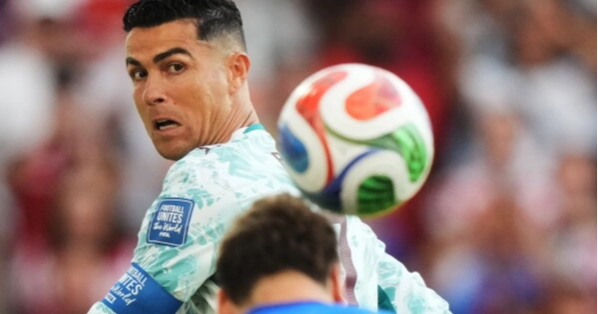
A piece of advanced technology inside the official match ball played a decisive role in one of the most dramatic moments of the FIFA World Cup, helping officials rule out a late Croatia goal against Portugal.
The controversial decision came deep into stoppage time on Thursday when Croatia appeared to have scored a dramatic equalizer against Portugal in Toronto. However, the goal was disallowed after the Video Assistant Referee (VAR) determined that Croatia's Igor Matanovic had made a slight touch on the ball before it reached Mario Pasalic, who was in an offside position.
Portugal went on to win the match 2-1 and secure a place in the Round of 16, while Croatia's players and supporters were left frustrated, believing the goal had been wrongly ruled out.
According to FIFA, the decision was based on its "connected ball technology," which uses advanced sensors inside the official Adidas "Trionda" match ball to detect even the slightest contact that cannot be seen by the human eye or standard video replays.
The sensor, known as an inertial measurement unit (IMU), collects data around 500 times per second, allowing officials to identify the exact moment a player touches the ball.
The system works alongside multiple stadium cameras, sending real-time information to VAR officials to help review offside decisions, handballs and penalty incidents.
During the review, referee Espen Eskås was asked to check the pitch-side monitor. FIFA said the technology showed a clear signal indicating the ball had lightly brushed Matanovic's head before reaching Pasalic, making the offside call valid.
Professor Manos Tentzeris of the Georgia Institute of Technology said the system is highly accurate, regardless of how fast the ball is moving or how much it is spinning.
He said the technology can determine the ball's position with about 99.99% accuracy and precisely identify where players are on the field, even down to the tip of a shoe in close offside situations.
FIFA first introduced connected ball technology at the 2022 World Cup after testing it between 2020 and 2022 at competitions including the Arab Cup and the Club World Cup. It was also used during the UEFA European Championship in 2024.
The technology has previously influenced major decisions. At Euro 2024, ball sensors detected that Denmark defender Joachim Andersen had handled the ball in the penalty area against Germany. After a VAR review, Germany was awarded a penalty, which Kai Havertz converted in a 2-0 victory.
Following that match, Denmark coach Kasper Hjulmand criticized the growing influence of technology, saying it was not how football was meant to be played.
Croatia coach Zlatko Dalić expressed similar frustration after his team's World Cup exit, saying such decisions were taking the joy out of football.