Samsung Electronics on Thursday reported a record operating profit of 89.5 trillion won ($62 billion) for the April-June quarter, as the South Korean technology giant and rival SK Hynix continue to benefit from surging global demand for chips used in artificial intelligence systems.
The earnings came a day after SK Hynix, the world's second-largest memory chipmaker, also reported record quarterly revenue, highlighting how the global AI boom is boosting South Korea's semiconductor industry.
However, shares of both companies have fallen sharply this week amid concerns about their huge planned investments to expand chip production and growing competition from China.
Samsung's second-quarter operating profit was more than 19 times higher than a year earlier, with almost all of the earnings coming from its semiconductor business.
The chip division benefited from higher prices, strong demand for AI servers and increased sales of advanced high-bandwidth memory (HBM) chips used in AI applications. These gains more than offset losses in Samsung's mobile devices, televisions and home appliances businesses, which were affected partly by higher component costs.
Samsung's quarterly revenue also reached a record 171.5 trillion won ($119 billion).
The company said it expects demand for memory chips to remain strong during the second half of the year, supported by continued investment in AI infrastructure and wider use of so-called agentic AI.
Demand for chips used in data centers is also expected to grow further, potentially keeping supplies below market demand, Samsung said.
SK Hynix reported record second-quarter revenue of 60.5 trillion won ($42 billion) on Wednesday. However, its profit fell short of market expectations, sending its shares down more than 9 percent. Samsung's shares have also declined this week.
Kim Jaejune, an executive in Samsung's memory chip division, said the gap between chip supply and demand could widen further in 2027.
He said Samsung plans to begin construction of its second semiconductor factory in Taylor, Texas, before the end of this year, with the facility expected to start operations by 2030.
Kim said Samsung has secured long-term chip supply agreements with five major global data center customers, possibly referring to Amazon Web Services, Google, Meta, Oracle and Microsoft.
The company is also in talks with other major technology firms as demand for AI infrastructure continues to rise.
"Despite our efforts to increase production, demand growth is outpacing our efforts," Kim said during a conference call.
Samsung and SK Hynix together account for about two-thirds of global memory chip production.
Both companies are making major investments in new semiconductor factories and data centers as South Korea seeks to strengthen its position in the global AI industry. However, some analysts have raised concerns about whether such large-scale spending will generate sufficient returns.
South Korean chipmakers are also facing pressure from concerns over stronger competition from China.
Reports that a state-owned Chinese company has started mass-producing domestically developed immersion deep-ultraviolet lithography machines, which are important for advanced chip manufacturing, have added to investor concerns.
The strong stock market debut of Chinese memory chipmaker ChangXin Memory Technologies has also increased worries about competition from China, analysts said.
Last month, Samsung and SK Hynix announced plans to jointly invest 800 trillion won ($554 billion) in a new semiconductor hub in southwestern South Korea to take advantage of rapidly growing AI-related demand.
The heads of Samsung, SK and South Korean automaker Hyundai joined President Lee Jae Myung during his trip to San Francisco last week, where they announced hundreds of billions of dollars in planned cooperation with major US technology companies.
The agreements involve AI firms OpenAI and Anthropic, as well as chip designers Nvidia and Broadcom, and cover chip technology, data centers and other AI infrastructure.
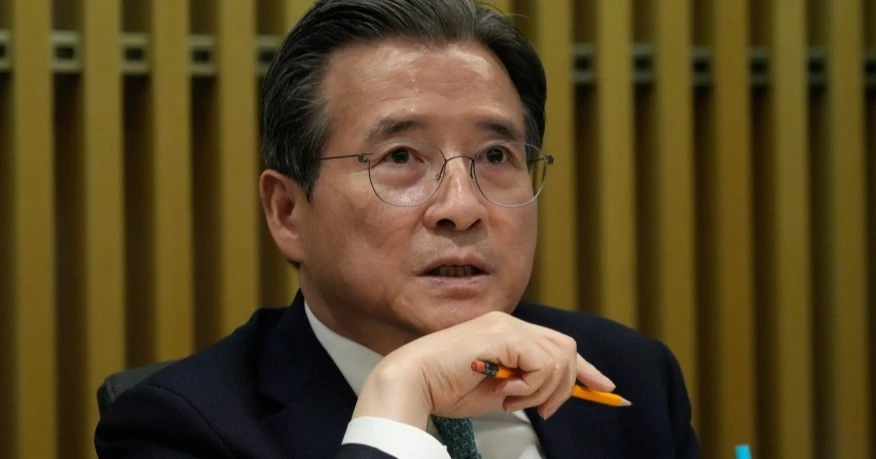
Kim Yong-beom, President Lee's chief policy adviser, said at a foreign media roundtable last week that the initiatives show how global technology companies are seeking long-term partnerships with South Korean chipmakers to secure reliable supplies of memory chips for AI systems.
However, the sharp swings in the share prices of Samsung, SK Hynix and other global technology companies suggest that investors are increasingly looking beyond short-term earnings and focusing on whether such growth can be sustained over the long term, semiconductor analyst Son In-joon of Eugene Securities said in a report this week.