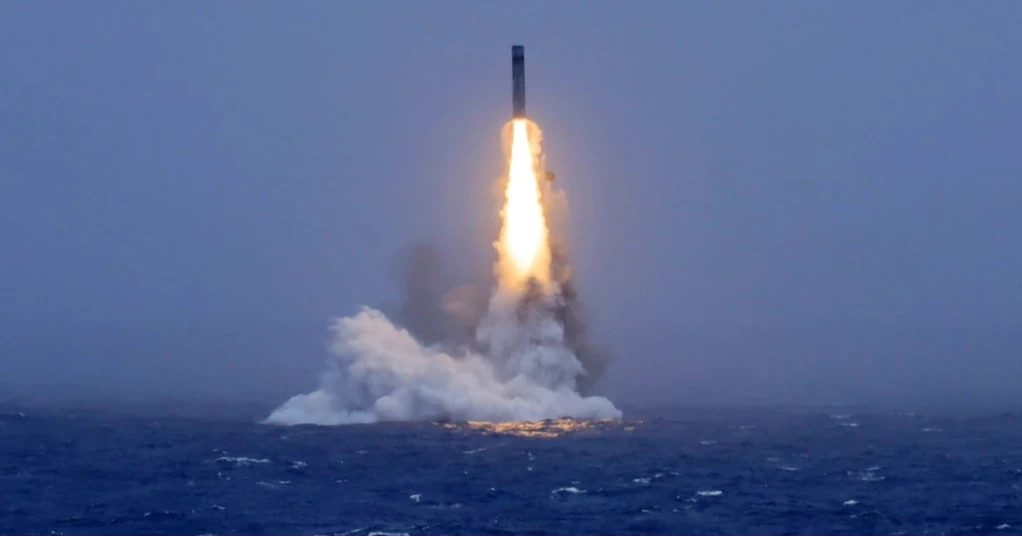
China's recent launch of a ballistic missile into the South Pacific was widely seen by security experts as a clear message to the United States, highlighting Beijing's growing nuclear capabilities despite criticism from countries in the Pacific region.
The missile, launched on Monday from a nuclear-powered submarine, marked one of the few public tests of a nuclear-capable weapons system by China. It came two years after a similar launch over international waters in the Pacific.
While several Pacific island nations criticised the test, saying the region should not become a stage for rivalry between major powers, analysts said the main audience for the launch was Washington.
"The key message is that the People's Liberation Army is becoming a stronger military force with a powerful strategic nuclear capability," said Tong Zhao, a senior fellow with the Nuclear Policy Program at the Carnegie Endowment for International Peace.
The launch showcased the sea-based part of China's nuclear triad — its ability to launch nuclear weapons from land, sea and air. It also demonstrated what military experts call a "second-strike capability," meaning China could still retaliate with nuclear weapons even if it were attacked first.
Dominic Meagher, a research fellow at Australia's Crawford School of Public Policy, said the submarine launch showed that China's nuclear forces could respond from anywhere, making them harder to eliminate in a first strike.
China described the launch as part of its annual military exercises, leading experts to believe similar tests could become more common.
"I see this as part of a broader strategy rather than a one-time event," said K. Tristan Tang, a nonresident fellow at the National Bureau of Asian Research.
The missile test comes as China continues expanding its fleet of nuclear-powered submarines. According to the International Institute for Strategic Studies, China has built these submarines at a faster pace than the United States over the past five years.
Pacific nations raise concerns
The launch drew criticism from Pacific countries because the missile landed in waters covered by the South Pacific Nuclear Free Zone, created under the 1986 Treaty of Rarotonga.
The region has a painful history of nuclear testing. The United States, Britain and France carried out nuclear tests in the Pacific during the last century, leaving lasting environmental damage and health problems, including cancers and birth defects that some island communities say continue to affect generations.
Meagher said those experiences led to international agreements aimed at preventing future nuclear testing in the region.
Solomon Islands Prime Minister Matthew Wale criticised China's action, saying while China is an important partner, "this is not something a friend does" and is not good for the region.
Although the United States still conducts missile tests in the Pacific, Meagher noted that they avoid the treaty-protected nuclear-free zone.
Regional powers question lack of notice
Australia and New Zealand said they received very little advance warning about the launch, while Japan criticised China for not being transparent.
Australia and New Zealand have become increasingly concerned about China's growing influence in the Pacific, where Beijing has strengthened ties with several island nations through security and development agreements.
Australian Prime Minister Anthony Albanese, speaking during a visit to the Solomon Islands on Tuesday, described the launch as "a provocative act" that could increase tensions in the region.
"The fact that this test took place with very little notice is a real concern," he said.
China defended the launch, saying it had informed relevant countries in advance and that the exercise was conducted openly and transparently.
Experts noted that while the Hague Code of Conduct encourages countries to provide at least 24 hours' notice before ballistic missile launches, the code is voluntary and China is not a member.
Uncertainty over missile type
Questions also remain over exactly which missile was launched.
Taiwan's National Security Council said it was likely a JL-2 submarine-launched ballistic missile fired from waters off Guangdong province in southern China.
However, Chinese state media quoted military experts as saying the launch probably involved the newer JL-3 missile, which has a much longer range and is capable of reaching targets across the Pacific.
Analysts say that as China expands its military power, it is likely to face greater international scrutiny over its weapons development and military activities.