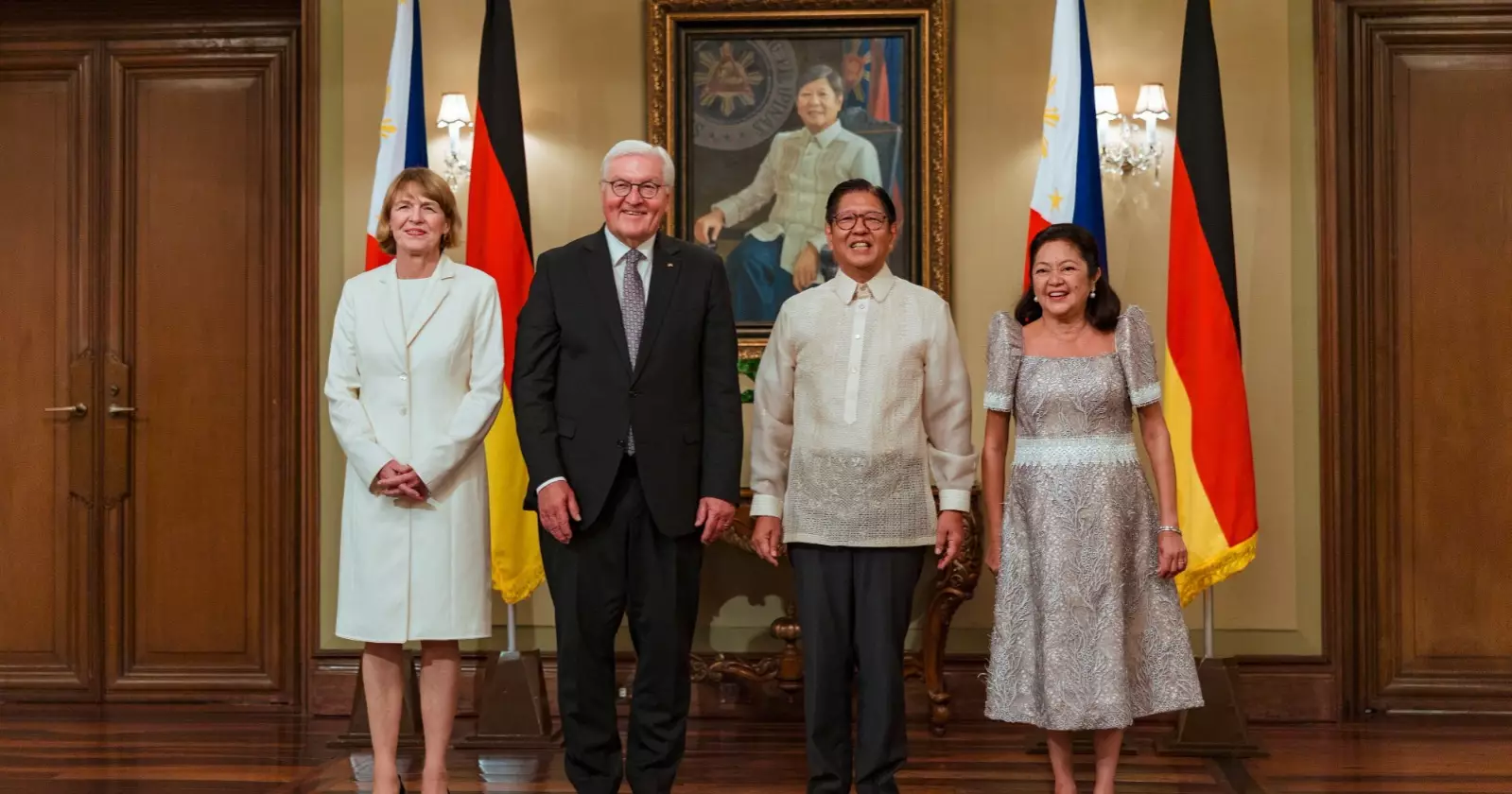
German President Frank-Walter Steinmeier on Tuesday expressed concern over rising tensions in the disputed South China Sea, warning that any major conflict in the region could threaten freedom of navigation and disrupt global trade.
Speaking alongside Philippine President Ferdinand Marcos Jr. during a state visit to Manila, Steinmeier said Europe is closely monitoring developments in the South China Sea, particularly ongoing confrontations between the Philippines and China.
Referring to the recent disruption in the Strait of Hormuz linked to the Iran conflict, Steinmeier said such incidents show how regional disputes can have global economic consequences.
“The situation in the South China Sea remains tense, and that is a cause for concern,” he said through an interpreter. “The Indo-Pacific, especially Southeast Asia, is one of the world’s most dynamic economic regions. Any serious incident there would also affect Europe.”
He warned that violations of international maritime law could jeopardize freedom of navigation, similar to the impact caused by the closure of the Strait of Hormuz, which led to sharp increases in global fuel and fertilizer prices.
The Strait of Hormuz situation was among the topics discussed during a private meeting between Steinmeier and Marcos.
Although Steinmeier did not directly name any country, Germany has previously criticized China’s actions in the South China Sea, saying they undermine the rights of coastal states such as the Philippines and threaten free navigation along one of the world’s busiest trade routes.
The territorial disputes involve China, the Philippines, Vietnam, Malaysia, Brunei and Taiwan.
The United States, while not a claimant in the South China Sea, has repeatedly stated that it is committed to defending the Philippines under their mutual defense treaty if Filipino forces, vessels or aircraft come under armed attack.
China, meanwhile, has urged Washington not to interfere in the regional disputes.
During a visit to Manila in 2024, then German Foreign Minister Annalena Baerbock voiced concern over China's actions in the disputed waters, including incidents involving Philippine vessels. She said such actions violated the rights of coastal nations and hindered their economic development.
Baerbock also said China’s sweeping claims in the South China Sea were not supported by international law and called for a peaceful settlement of the disputes.
On Tuesday, Steinmeier reaffirmed Germany’s support for the Philippine Coast Guard, which has played a key role in protecting the country’s maritime interests and has been involved in several confrontations with Chinese vessels.
Marcos thanked Germany for consistently backing the Philippines’ efforts to uphold international law in the South China Sea and for supporting compliance with the 2016 international arbitration ruling.
The ruling, based on the 1982 United Nations Convention on the Law of the Sea, rejected China’s broad claims in the South China Sea. China refused to participate in the arbitration process, rejected the decision and continues to oppose it.